
Introduction
What Is Zero Liquid Discharge (ZLD)?
Zero Liquid Discharge (ZLD) is an advanced industrial wastewater management approach designed to treat wastewater, recover usable water and minimize or eliminate the discharge of liquid effluent outside the facility.
Unlike conventional wastewater treatment systems that may discharge treated effluent after meeting applicable standards, a ZLD system is designed around maximum water recovery and internal reuse.
A typical ZLD approach involves:
- Collection and treatment of industrial wastewater
- Removal of pollutants and suspended matter
- Advanced filtration and membrane treatment
- Recovery of reusable water through RO
- Concentration of high-TDS reject streams
- Evaporation and crystallization where required
- Management of the resulting salts and solid residues
The actual ZLD configuration depends on the wastewater characteristics, production process, water balance and applicable regulatory requirements.
For a comparison of conventional sewage and industrial effluent treatment systems, see STP vs ETP: What's the Difference Between Sewage Treatment Plants and Effluent Treatment Plants.
Why Is ZLD Important for Industries?
Industrial operations can consume substantial quantities of freshwater and generate wastewater containing organic matter, dissolved solids, chemicals and other contaminants.
Growing pressure on water resources has increased the importance of:
- Water conservation
- Wastewater recycling
- Reduction of freshwater consumption
- Efficient industrial water management
- Controlled wastewater disposal
- Compliance with environmental requirements
ZLD provides an approach in which treated wastewater can be recovered and reused within the facility instead of being routinely discharged.
For water-intensive industries, this can form an important part of an overall industrial water-recycling and environmental compliance strategy.
Industries can also understand wastewater quality parameters through BOD, COD, TDS & TSS in Wastewater: Meaning, Importance and ETP Performance.
How Does a ZLD System Work?
A ZLD system generally combines conventional wastewater treatment with advanced membrane and thermal treatment technologies.
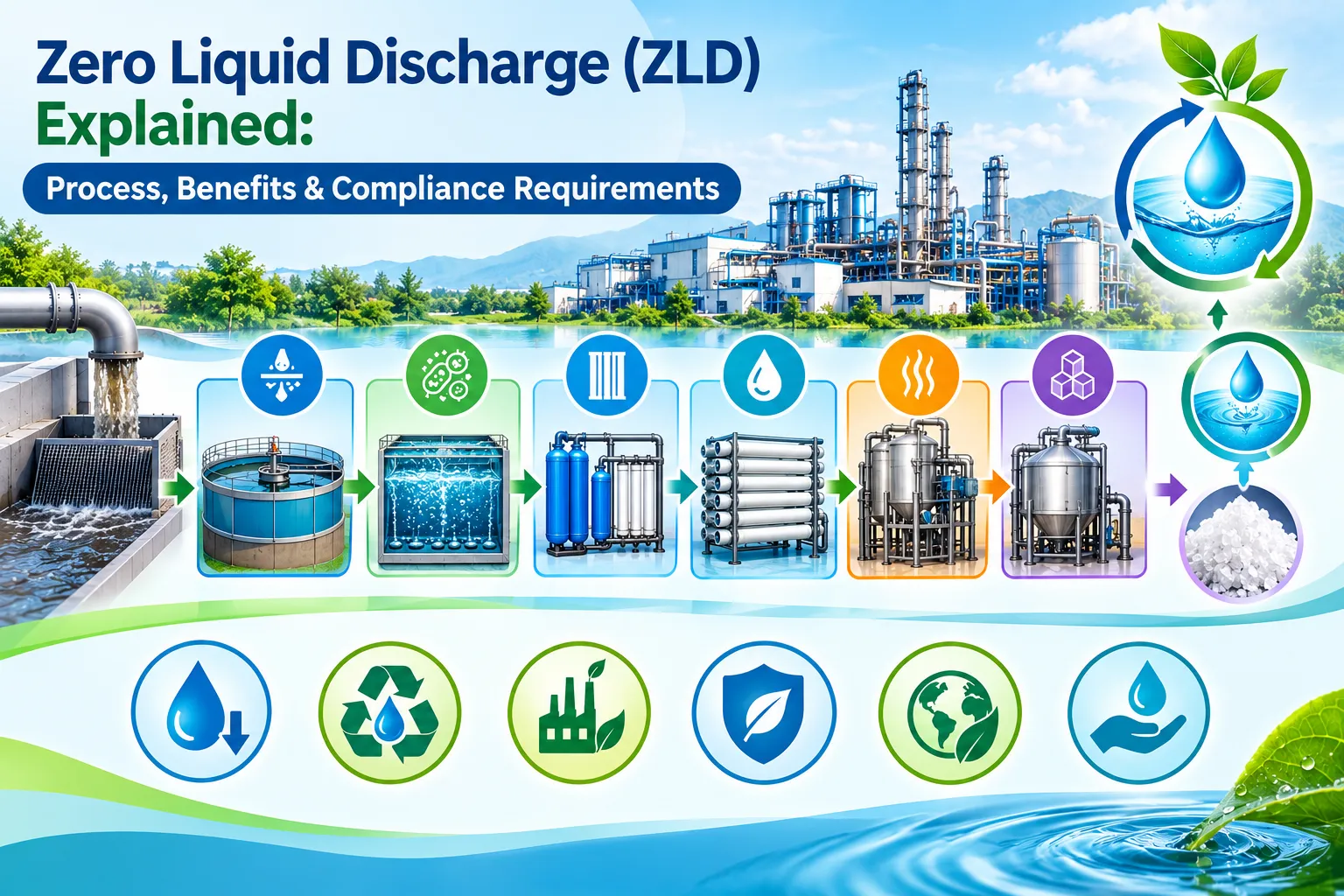
The exact process varies from industry to industry, but a typical system can include the following stages.
Step 1: Primary Wastewater Treatment
The first stage focuses on removing materials that can interfere with downstream treatment systems.
Depending on the wastewater, this stage may address:
- Suspended solids
- Oil and grease
- Floating material
- Coarse contaminants
- Settleable matter
Physical and chemical treatment processes may be used depending on wastewater characteristics.
Proper primary treatment is important because excessive solids, oil or other contaminants can affect the performance of biological and membrane systems.
Step 2: Secondary Biological Treatment
Where wastewater contains significant biodegradable organic matter, biological treatment may be incorporated into the ETP.
The objective is to reduce parameters such as:
- BOD
- COD
- Biodegradable organic pollutants
The treatment configuration depends on the characteristics of the industrial effluent.
Properly designed biological treatment can improve the quality of water entering subsequent tertiary and membrane treatment stages.
Step 3: Tertiary and Advanced Treatment
After primary and secondary treatment, additional treatment may be required to produce water suitable for membrane recovery and reuse.
Common technologies can include:
- Multimedia filtration
- Activated carbon filtration
- Ultrafiltration (UF)
- Other polishing processes
The purpose is to further reduce suspended particles, organics and other substances that could affect downstream RO performance.
Step 4: Reverse Osmosis (RO)
Reverse Osmosis (RO) is one of the major components of many ZLD systems.
RO separates treated wastewater into two primary streams:
RO Permeate
The permeate is the relatively low-TDS water recovered through the membrane process.
Depending on its quality and the facility's water requirements, it may be reused for:
- Process applications
- Cooling systems
- Utility operations
- Cleaning
- Other suitable industrial applications
RO Reject
The reject contains a higher concentration of dissolved salts and other retained contaminants.
Instead of discharging this stream, a ZLD system generally sends it for further concentration and recovery.
Step 5: Evaporation
RO reject may be processed through thermal evaporation systems when required by the ZLD configuration.
Common technologies include:
- Multiple Effect Evaporator (MEE)
- Mechanical Vapor Recompression (MVR)
The evaporation stage removes water from the concentrated stream and further increases the concentration of dissolved solids.
Recovered condensate may be treated and reused where suitable.
Step 6: Crystallization
The concentrated stream can undergo further treatment through a crystallizer.
The objective is to convert dissolved salts and concentrated residues into a solid form.
The resulting material requires appropriate handling and disposal or recovery in accordance with the applicable requirements.
Therefore, ZLD does not simply eliminate waste; it changes the wastewater management pathway from liquid discharge toward water recovery and concentrated solid-residue management.
Major Components of a ZLD System
A ZLD plant can contain several treatment units depending on the wastewater characteristics and required recovery level.
A typical configuration may include:
- Equalization tank
- Primary treatment system
- Biological ETP
- Clarification system
- Multimedia filter
- Activated carbon filter
- Ultrafiltration system
- Reverse Osmosis system
- RO reject management
- Multiple Effect Evaporator
- MVR system
- Crystallizer
- Condensate recovery system
- Sludge handling system
- Salt and residue management system
Not every ZLD plant requires exactly the same configuration. The system should be designed according to the wastewater composition, flow rate, TDS level, recovery target and regulatory requirements.
Which Industries Use ZLD Systems?
ZLD is particularly relevant to industries where wastewater generation, dissolved solids, water consumption or regulatory requirements make advanced water recovery necessary.
Textile and Textile Processing Industries
Textile manufacturing and processing can generate wastewater containing colour, chemicals, salts and organic pollutants.
Advanced treatment and water recovery systems can therefore become an important part of wastewater management.
Pharmaceutical Industries
Pharmaceutical manufacturing can produce wastewater with complex chemical characteristics.
Treatment requirements depend on the manufacturing process, raw materials and wastewater composition.
Chemical Industries
Chemical industries may generate high-TDS or difficult-to-treat wastewater streams.
ZLD can be considered where conventional treatment and discharge options are insufficient or where applicable regulatory conditions require higher levels of water recovery.
Distilleries
Distillery wastewater can contain high organic loads and concentrated pollutants.
Advanced treatment and water-management systems may be required depending on the process and applicable regulatory requirements.
Dye and Dye-Intermediate Industries
These industries may generate wastewater containing colour, dissolved solids and chemical contaminants.
A combination of biological, membrane and thermal treatment can be considered based on wastewater characteristics.
Power Plants
Power generation facilities can generate multiple wastewater streams from utilities and operational processes.
Water recovery systems can help improve overall water-use efficiency where technically and regulatorily appropriate.
Food Processing Industries
Food-processing facilities can generate significant quantities of wastewater containing biodegradable organic matter.
Where water reuse targets or site-specific regulatory requirements apply, advanced treatment and recycling systems can be evaluated.
When Can ZLD Be Required?
ZLD applicability is project-specific. It should not be assumed that every industry or every facility in India is automatically required to implement ZLD.
A ZLD requirement may arise from factors such as:
Environmental Clearance Conditions
An Environmental Clearance may contain project-specific conditions relating to wastewater treatment, reuse and discharge.
Where a project has a ZLD condition, the facility is expected to design and operate its wastewater-management system accordingly.
For understanding the wider EC framework, see EIA Clearance Process in India: Step-by-Step Environmental Approval Framework.
Pollution Control Board Consent Conditions
The applicable Consent to Establish (CTE) and Consent to Operate (CTO) may contain requirements concerning wastewater treatment, reuse and discharge.
The specific conditions depend on the project, industry category, wastewater characteristics and applicable regulatory requirements.
For the distinction between these two approvals, see Difference Between CTE and CTO in India.
Water Availability and Site Conditions
Water availability can influence the wastewater-management strategy of an industrial facility.
Projects operating in water-stressed or groundwater-sensitive locations may need stronger water-conservation and recycling measures depending on applicable permissions and regulatory conditions.
Sector-Specific Requirements
Certain industrial sectors may be subject to specific wastewater-management requirements.
Therefore, industries should evaluate:
- Applicable environmental regulations
- EC conditions
- Consent conditions
- Sector-specific requirements
- Water availability
- Groundwater permissions
- Wastewater characteristics
before deciding on the appropriate ZLD configuration.
Benefits of Zero Liquid Discharge
Reduced Freshwater Consumption
Recovering treated wastewater can reduce the quantity of freshwater required for suitable industrial applications.
Higher Water Recycling
ZLD allows treated water to be recovered and reused within the facility instead of relying entirely on fresh-water sources.
Reduced Liquid Effluent Discharge
A properly designed ZLD system is intended to minimize or eliminate routine liquid effluent discharge from the facility.
Better Water-Resource Management
Water recovery can support more efficient use of available water resources.
Support for Environmental Compliance
Where ZLD is required under applicable EC, consent or sector-specific conditions, an appropriately designed and operated system can support compliance with those requirements.
Improved Sustainability Performance
Water recycling and reduced freshwater dependence can contribute to broader resource-efficiency and sustainability objectives.
Water Recovery and Reuse in ZLD
Recovered water can potentially be reused for different industrial applications, depending on its quality.
Examples include:
- Cooling tower makeup
- Process water
- Utility applications
- Boiler-related applications after appropriate treatment
- Equipment cleaning
- Floor washing
- Other suitable non-potable uses
The actual reuse route should be determined through a water-quality assessment and water balance study.
A high recovery percentage should not be assumed without considering wastewater composition, membrane performance, scaling potential and thermal-treatment requirements.
Challenges of ZLD Systems
Although ZLD can provide significant water-recovery benefits, it also presents technical and operational challenges.
High Capital Investment
A ZLD system generally requires more equipment and infrastructure than a conventional wastewater treatment plant.
Membrane systems, evaporators, crystallizers and associated utilities can significantly increase project costs.
Energy Requirement
Thermal systems such as MEE and other evaporation technologies can consume substantial energy.
Energy optimization is therefore an important part of ZLD design.
Operational Complexity
ZLD plants require appropriate operation and maintenance.
Operators need to monitor parameters affecting:
- ETP performance
- Membrane operation
- RO recovery
- Scaling
- Fouling
- Evaporator performance
- Crystallizer operation
Salt and Residue Management
ZLD converts part of the wastewater pollutant load into concentrated solids or salts.
These materials must be managed through appropriate storage, handling, recovery or authorized disposal routes as applicable.
For related hazardous-waste compliance requirements, see Hazardous Waste Authorization Process in India: Complete Compliance Guide.
Membrane Fouling and Scaling
RO and other membrane systems can experience fouling or scaling when pretreatment is inadequate or wastewater characteristics vary significantly.
Proper pretreatment and regular maintenance are therefore essential.
ZLD and Groundwater Management
Industrial water management is closely connected with groundwater consumption where groundwater is used as a source of industrial water.
A ZLD system can support water conservation by increasing wastewater reuse and reducing the need for additional freshwater intake.
However, ZLD should not be treated as a substitute for obtaining the required groundwater permissions or complying with applicable groundwater conditions.
Industries should maintain an integrated approach covering:
- Groundwater abstraction
- Water consumption
- Wastewater generation
- Water recovery
- Reuse
- Discharge
- Recharge, where applicable
- Regulatory reporting
For groundwater-related permissions, see Groundwater NOC Process in India | Borewell Permission & CGWA Approval.
ZLD and Industrial Water Recycling
ZLD is an advanced form of industrial water recycling in which wastewater is progressively treated and recovered rather than being managed primarily through liquid discharge.
The approach supports:
- Water reuse
- Resource conservation
- Reduced freshwater dependency
- Improved water efficiency
- Circular water-management practices
A successful ZLD strategy therefore depends not only on installing treatment equipment but also on establishing an effective water balance and reuse plan.
Importance of Water Balance in ZLD Projects
A water balance study is an important planning tool for industrial wastewater and ZLD systems.
It tracks water entering, being consumed, treated, recovered, reused and lost within the facility.
A water balance can help determine:
- Freshwater requirement
- Process-water consumption
- Wastewater generation
- ETP capacity
- RO feed quantity
- RO permeate recovery
- RO reject generation
- Evaporator load
- Reuse opportunities
- Overall water recovery
It can also support environmental documentation, water-conservation planning and evaluation of groundwater-related requirements where applicable.
For a detailed explanation, see Industrial Water Balance Study Explained: Why It Matters for Groundwater NOC, EC & ZLD Compliance.
Common Compliance and Operational Issues in ZLD Plants
A ZLD system may fail to deliver its intended performance when treatment units are not properly operated or monitored.
Common issues can include:
RO Performance Problems
Reduced recovery, membrane fouling or poor pretreatment can affect RO performance.
Evaporator Performance Issues
Scaling, energy inefficiency or inadequate maintenance can reduce evaporation performance.
Inadequate Monitoring
Without regular testing and process monitoring, treatment problems may remain undetected.
Improper Residue Management
Concentrated salts, sludge and other residues require appropriate handling and disposal.
Water Accounting Gaps
Industries should maintain a clear record of water intake, consumption, wastewater generation, recovery and reuse.
Bypass or Overflow Risks
Poorly maintained systems can create operational situations where untreated or partially treated wastewater is not managed as intended.
Best Practices for ZLD Compliance
Industries operating ZLD systems should consider the following practices:
- Maintain an updated water balance
- Monitor wastewater characteristics regularly
- Track RO recovery and reject generation
- Maintain membrane systems properly
- Monitor evaporator performance
- Control scaling and fouling
- Maintain crystallizer systems where installed
- Record water recovery and reuse
- Maintain sludge and salt disposal records
- Conduct periodic system performance reviews
- Maintain required environmental monitoring records
- Review EC and consent conditions periodically
- Train operators in ZLD plant operation
A ZLD system should be treated as an operating environmental-management system rather than simply as a piece of treatment equipment.
ZLD Compliance Audit
A periodic ZLD compliance audit can help industries evaluate whether their wastewater-management system is operating according to the intended design and applicable requirements. An audit may review:
- Water balance
- ETP operation
- RO performance
- MEE/MVR operation
- Crystallizer operation
- Water recovery
- Wastewater reuse
- Monitoring records
- Chemical consumption
- Sludge management
- Salt/residue management
- EC conditions
- CTE/CTO conditions
- Groundwater-related requirements
- Environmental reporting
The findings can then be used to identify corrective and preventive actions. For a broader audit methodology, see Environmental Audit for Industries: Types, Process & Compliance Benefits .
How SimpliComp Can Help with ZLD Compliance
SimpliComp provides consultancy support for industrial wastewater management, ZLD systems and related environmental compliance requirements. Our support can include:
- ZLD compliance assessment
- Industrial wastewater management planning
- Water balance studies
- Wastewater recycling assessment
- ETP/RO/ZLD performance review
- Environmental compliance audits
- EC condition review
- CTE/CTO compliance support
- Groundwater compliance support
- Wastewater monitoring and documentation
- Regulatory compliance guidance
- Water conservation planning
Our approach focuses on understanding the industry's actual wastewater generation, treatment process, water consumption and reuse requirements before recommending compliance measures.
ZLD for New Industrial Projects
For a new industrial project, ZLD planning should ideally begin during the project-design stage. The project team should assess:
- Total water requirement
- Process-water demand
- Wastewater generation
- Wastewater characteristics
- Treatment capacity
- Water recovery target
- Reuse applications
- RO reject management
- Thermal treatment requirements
- Solid residue management
- Applicable environmental conditions
Early planning allows the ZLD system to be integrated with the overall plant water balance instead of being added as a separate system after commissioning. For a wider environmental approval checklist for new manufacturing facilities, see Environmental Approvals & Compliance Checklist Required to Set Up a Manufacturing Plant in India .
ZLD for Existing Industries
Existing industries can also review their wastewater-management systems to identify opportunities for higher water recovery. A review may examine:
- Existing ETP performance
- Current water consumption
- Wastewater generation
- Existing RO system
- RO recovery
- Reject management
- Evaporator capacity
- Water reuse
- Sludge and salt handling
- Regulatory conditions
- Operational records
Based on the findings, the facility can identify technical and compliance improvements.
Conclusion
Zero Liquid Discharge (ZLD) is an advanced approach to industrial wastewater management focused on maximizing water recovery, increasing reuse and minimizing liquid effluent discharge.
A typical ZLD system may combine ETP treatment, tertiary filtration, UF, RO, evaporation and crystallization. However, the appropriate configuration depends on wastewater characteristics, water balance, recovery requirements and applicable regulatory conditions.
ZLD can help industries reduce freshwater dependence and improve industrial water management, but its effectiveness depends on proper design, operation, monitoring and residue management.
Before implementing or modifying a ZLD system, industries should evaluate their water balance, wastewater characteristics, applicable EC and consent conditions, groundwater requirements and sector-specific regulatory obligations.
Related Guides & Resources
- Groundwater Annual Compliance & Returns: Complete Guide for Industries →
- OCEMS Compliance Guide for Industries: CPCB Requirements, Monitoring & Regulatory Obligations →
- Groundwater Monitoring Explained: Methods, Parameters & Compliance Requirements →
- Environmental Compliance Checklist for Industries in India →
- Water Balance Study Explained: Why It Is Essential for Groundwater NOC & Environmental Compliance →
Need Help with ZLD Compliance?
Simplicomp assists industries with:
- ZLD compliance reviews
- Water balance studies
- Industrial water recycling
- Wastewater management planning
- Treated effluent testing
- Environmental compliance audits
- Regulatory approvals