

Introduction
Installing an ETP or STP alone is not sufficient to understand the actual performance of a wastewater treatment system. Regular monitoring of treated and untreated wastewater quality parameters is essential to evaluate treatment efficiency.
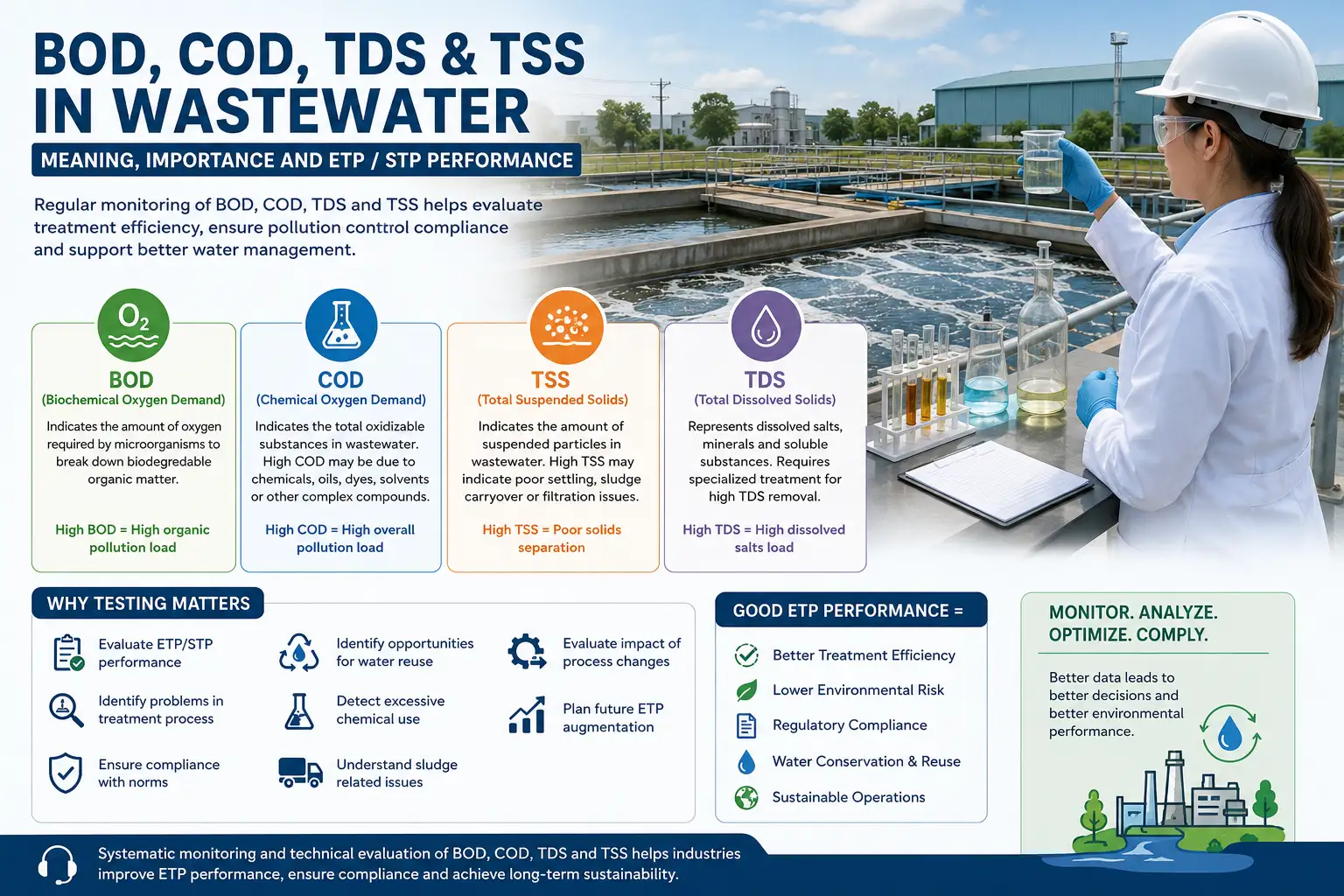
BOD, COD, TDS, and TSS are some of the most important parameters used in wastewater analysis. These values provide useful information about organic load, suspended particles, dissolved salts, and the overall performance of the treatment system.
For manufacturing units, commercial establishments, housing projects, and other water-intensive facilities, monitoring these parameters plays an important role in pollution control compliance, ETP/STP operation, and treated water reuse planning.
What Do BOD, COD, TDS and TSS Tell Us?
Each wastewater parameter represents a different aspect of treatment performance. Therefore, evaluating an ETP/STP based on only one parameter is not appropriate.
BOD – Biochemical Oxygen Demand
BOD indicates the amount of oxygen required by microorganisms to break down biodegradable organic matter present in wastewater.
If wastewater has a high BOD, the organic pollution load may generally be comparatively high. If BOD remains consistently high even after biological treatment, factors such as aeration, biological activity, retention time, sludge management, and hydraulic loading should be reviewed.
COD – Chemical Oxygen Demand
COD indicates the overall load of oxidizable substances present in wastewater. COD testing can provide results comparatively faster than BOD testing.
High COD in industrial wastewater may be caused by process chemicals, complex organic compounds, oils, solvents, dyes, or other difficult-to-biodegrade substances.
If COD reduction is not satisfactory after biological treatment, the wastewater characteristics and treatment sequence should be technically evaluated.
TDS – Total Dissolved Solids
TDS represents dissolved salts, minerals, and other soluble substances present in water.
The behaviour of TDS is different from BOD and TSS. Conventional biological treatment does not significantly remove dissolved salts. Therefore, for high-TDS wastewater, options such as RO, membrane treatment, evaporation, reject management, or ZLD may be assessed depending on the treatment requirements.
TSS – Total Suspended Solids
TSS indicates the quantity of suspended particles present in wastewater.
High TSS may indicate poor settling, sludge carryover, clarifier issues, filtration problems, or excessive biological solids within the treatment plant.
Consistently high outlet TSS can affect treated water quality and create an additional load on downstream treatment units.
Why BOD, COD, TDS and TSS Testing Matters for Industries
The purpose of wastewater testing is not simply to generate a laboratory report. Proper interpretation of test results helps industries understand the actual condition of their treatment systems.
Regular testing allows industries to:
- Evaluate ETP/STP performance
- Identify problems in the treatment process
- Check treatment performance against pollution control requirements
- Identify opportunities for treated water reuse
- Detect excessive chemical consumption
- Understand sludge-related issues
- Evaluate the impact of process changes
- Assess the need for future ETP augmentation
Therefore, wastewater analysis should be considered not only a routine compliance activity but also a process management tool.
BOD and COD: What Does the Ratio Indicate?
Evaluating BOD and COD together can be helpful in understanding the biodegradability of wastewater.
A relatively higher BOD/COD ratio generally indicates that a larger portion of the organic load may be biologically treatable.
On the other hand, a lower ratio may indicate the presence of comparatively less biodegradable compounds.
However, the ratio should not be used as an isolated value. For actual treatment decisions, it is also important to consider the wastewater source, process chemicals, pH, toxicity, temperature, and historical laboratory data.
Why This Matters for ETP/STP Design
If wastewater is predominantly biodegradable, a biological treatment system may be effective.
However, if difficult-to-degrade compounds are present in significant quantities, additional treatment stages may be required.
Therefore, ETP/STP design depends not only on wastewater quantity but also on wastewater quality.
What Can High BOD Indicate?
Some possible reasons for repeatedly high BOD at the ETP/STP outlet include:
- Insufficient aeration
- Inadequate biological activity
- Hydraulic overloading
- Sudden organic shock load
- Poor sludge management
- Insufficient retention time
- Improper nutrient balance
- Operational instability in the treatment process
Before taking corrective action, it is better to compare inlet and outlet data and review the complete treatment process.
What Can High COD Indicate?
High COD can be strongly associated with the chemical characteristics of wastewater.
Possible reasons include:
- Complex organic compounds
- Process chemicals
- Oils and solvents
- Dyes or colour-causing compounds
- Non-biodegradable substances
- Industrial process changes
- Inadequate treatment stages
If COD remains consistently high after biological treatment, simply increasing aeration may not be sufficient in every situation.
Based on wastewater characterization, options such as chemical treatment, tertiary treatment, advanced oxidation, filtration, or source segregation may be evaluated.
What Does High TSS Tell About an ETP/STP ?
High TSS generally indicates that attention should be given to the performance of the solids separation section of the treatment plant.
Possible causes include:
- Poor settling
- Clarifier overload
- Sludge carryover
- Improper sludge wasting
- Filtration problems
- Excessive biomass
- Hydraulic fluctuations
Instead of focusing only on reducing outlet TSS, the ETP/STP operator should identify the underlying cause of the high TSS.
Why High TDS Requires a Different Treatment Approach
Controlling TDS can be fundamentally different from reducing BOD or TSS.
Biological treatment can reduce organic pollutants, but dissolved salts may remain in the treatment process.
Therefore, industries generating high-TDS wastewater should conduct a detailed assessment of their water balance and wastewater streams.
Possible strategies may include:
- High-TDS stream segregation
- Reduction in freshwater consumption
- Treated water reuse
- RO system
- Concentrate management
- Evaporation-based systems
- ZLD feasibility assessment
ZLD does not automatically need to be installed in every case. First, the actual water balance, discharge requirements, reuse potential, reject quantity, and operational cost should be evaluated.
Important Wastewater Ratios for ETP/STP Evaluation
Along with individual parameters, certain ratios can also be useful for understanding treatment performance.
BOD/COD Ratio
This can be a useful indicator for understanding the biodegradable fraction of wastewater.
TSS/COD Relationship
This helps provide a better understanding of the relationship between particulate load and organic load in wastewater.
VSS/TSS Ratio
Comparing VSS and TSS can help understand the organic fraction of biological solids.
SVI – Sludge Volume Index
SVI is a useful operational indicator for assessing sludge settling behaviour in biological treatment systems.
If sludge does not settle properly, both secondary clarifier performance and treated water quality can be affected.
Important: Ratios should not be used as replacements for individual laboratory values. They should be used as supporting indicators for overall ETP/STP assessment.
How to Read an ETP/STP Laboratory Report
A wastewater test report should not be evaluated only from a “pass” or “fail” perspective.
For better ETP/STP assessment, industries should regularly compare the following information:
| Parameter | What It Helps Indicate |
|---|---|
| BOD | Biodegradable organic load |
| COD | Overall oxidizable load |
| TSS | Suspended solids and settling performance |
| TDS | Dissolved salts and soluble load |
| pH | Acidity/alkalinity condition |
| Flow | Hydraulic loading |
| Oil & Grease | Oil-related contamination |
| Conductivity | Dissolved ionic load |
Comparing historical reports makes it easier to identify sudden changes, gradual deterioration, and recurring treatment problems.
When Should an ETP/STP Performance Review Be Considered?
A technical review can be particularly useful when:
- ETP/STP outlet parameters are repeatedly unsatisfactory
- Production capacity has increased
- Wastewater characteristics have changed
- Chemical consumption is unexpectedly increasing
- Sludge quantity has suddenly increased
- Colour, odour, or turbidity appears in treated water
- The ETP/STP is frequently overloaded
- Observations have been received from the Pollution Control Board
- A treated water reuse plan is being considered
- The existing ETP/STP was designed for an older production load
- The industry is planning expansion or process modification
Every ETP/STP problem requires a complete replacement. In some cases, performance can be improved through process optimisation, aeration correction, equalisation improvement, sludge management, filtration upgrades, or partial augmentation.
Wastewater Quality and ETP/STP Design Are Closely Connected
Defining ETP/STP capacity only in terms of KLD is not sufficient.
Proper ETP/STP planning should also consider wastewater characteristics such as:
- Wastewater quantity
- Peak flow
- BOD
- COD
- TSS
- TDS
- pH
- Oil & grease
- Colour
- Heavy metals, wherever applicable
- Process chemicals
- Required treated water quality
- Reuse or discharge requirements
For example, two industrial units with the same 100 KLD capacity may have completely different wastewater treatment requirements.
Therefore, instead of selecting the lowest-cost ETP, it is more practical to select a treatment system based on wastewater characteristics and long-term operational requirements.
Role of Water Balance in Wastewater Management
Preparing a complete water balance is useful for improving wastewater management.
A water balance helps industries identify:
This analysis can help identify unnecessary freshwater consumption, recoverable water streams, and high-strength wastewater sources.
Integrating the water balance with an ETP performance review can improve both water conservation and pollution control planning.
BOD, COD, TDS & TSS and Pollution Control Compliance
Maintaining treated wastewater quality is an important part of environmental compliance for industries.
However, the compliance approach should not be limited to occasional sampling.
Industries should maintain appropriate records related to:
- Wastewater Testing
- Flow Measurement
- ETP Operation
- Chemical Consumption
- Sludge Handling
- Maintenance
- Water Consumption
- Treated Water Reuse
- Corrective Actions
- Pollution Control Observations
Proper documentation can be useful during future inspections, compliance reviews, and internal audits.
How SimpliComp Can Help with ETP/STP & Wastewater Management
SimpliComp Tech LLP provides technical support to industries, commercial projects, housing developments, and other establishments for environmental compliance and pollution-control requirements.
Our support can include:
- ETP Performance Assessment
- STP Performance Review
- Wastewater Parameter Interpretation
- BOD/COD Analysis Support
- TDS Management Assessment
- TSS and Sludge-Related Troubleshooting
- Water Balance Preparation
- Water Conservation Planning
- Treated Water Reuse Assessment
- ETP/STP Augmentation Review
- ZLD Feasibility Support
- Pollution-Control Compliance Assistance
- Environmental Monitoring and Reporting Support
The objective is not simply to reduce one laboratory parameter, but to understand the complete wastewater treatment system and identify practical improvements.
Practical Approach to Better ETP/STP Performance
A good wastewater management strategy can follow these steps:
1. Characterise the Wastewater
Understand the actual quality and quantity of wastewater generated.
2. Establish a Water Balance
Identify where freshwater is consumed and where wastewater is generated.
3. Review ETP/STP Design
Check whether the existing treatment system is suitable for the current load.
4. Analyse Inlet and Outlet Trends
Compare historical BOD, COD, TDS, TSS, and other relevant parameters.
5. Identify the Root Cause
Determine whether the issue is related to hydraulic loading, biological treatment, chemicals, sludge, filtration, or process changes.
6. Implement Corrective Measures
Optimise the existing system wherever possible before considering major modifications.
7. Continue Monitoring
Regular monitoring helps verify whether corrective measures are actually working.
Conclusion
BOD, COD, TDS, and TSS are more than laboratory numbers. Together, they provide valuable insight into wastewater characteristics and ETP/STP performance.
BOD and COD help in understanding organic loading, TSS provides information about suspended solids and settling behaviour, while TDS indicates the dissolved mineral and salt load that may require a different treatment strategy.
For industries, regular wastewater monitoring combined with ETP/STP performance assessment, water balance, process optimisation, and proper compliance documentation can help improve treatment efficiency and reduce environmental risks.
If your ETP/STP is showing repeated variation in BOD, COD, TDS, or TSS, a technical review can help determine whether the actual issue is related to treatment design, operation, wastewater characteristics, or changing production conditions.
Related Resources
- Groundwater NOC Process →
- CTE Document Checklist →
- E Waste Recycling Plant Setup in India →
- Major NGT Judgments Impacting Industries →
Need Help with Groundwater NOC & Borewell Permission?
Simplicomp assists industries with:
- Groundwater NOC applications
- CGWA approvals
- HWRA approvals
- UPGWD approvals
- Water balance studies
- Hydrogeological assessments
- Rainwater harvesting compliance
- Groundwater compliance management