

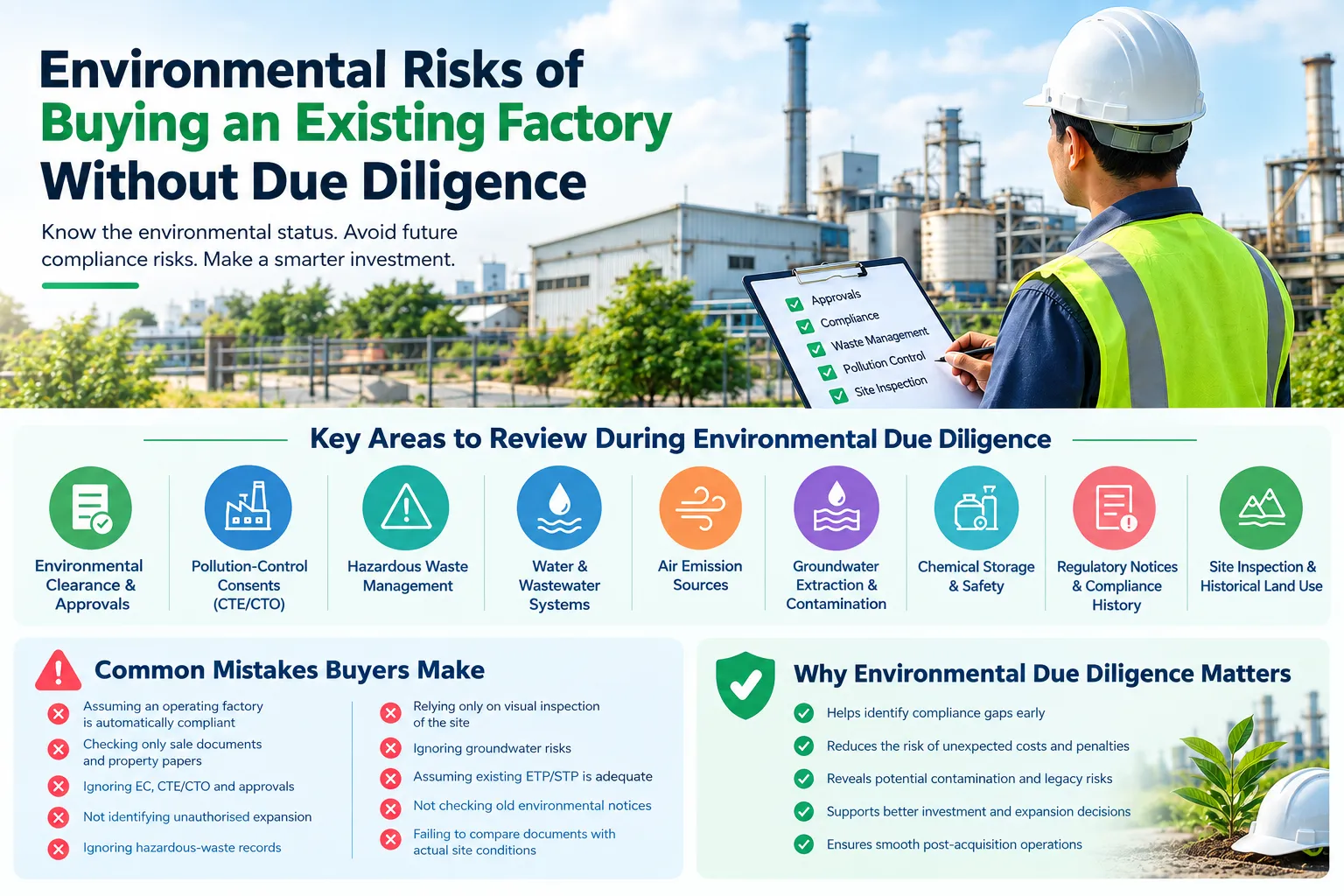
Introduction
Buying an existing factory can appear easier than developing a new industrial facility from the ground up. The land, buildings, machinery, utilities and production infrastructure may already be available, allowing a buyer to begin operations faster.
Manufacturing units, warehouses, infrastructure projects, commercial establishments, industrial parks, processing units, hotels, hospitals, and construction projects may require several environmental approvals and ongoing compliance obligations before and during operations.
What Is Environmental Due Diligence?
Environmental due diligence is a systematic review of the environmental condition, regulatory status and compliance history of an industrial property before acquisition. The assessment can help a buyer understand:
- Existing environmental approvals
- Pollution-control consents
- Environmental Clearance requirements
- Current production activity
- Historical industrial operations
- Waste generation and disposal
- Wastewater treatment systems
- Air-emission sources
- Hazardous chemical storage
- Groundwater extraction
- Environmental notices or directions
- Existing compliance gaps
- Potential contamination risks
The purpose is to identify environmental issues before they become costly compliance problems after acquisition.
Why Environmental Due Diligence Matters Before Buying a Factory
An existing industrial facility does not automatically have a clean environmental compliance record simply because it has been operating for years. Previous operations may have resulted in:
- Regulatory non-compliance
- Unauthorised changes in production
- Excessive pollution loads
- Improper waste disposal
- Soil or groundwater contamination
- Expired or inadequate approvals
- Poorly maintained treatment systems
- Pending regulatory actions
A buyer may also unknowingly inherit operational practices that do not match the facility's approved environmental conditions. If these matters are discovered only after the acquisition, the new owner may have to spend significant time and resources addressing them. Due diligence provides an opportunity to identify such issues before the transaction is completed. For a broader review of industrial environmental requirements, buyers can refer to the Environmental Compliance Checklist for Industries in India .
Common Mistakes Buyers Make When Buying an Existing Factory
1. Assuming That an Operating Factory Is Automatically Compliant
One of the most common mistakes is assuming that a factory is environmentally compliant simply because it has been operating for several years. A facility may continue operations while having:
- Expired approvals
- Pending renewals
- Compliance gaps
- Unauthorised modifications
- Environmental notices
- Inadequate pollution-control systems
Mistake: Treating ongoing operation as proof of environmental compliance.
Better approach: Verify the current approval and compliance status independently before acquisition.
2. Checking Only the Sale Documents and Property Papers
Buyers often focus on:
- Sale deed
- Property ownership
- Land records
- Building documents
- Machinery details
- Financial records
These documents are important, but they do not establish the environmental condition of an industrial facility. Environmental approvals and compliance records should also be reviewed.
Mistake: Completing property due diligence without environmental due diligence.
Better approach: Conduct a separate environmental review covering approvals, pollution control, waste, water, emissions and historical compliance.
3. Not Verifying CTE and CTO Status
Depending on the activity, an industrial facility may require applicable Consent to Establish (CTE) and Consent to Operate (CTO) from the concerned State Pollution Control Board. The buyer should verify:
- Consent validity
- Approved production capacity
- Permitted products
- Raw materials
- Water consumption
- Wastewater generation
- Air-emission sources
- Fuel usage
- Waste-generation details
- Consent conditions
Mistake: Looking at the consent certificate without checking whether the actual factory matches it.
Better approach: Compare the consent documents with the present production activity, machinery, capacity, utilities and pollution-control systems. The regulatory distinction and purpose of these two permissions are explained in Difference Between CTE and CTO in India .
4. Ignoring Environmental Clearance Requirements
Certain industrial and development projects may require Environmental Clearance (EC) under the applicable environmental framework. A buyer should determine whether the facility has:
- Applicable Environmental Clearance
- Valid EC documentation
- EC conditions
- Compliance reports
- Approved production capacity
- Conditions relating to expansion or modernization
Mistake: Assuming that an old factory does not need EC-related verification because it was already operating before the acquisition.
Better approach: Review the project's environmental approval history and determine whether current operations and proposed changes are covered by the applicable approvals. The buyer can also review the Documents Required for Environmental Clearance (EC) in India when preparing an environmental document review.
5. Failing to Identify Unauthorised Expansion
An existing factory may have increased production capacity, installed additional equipment or introduced new products without updating its environmental approvals. For example:
- Additional production lines may have been installed
- Production capacity may have increased
- Boiler capacity may have changed
- Chemical storage may have increased
- Water consumption may have increased
- New discharge points may have been created
- Manufacturing processes may have changed
Mistake: Checking only the originally approved capacity.
Better approach: Compare the approved capacity and process details with the actual machinery, production and site conditions. Where production enhancement is being assessed, the No Increase in Pollution Load (NIPL) guide can provide additional context on production-capacity changes and pollution-load considerations.
6. Ignoring Hazardous-Waste Records
Factories may generate hazardous waste from manufacturing and maintenance activities. Potential waste streams can include:
- Used oil
- Chemical residues
- Contaminated containers
- Process residues
- ETP sludge
- Solvent-related waste
- Contaminated materials
The buyer should review:
- Hazardous-waste authorisation
- Waste categories
- Quantities generated
- Storage arrangements
- Disposal records
- Authorised vendors
- Manifest records
- Annual returns
- Historical accumulation
Mistake: Looking at the hazardous-waste authorisation but not checking actual storage and disposal practices.
Better approach: Match authorised quantities and categories with actual waste generation, storage and disposal records. The Hazardous Waste Authorization Process in India provides further information on hazardous-waste compliance requirements.
7. Assuming Clean-Looking Land Means No Contamination
A factory site can appear clean while having historical contamination below the surface. Potential contamination sources include:
- Chemical storage areas
- Fuel storage
- Oil-handling areas
- Waste-storage zones
- Process areas
- ETP areas
- Underground pipelines
- Old disposal locations
Mistake: Relying only on a visual inspection.
Better approach: Review the historical use of the property and consider appropriate environmental investigation or sampling where potential contamination is identified.
8. Ignoring Groundwater Risks
Groundwater can be affected by historical industrial activities, particularly where chemicals, fuels or contaminated wastewater may have entered the subsurface. Potential sources include:
- Chemical leakage
- Underground tanks
- Waste disposal
- Leaking pipelines
- Unlined storage areas
- Historical effluent discharge
Mistake: Checking only the present groundwater-use permission while ignoring historical site conditions.
Better approach: Review groundwater-related records along with the site's environmental history and available monitoring information. For background on groundwater-related regulatory requirements, see Groundwater Laws & Regulations in India .
9. Not Checking Groundwater Extraction Compliance
If the factory uses groundwater, the buyer should check the applicable groundwater permission or NOC status. Important records may include:
- Approved extraction quantity
- Number and location of borewells
- Water meters
- Groundwater abstraction records
- Water consumption
- Recharge measures
- Water-conservation measures
- Applicable compliance submissions
Mistake: Assuming that existing borewells can automatically continue operating after acquisition.
Better approach: Verify the applicable groundwater approval, permitted abstraction and compliance requirements before continuing or increasing extraction. The Groundwater NOC Process in India covers the broader groundwater permission and approval framework.
10. Assuming an Existing ETP or STP Is Automatically Adequate
The presence of an ETP, STP or other treatment system does not by itself establish environmental compliance. The buyer should examine:
- Treatment capacity
- Actual wastewater generation
- Treatment process
- Treated-water quality
- Sludge generation
- RO system, where applicable
- ZLD system, where applicable
- Bypass arrangements
- Maintenance records
- Monitoring reports
- Reuse and discharge arrangements
Mistake: Assuming that an installed treatment plant is sufficient simply because it exists.
Better approach: Compare design capacity, actual wastewater generation, treatment performance and applicable discharge/reuse requirements. For understanding important wastewater performance parameters, see BOD, COD, TDS & TSS in Wastewater .
11. Not Reviewing Air-Emission Sources
Industrial facilities may have boilers, furnaces, DG sets, process stacks or other emission sources. The buyer should review:
- Stack details
- Fuel type
- Fuel consumption
- Pollution-control equipment
- Stack monitoring
- Emission-monitoring records
- Consent conditions
- DG-set arrangements
- Applicable emission requirements
Mistake: Assuming existing air-pollution-control equipment will automatically remain adequate after acquisition.
Better approach: Verify the equipment, operating condition, approved parameters and current production-related emissions.
12. Ignoring Hazardous Chemical Storage
Factories handling hazardous chemicals may have additional environmental and safety requirements. The buyer should identify:
- Chemicals stored on-site
- Maximum inventory
- Storage tanks
- Chemical warehouses
- Compatibility requirements
- Spill-control arrangements
- Safety documentation
- Emergency preparedness
- Historical chemical incidents
Mistake: Checking only the chemical inventory without verifying storage conditions and regulatory records.
Better approach: Compare actual chemical storage with approved quantities, safety arrangements and applicable requirements.
13. Not Checking Old Environmental Notices
Another major mistake is failing to investigate the facility's regulatory history. A buyer should check for:
- Show-cause notices
- Environmental directions
- Closure directions
- Consent-related notices
- Pollution-control notices
- Penalties
- Environmental compensation demands
- Compliance directions
- Court or tribunal-related proceedings
Mistake: Assuming that previous notices automatically become irrelevant after the property changes ownership.
Better approach: Identify unresolved matters and understand the status of each environmental proceeding before acquisition. Where regulatory violations have resulted in monetary environmental liability, buyers may also review Environmental Compensation Explained in India .
14. Ignoring Environmental Conditions Attached to Approvals
Environmental approvals may contain conditions relating to:
- Wastewater treatment
- Air pollution control
- Water conservation
- Greenbelt
- Waste management
- Environmental monitoring
- Occupational safeguards
- Environmental reporting
Mistake: Collecting approval documents without checking whether their conditions were actually implemented.
Better approach: Review compliance reports and verify important conditions during a site inspection. An Environmental Audit for Industries can help structure the review of environmental compliance and identify potential gaps.
15. Not Inspecting Waste-Storage Areas
Improper waste storage can create immediate environmental risks. During a site inspection, attention should be given to:
- Hazardous-waste storage
- ETP sludge
- Used oil
- Chemical containers
- Leaking drums
- Unlabelled containers
- Spill marks
- Open dumping
- Drain contamination
- Waste accumulation
Mistake: Inspecting only the production floor and ignoring waste-storage areas.
Better approach: Include all waste-handling and storage locations in the environmental site inspection.
16. Ignoring Legacy Pollution
A factory may have operated under previous owners for many years. Historical operations can leave behind:
- Old chemical storage
- Buried waste
- Contaminated soil
- Abandoned tanks
- Historical wastewater discharge
- Old process areas
- Underground pipelines
- Previous industrial activities
Mistake: Reviewing only the current owner's operations.
Better approach: Investigate the site's historical industrial use and previous activities wherever relevant.
17. Not Comparing Documents With Actual Site Conditions
This is one of the most important mistakes during factory acquisition. For example, approved documents may show:
- One production line
- Limited chemical storage
- Specific wastewater quantity
- Certain fuel consumption
But the actual facility may have:
- Additional machinery
- Higher production
- Additional chemicals
- Increased wastewater
- Different waste streams
Mistake: Treating regulatory documents as a complete representation of the current site without physical verification.
Better approach: Compare documents, production records, equipment and actual site conditions.
Environmental Due Diligence Checklist for Factory Acquisition
Before purchasing an existing factory, the buyer should consider reviewing the following.
Regulatory Approvals
- Environmental Clearance
- Consent to Establish
- Consent to Operate
- Hazardous-waste authorisation
- Groundwater NOC, where applicable
- Applicable waste-management permissions
- Other environmental approvals
Environmental Records
- Previous compliance reports
- Environmental monitoring reports
- Water and air test reports
- Waste records
- Annual returns
- Groundwater records
- Regulatory correspondence
Site Conditions
- ETP/STP
- Air-pollution-control equipment
- Hazardous-waste storage
- Chemical storage
- Drainage system
- Waste-storage areas
- Spill areas
- Chemical tanks
- Borewells
- Greenbelt
Historical Issues
- Regulatory notices
- Penalties
- Environmental compensation
- Complaints
- Litigation
- Accident history
- Previous contamination
For a wider review of environmental approvals and compliance requirements for industrial facilities, see the Environmental Approvals & Compliance Checklist Required to Set Up a Manufacturing Plant in India .
Documents to Request Before Buying an Existing Factory
A buyer can request an organised environmental document package from the seller. This may include:
- Environmental Clearance documents
- CTE and CTO
- Consent renewal records
- Hazardous-waste authorisation
- Groundwater permissions
- Environmental statements
- Annual returns
- Monitoring reports
- ETP/STP records
- Waste-disposal records
- Water-consumption records
- Production records
- Chemical inventory
- Regulatory notices
- Compliance reports
- Environmental audit reports
- Site plans and process-flow diagrams
The exact documents required depend on the factory's industry, production process and environmental profile.
Environmental Site Inspection
Document review should ideally be supported by a physical site inspection. During an inspection, the consultant may review:
- Production areas
- Chemical storage
- Waste-storage locations
- ETP/STP
- RO/ZLD systems
- Air-pollution-control systems
- Drainage
- Wastewater discharge points
- Borewells
- Fuel-storage areas
- Hazardous-waste areas
- Potential spill locations
The objective is to determine whether the physical facility is consistent with the available environmental records.
Environmental Due Diligence for Factory Acquisition: Step-by-Step
Step 1: Understand the Factory
Identify:
- Industry type
- Products
- Production capacity
- Raw materials
- Processes
- Utilities
- Water requirement
- Waste generation
Step 2: Review Environmental Approvals
Collect and verify applicable permissions, consents and authorisations.
Step 3: Review Compliance History
Examine monitoring reports, returns, notices and regulatory correspondence.
Step 4: Conduct Site Inspection
Compare documents with actual site conditions.
Step 5: Identify Environmental Risks and Mistakes
Classify findings such as:
- Documentation gaps
- Operational non-compliance
- Pollution-control deficiencies
- Waste-management issues
- Potential contamination
- Regulatory liabilities
- Unauthorised changes
- Mismatch between approvals and actual operations
Step 6: Assess Corrective Actions
Determine what may be required to address the identified issues.
Step 7: Prepare Due-Diligence Report
The findings can be documented in a structured report for the buyer's acquisition and environmental risk-assessment process.
What Happens If Environmental Due Diligence Is Skipped?
Skipping environmental due diligence can result in unexpected costs and compliance challenges after acquisition. Potential consequences may include:
- Cost of upgrading pollution-control systems
- Waste-remediation expenses
- Soil or groundwater investigation
- Regulatory compliance costs
- Additional environmental studies
- Consent modification or renewal requirements
- Waste-disposal expenses
- Production restrictions
- Delays in restarting or expanding operations
The actual impact depends on the facility's history, industry, regulatory status and environmental condition.
Environmental Due Diligence and Factory Expansion
Environmental due diligence is also important when the buyer intends to expand the acquired factory. Before investing in new machinery or increasing production, the buyer should understand:
- Existing approved capacity
- Current pollution load
- Water availability
- Wastewater treatment capacity
- Air-emission capacity
- Existing environmental conditions
- Expansion-related EC requirements
- Pollution-control consent requirements
Common mistake: Purchasing the factory first and checking expansion-related environmental requirements later. The environmental feasibility of the proposed expansion should be reviewed before major investment decisions are finalised.
Environmental Due Diligence for Industrial Land and Buildings
The assessment should not be limited to machinery and current production. The surrounding property should also be considered. Important areas may include:
- Historical land use
- Adjacent industries
- Drainage
- Nearby water bodies
- Groundwater conditions
- Waste-disposal areas
- Storage yards
- Underground tanks
- Former process areas
Common mistake: Assuming that a clean-looking building means the entire property has no environmental concerns. The property's environmental history can remain relevant even when the current facility appears clean and operational.
How SimpliComp Can Help With Environmental Due Diligence
SimpliComp provides environmental consultancy support for businesses evaluating existing industrial facilities before acquisition, takeover, expansion or operational restart. Our support can include:
- Environmental due-diligence assessment
- Regulatory approval review
- EC applicability review
- CTE/CTO review
- Hazardous-waste compliance review
- Groundwater compliance assessment
- ETP/STP/ZLD assessment
- Environmental monitoring record review
- Site inspection support
- Compliance-gap identification
- Environmental risk documentation
- Corrective-action recommendations
- Post-acquisition environmental compliance planning
The assessment can help buyers understand the existing environmental position of a facility before making major investment decisions.
Conclusion
Buying an existing factory involves more than evaluating land, buildings, machinery and production capacity. The buyer should also understand the facility's environmental approvals, compliance history, pollution-control systems, waste-management practices and potential legacy risks.
Some of the most important mistakes include:
- Assuming an operating factory is automatically compliant
- Not checking CTE/CTO status
- Ignoring Environmental Clearance requirements
- Failing to identify unauthorised expansion
- Not reviewing hazardous-waste records
- Ignoring groundwater and contamination risks
- Assuming an existing ETP or STP is adequate
- Not checking old environmental notices
- Failing to compare documents with actual site conditions
- Ignoring historical industrial activities
A structured review of documents combined with a physical site assessment can provide a clearer picture of the facility's environmental status before acquisition.
For businesses planning to purchase an existing industrial facility, conducting environmental due diligence before finalising the transaction can help identify potential compliance obligations, environmental risks and corrective actions at an early stage.
Related Guides & Resources
- Environmental Clearance & EIA →
- Groundwater & Water NOC →
- Pollution Control Compliance →
- EPR & Waste Management →
- Environmental Laws & Notifications →
Need Help with Environmental Compliance?
Simplicomp provides support for:
- Environmental Clearance (EC)
- CTE & CTO approvals
- Groundwater NOC approvals
- EPR registration
- Hazardous waste compliance
- Environmental monitoring
- SPCB compliance management
- Environmental audits and reporting