

Introduction
Environmental compliance has become a critical responsibility for industries, factories, construction companies and infrastructure developers operating across Delhi-NCR. Regulatory authorities are increasingly monitoring industrial emissions, construction dust, pollution-control systems and adherence to environmental directions. Even a compliance gap can attract inspections and regulatory action, depending on the nature and seriousness of the violation.
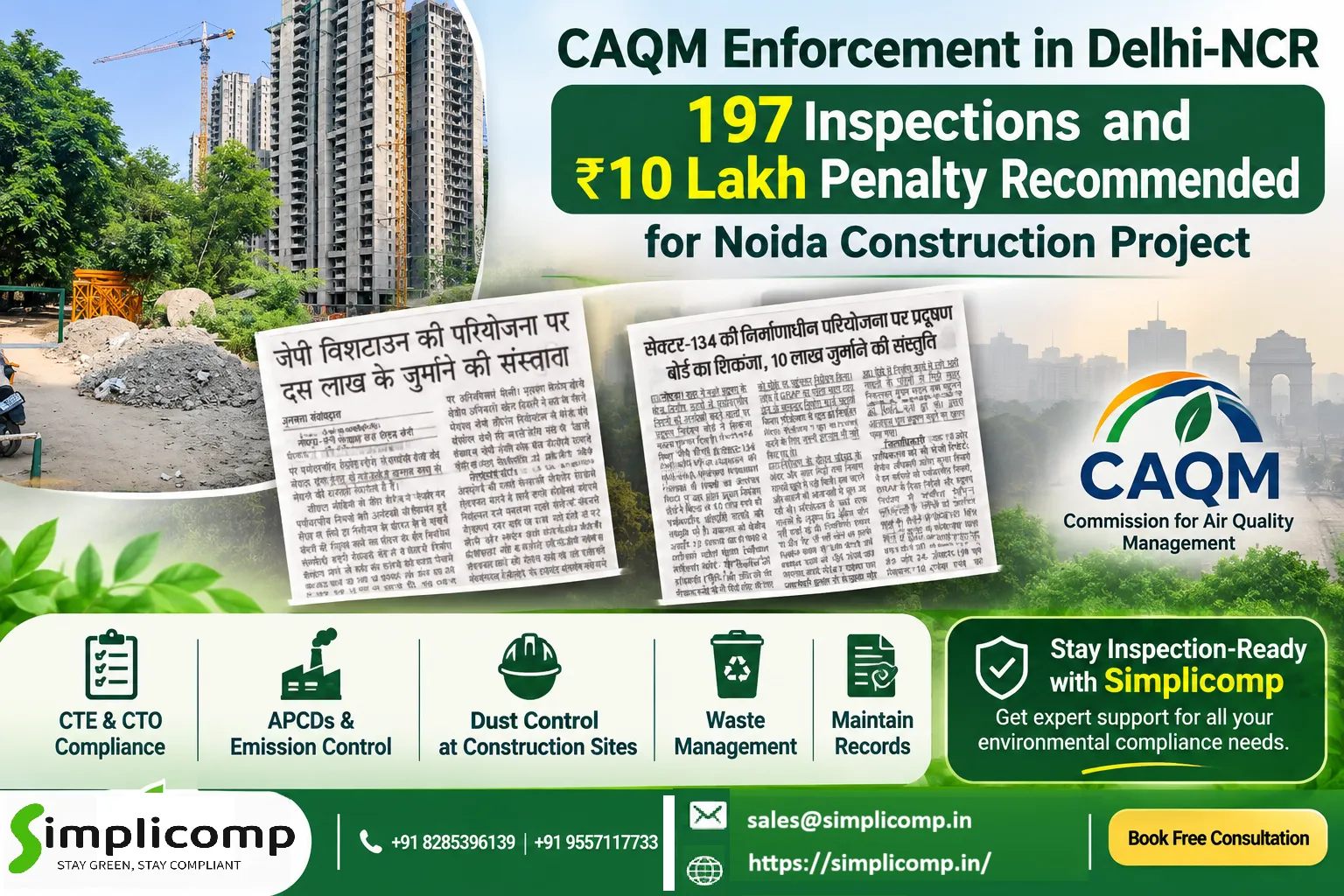
Recent developments highlight the importance of maintaining proper environmental approvals and pollution-control arrangements. According to a Commission for Air Quality Management (CAQM) update published on 2 October 2026, a total of 197 inspections were reported across the National Capital Region (NCR) during the period from 8 to 24 September 2026. Out of these, 111 inspections were conducted in the industrial sector.
Additionally, a newspaper report published in Jansatta on 30 October 2026 highlighted a recommendation for a ₹10 lakh penalty in connection with alleged environmental rule violations at a construction project in Noida.
These developments underline an important message for businesses and project developers: environmental compliance should not be treated as a formality. It requires valid approvals, functioning pollution-control equipment, proper documentation and regular monitoring.
CAQM Reports 197 Inspections Across NCR
The CAQM inspection update published on 2 October 2026 reported 197 inspections across NCR between 8 and 24 September 2026.
The industrial sector accounted for 111 of these inspections, highlighting the importance of industrial pollution monitoring and compliance verification.
Industrial establishments may need to demonstrate compliance with applicable environmental requirements, including:
- Valid Consent to Establish (CTE) and Consent to Operate (CTO), wherever applicable.
- Proper installation and operation of Air Pollution Control Devices (APCDs).
- Compliance with applicable emission standards.
- Use of approved or permitted fuels.
- Proper operation and maintenance of industrial equipment.
- Compliance with applicable CAQM directions.
- Maintenance of environmental monitoring and operational records.
An inspection is not limited to checking whether an approval document exists. Authorities may also examine whether the facility is following the conditions mentioned in its approvals and applicable pollution-control directions.
For industries, this makes regular compliance reviews particularly important. Businesses can refer to our Environmental Compliance Checklist for Industries to understand important areas that should be reviewed.
10 Lakh Penalty Recommendation Highlighted in Noida Construction Case
A Jansatta newspaper report dated 30 October 2026 highlighted a recommendation for a ₹10 lakh penalty in connection with alleged environmental rule violations at a construction project in Noida.
The reported development brings attention to the environmental responsibilities of construction and infrastructure projects operating in Delhi-NCR.
Construction activities can contribute to air pollution through dust generated during excavation, demolition, material handling, transportation and other site operations. If dust-control arrangements are inadequate or applicable environmental directions are not followed, a project may face regulatory scrutiny.
It is important to understand that a penalty recommendation is not necessarily the same as a final penalty order. The exact allegations, findings and final regulatory outcome should be understood from the complete newspaper report and the relevant official order, where available.
Nevertheless, the report serves as a reminder that construction companies should review their environmental compliance arrangements instead of waiting for an inspection or notice.
Why Environmental Compliance Is Important for Industries
Industrial operations can generate air emissions, wastewater, hazardous waste and other environmental impacts. The applicable approvals and compliance requirements depend on the type of industry, its processes, pollution potential, location and relevant regulatory provisions.
Businesses should not assume that obtaining one approval automatically covers every environmental requirement.
The following areas deserve regular attention.
1. Consent to Establish (CTE) and Consent to Operate (CTO)
Consent to Establish and Consent to Operate are important approvals issued by the concerned State Pollution Control Board or Pollution Control Committee, as applicable.
- CTE: Generally required before establishing or undertaking activities covered by the applicable consent provisions.
- CTO: Generally required before starting operations covered by the applicable consent provisions.
Industries should verify the validity of their consents, approved production capacity, permitted processes, fuel details and other conditions.
If an industry changes its production capacity, manufacturing process, fuel or other relevant operational details, it should assess whether an amendment or fresh approval is required.
Operating without the applicable consent or violating consent conditions may result in regulatory action.
For a better understanding, read our guides on Consent to Establish (CTE) Process, Consent to Operate (CTO) Explained and Difference Between CTE and CTO.
2. Air Pollution Control Devices (APCDs)
Industries must identify and operate suitable air pollution-control systems according to their processes and applicable regulatory requirements.
Depending on the nature of operations, pollution-control arrangements may include:
- Dust collectors and bag filters.
- Scrubbers.
- Fume extraction systems.
- Cyclone separators.
- Adequate ventilation and exhaust arrangements.
- Other process-specific emission-control equipment.
Merely installing an APCD does not establish compliance. Equipment should be properly operated and maintained, and relevant records should be available.
3. Approved Fuel and Emission Standards
Industrial units should verify whether the fuel used in their operations is permitted under the applicable directions and regulations.
They should also review applicable emission standards and ensure that their equipment and processes comply with the requirements relevant to their industry.
Using an unapproved fuel or failing to meet applicable emission standards can create compliance risks.
4. DG Set Compliance
Diesel Generator (DG) sets are another important area of environmental compliance.
Industries and commercial establishments should check the applicable emission requirements, capacity-related conditions and restrictions governing DG set operations.
Depending on the applicable directions, requirements may relate to emission-control systems, dual-fuel arrangements, permitted fuels and emergency-use conditions.
Businesses should verify the requirements applicable to their specific DG set instead of assuming that the same conditions apply to every capacity and installation.
5. Environmental Documentation and Monitoring Records
Documentation is an essential part of environmental compliance. During an inspection, an establishment may need to demonstrate that it has obtained the necessary approvals and is following the relevant conditions.
Businesses should maintain applicable records, such as:
- Valid CTE and CTO documents.
- Environmental permissions and approvals.
- Pollution-control equipment operation and maintenance records.
- Applicable emission and wastewater monitoring reports.
- Waste generation, storage and disposal records.
- DG set details and maintenance records.
- Compliance reports and relevant regulatory correspondence.
The exact documentation requirements depend on the type of establishment and applicable approvals.
Businesses can also refer to our OCEMS Compliance Guide for information on online monitoring-related compliance.
Construction Projects Must Pay Attention to Dust-Control Measures
Construction and demolition activities can generate substantial dust if appropriate control measures are not implemented.
Project developers, builders and contractors operating in Delhi-NCR should review the environmental directions applicable to their projects and ensure that dust-control measures are implemented at the site.
Important areas to review include:
Dust Suppression at Construction Sites
- Regular water sprinkling or other suitable dust-suppression arrangements.
- Appropriate covering of construction materials.
- Proper storage and handling of sand, soil and other dust-generating materials.
- Covering vehicles transporting construction materials and waste.
- Maintaining site cleanliness and preventing dust from spreading beyond project boundaries.
- Appropriate dust-control arrangements during excavation and demolition.
Construction and Demolition Waste Management
Construction and demolition waste should be collected, handled, transported and disposed of through the applicable authorised arrangements.
Project developers should avoid dumping debris on roads, vacant plots or other unauthorised locations. They should also maintain relevant waste-management records wherever required.
Compliance with CAQM Directions and GRAP Restrictions
Construction projects in Delhi-NCR should regularly review applicable CAQM directions and restrictions under the Graded Response Action Plan (GRAP).
Restrictions may vary according to the prevailing GRAP stage and the specific directions issued by the competent authorities. Project developers should therefore verify which measures apply to their location and project activities.
What Should Industries and Project Developers Review Before an Inspection?
The CAQM inspection update and the Noida construction-related report make it important for businesses to conduct an internal compliance review.
The following checklist can help identify common areas requiring attention.
| Compliance area | What to review |
|---|---|
| CTE and CTO | Validity, approved activities and consent conditions |
| APCDs | Installation, operation and maintenance |
| Fuel compliance | Permitted fuel and applicable requirements |
| Emission standards | Compliance with applicable limits |
| DG sets | Capacity-related requirements and emission-control arrangements |
| Construction dust | Dust suppression and material covering |
| Waste management | Collection, storage and authorised disposal |
| CAQM directions | Compliance with applicable directions and GRAP restrictions |
| Documentation | Approvals, monitoring reports and maintenance records |
This checklist is a general compliance guide. The actual requirements may differ depending on the industry, project category, location and applicable regulatory framework.
Possible Consequences of Environmental Non-Compliance
Environmental non-compliance can create operational, financial and regulatory challenges for businesses.
Depending on the applicable law, the nature of the violation and the findings of the competent authority, possible consequences may include:
- Regulatory notices and directions.
- Environmental compensation or financial penalties, wherever applicable.
- Directions to improve or install pollution-control systems.
- Restrictions on specific activities.
- Closure or stoppage directions in applicable cases.
- Additional monitoring and compliance requirements.
- Delays in project execution or business operations.
Not every violation automatically results in closure or a financial penalty. The action taken depends on the applicable provisions, facts of the case and decision of the competent authority.
However, maintaining proper approvals and operational compliance can help businesses reduce avoidable regulatory risks. Read more about Environmental Audit and Environmental Compensation to understand these compliance-related areas.
How Simplicomp Can Help with Environmental Compliance
Managing environmental approvals, documentation and regulatory requirements can be challenging, particularly for industries and construction projects dealing with multiple compliance obligations.
Simplicomp provides a one-window solution for environmental compliance requirements, helping businesses manage approval-related processes and address compliance challenges.
Our consultancy support includes:
- Consent to Establish (CTE) assistance.
- Consent to Operate (CTO) assistance.
- Environmental documentation and application support.
- Regulatory registrations and approvals.
- Assistance with applicable pollution-control compliance requirements.
- Guidance on environmental compliance-related queries.
- Support in managing approval processes and regulatory documentation.
Simplicomp works with businesses to understand their applicable requirements and provide support throughout the relevant compliance process.
Whether you are establishing a new industrial unit, operating an existing factory or managing a construction project, reviewing your environmental compliance in advance can help you prepare for regulatory inspections.
Conclusion
The report of 197 inspections across NCR, including 111 industrial-sector inspections, along with the Jansatta report highlighting a ₹10 lakh penalty recommendation in a Noida construction case, reinforces the importance of environmental compliance for industries and project developers.
Businesses should not wait for a regulatory inspection to identify gaps in their approvals, pollution-control systems or documentation. Regular compliance reviews, proper maintenance of pollution-control equipment and timely attention to applicable CAQM directions can help reduce regulatory risks.
Related Guides & Resources
- CAQM Grap Guidelines 2026 Delhi NCR →
- CAQM Stage-1 Grap Delhi NCR →
- Environmental Approvals Checklist Manufacturing Plant India →
- CPCB Industry Categorization Guide →
Need Help with CAQM Closure Compliance?
Simplicomp provides support for:
- CAQM Closure Notice & Direction Review
- Environmental Compliance Gap Assessment
- Corrective & Preventive Action Plan
- Dust, Air Pollution & Environmental Compensation Compliance
- Documentation, Verification & Resumption Support