
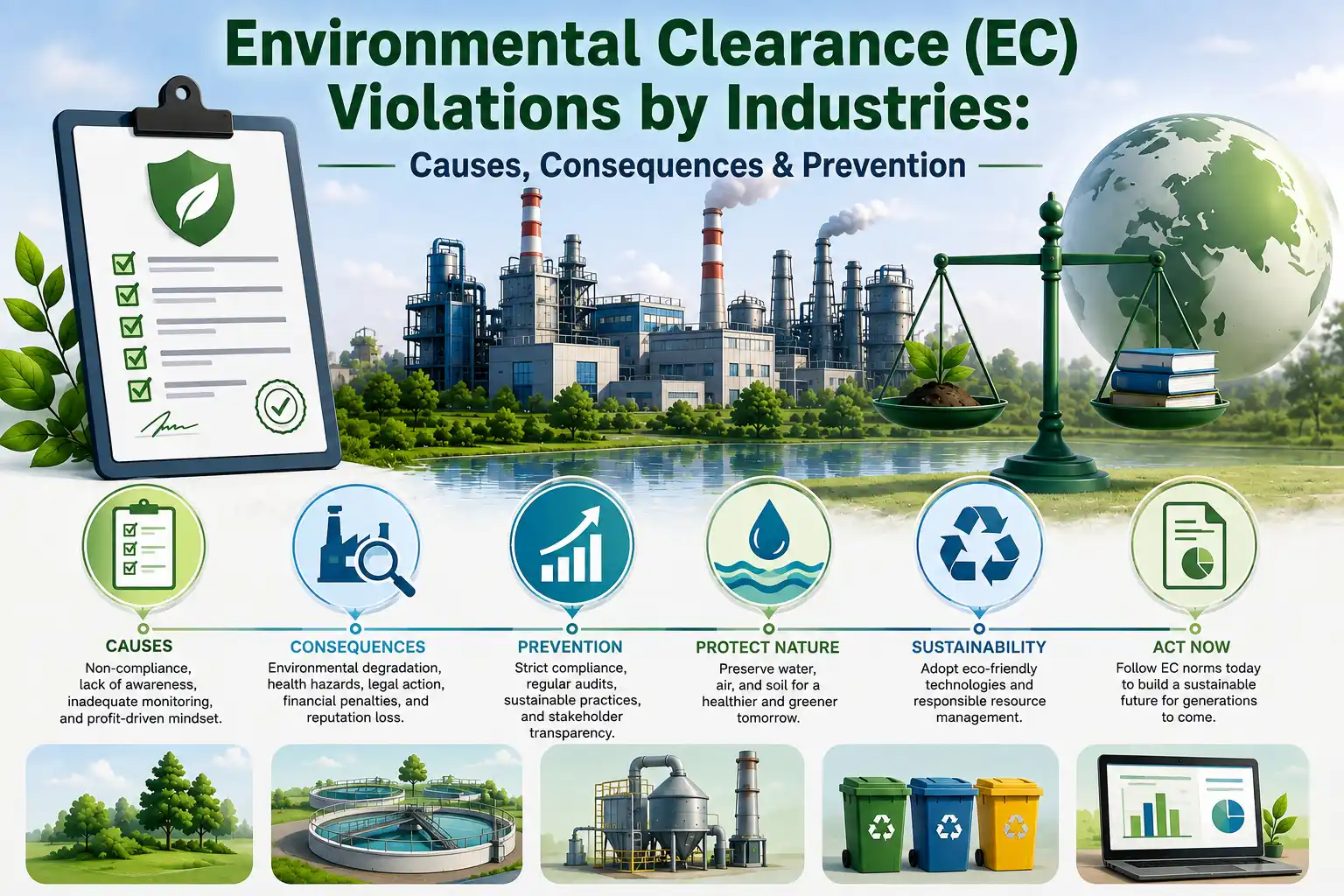
Environmental Clearance (EC) Violations by Industries and How to Avoid Them
Environmental Clearance (EC) is an important regulatory requirement for projects and activities covered under the applicable environmental clearance framework in India. It is intended to ensure that projects with potential environmental impacts are assessed and appropriate environmental safeguards are incorporated before implementation.
For industries, obtaining Environmental Clearance is only the beginning of their environmental regulatory responsibilities. Once EC is granted, the project proponent is required to comply with the conditions, safeguards and commitments specified in the approval.
Failure to follow these conditions or undertaking activities without the required prior approval can result in an Environmental Clearance violation.
EC violations can create significant regulatory, financial and operational risks for industries. Depending on the nature and seriousness of the violation, authorities may require corrective measures, environmental compensation, remediation, additional compliance or other regulatory action.
For this reason, industries should establish a system for continuously monitoring their EC conditions rather than checking compliance only when an inspection or expansion is planned.
This guide explains common EC violations by industries, their consequences, voluntary disclosure, corrective measures and practical ways to prevent environmental clearance violations.
What Is an EC Violation?
An EC violation occurs when a project or industry fails to comply with the applicable Environmental Clearance requirements or undertakes an activity in a manner that is not permitted under the granted EC or applicable environmental regulations.
The violation can relate to:
- Starting a project without obtaining required prior EC
- Exceeding the production capacity approved in the EC
- Changing project configuration without required approval
- Expanding production without obtaining applicable environmental approval
- Failing to implement EC conditions
- Constructing or operating beyond the approved project scope
- Failing to submit applicable compliance reports
- Not implementing prescribed environmental safeguards
- Continuing activities after expiry or without required renewal/approval
- Providing inconsistent or incorrect information to regulatory authorities
The exact nature and consequences of a violation depend on the facts of the individual project and the applicable regulatory framework.
Common EC Violations by Industries
Industries can violate EC conditions in several ways. Some violations occur intentionally, while others result from poor internal compliance management.
1. Starting Construction Without Prior EC
One of the major environmental violations is starting activities that require prior Environmental Clearance before obtaining the required approval.
An industry may begin:
- Construction
- Civil work
- Installation
- Expansion
- Project development
without first confirming EC applicability.
Where prior EC is mandatory, such action can expose the project to regulatory proceedings.
How to Avoid It
Before beginning project implementation:
- Assess EC applicability
- Review the EIA Notification and applicable amendments
- Determine the project category
- Obtain the required EC before undertaking activities covered by the requirement
Operating Beyond the Approved Production Capacity
Another common issue occurs when an industry produces more than the capacity approved under its Environmental Clearance.
For example, if an EC permits a particular production capacity and the industry increases production beyond the approved limit without obtaining the required approval, it may create a compliance issue.
This can happen because of:
- Increased market demand
- Additional production shifts
- Improved machinery efficiency
- Product diversification
- Increased utilization of existing equipment
How to Avoid It
Maintain a monthly comparison of:
This simple internal monitoring system can help identify capacity-related deviations early.
Expansion Without Required Environmental Approval
Industries sometimes expand their operations without first determining whether the proposed expansion requires an amendment, fresh EC or another regulatory approval.
Expansion may involve:
- Additional production
- New manufacturing lines
- Additional equipment
- New products
- Plant-area expansion
- Process modifications
- Additional raw materials
Before implementing any major change, the existing EC should be reviewed.
4. Changes in Project Configuration
An industry may modify its project configuration after receiving EC.
For example, changes could involve:
- Manufacturing Process
- Production Units
- Equipment
- Raw Materials
- Product Mix
- Plant Layout
- Pollution-Control Systems
Not every change automatically constitutes a violation, but significant deviations from the approved project should be evaluated against the applicable regulatory requirements before implementation.
5. Failure to Implement EC Conditions
Environmental Clearance normally comes with specific conditions that the project proponent must follow.
These may relate to:
- Air Pollution Control
- Water Management
- Waste Management
- Greenbelt Development
- Environmental Monitoring
- Energy Conservation
- Hazardous Waste Management
- Effluent Treatment
- Emission Monitoring
- Environmental Reporting
Failure to implement these conditions can result in non-compliance.
How to Avoid It
Prepare an EC Condition Compliance Matrix containing:
| EC Condition | Required Action | Responsible Person | Status | Evidence |
|---|---|---|---|---|
| Environmental monitoring | Conduct prescribed monitoring | EHS Team | Completed | Monitoring Report |
| Waste management | Maintain authorized disposal | EHS Team | Ongoing | Records |
| Greenbelt | Maintain plantation | Project Team | Ongoing | Photographs |
| Compliance reporting | Submit report | Compliance Team | Scheduled | Submission proof |
This allows the industry to track each condition systematically.
6. Failure to Submit EC Compliance Reports
Environmental compliance does not end after receiving EC.
Where periodic compliance reporting is applicable, the project must submit the required reports within the prescribed timelines.
These reports can include information regarding:
- Status of EC Conditions
- Environmental Monitoring
- Waste Management
- Water Consumption
- Pollution-Control Systems
- Greenbelt
- Environmental Safeguards
Missing or delayed reports can create unnecessary compliance risks.
7. Environmental Monitoring Gaps
Some EC conditions require environmental monitoring at specified intervals.
Industries may need to monitor parameters related to:
- Ambient Air
- Stack Emissions
- Water Quality
- Effluent
- Groundwater
- Noise
- Other Project-Specific Environmental Parameters
Failure to conduct required monitoring or maintain proper records can make it difficult to demonstrate compliance.
8. Pollution-Control Equipment Not Operating Properly
An industry may have an ETP, STP, scrubber, bag filter, ESP or other pollution-control equipment installed but fail to operate or maintain it effectively.
Having equipment installed is not enough.
The system should be:
- Properly Designed
- Operational
- Maintained
- Monitored
- Supported by Relevant Records
Poor operation of pollution-control systems can result in non-compliance with EC as well as pollution-control requirements.
EC Violation Due to Expired Approval
Another issue can arise when project activities continue without verifying the validity or status of the applicable environmental approval.
Industries should maintain an approval calendar covering:
- Environmental Clearance
- Consent to Establish
- Consent to Operate
- Waste Authorizations
- Groundwater Approvals
- Other Environmental Permissions
The expiry dates and renewal requirements should be monitored well in advance.
Why Do EC Violations Happen?
EC violations do not always happen because an industry deliberately ignores environmental regulations.
Common reasons include:
Lack of Internal Compliance Monitoring
The industry may not have a dedicated system for tracking EC conditions.
Poor Communication Between Departments
Production, engineering, projects and EHS teams may make changes without informing the environmental compliance team.
Unplanned Production Increase
Higher demand can lead to production exceeding approved capacity.
Changes in Machinery
Engineering teams may install new machinery without checking its environmental approval implications.
Inadequate Documentation
The project may actually be implementing some environmental measures but fail to maintain documentary evidence.
Failure to Track Regulatory Updates
Environmental regulations and procedures can change, making regular compliance review important.
Consequences of EC Violations
The consequences of an EC violation depend on the nature, extent and circumstances of the violation.
Possible regulatory consequences can include:
- Notices from Regulatory Authorities
- Directions for Corrective Action
- Environmental Compensation
- Remediation Requirements
- Additional Compliance Conditions
- Restrictions on Activities
- Legal Proceedings
- Financial Losses
- Project Delays
- Operational Disruption
- Potential Closure-Related Action in Serious Cases
Therefore, EC violations should be addressed as soon as they are identified.
What Should an Industry Do After Discovering an EC Violation?
Ignoring an identified violation can make the situation more difficult.
An industry should first conduct an internal assessment to understand:
- What condition was violated?
- When did the deviation begin?
- Is the violation continuing?
- What is the extent of the deviation?
- What environmental impact may have occurred?
- What corrective action is possible?
- What regulatory approval or disclosure may be required?
The response should be based on the specific facts of the project and applicable regulatory provisions.
Voluntary Disclosure of EC Violation
Where an industry identifies a potential EC violation, it may need to consider the applicable regulatory mechanism for disclosure and regularization.
The source material highlights the concept of voluntary declaration of EC violation for projects that have undertaken activities without the required EC.
However, industries should not assume that simply filing a voluntary declaration automatically resolves the violation.
The applicable process, eligibility, remediation requirements, environmental compensation and regulatory pathway depend on the prevailing legal framework and the project's specific circumstances.
Professional environmental and legal assessment can therefore be important before making a submission.
EC Violation Assessment
Before approaching the authority, the project should conduct a detailed violation assessment.
The assessment can cover:
Project History
When was the project established?
Existing EC
What capacity and activities are covered by the EC?
Actual Development
What construction and operational activities were actually undertaken?
Production
What has been the actual production compared with the approved capacity?
Environmental Compliance
Which EC conditions have been implemented?
Monitoring Records
Are environmental monitoring reports available?
Pollution Control
Are pollution-control systems operational?
Regulatory Approvals
Are CTE, CTO and other approvals valid and consistent with the project?
This assessment provides a clearer picture of the compliance status.
Remediation and Environmental Management
Where environmental damage or non-compliance has occurred, the applicable regulatory process may require corrective or remediation measures.
Depending on the project and regulatory direction, measures may relate to:
- Ecological Restoration
- Pollution Control
- Water-Resource Protection
- Waste Management
- Community-Related Measures
- Natural Resource Augmentation
- Environmental Monitoring
The remediation plan should be based on the actual environmental impacts and applicable regulatory requirements.
The assessment can depend on factors such as:
- Nature of Violation
- Duration
- Project Cost
- Environmental Impact
- Production/Operations
- Pollution Potential
- Extent of Non-Compliance
- Regulatory Directions
Because the applicable methodology can change through regulations, orders and directions, industries should obtain a project-specific assessment rather than relying on a fixed percentage from an old article or secondary source.
Can an EC Violation Affect Future Expansion?
Yes, an existing compliance issue can become important when an industry plans:
- Capacity Expansion
- New Product Addition
- Plant Modification
- New Manufacturing Line
- Additional Machinery
- Project Investment
During the review of an expansion proposal, the existing environmental compliance status may become relevant.
Therefore, industries should ideally resolve or regularize known compliance issues before planning major expansion.
EC Compliance for Existing Industries
Industries should establish a structured EC compliance system.
A practical system can include:
EC Register
Maintain a master copy of all EC approvals.
Condition Matrix
List every EC condition and its compliance status.
Monitoring Calendar
Track all environmental monitoring requirements.
Reporting Calendar
Record deadlines for applicable compliance reports.
Production Monitoring
Compare actual production with EC-approved capacity.
Change Management
Require EHS review before implementing:
- New Machinery
- New Products
- Process Changes
- Capacity Increases
- Plant Modifications
Document Management
Maintain evidence of:
- Monitoring
- Waste Disposal
- Pollution-Control Maintenance
- Greenbelt
- Water Consumption
- Compliance Reports
EC Violation Prevention Checklist
Industries can use the following checklist to reduce the risk of EC violations:
- Maintain Valid Environmental Clearance
- Review All EC Conditions
- Maintain EC Compliance Matrix
- Monitor Production Against Approved Capacity
- Check Proposed Modifications Before Implementation
- Monitor Environmental Parameters
- Operate Pollution-Control Equipment Effectively
- Maintain Waste-Management Records
- Maintain Water-Consumption Records
- Maintain Environmental Monitoring Reports
- Submit Applicable Compliance Reports on Time
- Track EC and Consent Validity
- Conduct Periodic Internal Environmental Audits
- Train Relevant Employees
- Obtain Regulatory Advice Before Major Expansion
How to Avoid Environmental Clearance Violations?
The best approach is preventive environmental compliance.
Instead of waiting for an inspection, industries should conduct periodic internal reviews.
A strong compliance system should cover four stages:
Stage 1: Approval Review
Understand exactly what the EC permits.
Stage 2: Implementation
Ensure the project is developed according to the approved proposal.
Stage 3: Monitoring
Track production, emissions, wastewater, waste and other relevant environmental parameters.
Stage 4: Reporting
Maintain and submit applicable compliance reports within the prescribed timelines.
This approach helps identify deviations before they become major regulatory issues.
Role of an Environmental Consultant in EC Compliance
Environmental consultants can assist industries in identifying and managing potential EC compliance issues.
Their role may include:
- EC Applicability Review
- Existing EC Assessment
- EC Condition Mapping
- Compliance Audit
- Production-Capacity Assessment
- Environmental Monitoring Review
- Compliance Documentation
- Violation Assessment
- Remediation Planning
- Regulatory Documentation
- Expansion Compliance Assessment
- Post-EC Compliance Support
An independent compliance review can be particularly useful before an industry applies for expansion.
How SimpliComp Helps Industries With EC Compliance
SimpliComp Tech LLP provides environmental consultancy and regulatory compliance support for industries and development projects.
Our EC compliance support can include:
EC Compliance Audit
We review the existing Environmental Clearance and compare its conditions with the actual project status.
EC Condition Compliance Matrix
We help organize EC conditions into a structured monitoring and compliance framework.
Production Capacity Review
We can help compare approved and actual production capacities to identify potential deviations.
Environmental Compliance Documentation
We assist with organizing environmental monitoring and compliance records.
Violation Assessment
Where a potential violation is identified, we can help assess the project's regulatory position and identify the documentation and corrective actions that may be required.
Expansion Compliance Review
Before an industry expands production, we can review existing EC conditions and identify potential environmental approval requirements.
Why Choose SimpliComp for EC Compliance?
EC compliance requires continuous monitoring rather than a one-time approval.
SimpliComp focuses on helping industries maintain compliance by reviewing:
- Existing EC Conditions
- Approved Production Capacity
- Actual Production
- Project Configuration
- Environmental Monitoring
- Pollution-Control Systems
- Waste Management
- Water Management
- Reporting Requirements
- Proposed Changes and Expansion Plans
This structured approach can help industries identify potential compliance gaps at an early stage.
EC Violation vs EC Non-Compliance
The terms violation and non-compliance are sometimes used interchangeably, but industries should understand that the seriousness of an issue can depend on its nature and regulatory context.
For example:
Non-compliance may refer to failure to meet a particular environmental condition.
Violation may involve a more significant departure from an applicable approval or regulatory requirement, such as undertaking activities without required prior EC.
The regulatory consequences depend on the facts and applicable law.
EC Compliance Before Industrial Expansion
Before increasing production capacity, an industry should conduct an environmental approval review.
The review should ask:
- What Is the Existing EC Capacity?
- What Is the Proposed Capacity?
- Will Pollution Load Increase?
- Will New Machinery Be Installed?
- Will the Manufacturing Process Change?
- Will Raw Materials Change?
- Will Product Mix Change?
- Will Additional Wastewater Be Generated?
- Will Emissions Increase?
- Will Additional Waste Be Generated?
- Is an EC Amendment or Expansion Approval Required?
- Is CTE/CTO Amendment Required?
This assessment can prevent an expansion from inadvertently creating an EC violation.
Benefits of Regular EC Compliance Audits
Periodic environmental compliance audits can help industries:
- Identify Gaps Early
- Reduce Regulatory Risks
- Maintain Proper Records
- Improve Environmental Performance
- Prepare for Inspections
- Support Future Expansion
- Improve Internal Accountability
- Avoid Unexpected Compliance Issues
For industries with multiple EC conditions, a periodic audit can be particularly valuable.
Conclusion
Environmental Clearance compliance is an ongoing responsibility for industries. Obtaining EC does not mean that the environmental approval process ends. The project must continue to operate within the approved conditions and comply with applicable environmental safeguards.
Common issues such as starting activities without prior EC, exceeding approved production capacity, undertaking unauthorized expansion, modifying the project without required approval and failing to implement EC conditions can create significant regulatory risks.
The best way to avoid such problems is to establish a proactive EC compliance management system.
Industries should regularly review their EC conditions, monitor production and environmental performance, maintain supporting records and consult environmental professionals before making significant changes to the project.
If a potential violation has already occurred, ignoring it can increase the risk. The project should be assessed carefully and the appropriate regulatory pathway should be determined based on the current legal framework and specific facts.
SimpliComp Tech LLP provides Environmental Clearance consultancy, EC compliance audits, environmental documentation, regulatory support and post-EC compliance services for industries across India.
Related Guides & Resources
- Factory Setup Environmental Approvals NCR →
- Pollution Control Compliance →
- Consent to Establish (CTE) →
- Environmental Compliance Checklist →
- Environmental Compliance Document Checklist →
Need Help with CPCB Categorization & Pollution Board Approvals?
Simplicomp provides support for:
- CPCB categorization assessment
- CTE & CTO approvals
- Pollution Board NOC applications
- Environmental compliance audits
- Hazardous waste compliance
- Industrial compliance management