

Introduction
The growth of apartments, group housing projects and residential townships has increased the amount of domestic wastewater generated every day. Managing this wastewater properly is an important part of environmental protection as well as residential project compliance.
A housing society cannot treat sewage management as simply a plumbing or maintenance issue. The collection, treatment, reuse and disposal of wastewater need to be planned according to the applicable environmental regulations, local development requirements and approval conditions of the project.
A properly functioning Sewage Treatment Plant (STP) can convert domestic wastewater into treated water suitable for permitted non-potable applications, subject to the required quality standards.
However, installing an STP alone does not guarantee compliance. Its capacity should correspond with the actual sewage load, treatment units should work efficiently, treated water should be monitored and the entire system should be maintained with proper records.
This article explains the important aspects of STP compliance for housing societies in India, including consent requirements, treatment, monitoring, treated-water reuse, maintenance and common problems.
Why Sewage Management Matters in Residential Projects
Every residential complex generates wastewater from activities such as bathing, washing, toilet use, cleaning and other domestic requirements.
If this wastewater is released without adequate treatment, it can contribute to:
- Water pollution
- Unpleasant odour
- Groundwater contamination
- Public health concerns
- Degradation of nearby water bodies
- Unsanitary surroundings
An effective sewage-treatment system helps reduce these risks before the wastewater is reused or disposed of through an approved route.
For this reason, sewage management should ideally be considered while the residential project is being planned rather than after the society becomes operational.
When Does a Housing Project Need an STP?
There is no single STP capacity or requirement that can automatically be applied to every housing society.
The requirement may depend upon several project-specific factors, including:
- Number of residents
- Number of dwelling units
- Built-up area
- Estimated sewage generation
- Project location
- Development authority requirements
- Environmental Clearance conditions
- State Pollution Control Board requirements
- Applicable local regulations
Large residential developments may have specific requirements for installing and operating an STP.
Therefore, before deciding whether an STP is required, the project should be evaluated against the applicable state and local regulatory framework.
Legal Framework for Sewage Treatment
Sewage and wastewater management in India is linked with environmental laws and regulatory standards.
The Water (Prevention and Control of Pollution) Act, 1974 provides an important legal framework for controlling water pollution, while the Environment (Protection) Act, 1986 provides the broader framework for environmental standards and protection.
The concerned State Pollution Control Board (SPCB) may prescribe requirements relating to sewage discharge, consent, treated-water quality and environmental monitoring.
In addition, development authorities may impose STP-related conditions while approving large residential developments.
This means that an RWA or developer should consider both environmental regulations and project-specific approval conditions.
STP Planning Starts With a Correct Water Balance
One of the most important steps in designing a sewage treatment system is understanding the project's water requirement.
The project should assess:
Freshwater requirement → wastewater generation → STP capacity → treated-water quantity → reuse/disposal
A detailed Industrial Water Balance Study can help explain how water consumption, wastewater generation, treatment capacity and reuse requirements are connected.
If the sewage generation estimate is inaccurate, the STP may be:
- Undersized
- Oversized
- Frequently overloaded
- Operating below its ideal treatment conditions
A proper water balance therefore helps in selecting a more suitable STP capacity and developing an effective treated-water reuse strategy.
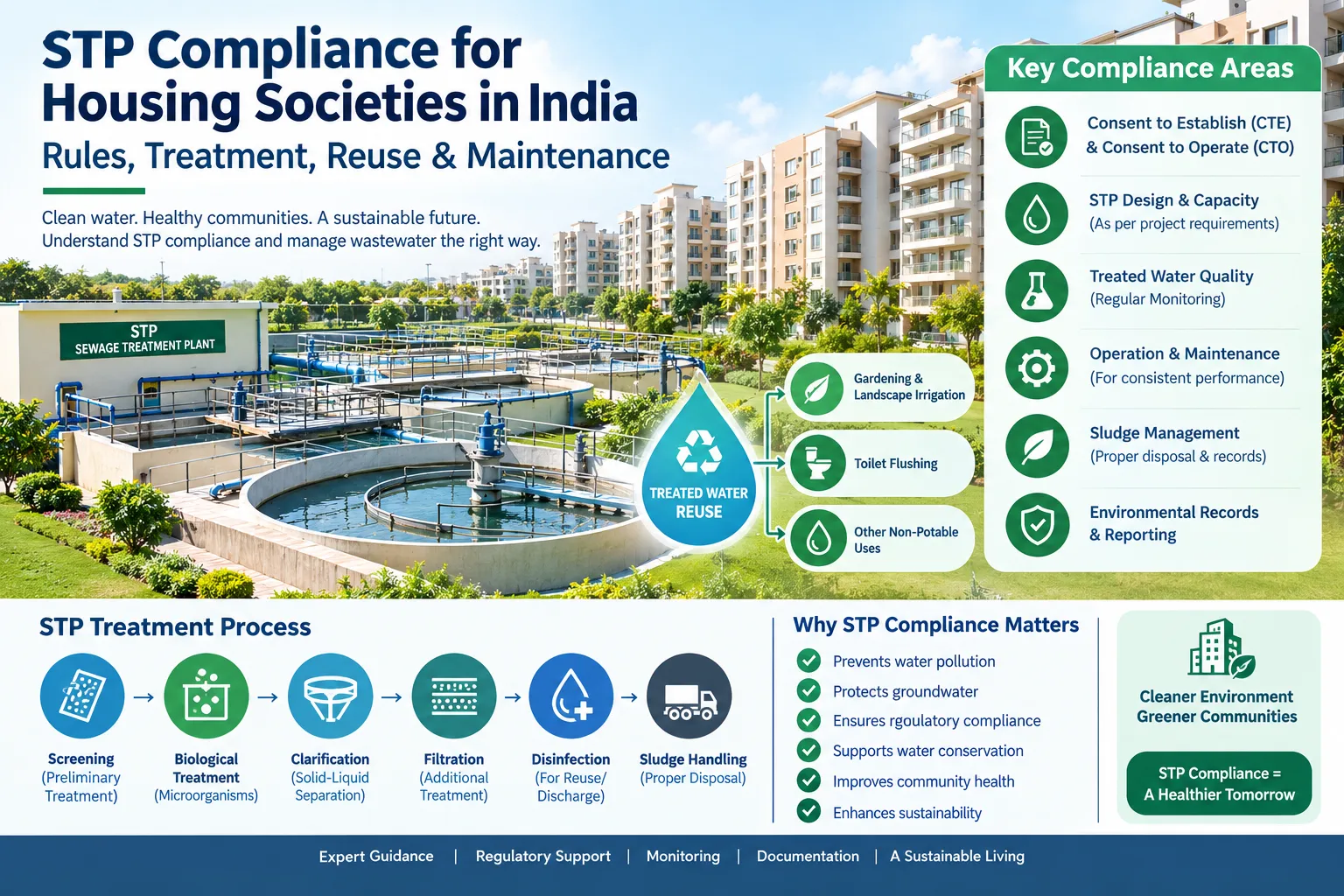
What Happens Inside a Sewage Treatment Plant?
An STP generally uses a combination of physical, biological and disinfection processes.
The exact configuration depends on the selected technology and project requirements.
Preliminary Treatment
Incoming sewage first passes through screening and related processes to remove larger materials.
Biological Treatment
Microorganisms are used to reduce biodegradable organic matter present in the wastewater.
Solid-Liquid Separation
The biological solids are separated from the treated water through appropriate clarification processes.
Further Treatment
Where required, additional filtration or tertiary treatment can be incorporated to achieve the quality needed for the intended reuse or discharge.
Disinfection
Disinfection may be provided to reduce microbial contamination before treated water is reused or discharged.
Sludge Handling
The solids separated during treatment need to be periodically removed and managed through an appropriate route.
What Should Be Checked in STP Treated Water?
The performance of an STP should be evaluated through appropriate water-quality testing.
Depending on the applicable requirement, parameters may include:
- pH
- BOD
- COD
- Total Suspended Solids
- Oil and Grease
- Nitrogen
- Phosphorus
- Fecal Coliform
- Other parameters specified by the applicable authority
For a detailed explanation of important wastewater parameters and ETP performance, see BOD, COD, TDS & TSS in Wastewater
There is an important point here:
The required quality is not necessarily identical for every reuse or discharge situation.
The applicable limit may depend on where the treated water is being discharged or how it is being reused.
Therefore, a society should follow the standards and conditions applicable to its particular project instead of relying on a generic internet checklist.
Can Housing Societies Reuse Treated Wastewater?
Yes, treated wastewater can be reused for suitable non-potable applications, provided the required quality is achieved.
Common examples include:
Landscape Irrigation
Treated water may be used for maintaining gardens and landscaped areas when appropriate.
Toilet Flushing
Residential complexes can use properly treated and disinfected water for flushing systems.
Other Non-Potable Uses
Depending on the project and applicable requirements, treated water may also be considered for other non-potable applications.
Water reuse can reduce the demand for fresh water and lower the quantity of treated effluent requiring disposal.
Why Treated Water Reuse Is Beneficial
A residential society can potentially reduce its freshwater dependency by creating a planned reuse system.
Benefits may include:
- Better water conservation
- Lower freshwater requirement
- Reduced wastewater discharge
- More efficient water management
- Improved environmental performance
- Better utilization of treated wastewater
The reuse plan should, however, be based on actual water demand and the quality of treated water available.
Consent Requirements for Housing Society STPs
Depending on the applicable regulatory framework, a residential project may need to obtain relevant consent from the State Pollution Control Board.
Consent to Establish
Where applicable, Consent to Establish (CTE) is obtained before establishing a facility covered by the consent requirements.
For a broader understanding of the process, see Consent to Establish (CTE) for Industries in India.
Information may include:
- Project details
- Sewage generation
- Proposed STP capacity
- Treatment technology
- Layout
- Water requirement
- Disposal/reuse proposal
For supporting documentation, readers can also refer to Consent to Establish / Pollution Board NOC Documents Required in India.
Consent to Operate
After establishment, applicable projects may need Consent to Operate (CTO) before operation/discharge.
The requirements can vary between states and project types, so the exact consent pathway should be verified before application.
For information on maintaining consent compliance after approval, see the Consent to Operate (CTO) Renewal Process in India.
STP Operation Is as Important as Installation
One of the biggest mistakes made by housing societies is assuming that an STP is compliant simply because the equipment has been installed.
A plant can become ineffective because of:
- Poor operation
- Insufficient aeration
- Excess sludge
- Equipment failure
- Hydraulic overloading
- Improper chemical dosing
- Irregular maintenance
- Lack of trained operators
An STP needs regular attention throughout its operational life.
Important STP Maintenance Activities
The society's maintenance team should periodically inspect:
- Inlet screens
- Pumps
- Blowers
- Aeration system
- Clarifiers
- Filters
- Dosing equipment
- Disinfection system
- Sludge handling equipment
- Electrical panels
- Treated-water outlet
Preventive maintenance can help reduce unexpected breakdowns and treatment failures.
Common STP Problems in Residential Societies
1. Foul Smell From STP
Persistent odour may indicate inadequate aeration, sludge accumulation or other process problems.
2. Poor Outlet Water Quality
If treated water does not meet the applicable requirement, the treatment process needs to be investigated.
3. High Power Consumption
Poorly selected or improperly operated blowers and pumps can increase electricity consumption.
4. Excess Sludge
Irregular sludge removal can affect treatment performance.
5. Low or Uneven Sewage Flow
Actual sewage flow may be considerably different from the design assumptions.
6. Equipment Breakdown
Failure of pumps, blowers or other critical equipment can interrupt treatment.
How to Improve an Underperforming STP
When an STP is not performing properly, replacing the complete system may not always be the first solution.
A technical assessment can identify whether the problem is related to:
- Hydraulic loading
- Organic loading
- Aeration
- Sludge management
- Pumping
- Treatment configuration
- Chemical dosing
- Equipment condition
- Operator practices
Depending on the findings, corrective measures may include:
- Process optimization
- Equipment repair
- Aeration adjustment
- Sludge management improvement
- Load balancing
- Additional treatment
- STP augmentation
- Operational training
Importance of STP Monitoring
Regular monitoring helps determine whether the treatment plant is actually achieving the required performance.
The society should maintain appropriate records of:
- Treated-water test reports
- STP operating hours
- Pump operation
- Blower operation
- Maintenance work
- Sludge removal
- Water consumption
- Sewage generation
- Reuse quantity
- Disposal quantity
These records can be useful during internal reviews as well as regulatory inspections.
A broader Environmental Compliance Checklist for Industries in India can also help organize environmental records and compliance activities.
STP Sludge Should Not Be Ignored
Sewage treatment generates sludge that needs proper management.
Leaving excess sludge inside treatment tanks for long periods can affect the plant's efficiency.
The society should establish a routine for:
- Monitoring sludge accumulation
- Removing excess sludge
- Dewatering where required
- Temporary storage in an appropriate manner
- Transportation through an appropriate route
- Maintaining disposal records
The applicable disposal or reuse requirements should be followed based on the nature of the sludge and relevant regulations.
What Can Happen During a Regulatory Inspection?
During an environmental inspection, authorities may review more than just the physical STP.
They may examine:
- Whether the STP is operational
- Actual treatment capacity
- Treated-water quality
- Disposal/reuse arrangements
- Consent documents
- Environmental monitoring records
- Maintenance records
- Sludge management
- Compliance with approval conditions
Therefore, keeping the plant operational and maintaining documentation throughout the year is much better than preparing records only when an inspection is expected.
STP Compliance Checklist for RWAs
Housing societies can use the following basic checklist:
- STP requirement assessed
- Applicable permissions identified
- STP capacity verified
- Water balance prepared
- Sewage generation assessed
- STP operating properly
- Pumps maintained
- Blowers checked
- Sludge periodically removed
- Treated water tested
- Reuse system checked
- Disposal arrangement verified
- Maintenance records maintained
- Laboratory reports maintained
- Consent conditions reviewed
- Environmental compliance records updated
STP Compliance in Delhi NCR, Noida and Greater Noida
Residential projects in Delhi NCR, Noida, Greater Noida and Haryana may be subject to requirements from the concerned Pollution Control Board as well as local development authorities.
The exact requirements can differ depending on:
- Project location
- Project size
- Development approval
- Sewage generation
- Number of residents
- Environmental Clearance conditions
- Applicable state regulations
For this reason, a residential society should get its requirements assessed specifically for its location rather than applying rules from another state or city.
How SimpliComp Can Help With STP Compliance
SimpliComp provides environmental consultancy and compliance support for residential, commercial and industrial projects.
For housing societies, our support can cover:
STP Compliance Assessment
Reviewing the existing sewage treatment arrangement and identifying potential regulatory or operational gaps.
Consent & Regulatory Support
Assistance with applicable CTE/CTO and Pollution Control Board requirements, depending on the project.
Environmental Monitoring
Support for appropriate environmental monitoring and documentation.
STP Performance Review
Reviewing treatment capacity, operational practices, maintenance and treated-water management.
Treated Water Reuse Planning
Helping assess practical options for utilizing treated wastewater for suitable non-potable purposes.
Compliance Documentation
Assistance in maintaining environmental records, test reports and applicable compliance documentation.
Why Choose SimpliComp?
STP compliance requires coordination between technical treatment performance and environmental regulations.
SimpliComp's approach focuses on understanding the complete project rather than looking at the STP as an isolated piece of equipment.
We can help with:
- Environmental compliance assessment
- STP-related approvals
- Water management
- Sewage treatment planning
- Monitoring support
- Documentation
- Treated-water reuse
- Regulatory coordination
- Post-approval compliance
This approach helps housing societies identify potential issues before they turn into major compliance problems.
Conclusion
Effective sewage management is an important responsibility for large housing societies and residential developments. An STP should not be treated as a one-time installation project; it is an ongoing environmental management system.
From estimating sewage generation and selecting suitable treatment capacity to monitoring treated water, managing sludge and maintaining regulatory records, every stage contributes to successful STP compliance.
Societies that regularly monitor their STP can identify operational problems earlier, improve treated-water quality and make better use of recycled water.
SimpliComp Tech LLP supports residential projects and housing societies with environmental consultancy, STP compliance, consent-related assistance, environmental monitoring and regulatory documentation.
Related Guides & Resources
- STP VS ETP Difference →
- E Waste Recycling Plant Setup in India →
- Terms of Reference in EIA →
- 5 Reasons to Adopt Rainwater Harvesting →
- CPCB Industry Categorization Guide →
Need Help with STP, ETP & ZLD Compliance Services
Simplicomp assists industries with:
- Sewage Treatment Plant
- Domestic wastewater treatment
- BOD & COD reduction
- Industrial wastewater treatment
- Removal of pollutants & chemicals
- Treated effluent disposal/reuse
- Treated water reuse