

Introduction
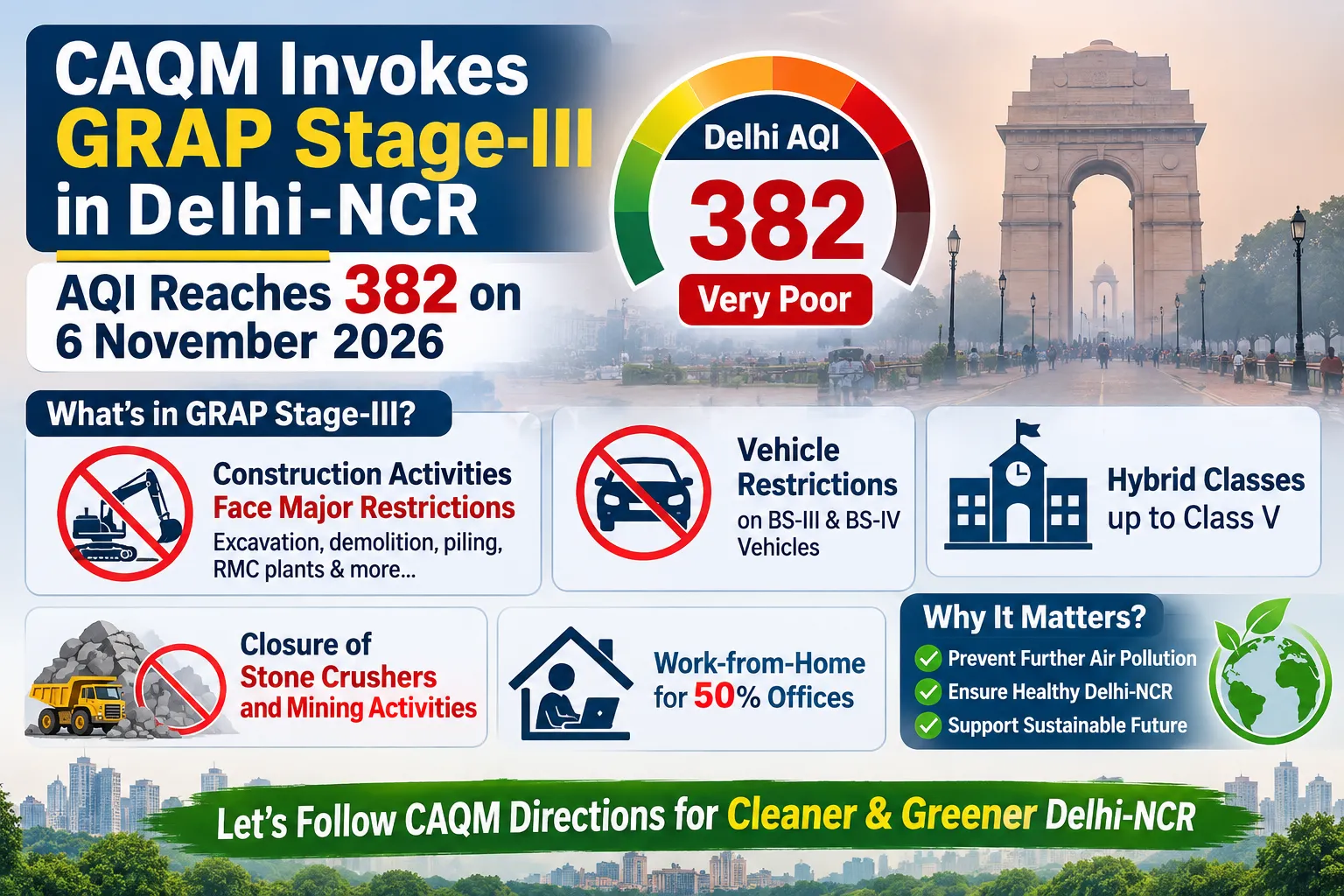
The Commission for Air Quality Management (CAQM) has invoked Stage-III of the Graded Response Action Plan (GRAP) across Delhi-NCR with immediate effect on 6 November 2026 to prevent further deterioration in air quality.
According to the CAQM order, Delhi recorded an Air Quality Index (AQI) of 382, falling under the Very Poor category. The Sub-Committee on GRAP reviewed the prevailing air quality situation and meteorological forecasts issued by the India Meteorological Department (IMD) and the Indian Institute of Tropical Meteorology (IITM). The forecasts indicated that air quality could deteriorate further and enter the Severe category.
With this development, Stage-III measures have been added to the Stage-I and Stage-II restrictions that were already in force across the National Capital Region (NCR).
For industries, construction companies, infrastructure developers and vehicle owners, the latest directions require immediate attention. Several activities related to construction, industrial operations, transportation and pollution control may be affected.
For a broader understanding of the regulatory framework, read our guide on the CAQM Act 2021 and Air Pollution Control in Delhi-NCR.
1. What Does the CAQM Stage-III Order Say?
The CAQM issued its order on 6 November 2026, directing all concerned agencies across Delhi-NCR to implement Stage-III actions under the revised GRAP schedule dated 29 September 2026.
The order states that:
- Delhi's AQI reached 382 on 6 November 2026.
- The air quality was recorded in the Very Poor category.
- Unfavourable meteorological conditions were affecting the dispersion of pollutants.
- IMD and IITM forecasts indicated a possibility of the AQI entering the Severe category.
- Stage-III actions were invoked with immediate effect across Delhi-NCR.
- Stage-I, Stage-II and Stage-III measures must be implemented and monitored by the concerned authorities.
Stage-III of GRAP corresponds to the Severe AQI range of 401–450. Its invocation is intended to prevent further deterioration in air quality.
2. Delhi-NCR AQI and GRAP Stage Status
The following table explains the AQI categories under the revised GRAP schedule:
| GRAP Stage | AQI Category | AQI Range |
|---|---|---|
| Stage-I | Poor | 201–300 |
| Stage-II | Very Poor | 301–400 |
| Stage-III | Severe | 401–450 |
| Stage-IV | Severe+ | Above 450 |
Although Delhi's AQI was recorded at 382 on 6 November, the CAQM Sub-Committee invoked Stage-III as a preventive measure in view of the forecast deterioration.
3. Major Restrictions Under GRAP Stage-III
The Stage-III schedule introduces restrictions and additional compliance requirements across construction, transportation, industrial and other sectors.
A. Restrictions on Construction and Demolition Activities
One of the most significant measures under Stage-III concerns dust-generating construction and demolition activities across the entire NCR.
The following activities are subject to strict restrictions:
- Earthwork involving excavation and filling, including boring and drilling.
- Piling activities.
- All demolition works.
- Open-trench laying of sewer lines, water pipelines, drainage systems and electric cables.
- Brickwork and masonry activities.
- Operation of Ready-Mix Concrete (RMC) batching plants.
- Major welding and gas-cutting operations.
- Painting, polishing and varnishing activities.
- Cement, plaster and other coating work, except minor indoor repairs and maintenance.
- Cutting, grinding and fixing of tiles, stones and other flooring materials, except minor indoor repairs and maintenance.
- Road construction and major road repair activities.
- Loading, unloading and transfer of dust-generating materials such as cement, fly ash, bricks, sand, murram, pebbles and crushed stone.
- Movement of vehicles carrying construction materials or C&D waste on unpaved roads.
Minor welding activities related to Mechanical, Electrical and Plumbing (MEP) works are permitted under the schedule. Pothole repairs are also permitted.
Other construction activities that are relatively less polluting may continue, subject to strict compliance with dust-control requirements and C&D Waste Management Rules.
Construction companies can refer to our Builder Site Dust Compliance Checklist – Delhi-NCR for guidance on site-level dust-control practices and documentation.
B. Exemptions for Essential and National Importance Projects
The Stage-III schedule allows specified categories of projects to continue construction-related activities, including activities otherwise restricted under the schedule. However, these projects must comply with applicable C&D waste management and dust-control requirements.
The listed categories include:
- Railway services and railway stations.
- Metro rail services and stations.
- Airports and inter-state bus terminals.
- National security and defence-related projects, including projects of national importance.
- Hospitals and healthcare facilities.
- Linear public infrastructure projects, such as highways, roads, flyovers, power transmission and distribution lines, pipelines and telecommunication services.
- Sanitation projects, including sewage treatment plants and water supply projects.
- Ancillary activities specifically supporting the above project categories.
Important: Being an exempt project does not mean that dust-control and environmental compliance requirements can be ignored.
C. Closure of Stone Crushers and Mining Activities
The CAQM Stage-III schedule directs:
- Closure of stone crusher operations across the entire NCR.
- Closure of all mining and associated activities across the entire NCR.
The concerned Pollution Control Boards, police authorities and District Magistrates/Deputy Commissioners are responsible for implementing these directions.
D. Restrictions on Certain Vehicles
Stage-III introduces additional restrictions on specific vehicle categories.
The major directions include:
E. BS-III Petrol and BS-IV Diesel LMVs
NCR State Governments and the Government of NCT of Delhi are required to impose strict restrictions on the plying of BS-III petrol and BS-IV diesel or older-standard Light Motor Vehicles (LMVs), specifically four-wheelers, in:
- Delhi
- Gurugram
- Faridabad
- Sonipat
- Ghaziabad
- Gautam Buddha Nagar
A specific exemption is provided for persons with disabilities whose vehicles are specially adapted for their use and operated only for their personal purposes.
Restrictions on Medium Goods Vehicles
The directions also cover diesel-operated BS-IV and older-standard Medium Goods Vehicles (MGVs):
- Delhi-registered vehicles of these categories face restrictions in Delhi.
- Vehicles registered outside Delhi are not permitted to enter Delhi under the specified restrictions.
Restrictions on Light Goods Vehicles
Diesel-operated BS-IV and older-standard Light Goods Vehicles (LGVs) registered outside Delhi are also not permitted to enter Delhi under the Stage-III schedule.
Vehicle owners and transport operators should check the applicable directions and enforcement notifications before planning movement.
Hybrid Classes for Primary Schools
Stage-III directs the concerned governments to mandatorily conduct classes for children up to Class V in hybrid mode, wherever online education is feasible.
This direction applies to:
- Delhi
- Gurugram
- Faridabad
- Ghaziabad
- Gautam Buddha Nagar
Other NCR State Governments may also consider implementing hybrid classes in their respective NCR areas.
The option to attend classes online, wherever available, rests with students and their guardians.
F. Work-from-Home and Office Attendance
Under the Stage-III schedule, NCR State Governments and the Government of NCT of Delhi are required to take a decision on allowing public, municipal and private offices to operate at 50% strength, with the remaining employees working from home.
The Central Government may separately take an appropriate decision regarding work-from-home arrangements for employees in Central Government offices.
Businesses should follow the applicable government decision or notification rather than assume that a uniform 50% attendance requirement automatically applies to every office.
4. What Should Industries and Businesses Do?
The implementation of GRAP Stage-III increases the importance of environmental compliance across industrial and commercial establishments in Delhi-NCR.
Industries should review their pollution-control systems and operational practices to ensure that they are following applicable environmental requirements.
Key areas requiring attention include:
Industrial Emission Compliance
- Ensure compliance with prescribed emission standards.
- Operate pollution-control equipment effectively.
- Use only approved fuels as applicable to the industry.
- Maintain records of pollution-control equipment operation and maintenance.
- Cooperate with inspections conducted by the concerned authorities.
Businesses can use our Environmental Compliance Checklist for Industries to review important approval, monitoring and documentation requirements.
Dust and Material Handling
- Prevent dust emissions from material storage and handling.
- Keep construction materials properly covered.
- Follow applicable dust-suppression requirements.
- Ensure that vehicles transporting dusty materials follow prescribed conditions.
- Maintain proper housekeeping within industrial premises.
DG Set Compliance
The GRAP schedule requires industries and other establishments to follow the existing regulated-operation requirements for diesel generator sets.
Businesses should review the applicable CAQM directions, including Direction No. 76 dated 29 September 2023 and subsequent amendments, wherever applicable.
The schedule also states that diesel generator sets should not be used as a regular source of power supply.
Certain emergency services and essential activities have specified provisions under the schedule. Businesses should verify whether their DG set configuration and intended use meet the applicable requirements.
Construction and Infrastructure Projects
Project owners, builders and contractors should:
- Review whether their ongoing activities fall under restricted categories.
- Identify whether the project qualifies for an expressly listed exemption.
- Check the applicable conditions for continuing permitted work.
- Maintain C&D waste management records.
- Ensure compliance with dust-prevention and suppression requirements.
- Follow directions issued by the concerned authorities.
5. Role of Pollution Control Boards and Government Authorities
The CAQM order directs concerned government departments and implementing agencies to ensure strict implementation of Stage-I, Stage-II and Stage-III actions throughout the NCR.
The authorities and agencies involved include:
- Central Pollution Control Board (CPCB).
- Delhi Pollution Control Committee (DPCC).
- Uttar Pradesh Pollution Control Board (UPPCB).
- Haryana State Pollution Control Board (HSPCB).
- Rajasthan State Pollution Control Board (RSPCB).
- State Governments and the Government of NCT of Delhi.
- District Magistrates and Deputy Commissioners.
- Municipal corporations and urban local bodies.
- Traffic police and transport departments.
- Construction, road-owning and infrastructure agencies.
These agencies are expected to monitor compliance, intensify enforcement measures and take appropriate action against violations.
Industries using online emission or effluent monitoring systems can also refer to our OCEMS Compliance Guide to understand monitoring-related compliance requirements.
6. Areas Covered Under the GRAP Stage-III Directions
The order directs implementation of Stage-III measures across the entire NCR.
The distribution list includes authorities and implementing agencies in Delhi, Uttar Pradesh, Haryana and Rajasthan, including areas such as:
- Uttar Pradesh: Noida, Greater Noida, Ghaziabad, Meerut, Hapur, Baghpat, Bulandshahr, Muzaffarnagar and Shamli.
- Haryana: Gurugram, Faridabad, Sonipat, Rohtak, Panipat, Karnal, Jhajjar, Rewari, Nuh, Palwal and other listed NCR districts.
- Delhi: The National Capital Territory of Delhi.
The order also specifically includes Noida Authority, Greater Noida Industrial Development Authority and Ghaziabad Development Authority among the authorities receiving the directions.
7. Citizen Responsibilities Under GRAP Stage-III
The CAQM citizen charter encourages residents to take steps to reduce pollution exposure and emissions.
Citizens should:
- Walk or use bicycles for short distances.
- Prefer cleaner modes of transportation.
- Combine short journeys and reduce unnecessary trips.
- Avoid coal and wood for heating.
- Avoid open burning of biomass and municipal solid waste.
- Follow hybrid schooling and work-from-home arrangements wherever directed.
- Provide electric heaters to security and other staff where applicable to prevent open burning.
- Avoid unnecessary outdoor activities that increase exposure to pollution.
People should also report air-polluting activities through the relevant government applications and complaint platforms.
8. How Simplicomp Can Help Businesses with Environmental Compliance
The implementation of GRAP Stage-III highlights the importance of maintaining proper environmental compliance and pollution-control systems.
For industries, builders, infrastructure developers and commercial establishments operating in Delhi-NCR, timely compliance planning can help reduce regulatory risks and improve operational preparedness.
Simplicomp provides environmental compliance consultancy and documentation support to businesses for various regulatory requirements, including:
- Consent to Establish (CTE) and Consent to Operate (CTO).
- Pollution Control Board approvals and compliance documentation.
- Environmental Clearance (EC) consultancy and EIA coordination.
- Environmental compliance assessments.
- Air and water pollution-control compliance support.
- Groundwater NOC consultancy.
- Waste management authorisations and EPR-related compliance.
- Environmental documentation and regulatory coordination.
Businesses seeking approval assistance can read our guides on Consent to Establish (CTE) Process and Consent to Operate (CTO) Explained.
Our objective is to help businesses understand their applicable environmental obligations and maintain the necessary compliance documentation.
Related Guides & Resources
- CAQM Grap Guidelines 2026 Delhi NCR →
- CAQM Stage-1 Grap Delhi NCR →
- CAQM Grap Stage-2 Delhi →
- CPCB Industry Categorization Guide →
Need Help with CAQM Closure Compliance?
Simplicomp provides support for:
- CAQM Closure Notice & Direction Review
- Environmental Compliance Gap Assessment
- Corrective & Preventive Action Plan
- Dust, Air Pollution & Environmental Compensation Compliance
- Documentation, Verification & Resumption Support