

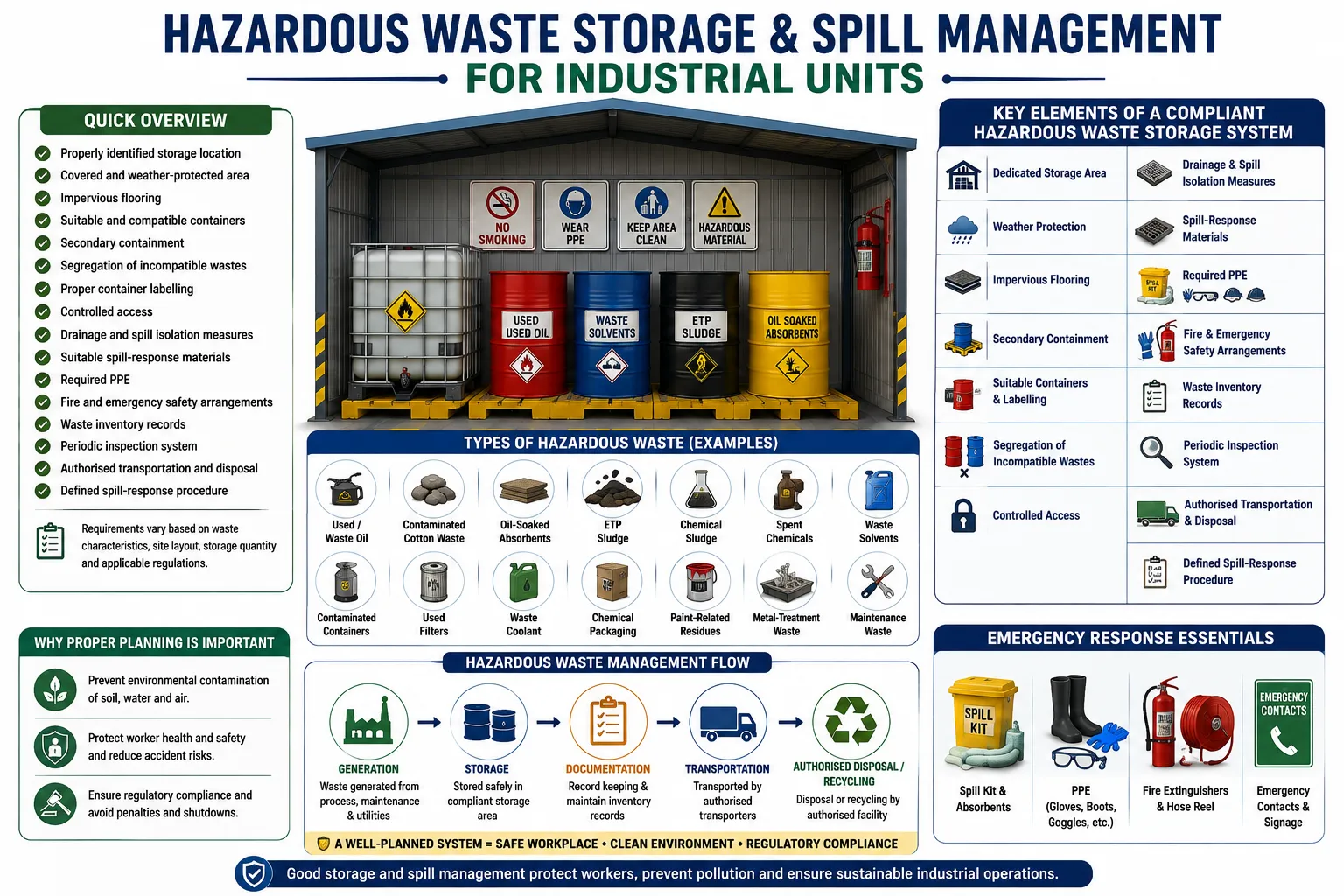
Hazardous Waste Storage & Spill Management for Industrial Units
Hazardous waste management is not limited to keeping waste containers inside a designated shed. A compliant storage system requires proper identification, segregation, containment, labelling, record keeping, authorised disposal and an effective emergency response mechanism.
This becomes particularly important in industries such as automobile manufacturing, engineering, metal processing, machining, chemical manufacturing and surface treatment, where different types of hazardous waste may be generated from production, maintenance, utilities and wastewater treatment activities.
A small leakage from an oil drum, chemical container or ETP sludge storage area can quickly become an environmental and safety concern if the storage area is not designed to contain the material.
For this reason, industries should look at their hazardous-waste storage area as a controlled environmental management zone, rather than simply a temporary waste collection point.
This article explains the major requirements for hazardous-waste storage, secondary containment, spill prevention, emergency response, inventory management and periodic compliance inspections.
Quick Overview: What Should a Hazardous Waste Storage Area Have?
Depending on the type and quantity of waste, an industrial hazardous-waste storage area should generally provide:
- Properly identified storage location
- Covered and weather-protected area
- Impervious flooring
- Suitable and compatible containers
- Secondary containment
- Segregation of incompatible wastes
- Proper container labelling
- Controlled access
- Drainage and spill isolation measures
- Suitable spill-response materials
- Required PPE
- Fire and emergency safety arrangements
- Waste inventory records
- Periodic inspection system
- Authorised transportation and disposal
- Defined spill-response procedure
The exact requirements should be evaluated according to the waste characteristics, applicable authorisation, site layout, storage quantity and relevant environmental regulations.
Why Hazardous Waste Storage Needs Proper Planning
Hazardous waste may include liquids, sludges, contaminated solids, oils, chemicals or residues that can create environmental or occupational risks if improperly handled.
Depending on the industrial process, waste streams may include:
- Used or waste oil
- Contaminated cotton waste
- Oil-soaked absorbents
- ETP sludge
- Chemical sludge
- Spent chemicals
- Waste solvents
- Contaminated containers
- Used filters
- Waste coolant
- Chemical packaging
- Paint-related residues
- Metal-treatment waste
- Maintenance-generated hazardous waste
The classification of each waste stream should be confirmed from the actual process and applicable regulatory requirements. Waste should not be classified simply on the basis of common names used by plant workers.
A proper waste-management system should connect generation → storage → documentation → transportation → authorised disposal/recycling. Industries should also understand the applicable hazardous waste authorization process in India to ensure that storage and disposal activities are properly documented.
Key Elements of a Compliant Hazardous Waste Storage System
1. Dedicated Storage Area
Hazardous waste should be kept in a clearly identified and designated area.
The storage zone should not gradually become a general-purpose area for:
- Scrap material
- Empty pallets
- Maintenance equipment
- General waste
- Unused chemicals
- Rejected products
- Miscellaneous materials
Keeping unrelated materials in the hazardous-waste area can create confusion during inspections and increase the possibility of incorrect waste handling.
2. Weather Protection
The storage area should be appropriately protected against rain and direct exposure to weather.
Rainwater entering a hazardous-waste area can result in:
- Contaminated runoff
- Reduced containment capacity
- Damaged labels
- Container corrosion
- Increased spill volume
- Contamination of nearby drainage systems
The roof and layout should therefore be planned so that rainwater does not unnecessarily enter the containment zone.
3. Impervious Flooring
The floor is one of the most important physical controls in a hazardous-waste storage area. It should be:
- Impervious
- Strong enough for the stored containers
- Resistant to the materials being stored
- Easy to inspect
- Easy to clean
- Free from significant cracks or damaged sections
Hazardous liquids should never be allowed to directly contact soil. Any leakage should remain within a controlled area where it can be recovered safely.
4. Secondary Containment
A primary container may fail because of corrosion, impact, overfilling or physical damage. Secondary containment provides an additional barrier against such failures. Depending on the application, this may include:
- Bund walls
- Spill pallets
- Collection trays
- Kerbed storage bays
- Controlled sumps
- Collection trenches
- Drum containment systems
The containment arrangement should be designed according to the type and quantity of material stored. Where different waste streams could react with each other, they should not simply be placed inside one common containment area.
5. Correct Container Selection
The container should be compatible with its contents. During inspections, industries should check for:
- Corrosion
- Cracks
- Bulging
- Damaged lids
- Leakage
- Deformation
- Unstable positioning
- Missing closures
Containers should remain closed when waste is not being added or removed. A damaged container should be isolated and transferred using a safe recovery arrangement rather than continuing to use it until it fails.
6. Waste Segregation
Different hazardous wastes should be segregated according to their characteristics. Improper mixing can potentially result in:
- Chemical reactions
- Heat generation
- Fire
- Gas formation
- Cross-contamination
- Higher disposal costs
- Incorrect waste classification
Separate containment zones, pallets, bays or clearly marked sections can be used depending on the site requirement.
7. Proper Labelling
Every waste container should be identifiable without having to open it. Labels should provide sufficient information such as:
- Waste description
- Applicable waste category/code
- Source department
- Generation date
- Relevant hazard information
- Storage status
- Responsible department
The same terminology should ideally be followed across the: Container Label → Waste Register → Manifest → Disposal Record → Annual Return. This makes reconciliation much easier during an environmental audit.
8. Access Control
Hazardous-waste storage should have controlled access. Only authorised employees and contractors should handle the waste. Access control can help prevent:
- Unauthorised removal
- Mixing of wastes
- Accidental container damage
- Incorrect disposal
- Unrecorded waste movement
The plant should also nominate responsible personnel for hazardous-waste management and provide an alternate person for emergency situations.
9. Drain and Stormwater Protection
One of the most important questions during a hazardous-waste inspection is:
If the largest reasonably foreseeable spill occurs here, where will the liquid go?
The answer should not be an open stormwater drain. The plant should assess:
- Floor slope
- Drain locations
- Stormwater connections
- Spill travel path
- Drain isolation arrangements
- Drain covers
- Containment capacity
Drain protection should form an integral part of the spill-response procedure.
Spill Management: Why a Written Plan Is Important
A spill-response plan should explain what employees need to do when hazardous material is accidentally released. A useful plan should define:
- Potential spill sources
- Likely materials involved
- Possible spill quantities
- PPE requirements
- Spill-control equipment
- Drain protection method
- Responsible persons
- Emergency communication
- Recovery procedure
- Temporary storage of recovered waste
- Disposal procedure
- Incident documentation
- Corrective-action process
A generic procedure copied from another factory may not be sufficient because every facility has different chemicals, layouts, drainage arrangements and waste quantities.
Practical Spill Response Procedure
Step 1: Identify and Report the Incident
The employee noticing the spill should immediately inform the designated responsible person. The area should be restricted to prevent unnecessary exposure. Employees should not approach an unknown chemical spill without understanding the associated hazards.
Step 2: Stop the Leakage If Safe
Where it can be done without creating additional risk, the source may be controlled by:
- Closing a valve
- Uprighting a container
- Stopping a pump
- Moving a small leaking container into an overpack
- Transferring material into a suitable recovery container
If there is a possibility of toxic fumes, fire, chemical reaction or significant exposure, the emergency response team should take control.
Step 3: Protect Nearby Drains
Drain protection should happen before the material spreads. Possible controls include:
- Drain covers
- Absorbent socks
- Temporary barriers
- Spill booms
- Isolation arrangements
The objective is to prevent the spilled material from entering the stormwater or other uncontrolled drainage system.
Step 4: Contain the Spill
The material should be confined to the smallest practical area. Suitable absorbents or barriers should be selected according to the characteristics of the spilled material.
Step 5: Recover the Material
Recovered liquid or contaminated absorbent should be transferred to a suitable and labelled container. The cleanup material itself may become hazardous waste and should therefore be managed through the applicable authorised route.
Step 6: Clean and Inspect
Once the spill has been recovered, the affected area should be cleaned using a method that does not transfer contamination to another environmental pathway. The storage floor, nearby containers and containment system should then be inspected.
Step 7: Document the Incident
The incident record should ideally include:
- Date and time
- Location
- Waste/material involved
- Approximate quantity
- Cause
- Immediate response
- Cleanup material generated
- Disposal route
- Photographs where appropriate
- Corrective action
- Responsible person
- Closure date
The spill kit should also be replenished after the incident.
What Should an Industrial Spill Kit Contain?
There is no single spill-kit configuration suitable for every industry. The contents should be selected according to the hazardous materials stored at the facility. A site-specific spill kit may include:
- Absorbent pads
- Absorbent socks
- Spill booms
- Suitable loose absorbent
- Drain covers
- Waste collection bags
- Recovery containers
- Overpack drums
- Chemical-resistant gloves
- Safety goggles
- Face protection
- Protective clothing
- Safety footwear
- Suitable hand tools
- Warning tape
- Emergency signage
- Spill-response instructions
- Emergency contact information
Industries should distinguish between oil-only, universal and chemical-specific absorbents. The wrong absorbent can be ineffective or unsuitable for a particular chemical.
Where Should the Spill Kit Be Located?
The spill kit should be easily accessible but should not be placed directly inside the area where a spill is likely to accumulate. It should be:
- Clearly marked
- Easily reachable
- Protected from weather
- Available during all shifts
- Regularly inspected
- Appropriate for nearby waste types
A spill kit that exists only on paper is of little value during an actual incident.
Loading and Unloading: An Often-Ignored Risk
Hazardous-waste incidents do not occur only during storage. Risk can increase considerably while waste is:
- Loaded into a vehicle
- Shifted using a forklift
- Moved with a drum trolley
- Pumped
- Decanted
- Weighed
- Transferred between containers
The loading/unloading area should therefore be checked for:
- Container stability
- Vehicle movement
- Drain proximity
- Spill containment
- Safe lifting practices
- PPE
- Supervision
- Emergency access
- Waste documentation
- Weather exposure
Waste should be handed over only through the applicable authorised transportation and disposal mechanism.
For broader pollution-control documentation, industries can also refer to the CTE / Pollution Board NOC SPCB Approval Process in India
Hazardous Waste Inventory Management
Physical waste quantities should match the records maintained by the facility.
A useful inventory can include:
| Parameter | Record |
|---|---|
| Waste type | Name/category |
| Source | Generating department |
| Opening quantity | Previous balance |
| Generation | Period-wise quantity |
| Dispatch | Quantity sent for disposal/recycling |
| Closing stock | Physical balance |
| Storage location | Bay/container identification |
| Oldest waste | Generation/accumulation date |
| Disposal route | Authorised facility |
| Manifest | Reference/document number |
Regular reconciliation can help identify missing records, delayed dispatches or unexplained stock differences.
Hazardous Waste Storage Period
The applicable hazardous-waste rules generally prescribe limits for temporary storage, with the commonly referenced period being 90 days, subject to the conditions, exceptions and permissions applicable to the particular case.
Industries should not rely solely on a generic 90-day statement. The current regulatory requirements, applicable authorisation conditions and directions of the concerned pollution control authority should be checked.
A good practice is to maintain an age-wise waste inventory so that older waste lots can be identified before they become a compliance concern.
Industries approaching renewal should also review their hazardous waste authorization renewal requirementsand ensure that records and supporting documents are properly maintained.
Common Hazardous-Waste Storage Gaps
During environmental compliance reviews, industries may encounter issues such as:
Unidentified Containers
Drums without proper labels create uncertainty about their contents.
Damaged Drums
Corrosion, leakage or bulging containers require immediate attention.
No Secondary Containment
A leaking container can allow hazardous material to spread beyond the storage area.
Poor Segregation
Different waste types may be stored together without considering compatibility.
Incomplete Spill Kit
The storage area may have absorbent pads but lack drain covers, recovery containers or suitable PPE.
Unprotected Drainage
A spill may have a direct pathway towards the stormwater network.
Poor Inventory Reconciliation
Physical quantities may not match the waste register.
Uncontrolled Access
Unauthorised handling can result in damage or unrecorded waste movement.
Waste Stored for Extended Periods
Delayed dispatch can create additional compliance and storage-management concerns.
No Mock Drill
Employees may know that a spill procedure exists but may not know how to implement it under pressure.
For a broader review of these types of issues, industries can use an environmental compliance checklist for industries.
How Industries Can Improve Hazardous-Waste Compliance
A practical improvement programme can be divided into four levels.
Immediate Actions
- Replace damaged containers
- Correct missing labels
- Provide suitable absorbents
- Protect nearby drains
- Remove incompatible materials
- Inspect existing waste stock
- Assign responsible personnel
Infrastructure Improvements
- Strengthen secondary containment
- Improve flooring
- Provide spill pallets or bunding
- Improve weather protection
- Create dedicated waste bays
- Provide suitable recovery containers
- Improve storage-area accessibility
Procedure Improvements
- Prepare a site-specific spill-response plan
- Create an inspection checklist
- Establish waste inventory reconciliation
- Define loading/unloading procedures
- Establish spill-kit inspection frequency
- Define incident-reporting requirements
Training & Verification
- Train EHS and operational staff
- Conduct mock spill exercises
- Demonstrate drain isolation
- Train employees on PPE and absorbent selection
- Document training
- Conduct follow-up inspections
- Verify closure of corrective actions
A structured environmental audit can help verify whether these measures are actually implemented. Industries can refer to the Environmental Audit for Industries: Types, Process & Compliance Benefits for a broader understanding of environmental compliance reviews.
Hazardous Waste and ETP/Stormwater Management
Hazardous-waste management is closely connected with the site's overall drainage and wastewater system.
For example, an accidental release can potentially affect:
Hazardous Waste Yard → Drainage → Stormwater/ETP → Soil/Water Environment
Therefore, an environmental compliance assessment should not inspect the waste yard in isolation.
The review should also consider:
- Stormwater drainage
- ETP inlet arrangements
- Rainwater harvesting systems
- Emergency containment
- Soil exposure
- Wastewater treatment capacity
- Potential shock loads
This integrated approach can help identify environmental risks before they become regulatory observations.
Industries reviewing wastewater treatment performance can also refer to BOD, COD, TDS & TSS in Wastewater and
When Should an Industry Conduct a Hazardous-Waste Assessment?
A detailed review is particularly useful when:
- A new manufacturing process is introduced
- Hazardous-waste generation increases
- New chemicals are added
- The facility expands
- Waste categories change
- A pollution-control authority raises an observation
- Hazardous-waste authorisation is being renewed
- Storage arrangements are modified
- A spill or near-miss has occurred
- Physical inventory does not match records
- Waste is accumulating for long periods
- An ISO/environmental audit identifies gaps
- The plant is preparing for an expansion or due-diligence exercise
A broader compliance review can also be aligned with an environmental approvals and compliance checklist for setting up a manufacturing plant where applicable.
How SimpliComp Can Help with Hazardous-Waste Compliance
SimpliComp can support industries in reviewing and improving their environmental compliance systems.
Our assessment approach can cover:
- Hazardous-waste storage-area review
- Waste classification and documentation review
- Storage and segregation assessment
- Secondary containment evaluation
- Spill-management planning
- Waste inventory verification
- Environmental compliance gap assessment
- Corrective-action planning
- ETP and wastewater compliance review
- Pollution-control documentation
- Regulatory coordination and compliance support
The objective is not simply to identify deficiencies. A useful compliance assessment should also establish what needs to be corrected, who should implement it and how closure can be verified.
Conclusion
Hazardous-waste compliance is a combination of proper infrastructure, operational discipline, documentation and emergency preparedness.
Simply having a designated hazardous-waste shed does not necessarily demonstrate effective environmental management. The storage area must be capable of preventing releases, containing leaks and supporting a safe response if an incident occurs.
Industries should therefore periodically review their:
Storage → Segregation → Containment → Labelling → Inventory → Spill Response → Disposal → Compliance Records
A proactive assessment can help identify weaknesses before they result in environmental contamination, regulatory observations, unnecessary disposal costs or operational disruption.
For industries looking to strengthen hazardous-waste management and broader environmental compliance, SimpliComp can assist with technical assessment, documentation, corrective-action planning and regulatory compliance support.
Related Guides & Resources
- Difference Between CTE and CTO →
- Hazardous Waste Authorization Process →
- Consent to Establish Process →
- 5 Reasons to Adopt Rainwater Harvesting →
- How Long Groundwater NOC Takes →
Need Help with Hazardous Waste Compliance?
Simplicomp assists industries with:
- Hazardous Waste Authorization applications
- Authorization renewals
- Waste inventory preparation
- Manifest compliance
- SPCB coordination
- Environmental compliance audits
- Waste management compliance