
Introduction
India's rapid urbanization has resulted in the development of large residential complexes, group housing projects, townships and other construction activities across major cities and developing urban areas. While such developments support economic growth and provide housing and infrastructure, they can also increase pressure on land, water, energy, transportation systems and local environmental resources.
For this reason, environmental considerations have become an important part of planning and developing large residential projects.
The Environment (Protection) Act, 1986 and the Environmental Impact Assessment (EIA) Notification, 2006, along with subsequent amendments and applicable directions, provide the regulatory framework for Environmental Clearance for specified projects and activities.
Depending on the nature, size and characteristics of a proposed development, the project may need to obtain prior Environmental Clearance (EC) before undertaking activities covered by the applicable regulatory framework.
For builders, developers and project proponents, determining EC applicability at the planning stage is important because environmental approvals can involve project documentation, environmental assessment, technical studies, regulatory appraisal and post-clearance compliance.
This detailed guide explains the major aspects of Environmental Clearance for residential projects in India, including project classification, site assessment, EIA and EMP requirements, documentation, regulatory process and post-EC compliance.
What Is Environmental Clearance?
Environmental Clearance is a regulatory approval mechanism used to evaluate the potential environmental impacts of specified development and infrastructure projects before they are implemented.
The process is intended to ensure that environmental considerations are incorporated into project planning and that appropriate measures are proposed to avoid, reduce or manage adverse environmental impacts.
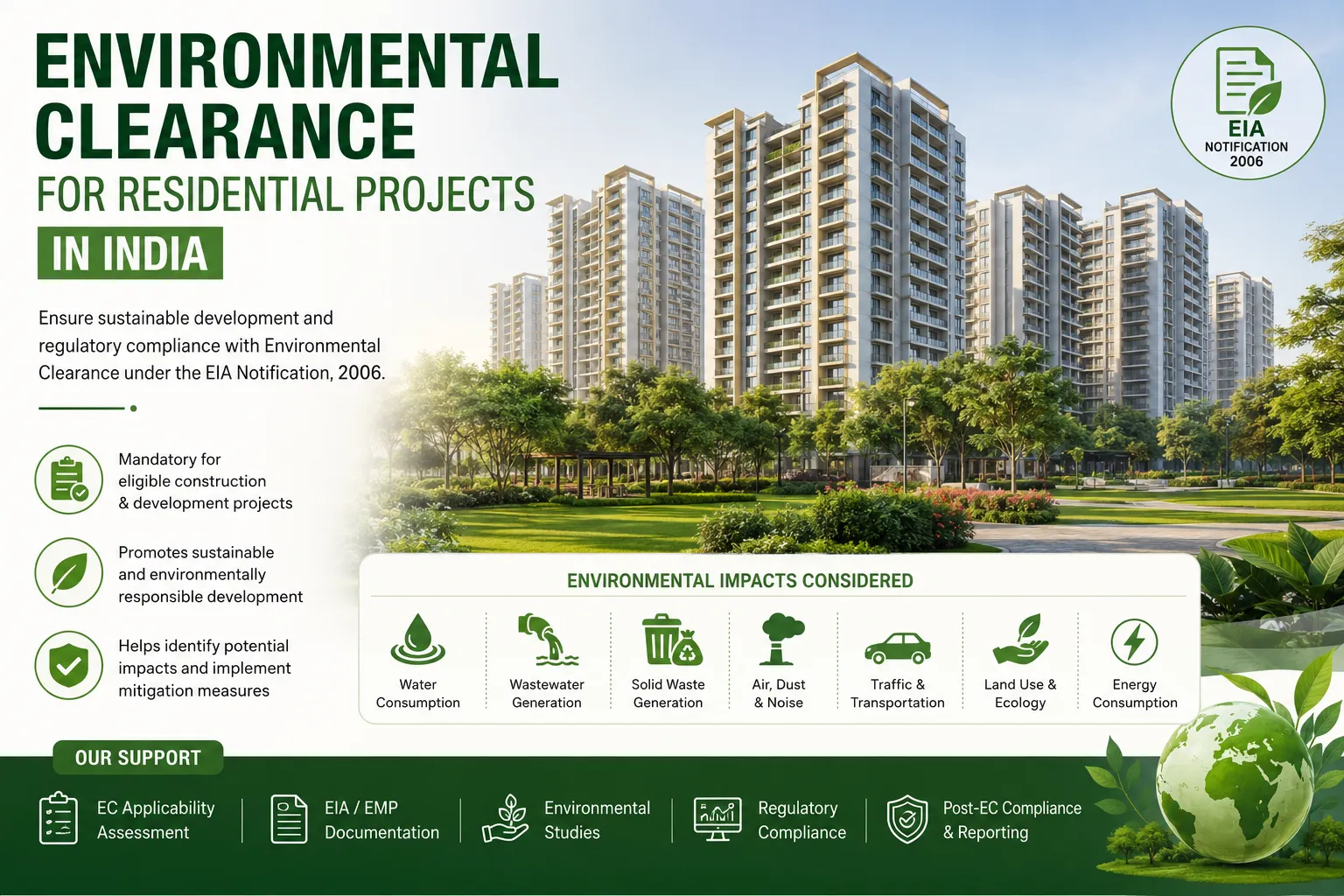
For a residential development, environmental assessment may consider aspects such as:
- Land use and site development
- Water requirement
- Wastewater generation
- Solid waste generation
- Construction activities
- Air pollution
- Noise generation
- Energy consumption
- Traffic movement
- Stormwater management
- Green areas and landscaping
- Ecology and biodiversity
- Resource conservation
- Environmental management measures
The objective is to integrate environmental safeguards into the project rather than addressing environmental issues only after construction has started.
Why Is Environmental Clearance Important for Residential Projects?
Modern residential developments can involve substantial construction activity and resource consumption.
A large project may require significant quantities of:
- Water
- Electricity
- Construction materials
- Fuel
- Land
- Transportation infrastructure
Once operational, residential developments can also generate:
- Domestic wastewater
- Municipal solid waste
- Sewage sludge
- Air emissions from backup systems, where applicable
- Traffic
- Noise
- Increased demand on local infrastructure
Environmental Clearance helps establish a framework through which these potential impacts can be assessed and managed.
For project developers, environmental planning can also help identify site constraints, infrastructure requirements and environmental management measures before significant investment is made.
Environmental Clearance for Residential and Construction Projects
The EIA framework classifies specified projects into different categories based on their potential environmental implications and prescribed criteria.
For construction-related activities covered under the relevant provisions, project size and built-up area can be important factors in determining the applicable environmental assessment requirements.
The source framework identifies two relevant Category B classifications for construction projects:
- Category B1
- Category B2
The applicable category determines the level of environmental assessment and documentation required.
However, project proponents should verify the current applicable notification, amendments and project-specific conditions before making a regulatory submission.
Category B1 and B2 Classification
As described in the source material, the construction project classification is based on built-up area.
| Category | Built-Up Area | Indicative Environmental Requirement |
|---|---|---|
| Category B2 | More than 20,000 sq. m. and up to 1,50,000 sq. m. | EMP-based appraisal under the source framework |
| Category B1 | More than 1,50,000 sq. m. | EIA Report required under the source framework |
The classification should not be determined only from an informal estimate. The project proponent should review the applicable schedule, notification, amendments and project characteristics before deciding the regulatory pathway.
What Is Category B1?
Under the source framework, projects exceeding the stated higher built-up-area threshold are treated as Category B1 projects.
Such projects require a more detailed environmental assessment, including preparation of an Environmental Impact Assessment (EIA) Report.
The EIA process can involve detailed studies of the project's environmental setting and predicted impacts.
What Is Category B2?
Under the source framework, projects falling within the stated B2 range are assessed without preparation of a full EIA report.
The environmental assessment focuses on the information prescribed for the project and the proposed Environmental Management Plan (EMP).
The EMP may address:
- Water management
- Wastewater treatment
- Solid waste management
- Air pollution control
- Noise control
- Energy conservation
- Greenbelt development
- Stormwater management
- Construction-phase environmental management
- Environmental monitoring
Environmental Clearance Applicability Assessment
One of the first steps for a residential project should be determining whether Environmental Clearance is applicable.
This assessment should consider:
1. Project Type
The proposed activity should be reviewed against the applicable project categories under the EIA framework.
2. Built-Up Area
The total built-up area is an important parameter for construction and development projects covered under the relevant provisions.
3. Project Location
The environmental sensitivity of the site can influence the regulatory requirements.
4. Project Components
The proposed residential development may include:
- Residential towers
- Clubhouse
- Commercial components
- Parking
- Utilities
- STP
- DG sets
- Landscaping
- Water infrastructure
These components should be considered when preparing the environmental proposal.
5. Environmental Sensitivity
The site should be screened for proximity to environmentally sensitive features and other regulatory constraints.
A proper applicability assessment at the beginning can help avoid costly changes later in the project.
Site Suitability for Residential Projects
Site suitability is an important consideration in environmental planning.
Before finalizing a site, project proponents should evaluate relevant environmental features surrounding the proposed development.
These may include:
- National Parks
- Wildlife Sanctuaries
- Biosphere Reserves
- Wildlife corridors
- Forest areas
- Water bodies
- Ecologically sensitive areas
- Other environmentally sensitive locations
The source material specifically refers to projects located within 10 km of National Parks, Sanctuaries, Biosphere Reserves and migratory corridors of wild animals and indicates that relevant authenticated mapping and wildlife-related recommendations may be required at the EC stage.
Because regulatory provisions can change, the exact applicability should be checked against the current requirements for the project.
Documents Required for Environmental Clearance
The exact document list depends on the project category and applicable regulatory requirements.
However, a residential project may need to compile information such as:
- Project application
- Project concept
- Site location details
- Site plan
- Layout plan
- Conceptual plan
- Land-use details
- Built-up area statement
- Project component details
- Water requirement
- Water balance
- Wastewater generation
- Sewage treatment proposal
- Solid waste management plan
- Construction waste management plan
- Energy requirement
- Parking details
- Traffic assessment
- Green area details
- Rainwater management proposal
- Environmental management measures
- EIA report, where applicable
- EMP, where applicable
All project documents should contain consistent information.
For example, the built-up area stated in the application should correspond with the architectural plans and environmental documentation.
Environmental Impact Assessment for Residential Projects
An Environmental Impact Assessment evaluates the potential environmental consequences of a proposed project.
For projects where EIA is applicable, the assessment can cover multiple environmental components.
Air Quality Assessment
Construction activities can generate dust and particulate matter. The assessment may consider existing air quality and potential impacts associated with construction and project operations.
Mitigation measures may include:
- Dust suppression
- Covered transportation of materials
- Vehicle management
- Proper storage of construction materials
- Construction-site housekeeping
Water Environment
Residential projects can require substantial water resources.
The assessment may consider:
- Freshwater demand
- Recycled water
- Sewage generation
- STP capacity
- Treated wastewater reuse
- Stormwater management
- Rainwater harvesting
- Groundwater considerations
Noise Environment
Construction machinery, vehicles and other activities can generate noise.
The environmental assessment can identify potential noise sources and recommend suitable measures.
Land Environment
Development can change existing land use and site characteristics.
The assessment may consider:
- Existing land use
- Soil characteristics
- Excavation
- Construction activity
- Landscaping
- Site development
Ecology and Biodiversity
Where relevant, ecological features surrounding the project site should be assessed.
This becomes particularly important where the project is located near environmentally sensitive areas.
Traffic and Transportation
Large residential projects can increase traffic generation.
The assessment may consider:
- Project access
- Parking requirements
- Internal roads
- Traffic generation
- Entry and exit arrangements
- Impact on surrounding roads
Socio-Economic Environment
Residential developments may influence local employment, infrastructure and community services.
The assessment can consider the project's potential socio-economic benefits and associated infrastructure requirements.
Environmental Management Plan for Residential Projects
An Environmental Management Plan (EMP) translates environmental assessment findings into practical management measures.
A residential project's EMP may include separate measures for construction and operational phases.
Construction Phase EMP
The construction phase can address:
- Dust control
- Construction waste
- Noise management
- Water conservation
- Labour safety
- Material storage
- Vehicle movement
- Site housekeeping
- Stormwater management
- Green area protection
Operational Phase EMP
After project completion, environmental management may cover:
- Sewage treatment
- Solid waste management
- Water conservation
- Rainwater harvesting
- Energy efficiency
- Greenbelt maintenance
- Waste segregation
- Environmental monitoring
- STP operation
- Sludge management
The EMP should be designed according to the actual project rather than using generic environmental measures.
Water Management in Residential Projects
Water management is one of the key environmental considerations for large residential developments.
A project may need to plan for:
- Freshwater requirement
- Domestic water demand
- Sewage generation
- STP treatment
- Reuse of treated wastewater
- Rainwater harvesting
- Stormwater drainage
- Water conservation
The project should develop a clear water balance showing the expected sources, uses, wastewater generation and reuse/disposal arrangements.
Sewage Treatment Plant
Residential developments generally generate domestic sewage during operation.
Where required, an appropriately designed Sewage Treatment Plant (STP) can be used to treat wastewater before reuse or disposal as permitted.
Treated wastewater may potentially be used for suitable non-potable purposes such as:
Applicability depends on:
- Landscaping
- Flushing
- Other permitted applications
The actual reuse arrangement should follow the applicable project approvals and regulatory conditions.
Solid Waste Management
Residential projects generate different types of waste during construction and operation.
Operational waste can include:
- Biodegradable waste
- Recyclable waste
- Domestic waste
- Sanitary waste
- Other applicable waste streams
The project should establish suitable segregation, storage, collection and disposal systems.
Construction activities can additionally generate:
- Excavated material
- Concrete waste
- Packaging
- Metal scrap
- Wood
- Other construction and demolition waste
The applicable waste-management requirements should be incorporated into the project planning.
Energy Conservation in Residential Projects
Large residential buildings can consume substantial energy for:
- Lighting
- Elevators
- Pumps
- Ventilation
- Air conditioning
- Common-area systems
Energy-efficiency measures can therefore form an important component of sustainable project design.
Depending on the project, measures may include:
- Energy-efficient lighting
- Efficient pumps
- Building-envelope improvements
- Solar energy systems
- Efficient electrical equipment
- Automated controls
- Energy monitoring
Green Area and Landscaping
Green areas can contribute to the environmental performance and overall livability of a residential development.
Landscape planning can consider:
- Suitable plant species
- Local climatic conditions
- Water-efficient landscaping
- Tree plantation
- Green spaces
- Irrigation requirements
- Treated wastewater reuse, where permitted
The proposed green-area details should be consistent with the approved project plan.
Environmental Clearance and Other Statutory Approvals
Obtaining Environmental Clearance does not necessarily mean that all other project permissions have been obtained.
Depending on the project, additional approvals may be required from different authorities.
These may relate to:
- Building permissions
- Local development authority approvals
- Fire safety
- Water supply
- Sewerage
- Electricity
- Groundwater
- Pollution control
- Waste management
- Traffic and access
- Other local or state requirements
A comprehensive compliance matrix can help identify which approval is required, from which authority and at what stage.
Post-Environmental Clearance Compliance
Environmental Clearance is followed by an ongoing compliance phase.
The project proponent must implement the environmental conditions and commitments associated with the approval.
Post-EC activities can include:
- Environmental monitoring
- EMP implementation
- Water management
- Waste management
- Pollution-control measures
- Greenbelt development
- Environmental record keeping
- Submission of compliance reports
- Corrective action where required
The source material highlights the submission of half-yearly environmental compliance reports for monitoring compliance with stipulated environmental conditions.
This demonstrates why environmental compliance should be treated as an ongoing responsibility rather than a one-time approval process.
Importance of Half-Yearly Environmental Compliance Reports
Post-EC compliance reporting helps demonstrate whether the conditions attached to the Environmental Clearance are being implemented.
A compliance report may include information regarding:
- Status of EC conditions
- Environmental monitoring results
- Water management
- Waste management
- Pollution-control measures
- Greenbelt development
- Other stipulated conditions
The report should be supported by relevant monitoring data and project records.
Risks of Starting a Project Without Required Environmental Clearance
Where prior Environmental Clearance is mandatory, commencing activities covered by the requirement without obtaining the necessary approval can expose the project to regulatory action.
Potential consequences can include:
- Regulatory notices
- Directions to stop or restrict activities
- Environmental compensation
- Additional compliance requirements
- Legal proceedings
- Project delays
- Financial implications
Therefore, the EC applicability assessment should ideally be completed before significant project activities begin.
Common Environmental Clearance Mistakes by Residential Developers
Starting Construction Too Early
One of the most serious mistakes is beginning activities before confirming whether prior EC is required.
Incorrect Built-Up Area Calculation
Incorrect or inconsistent area calculations can affect project classification and documentation.
Ignoring Site Sensitivity
Environmental constraints around the site should be evaluated before finalizing project plans.
Inconsistent Project Documents
Differences between architectural plans, EC documents and other approval applications can create regulatory queries.
Weak EMP Planning
A generic EMP may not adequately address the actual environmental risks of the project.
Ignoring Post-EC Compliance
Obtaining EC without establishing a system for ongoing compliance can create problems during later inspections and reporting.
Step-by-Step Environmental Clearance Strategy for Residential Projects
A practical approach can be structured as follows:
Step 1: Understand the proposed project
Step 2: Determine EC applicability
Step 3: Calculate and verify project area
Step 4: Assess site suitability
Step 5: Identify environmentally sensitive features
Step 6: Determine applicable project category
Step 7: Prepare required project documentation
Step 8: Conduct applicable environmental studies
Step 9: Prepare EIA/EMP documentation as applicable
Step 10: Submit the application through the prescribed regulatory mechanism
step 11: Address observations or queries raised during appraisal
Step 12: Obtain Environmental Clearance
Step 13: Implement EC conditions
Step 14: Conduct environmental monitoring
Step 15: Submit applicable post-EC compliance reports
This approach allows environmental compliance to be integrated into the project lifecycle.
Role of an Environmental Consultant
Environmental Clearance involves technical documentation and coordination between project information, environmental studies and regulatory requirements.
An environmental consultant can assist with:
- EC applicability assessment
- Project categorization
- Environmental documentation
- EIA coordination
- EMP preparation
- Water and waste assessment
- Pollution-control planning
- Regulatory documentation
- Compliance reporting
- Post-EC monitoring support
The consultant's role is particularly useful where the project involves multiple environmental components and statutory approvals.
How SimpliComp Helps With Residential Project Environmental Clearance
SimpliComp Tech LLP provides environmental consultancy and regulatory compliance services for construction, residential and development projects.
Our support can include:
Environmental Clearance Consultancy
We help project proponents assess the applicable EC requirements based on project characteristics, location and proposed development.
EIA Consultancy
Where an EIA is applicable, SimpliComp can support the preparation and coordination of the required environmental assessment documentation.
EMP Preparation
We assist in developing practical environmental management measures covering construction and operational phases.
Environmental Compliance
Our team can help project proponents understand and manage environmental conditions after EC is granted.
Half-Yearly Compliance Reporting
We can support preparation and submission of applicable environmental compliance reports based on project conditions and monitoring information.
Pollution and Waste Management
We provide consultancy related to wastewater, solid waste, pollution control and other environmental management requirements.
Why Choose SimpliComp?
Environmental compliance for a residential project should be planned from the initial stage rather than treated as an isolated approval activity.
SimpliComp focuses on providing project-specific environmental consultancy based on:
- Project size
- Project location
- Proposed development
- Environmental sensitivity
- Water and waste requirements
- Applicable regulatory framework
- Compliance obligations
Our objective is to help project proponents build a structured environmental compliance strategy from planning through operation.
Conclusion
Environmental Clearance is an important part of the regulatory planning process for eligible residential and construction projects in India.
A project should not look at EC simply as a form-filing exercise. The process can involve project classification, site assessment, environmental studies, water and waste planning, pollution-control measures, EIA/EMP documentation, regulatory appraisal and continuing post-approval compliance.
For larger developments, proper environmental planning at the beginning can help identify potential issues related to water, wastewater, waste, traffic, energy, ecology and site sensitivity before they become project-level complications.
Developers should also remember that obtaining Environmental Clearance is only one stage of environmental compliance. The conditions attached to the approval must be implemented throughout the relevant stages of project development and operation, with monitoring and reporting carried out as applicable.
If you are planning a residential project, group housing development, township or large construction project, an early EC applicability and environmental compliance assessment can help establish a clear regulatory roadmap.
SimpliComp Tech LLP provides Environmental Clearance, EIA, EMP and environmental compliance consultancy for development projects across India.
Plan your environmental approvals before construction begins—consult SimpliComp for project-specific Environmental Clearance and compliance support.
Related Guides & Resources
- Environmental Clearance & EIA →
- Groundwater & Water NOC →
- Pollution Control Compliance →
- EPR & Waste Management →
- Environmental Compliance Guides →
Need Help with Environmental Compliance?
Simplicomp provides support for:
- Environmental Clearance (EC)
- CTE & CTO approvals
- Groundwater NOC approvals
- EPR registration
- Hazardous waste compliance
- STP & ETP planning
- Environmental monitoring and reporting
- Industrial environmental compliance management