

Introduction
The rapid growth of electronic products has resulted in a significant increase in electronic waste, commonly known as e-waste. Discarded computers, mobile phones, televisions, appliances, networking equipment, circuit boards and other electronic products require proper collection, processing and recycling.
E-waste can contain both recoverable materials and substances that require controlled handling. Materials such as metals, plastics and other components can be recovered through suitable recycling processes, while certain hazardous constituents need environmentally responsible management. The regulatory framework for e-waste in India therefore places importance on authorized processing, recycling and proper waste management.
For entrepreneurs planning to establish an e-waste recycling unit in India, understanding the business model, site requirements, environmental approvals, CPCB requirements, pollution control systems and operational compliance is essential.
This guide explains the major considerations involved in establishing an e-waste recycling facility.
What Is an E-Waste Recycling Unit?
An e-waste recycling unit is a facility designed to receive, segregate, dismantle, process and recover useful materials from discarded electrical and electronic equipment.
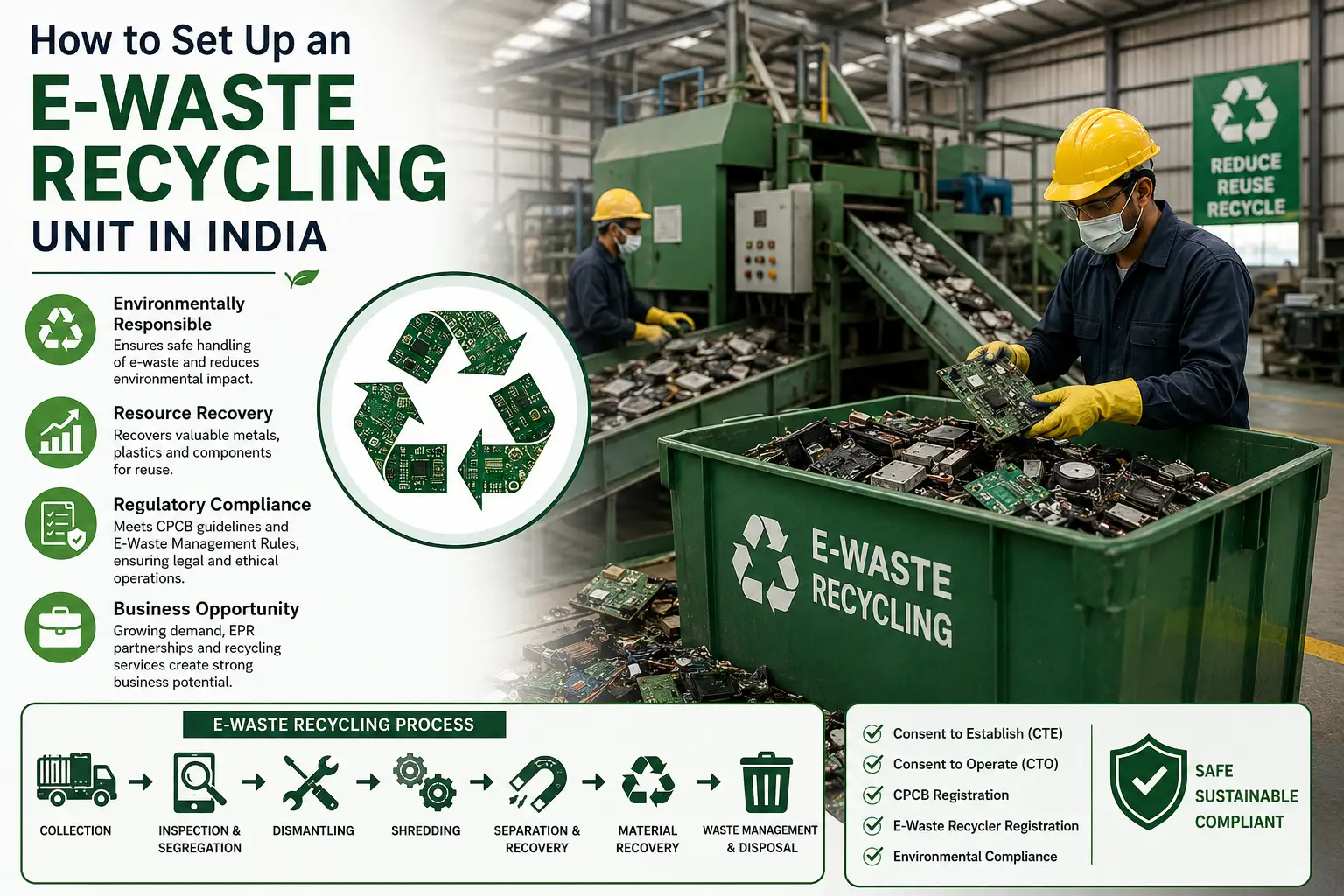
Depending on the facility's approved activities and technology, the recycling process may involve:
- Collection and receipt of e-waste
- Inspection and segregation
- Dismantling of electronic equipment
- Shredding or size reduction
- Separation of recyclable materials
- Recovery of metals and plastics
- Management of residual and hazardous waste
- Storage and dispatch of recovered materials
The objective is to maximize resource recovery while ensuring that waste and residues are handled in an environmentally sound manner.
Why Is E-Waste Recycling Important in India?
The increasing use of electronic devices has created a growing requirement for organized e-waste management. Recycling can support resource recovery, reduce uncontrolled disposal and contribute to the development of a circular economy.
An organized recycling facility can also create opportunities through:
- Collection and processing services
- Material recovery
- Recycling contracts
- EPR-related business arrangements
- Refurbishment and recovery activities
- Supply of recovered materials to downstream industries
However, the commercial potential of the sector must be considered alongside the applicable environmental and operational compliance requirements.
Key Steps to Set Up an E-Waste Recycling Unit
Setting up a recycling facility involves more than installing machinery. The project should be planned around the proposed capacity, process technology, location, waste streams, pollution-control measures and regulatory requirements.
1. Conduct Market and Feasibility Research
Before investing in the facility, evaluate the availability of e-waste in the proposed service area.
Potential sources may include:
- IT and technology companies
- Manufacturing units
- Government organizations
- Educational institutions
- Hospitals
- Electronic retailers
- Telecom companies
- Corporate offices
- Bulk consumers
You should also study existing recyclers, collection networks, processing capabilities, customer requirements and market conditions.
A feasibility assessment can help determine expected waste availability, processing capacity, investment requirements, operating costs and potential revenue.
2. Prepare a Detailed Project Report
A well-prepared Detailed Project Report (DPR) can help organize the technical, financial and environmental aspects of the proposed facility.
Depending on the project, the DPR may cover:
- Project overview
- Proposed business model
- Raw material or e-waste sources
- Recycling process
- Plant capacity
- Machinery and technology
- Infrastructure requirements
- Investment estimates
- Operating expenses
- Revenue projections
- Pollution-control arrangements
- Waste management plan
- Environmental safeguards
The project report should be aligned with the actual proposed facility rather than using generic assumptions.
3. Select a Suitable Business Structure
The proposed enterprise may be established through an appropriate legal structure depending on the promoters, investment pattern and business objectives.
Possible structures may include:
- Private Limited Company
- Limited Liability Partnership
- Partnership Firm
- Sole Proprietorship
Business registration, taxation and other commercial requirements should be assessed separately from environmental approvals.
4. Complete Applicable Business Registrations
Before commencing operations, the business may require various registrations depending on its structure and activities.
These can include:
- Company or entity registration
- PAN and TAN
- GST registration, where applicable
- Udyam/MSME registration, where applicable
- Import Export Code, where applicable
The exact requirement depends on the business model, transactions and applicable laws.
5. Choose the Right Location
Location selection is an important part of an e-waste recycling project.
The proposed site should be evaluated for:
- Permitted land use
- Industrial zoning requirements
- Accessibility for transportation
- Availability of electricity and water
- Drainage and utility infrastructure
- Distance from sensitive locations, where relevant
- Space for waste storage and plant operations
- Scope for future expansion
The land-use and local planning requirements should be checked before finalizing the site.
6. Decide the Recycling Capacity and Process
Plant capacity should be based on realistic e-waste availability, proposed technology, market demand, investment capability and regulatory permissions.
The facility may include different operational areas for:
- Receiving and weighing
- Segregation
- Dismantling
- Shredding
- Material separation
- Recovery
- Waste storage
- Hazardous residue management
- Finished-material storage
The proposed capacity and process should remain consistent across the project report, application documents and actual plant setup.
7. Obtain Consent to Establish
Environmental compliance should be planned before construction and installation of the facility.
Where applicable, the project may require Consent to Establish (CTE) from the concerned State Pollution Control Board.
The application can involve project-specific information such as:
- Site details
- Layout plan
- Process description
- Proposed capacity
- Raw materials or waste inputs
- Pollution sources
- Pollution-control measures
- Waste management arrangements
- Other supporting documents
The exact documentation and procedure can vary by state and project category.
8. Obtain Consent to Operate
After the facility has been established and the required systems have been installed, Consent to Operate (CTO) may be required before starting regular operations.
The authority may assess whether the facility has appropriately implemented the proposed:
- Plant and machinery
- Pollution-control systems
- Waste storage arrangements
- Environmental safeguards
- Operational infrastructure
The facility should operate within the conditions and limits specified in its consent.
9. Complete Applicable E-Waste Regulatory Registration
E-waste recycling activities are subject to the applicable requirements under India's e-waste regulatory framework.
For an eligible recycler or processor, registration with the appropriate regulatory authority, including applicable CPCB requirements, should be assessed based on the proposed activity.
The application process may require information relating to:
- Entity details
- Facility details
- Processing capacity
- Recycling process
- Machinery
- Environmental safeguards
- Waste handling arrangements
- Supporting environmental approvals
The exact requirements should be checked against the regulations and portal requirements applicable at the time of application.
10. Assess Hazardous Waste Requirements
E-waste processing can generate residues or waste streams that may fall under hazardous waste requirements depending on their characteristics and the actual process.
Where applicable, the facility should have systems for:
- Identification of hazardous residues
- Safe storage
- Proper labeling
- Record keeping
- Authorized transportation
- Disposal or treatment through authorized channels
The applicability of hazardous waste authorization should be assessed according to the actual waste generated by the facility.
11. Obtain Other Applicable Approvals
An e-waste recycling project may require additional approvals depending on its location, building, machinery, workforce and operational characteristics.
These may include, where applicable:
- Factory-related approvals
- Fire safety clearance
- Building or local authority approvals
- Land-use permissions
- Labour-related registrations
- Electrical or utility-related approvals
- Other state-specific permissions
Not every approval applies to every project, so a project-specific compliance assessment is important.
12. Design the Recycling Facility
A properly planned plant layout can improve material flow, worker safety and environmental management.
A typical facility may have designated areas for:
Receiving Area
Used for receiving, checking and weighing incoming e-waste.
Segregation Area
Different categories of electronic waste can be separated before further processing.
Dismantling Area
Equipment is dismantled using suitable tools and procedures.
Processing Area
Depending on the technology, shredding, crushing and other processing operations may take place here.
Material Recovery Area
Recoverable materials such as metals and plastics can be separated using appropriate systems.
Waste Storage Area
Separate and secure storage should be provided for relevant waste streams and residues.
Administrative and Compliance Area
Documentation, records, monitoring and regulatory activities can be managed from this section.
13. Install Suitable Machinery and Pollution-Control Systems
Machinery requirements depend on the type of e-waste, proposed capacity and recycling technology.
Equipment may include:
- Dismantling tools
- Shredders
- Crushers
- Conveyors
- Magnetic separation systems
- Air separation systems
- Screening equipment
- Dust collection systems
- Material recovery equipment
Pollution-control measures should be designed according to the actual process and pollution sources.
Depending on the facility, measures may include:
- Dust collection
- Filtration systems
- Fume extraction
- Ventilation
- Wastewater treatment, where applicable
- Water recycling or reuse systems
- Controlled storage of residues
The pollution-control design should be integrated into the project from the planning stage.
14. Establish an E-Waste Collection Network
A recycling plant requires a consistent and legally appropriate supply of e-waste.
Collection partnerships can be developed with:
- Electronics manufacturers
- Corporate organizations
- IT companies
- Manufacturing facilities
- Institutions
- Bulk consumers
- Authorized collection networks
A strong collection system can help maintain plant utilization and support long-term business operations.
15. Develop EPR-Related Business Partnerships
Extended Producer Responsibility, or EPR, is an important component of India's waste management framework.
Eligible producers and other obligated entities may need to meet specified waste management responsibilities through the applicable regulatory mechanism.
An authorized recycler can potentially work with eligible entities through appropriate EPR arrangements, subject to applicable rules, registration requirements and contractual conditions.
This can create opportunities for:
- Long-term business relationships
- Structured waste collection
- Recycling services
- Compliance support
- Traceable processing and documentation
16. Recruit and Train Employees
An e-waste facility requires employees who understand material handling, machinery operation, environmental safeguards and workplace safety.
Depending on the facility, the workforce may include:
- Recycling operators
- Plant supervisors
- Maintenance personnel
- Environmental professionals
- Safety personnel
- Collection staff
- Administrative employees
Training should cover safe waste handling, machinery operation, emergency response, environmental compliance and workplace procedures.
17. Implement Worker Safety Measures
Worker protection should be incorporated into the plant design and operating procedures.
Depending on the activities involved, appropriate PPE may include:
- Safety gloves
- Safety footwear
- Protective eyewear
- Helmets
- Respiratory protection, where required
The facility should also maintain suitable emergency procedures, first-aid arrangements, safety instructions and incident reporting systems.
18. Maintain Environmental and Operational Records
Good documentation is essential for regulatory compliance and internal control.
Records may include:
- E-waste received
- Waste processed
- Material recovered
- Residues generated
- Hazardous waste records, where applicable
- EPR-related transactions
- Pollution monitoring data
- Employee training records
- Dispatch and disposal records
Maintaining accurate records can make inspections, audits and periodic compliance activities easier to manage.
19. Conduct Trial Runs Before Commercial Operations
Before starting full-scale operations, the facility should verify that the installed systems work as intended.
Trial operations can be used to check:
- Machinery performance
- Material flow
- Pollution-control systems
- Waste storage arrangements
- Worker safety procedures
- Emergency response systems
- Documentation procedures
Any identified operational or environmental issues should be addressed before regular production.
Start Operations With Continuous Compliance
Once applicable approvals and registrations are in place and the facility is ready, commercial operations can begin within the permitted scope.
The operational cycle generally involves:
Compliance does not end after obtaining approvals. The facility should continue meeting consent conditions, applicable regulatory requirements, record-keeping obligations and environmental safeguards.
Major Approvals and Registrations to Consider
Depending on the project, location and applicable regulations, an e-waste recycling facility may need to evaluate:
- Business/entity registration
- PAN and TAN
- GST registration, where applicable
- Udyam registration, where applicable
- Land-use or local approvals
- Factory-related approval, where applicable
- Fire safety approval, where applicable
- Consent to Establish
- Consent to Operate
- Applicable e-waste recycler/processor registration
- CPCB-related registration or requirements
- Hazardous waste authorization, where applicable
- Labour-related registrations
- Import Export Code, where applicable
The final approval list should be prepared after reviewing the project's location, capacity, process and waste streams.
Common Challenges in E-Waste Recycling
Although the sector offers opportunities, entrepreneurs should also plan for several practical challenges.
E-Waste Collection
Obtaining a consistent and compliant supply of electronic waste can be challenging, particularly where informal collection networks are active.
Regulatory Compliance
Environmental regulations and online compliance systems can change over time. Regular monitoring of applicable requirements is therefore important.
Capital Investment
Modern processing, recovery and pollution-control equipment can require substantial investment.
Skilled Workforce
Specialized processes require trained operators, environmental personnel and safety staff.
Hazardous Residues
Certain components and residues require controlled handling, storage and disposal.
Market Fluctuations
The commercial value of recovered materials can change according to market conditions, affecting revenue projections.
How SimpliComp Can Help With E-Waste Recycling Compliance
Setting up an e-waste recycling facility involves multiple environmental and regulatory considerations. SimpliComp Tech LLP can support businesses in planning and managing applicable environmental compliance requirements.
Our support can include:
- Environmental compliance assessment
- Consent to Establish consultancy
- Consent to Operate consultancy
- E-waste regulatory compliance guidance
- CPCB-related registration support
- Hazardous waste compliance assessment
- Pollution-control compliance
- Environmental documentation
- Compliance planning and regulatory coordination
The exact scope of consultancy depends on the proposed project, location, capacity, process and applicable regulatory requirements.
How SimpliComp Can Help With E-Waste Recycling Compliance
Setting up an e-waste recycling facility involves multiple environmental and regulatory considerations. SimpliComp Tech LLP can support businesses in planning and managing applicable environmental compliance requirements.
Our support can include:
- Environmental compliance assessment
- Consent to Establish consultancy
- Consent to Operate consultancy
- E-waste regulatory compliance guidance
- CPCB-related registration support
- Hazardous waste compliance assessment
- Pollution-control compliance
- Environmental documentation
- Compliance planning and regulatory coordination
The exact scope of consultancy depends on the proposed project, location, capacity, process and applicable regulatory requirements.
Why Choose SimpliComp?
A recycling facility needs more than a registration application. Environmental requirements should be considered from project planning through plant operation.
SimpliComp focuses on helping businesses understand:
- Which environmental approvals may apply
- What documents are required
- How the proposed process affects compliance
- What pollution-control measures may be relevant
- How to organize environmental documentation
- How to maintain compliance after approval
With experience in environmental consultancy and regulatory compliance, SimpliComp can help businesses approach e-waste recycling projects with a structured compliance strategy.
Conclusion
Establishing an e-waste recycling unit in India requires coordinated planning across business, infrastructure, environmental approvals, recycling technology, worker safety and ongoing compliance.
A successful facility should be designed around its proposed waste streams, processing capacity and regulatory requirements. Obtaining applicable consents and registrations, implementing suitable pollution-control systems, establishing proper waste storage and maintaining reliable documentation are important parts of responsible operations.
For businesses planning a new e-waste recycling facility or expanding an existing operation, an early environmental compliance assessment can help identify approval requirements and reduce regulatory complications during project development.
Related Guides & Resources
- Environmental Clearance & EIA →
- Groundwater & Water NOC →
- Pollution Control Compliance →
- EPR & Waste Management →
- Environmental Compliance Guides →
Need Help with Environmental Compliance?
Simplicomp provides support for:
- Environmental Clearance (EC)
- CTE & CTO approvals
- Groundwater NOC approvals
- EPR registration
- Hazardous waste compliance
- STP & ETP planning
- Environmental monitoring and reporting
- Industrial environmental compliance management