

Introduction
Water is a critical resource for industrial, commercial, and infrastructure projects. As groundwater levels continue to decline in many parts of India, regulatory authorities are placing greater emphasis on efficient water management and conservation.
One of the most important technical documents used to assess a project's water requirement and usage is the Water Balance Study. It provides a comprehensive account of how water is sourced, consumed, recycled, treated, and discharged within a facility.
A well-prepared Water Balance Study is often a mandatory requirement for obtaining a Groundwater No Objection Certificate (NOC), Environmental Clearance (EC), and Consent to Establish (CTE) from Pollution Control Boards. It also helps industries optimize water consumption, reduce wastewater generation, and demonstrate compliance with environmental regulations.
This article explains the purpose, methodology, components, and importance of a Water Balance Study.
What is a Water Balance Study?
A Water Balance Study is a technical assessment that quantifies the movement of water within a project or facility. It tracks the amount of water entering the premises, its utilization in different processes, the quantity recycled, wastewater generated, losses through evaporation or consumption, and the final discharge.
The objective is to account for every unit of water used within the project.
A simplified water balance can be expressed as:
Water Input = Water Consumed + Water Recycled + Water Discharged + Water Losses
The study provides regulators with a clear understanding of how efficiently a project manages its water resources.
Why is a Water Balance Study Important?
Water Balance Studies are essential for both regulatory compliance and sustainable resource management.
They help to:
- Determine the actual water requirement of a project.
- Assess the availability of water from approved sources.
- Reduce dependence on groundwater.
- Identify opportunities for water conservation.
- Improve wastewater recycling and reuse.
- Minimize freshwater consumption.
- Support sustainable industrial operations.
- Demonstrate compliance with environmental regulations.
A scientifically prepared Water Balance Study also assists regulatory authorities in evaluating whether the proposed water requirement is justified.
Where is a Water Balance Study Required?
A Water Balance Study is commonly required during environmental approvals and statutory compliance.
Groundwater NOC
Authorities such as the Central Ground Water Authority (CGWA) and State Groundwater Authorities require Water Balance Studies to evaluate groundwater withdrawal, assess water conservation measures, and determine whether the proposed extraction is sustainable.
Environmental Clearance (EC)
Projects requiring Environmental Clearance under the EIA Notification, 2006 must provide a Water Balance Study to justify water demand, identify water sources, estimate wastewater generation, and demonstrate recycling measures.
Consent to Establish (CTE) and Consent to Operate (CTO)
State Pollution Control Boards may require Water Balance Studies while granting Consent to Establish or Consent to Operate, particularly for industries with significant water consumption or wastewater generation.
Industrial Expansion Projects
When industries propose capacity expansion, regulators often seek an updated Water Balance Study to ensure that additional water demand can be met without adversely affecting local water resources.
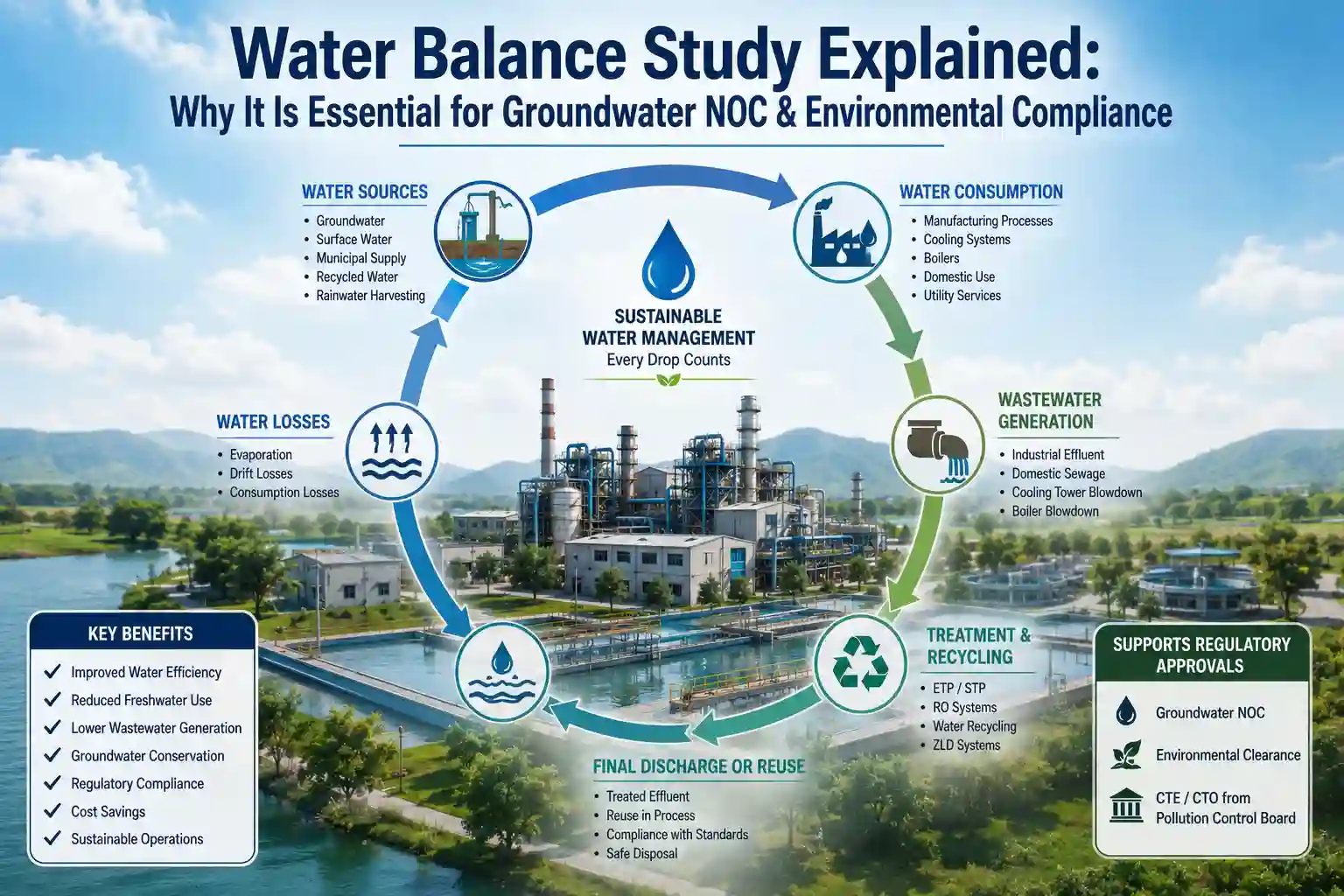
Components of a Water Balance Study
A comprehensive Water Balance Study generally includes the following components.
Water Sources
The study identifies all water sources available to the project, including:
- Groundwater
- Surface water
- Municipal water supply
- Tanker water
- Recycled water
- Rainwater harvesting systems
Water Consumption
Water demand is estimated for different activities such as:
- Manufacturing processes
- Cooling systems
- Boilers
- Domestic use
- Landscaping
- Utility services
- Firefighting reserves
Wastewater Generation
The study estimates the quantity of wastewater generated from each activity and categorizes it into industrial effluent, domestic sewage, cooling tower blowdown, boiler blowdown, or other wastewater streams.
Water Treatment and Recycling
Details of treatment facilities are provided, including:
- Effluent Treatment Plant (ETP)
- Sewage Treatment Plant (STP)
- Reverse Osmosis (RO) systems
- Water recycling systems
- Zero Liquid Discharge (ZLD) systems
The study also specifies the quantity of treated water that is reused within the facility.
Final Discharge
Where discharge is permitted, the study identifies:
- Quantity of treated effluent
- Point of discharge
- Compliance with applicable standards
- Reuse or disposal arrangements
How is a Water Balance Study Prepared?
Preparation of a Water Balance Study generally involves the following steps.
Step 1 – Collect Project Information
Gather details relating to:
- Production capacity
- Manufacturing process
- Utility requirements
- Number of employees
- Existing infrastructure
Step 2 – Estimate Water Requirement
Calculate water demand for:
- Industrial processes
- Cooling systems
- Boilers
- Domestic consumption
- Landscaping
- Utility operations
Step 3 – Estimate Wastewater Generation
Determine wastewater generation from each activity based on accepted engineering practices and applicable standards.
Step 4 – Assess Water Conservation Measures
Evaluate opportunities for:
- Water recycling
- Treated wastewater reuse
- Rainwater harvesting
- Low-water consumption technologies
Step 5 – Prepare the Water Balance Diagram
A flow diagram is prepared showing:
- Water sources
- Water distribution
- Water consumption
- Wastewater generation
- Treatment
- Recycling
- Final discharge
This visual representation enables regulators to easily understand the project's water management system.
Benefits of Conducting a Water Balance Study
A Water Balance Study provides several benefits, including:
- Improved water-use efficiency.
- Reduced freshwater consumption.
- Lower wastewater generation.
- Enhanced groundwater conservation.
- Reduced operating costs.
- Easier regulatory approvals.
- Better environmental compliance.
- Improved sustainability performance.
Common Mistakes While Preparing a Water Balance Study
Common issues that may lead to regulatory queries include:
- Incorrect estimation of water demand.
- Incomplete accounting of wastewater streams.
- Ignoring recycled water quantities.
- Lack of supporting calculations.
- Exclusion of rainwater harvesting measures.
- Failure to consider future expansion.
- Inconsistencies between the water balance and project design.
Preparing an accurate and realistic Water Balance Study is essential for obtaining timely approvals.
Conclusion
A Water Balance Study is far more than a regulatory requirement—it is a valuable planning tool that helps industries manage water resources responsibly and efficiently.
By accurately estimating water demand, identifying opportunities for conservation, promoting recycling, and reducing wastewater generation, the study supports sustainable industrial development while facilitating statutory approvals such as Groundwater NOC, Environmental Clearance, and Pollution Control Board consents.
As water scarcity and regulatory oversight continue to increase, a well-prepared Water Balance Study has become an indispensable component of responsible environmental management.
Related Resources
Need Help with Groundwater NOC Approval?
Simplicomp provides support for:
- Groundwater NOC applications
- Borewell permission approvals
- CGWA approvals
- Water balance studies
- Rainwater harvesting compliance
- Groundwater documentation and regulatory coordination