

Introduction
The Environmental Clearance (EC) process in India is governed by the EIA Notification 2006 issued by the Ministry of Environment, Forest and Climate Change.
It defines a structured procedure to assess environmental impacts before granting approval to projects.
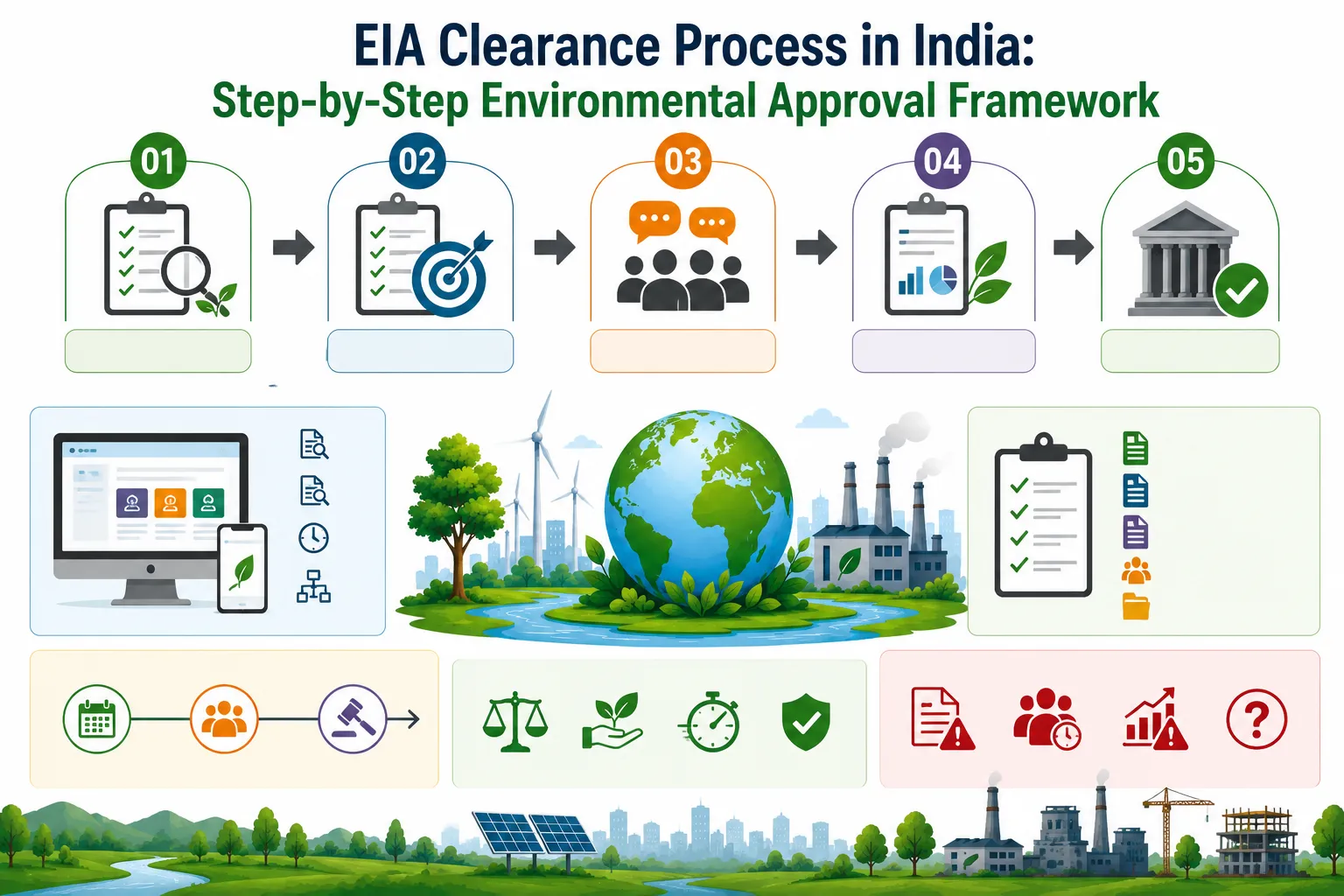
Overview of EIA Clearance Process
The Environmental Clearance process involves five key stages:
- Screening
- Scoping
- Public Consultation
- EIA Report Preparation
- Appraisal and Decision
Each stage ensures that environmental risks are systematically evaluated
Step 1 – Screening
Screening is applicable only to Category B projects
Purpose:
To determine whether a detailed EIA study is required.
Outcome:
Project classified as:
- B1 (EIA required)
- B2 (EIA not required)
Step 2 – Scoping (Terms of Reference – ToR)
Scoping defines the scope and depth of the EIA study.
Key Activities:
- Submission of Form 1
- Review by Expert Appraisal Committee (EAC/SEAC)
- Issuance of Terms of Reference (ToR)
- Environmental parameters to be studied
- Data requirements
- Impact analysis scope
Step 3 – Public Consultation
Public consultation ensures transparency and stakeholder participation.
Not Applicable:
Certain project categories may be exempted.
Step 4 – EIA Report Preparation
Based on ToR, a detailed EIA report is prepared.
Key Components:
- Baseline environmental data
- Impact assessment
- Mitigation measures
- Environmental Management Plan (EMP)
- Risk assessment
This report forms the basis for regulatory decision-making.
Step 5 – Appraisal and Environmental Clearance
The final stage involves evaluation by expert committees.
Authorities:
- EAC (Central Level)
- SEAC (State Level)
Outcome:
- Approval (with conditions)
- Rejection
- Request for additional information
Final clearance is granted by:
- MoEFCC (Category A)
- SEIAA (Category B)
Timeline of EIA Clearance Process
Typical regulatory timelines:
- ToR issuance: ~30–60 days
- Public consultation: ~45 days
- Appraisal and decision: ~60–105 days
Actual timelines vary based on project complexity and documentation.
Digital Process via PARIVESH
The entire EC process is conducted online through the PARIVESH Portal.
Features:
- Online application submission
- Document upload
- Real-time tracking
- Transparent approval workflow
Key Documents Required for EC Process
- Form 1 / Form 1A
- Pre-feasibility report
- EIA report
- Public hearing proceedings
Importance of Following the EC Process
A properly followed EC process ensures
- Legal compliance
- Reduced environmental risks
- Faster approvals
- Avoidance of penalties and project delays
Common Challenges in EC Process
- Incomplete documentation
- Delays in public consultation
- Data inconsistencies
- Regulatory queries
Need Help with Environmental Clearance?
Simplicomp provides professional support for:
- Environmental Clearance applications
- EIA studies
- ToR compliance
- Documentation and regulatory coordination