

Introduction
Air pollution is a major environmental challenge in Delhi and the National Capital Region (NCR), particularly during winter when unfavourable weather conditions can increase pollutant concentrations. To control pollution, the Commission for Air Quality Management (CAQM) implements the Graded Response Action Plan (GRAP), which introduces stage-wise measures based on Delhi's Air Quality Index (AQI).
The GRAP framework, revised on 29 September 2026, divides air quality into four stages: Poor, Very Poor, Severe and Severe+. Each stage introduces measures to control construction dust, industrial emissions, vehicle pollution, waste burning and other sources of air pollution. Businesses should also understand their applicable environmental compliance requirements.
These restrictions are important for builders, industrial units, infrastructure developers, transport operators and commercial establishments operating across Delhi-NCR. Understanding the applicable requirements helps businesses prepare for inspections, maintain environmental compliance and minimise operational disruptions.
What Is GRAP?
The Graded Response Action Plan (GRAP) is a pollution-control framework implemented by CAQM in coordination with pollution control boards, state governments, municipal authorities and other agencies.
Under this framework, increasingly strict measures are introduced as air quality deteriorates. Authorities may activate a stage in advance when weather and air quality forecasts indicate that pollution levels are likely to reach the relevant threshold and remain elevated.
If an unexpected event or extreme meteorological conditions cause AQI to cross a threshold, the corresponding stage may also be invoked immediately.
An important feature of GRAP is that restrictions from previous stages continue when a higher stage is activated. Therefore, Stage III measures operate alongside applicable Stage I and Stage II measures.
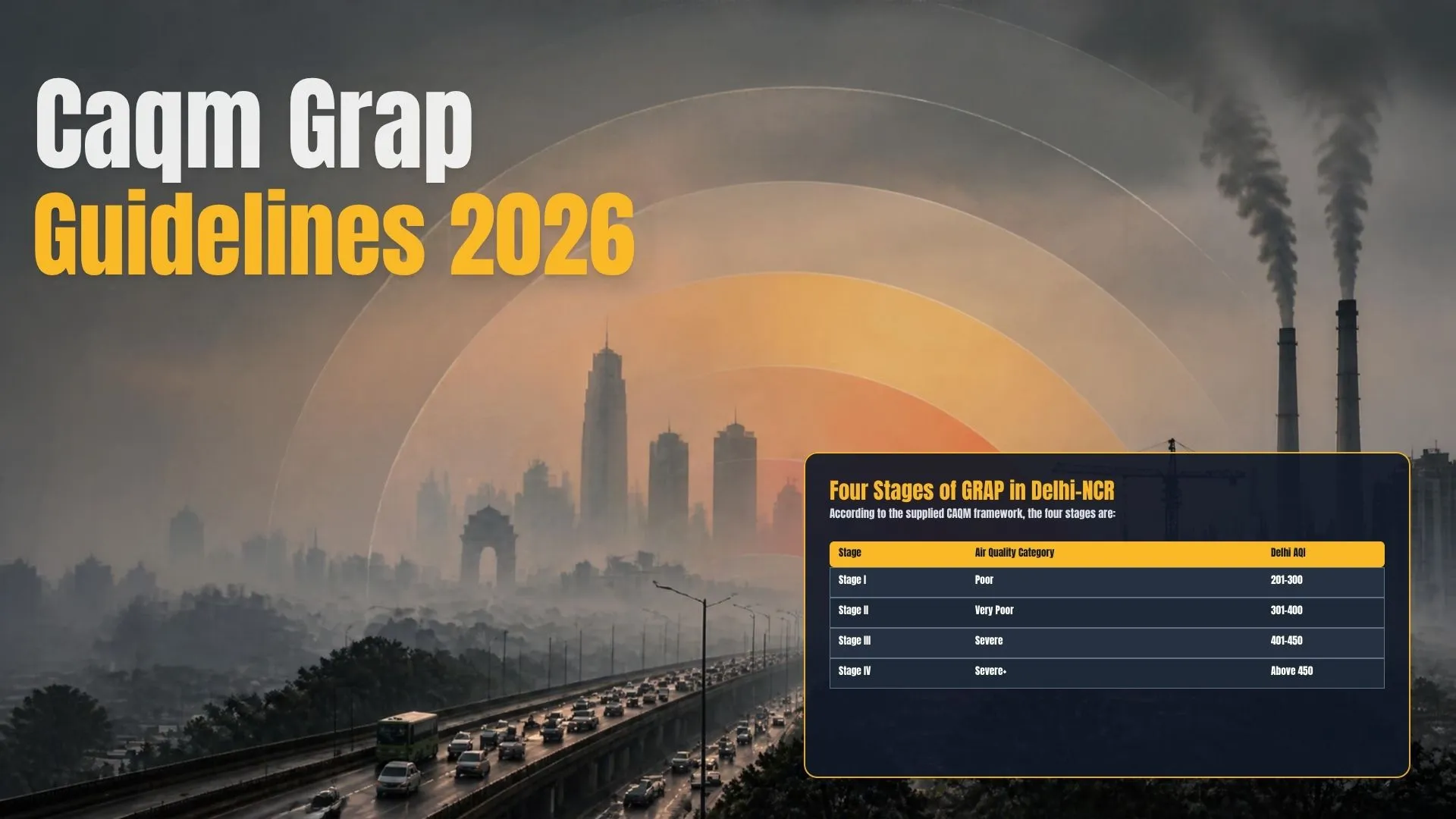
Four Stages of GRAP in Delhi-NCR
According to the supplied CAQM framework, the four stages are:
| Stage | Air Quality Category | Delhi NCR AQI |
|---|---|---|
| Stage I | Poor | 201–300 |
| Stage II | Very Poor | 301–400 |
| Stage III | Severe | 401–450 |
| Stage IV | Severe+ | Above 450 |
The applicable restrictions depend on the activated stage and the official directions in force.
Stage I GRAP: Poor Air Quality (AQI 201–300)
Stage I focuses on strengthening routine pollution-control measures and preventing further deterioration in air quality.
1. Construction Dust Control
Construction and demolition (C&D) sites must follow applicable dust mitigation requirements. These include covering construction materials, transporting C&D waste in covered vehicles, controlling dust during material handling and using suitable water sprinkling or dust suppression systems. Builders can refer to the Builder Site Dust Compliance Checklist for Delhi NCR for practical guidance on site-level precautions and documentation.
The supplied framework also refers to registration and monitoring requirements for C&D projects with plot sizes of 500 square metres or more under the relevant CAQM directions.
Builders should maintain site photographs, inspection records and other required evidence to demonstrate compliance.
2. Waste Management and Road Cleaning
Authorities must ensure regular collection of municipal solid waste, C&D waste, industrial waste and hazardous waste. Illegal dumping and open waste burning must be prevented. Industries handling regulated waste should also review the applicable hazardous waste authorisation and compliance requirements.
Mechanised road sweeping, water sprinkling and proper disposal of collected dust are also important measures. Road-owning agencies must strengthen dust suppression during road construction, repairs and maintenance.
3. Industrial Pollution Control
Industrial units, brick kilns and hot-mix plants must comply with applicable emission standards and use permitted fuels. Authorities are required to intensify inspections and take appropriate enforcement action against non-compliant units.
Industries should review pollution-control equipment, fuel records, emission monitoring arrangements and applicable Consent to Establish (CTE) and Consent to Operate (CTO) requirements.
Where continuous emission monitoring is applicable, industries should also check their OCEMS monitoring and compliance obligations.
4. Vehicle Emissions and DG Sets
Authorities must enforce Pollution Under Control (PUC) requirements and take action against visibly polluting vehicles. Applicable restrictions on overage vehicles and non-destined truck traffic must also be enforced.
Diesel generator sets must comply with relevant CAQM emission-control directions. Their permitted use depends on factors such as capacity, fuel, emission-control arrangements and applicable exceptions.
Stage II GRAP: Very Poor Air Quality (AQI 301–400)
Stage II introduces additional measures to reduce road dust, traffic-related pollution and construction emissions.
1. Intensified Road Cleaning
Identified roads must undergo more intensive mechanical or vacuum sweeping, preferably during night-time or early morning hours. Water sprinkling with suitable dust suppressants is required on relevant roads and high-traffic corridors.
Collected dust must be disposed of at designated sites.
2. Pollution Hotspot Management
Authorities must focus on identified pollution hotspots and strengthen measures targeting their major pollution sources. Depending on local conditions, these may include road dust, construction activities, traffic congestion or industrial emissions.
Businesses located in identified hotspots should ensure that applicable pollution-control measures and documentation are maintained.
3. Construction Site Inspections
Inspections at C&D sites are intensified to verify compliance with dust-control requirements. Builders should check material storage, site boundaries, vehicle movement routes and dust suppression arrangements. The construction dust compliance checklist can help site teams review these measures systematically.
4. Traffic and Workplace Measures
Stage II includes measures such as increasing parking fees to discourage private transport and introducing staggered timings for specified public offices and municipal bodies in Delhi and selected NCR districts, subject to government decisions.
Resident Welfare Associations are also required to provide electric heaters and suitable electricity arrangements for certain categories of staff to reduce open burning of biomass and municipal waste during winter.
Stage III GRAP: Severe Air Quality (AQI 401–450)
Stage III introduces significant restrictions on specified construction activities, mining, stone crushing and certain categories of vehicles.
1. Restrictions on Construction and Demolition
The supplied framework identifies several dust-generating activities for strict restriction across the NCR, including:
- Earthwork involving excavation, filling, boring and drilling.
- Piling and demolition.
- Open-trench laying of sewer lines, water lines and electrical cables.
- Brickwork, masonry and operation of RMC batching plants.
- Major welding and gas-cutting operations.
- Painting, polishing, varnishing and specified coating activities.
- Tile and stone cutting, grinding and fixing, subject to stated exceptions.
- Road construction and major repairs, except permitted pothole repairs.
- Loading and unloading cement, sand, bricks and other dust-generating materials.
- Movement of construction material and C&D waste vehicles on unpaved roads.
Certain relatively less-polluting activities may continue subject to applicable environmental standards and CAQM directions.
2. Projects Permitted Under Specified Conditions
The framework identifies certain categories of projects whose C&D activities may continue under strict compliance conditions. These include railway and metro projects, airports, interstate bus terminals, national security and defence projects, hospitals, specified linear public infrastructure, sewage treatment plants and water supply projects.
This is not a blanket exemption from all GRAP requirements. Project owners must verify eligibility and follow the applicable directions before continuing restricted activities.
3. Stone Crushers and Mining
Stage III requires closure of stone crushers and suspension of mining and associated activities across the NCR, as specified in the framework.
These restrictions may affect construction material suppliers, contractors and infrastructure developers. Businesses should verify the applicable official orders before planning operations or resumption.
4. Vehicle Restrictions
Stage III provides for restrictions on specified older vehicles, including BS-III petrol and BS-IV diesel or lower-standard light motor vehicles in Delhi and designated high-vehicle-density NCR districts.
Additional restrictions apply to specified diesel-operated medium goods vehicles and light goods vehicles entering or operating in Delhi.
Vehicle owners and fleet operators should check the applicable emission standard, registration location, geographical coverage and exemptions before arranging transportation.
5. Schools and Offices
The framework provides for hybrid-mode classes for students up to Class V in Delhi and specified NCR districts, where online education is feasible.
State governments may also decide whether public, municipal and private offices should operate with 50% staff strength, with the remainder working from home. Decisions regarding Central Government offices are handled separately.
Stage IV GRAP: Severe+ Air Quality (AQI Above 450)
Stage IV represents the highest pollution category in the supplied framework. Measures from previous stages continue, along with additional restrictions and emergency actions specified by CAQM.
The provided extract does not contain the complete Stage IV action schedule. Therefore, businesses and citizens should consult the latest official CAQM order to confirm the precise restrictions in force.
Industries, construction companies and transport operators should monitor official announcements and prepare contingency plans for activities that may be affected by additional restrictions.
GRAP Compliance Checklist for Businesses
Businesses can improve their preparedness by following these practical steps:
- Monitor AQI levels and official GRAP activation announcements.
- Identify activities affected by the current stage.
- Verify applicable Dust Portal registration and monitoring requirements.
- Maintain covered storage and transportation of construction materials.
- Implement dust suppression, housekeeping and water sprinkling measures.
- Maintain photographs, inspection records and compliance documentation.
- Review industrial emission controls, permitted fuels and CTE/CTO conditions.
- Verify DG set capacity and applicable operating requirements.
- Check vehicle emission standards and movement restrictions.
- Ensure proper waste collection and disposal.
- Inform employees, contractors and transport teams about applicable restrictions.
- Keep corrective-action records ready for inspections.
Actual requirements depend on the relevant CAQM directions, project category, location and applicable environmental regulations. Businesses can use an environmental audit for industries to help identify compliance gaps and review pollution-control practices.
How Simplicomp Can Help
Simplicomp supports industries, builders and project owners with environmental compliance and pollution-control documentation. Depending on project requirements, support may include environmental compliance reviews, gap assessments, construction dust mitigation documentation, applicable Dust Portal assistance, review of CTE/CTO conditions and corrective-action planning.
For businesses affected by GRAP restrictions, a compliance review can help identify documentation gaps and operational risks. Simplicomp also provides CAQM closure notice and resumption support, subject to applicable regulatory requirements. Consultancy support does not guarantee exemption from restrictions or automatic permission to resume suspended activities. Resumption must comply with applicable official orders.
Conclusion
The CAQM GRAP framework revised on 29 September 2026 introduces progressively stricter measures to control air pollution across Delhi-NCR. Its provisions cover construction dust, industrial emissions, waste management, vehicles and DG sets.
Builders, manufacturers, infrastructure developers and commercial establishments should monitor official updates, understand stage-specific restrictions and maintain adequate environmental compliance records. Reviewing the relevant environmental compliance checklist for industries can help businesses organise their compliance activities.
Related Guides & Resources
- Consent to Establish Process →
- Industrial Approvals Required Haryana →
- Environmental Approvals Checklist Manufacturing Plant India →
- CPCB Industry Categorization Guide →
Need Help with CAQM Closure Compliance?
Simplicomp provides support for:
- CAQM Closure Notice & Direction Review
- Environmental Compliance Gap Assessment
- Corrective & Preventive Action Plan
- Dust, Air Pollution & Environmental Compensation Compliance
- Documentation, Verification & Resumption Support