

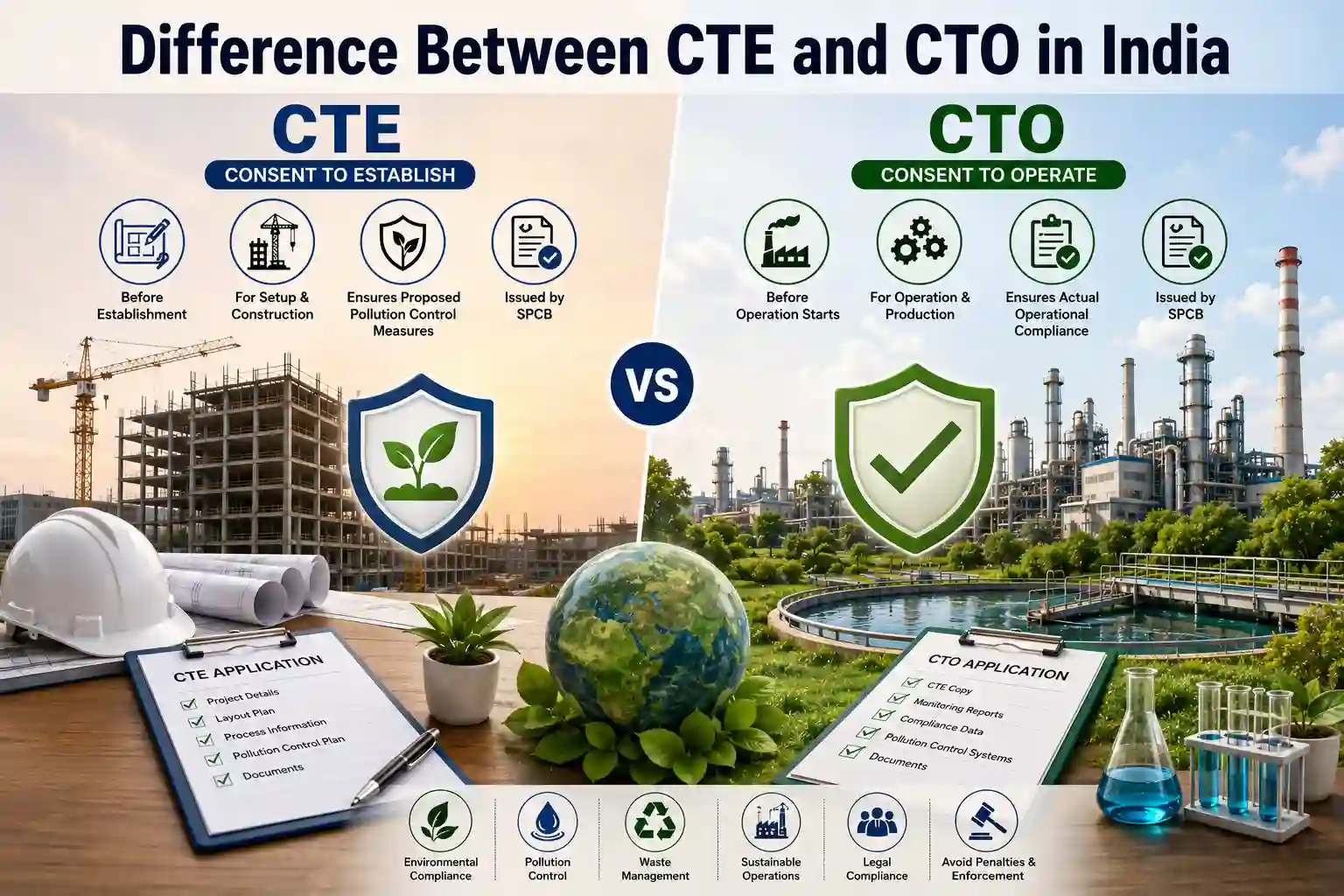
Introduction
Industries, manufacturing units, warehouses, infrastructure projects, commercial establishments, hospitals, hotels, and processing units in India commonly require approvals from State Pollution Control Boards (SPCBs) before establishment and operation.
The two most important approvals under pollution control regulations are:
- Consent to Establish (CTE)
- Consent to Operate (CTO)
These approvals are commonly referred to as:
- Pollution Board NOC
- Pollution Consent
- SPCB Consent
- Factory Pollution Approval
Many industries and project developers often confuse the purpose and applicability of CTE and CTO approvals.
This guide explains the major differences between Consent to Establish and Consent to Operate including approval stage, validity, compliance obligations, applicability, and regulatory requirements.
What is Consent to Establish (CTE)?
Consent to Establish (CTE) is an approval issued by the State Pollution Control Board before construction, installation, or project establishment begins.
CTE approval is generally required before:
- Land development
- Factory construction
- Machinery installation
- Industrial setup
- Infrastructure project execution
The purpose of CTE is to ensure that the proposed project has adequate pollution control systems and environmental safeguards before establishment.
CTE is also commonly known as:
CTO renewal commonly applies to:
- CTE Approval
- Pollution Board NOC
- Factory Setup Approval
- Pollution Consent for Establishment
What is Consent to Operate (CTO)?
Consent to Operate (CTO) is issued after project construction and installation are completed and before commercial operations begin.
CTO approval allows industries to legally commence or continue operations subject to environmental compliance conditions.
CTO commonly applies to:
- Manufacturing operations
- Industrial production
- Commercial operations
- Wastewater discharge
- Air emission activities
CTO is also referred to as:
- Pollution Board Operational Consent
- SPCB Operating Consent
- Factory Operation Approval
- Pollution NOC Renewal
Different validity periods may apply based on SPCB policies and industry categorization.
Key Difference Between CTE and CTO
| Parameter | Consent to Establish (CTE) | Consent to Operate (CTO) |
|---|---|---|
| Approval Stage | Before project establishment | Before operation starts |
| Purpose | Approval for setup/construction | Approval for operation |
| Applicable Phase | Planning & construction stage | Operational stage |
| Issued By | SPCB/PCC | SPCB/PCC |
| Focus Area | Proposed pollution control measures | Actual operational compliance |
| Validity | Limited project establishment period | Periodic operational validity |
| Inspection Basis | Proposed infrastructure | Existing operational systems |
| Renewal Requirement | Usually project-specific | Periodic renewal required |
Why are CTE & CTO Important?
CTE and CTO approvals help regulatory authorities ensure that industries operate with:
- Proper pollution control systems
- Wastewater treatment systems
- Air pollution control infrastructure
- Hazardous waste management systems
- Environmental monitoring mechanisms
Operating without valid consent approvals may result in:
- SPCB notices
- Environmental compensation
- Operational restrictions
- Closure directions
- NGT proceedings
WCTE Approval Process
The CTE approval process generally involves:
Step 1 – Project Assessment
Industries assess:
- SPCB applicability
- Pollution category
- Land-use compliance
- Pollution generation potential
Step 2 – Preparation of Documents
Applicants commonly prepare:
- Site layout plan
- Manufacturing process details
- Water balance
- Pollution control proposal
- Machinery details
- Land documents
Step 3 – SPCB Online Application
CTE applications are generally filed through online SPCB portals.
The process commonly includes:
- Application filing
- Document upload
- Fee submission
- Compliance declarations
Step 4 – SPCB Scrutiny & Approval
SPCB reviews:
- Pollution control measures
- Environmental safeguards
- Wastewater management systems
- Air pollution mitigation systems
before issuing CTE approval.
CTO Approval Process
CTO approval is generally sought after construction and installation are completed.
Step 1 – Installation of Pollution Control Systems
Industries install:
- STPs/ETPs
- APCDs
- Hazardous waste storage systems
- Monitoring infrastructure
Step 2 – Environmental Monitoring
Applicants commonly conduct:
- Stack monitoring
- Water analysis
- Ambient air monitoring
- Noise monitoring
Step 3 – CTO Application Filing
CTO applications are filed through SPCB portals along with:
- Monitoring reports
- Compliance reports
- Operational details
- Consent documents
Step 4 – SPCB Inspection & Approval
SPCB may conduct site inspections to verify:
- Pollution control infrastructure
- Operational compliance
- Waste management systems
- Environmental monitoring systems
before issuing CTO approval
Documents Required for CTE
CTE applications commonly require:
- Site plan/layout plan
- Manufacturing process flowchart
- Water balance study
- Machinery details
- Land ownership documents
- Pollution control system details
- Raw material details
Documents Required for CTO
CTO applications commonly require:
- Existing CTE copy
- Monitoring reports
- Wastewater analysis reports
- Hazardous waste records
- STP/ETP details
- Air emission monitoring reports
- Operational data
Validity of CTE & CTO
CTE validity is generally linked to project establishment timelines.
CTO validity commonly depends on:
- Industrial category
- SPCB regulations
- Pollution potential
- Compliance history
Red Category industries generally receive shorter consent validity periods compared to Green Category industries.
Common Mistakes by Industries
Industries commonly face delays due to:
- Operating without CTO
- Starting construction before CTE
- Incorrect industrial categorization
- Non-functional pollution control systems
- Incomplete documentation
- Expired monitoring reports
Proper compliance planning significantly improves approval timelines.
Importance of Environmental Compliance After CTO
SPAfter obtaining CTO, industries are generally required to maintain:
- Environmental monitoring
- Hazardous waste compliance
- Wastewater treatment systems
- Air pollution control systems
- Consent condition compliance
- Periodic reporting obligations
Failure to comply may result in environmental compensation and enforcement action.
Related Guides & Resources
Need Help with CTO Renewal?
Simplicomp provides support for:
- CTE applications
- CTO approvals & renewals
- Pollution Board NOC
- Environmental compliance management
- Hazardous waste compliance
- Environmental monitoring
- SPCB coordination