

Introduction
Paper remains an important material for packaging, printing, education, offices, e-commerce and several industrial applications. As paper consumption increases, the quantity of discarded paper also grows. This has created a growing opportunity for businesses involved in paper recovery and recycling.
A paper recycling unit collects and processes waste paper into usable pulp and recycled paper products. Depending on the technology and production line, recycled paper may be converted into products such as kraft paper, paperboard, packaging material, tissue products and other paper-based products.
For an entrepreneur, setting up a recycling plant involves much more than purchasing machinery. Site selection, project planning, water and energy requirements, pollution-control systems, regulatory approvals and waste management should all be evaluated before construction and production begin.
This guide explains the major steps involved in establishing a paper recycling unit in India, with particular focus on environmental approvals and compliance requirements.
This article explains the major requirements for hazardous-waste storage, secondary containment, spill prevention, emergency response, inventory management and periodic compliance inspections.
What Is Paper Recycling?
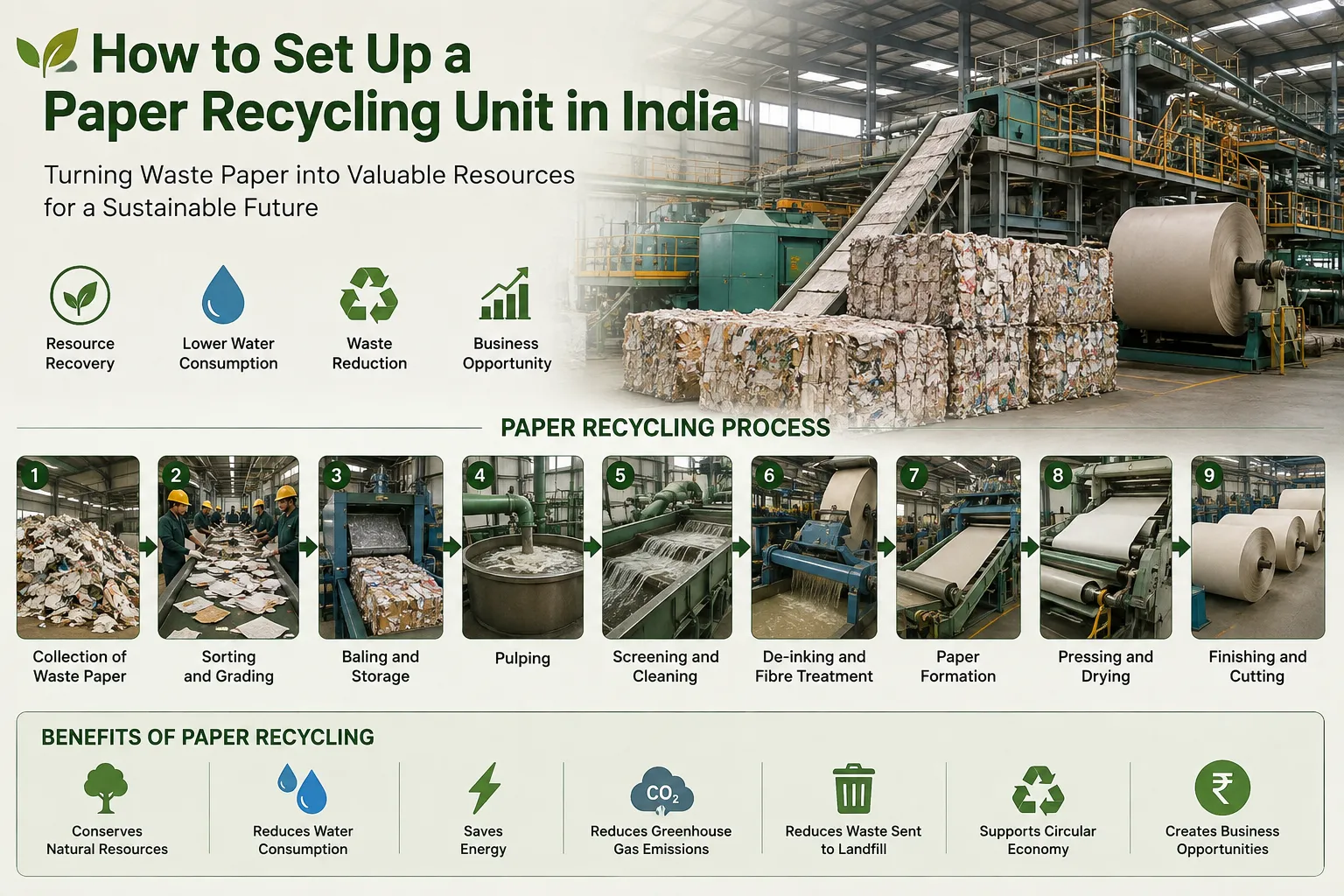
Paper recycling is the process of recovering usable fibre from discarded paper and converting it into new paper products.
Depending on the feedstock and final product, the process may involve:
- Collection of waste paper
- Sorting and grading
- Baling and storage
- Pulping
- Screening and cleaning
- De-inking, where required
- Fibre treatment
- Paper formation
- Pressing
- Drying
- Finishing and cutting
The objective is to recover usable fibre while reducing the quantity of paper waste sent for disposal.
Recycling can also reduce dependence on virgin raw materials and support the principles of resource recovery and circular economy.
Why Consider Setting Up a Paper Recycling Plant?
The business potential of paper recycling is linked to the availability of waste paper and demand for recycled paper products.
Some potential advantages include:
- Growing demand for recycled packaging materials
- Availability of paper waste from commercial and industrial sources
- Reduction in waste sent for disposal
- Recovery of reusable fibre
- Opportunities in packaging and paper-product markets
- Support for resource-efficient manufacturing
- Potential for water and material recovery through process optimisation
However, profitability depends on factors such as raw-material quality, plant capacity, product pricing, energy consumption, water requirements, technology, labour and compliance costs.
Types of Paper Recycling Units
Paper recycling plants can be developed at different scales depending on the proposed production capacity and product range.
Small-Scale Unit
A smaller facility may focus on relatively simple recycling operations and products such as:
- Handmade paper
- Craft paper
- Small packaging products
Such facilities generally require lower production capacity and infrastructure compared with large integrated plants.
Medium-Scale Plant
A medium-sized facility may manufacture products such as:
- Kraft paper
- Packaging paper
- Corrugated paper products
- Paperboard
The plant may require dedicated pulping, screening, treatment and paper-making systems.
Large-Scale Industrial Plant
Large facilities may operate sophisticated processing lines for products such as:
- Industrial paper
- Paperboard
- Tissue products
- Packaging grades
- Other specialised recycled-paper products
The exact plant configuration should be determined through a technical and financial feasibility assessment rather than by selecting machinery based only on production capacity.
How to Set Up a Paper Recycling Unit in India
Setting up a paper recycling unit should follow a planned sequence so that technical, financial and environmental requirements are addressed before construction.
Step 1: Conduct a Feasibility Assessment
Before purchasing land or machinery, evaluate:
- Market demand
- Proposed production capacity
- Raw-material availability
- Product specifications
- Water requirement
- Electricity requirement
- Fuel requirement
- Wastewater generation
- Air-emission sources
- Waste generation
- Capital investment
- Operating expenditure
- Environmental compliance requirements
A feasibility study can help identify whether the proposed site and manufacturing process are suitable for the intended project.
Step 2: Select an Appropriate Site
The location should be suitable for the proposed industrial activity and should provide adequate infrastructure.
Consider:
- Industrial land-use compatibility
- Road connectivity
- Availability of electricity
- Water availability
- Raw-material transportation
- Finished-product transportation
- Waste-management arrangements
- Space for pollution-control systems
- Space for future expansion
The environmental suitability of the site should also be reviewed before finalising the project.
Step 3: Prepare the Project Report
A detailed project report should describe the proposed manufacturing activity and associated infrastructure.
It may cover:
- Production capacity
- Manufacturing process
- Raw materials
- Machinery
- Water balance
- Power requirement
- Fuel consumption
- Wastewater generation
- Air-emission sources
- Solid and other waste
- Pollution-control measures
- Storage arrangements
- Manpower
- Project cost
This information is also useful while preparing applications for applicable statutory approvals.
Step 4: Establish the Business Entity
The entrepreneur can select an appropriate business structure depending on the ownership and investment model, such as:
- Proprietorship
- Partnership
- LLP
- Private Limited Company
Other business registrations may also apply depending on the nature and scale of the proposed operation.
Environmental Approvals for a Paper Recycling Unit
Environmental approvals should be assessed before construction and operation.
The exact approvals depend on the project's location, scale, process, production capacity and applicable regulations.
Consent to Establish
A proposed manufacturing unit may need to obtain Consent to Establish (CTE) from the concerned State Pollution Control Board before establishing the industrial facility, where applicable.
The application generally requires project and environmental information such as:
- Site details
- Land documents
- Project information
- Manufacturing process
- Raw-material details
- Water requirement
- Wastewater generation
- Air-emission details
- Pollution-control measures
- Project cost
- Layout and process documents
The specific documentation varies between states and project categories.
For a detailed understanding of the documentation involved, refer to Consent to Establish (CTE) / Pollution Board NOC Documents Required in India.
Consent to Operate
After construction and installation of the required pollution-control systems, the unit may need Consent to Operate (CTO) before starting commercial operations.
The operating consent generally considers whether the installed facility and pollution-control arrangements comply with the applicable conditions.
The entrepreneur should not assume that obtaining CTE automatically permits commercial production. CTO and other applicable approvals should be secured before operation.
Industries can also review the Consent to Operate (CTO) Renewal Process in India to understand the broader compliance requirements associated with operating consent.
Environmental Clearance, Where Applicable
Environmental Clearance requirements are project-specific. Depending on the project's classification, capacity, location and applicable provisions, EC may be required.
Therefore, the requirement should be assessed during the project-planning stage rather than after construction has started.
Project proponents can refer to the Documents Required for Environmental Clearance (EC) in India when evaluating the documentation that may be required for an EC application.
Paper Recycling Manufacturing Process
A typical recycling process may follow this broad sequence:
Waste Paper Collection → Sorting → Pulping → Screening → Cleaning → De-inking, if required → Fibre Treatment → Paper Formation → Pressing → Drying → Finishing → Packaging
The actual process may differ according to:
- Waste-paper quality
- Final product
- Production capacity
- Required paper characteristics
- Degree of contamination
- Technology selected
Waste Paper Collection and Sorting
Incoming paper is separated according to quality, grade and contamination.
Materials such as plastic, metal, tapes and other unwanted materials may need to be removed before processing.
Pulping
Sorted paper is mixed with water and processed to separate the fibres.
The operating conditions depend on the type of paper and desired pulp quality.
Screening and Cleaning
The pulp is passed through screening and cleaning systems to remove contaminants and unwanted particles.
De-inking
Where printed paper is used and the final product requires suitable brightness or quality, de-inking may form part of the process.
Paper Formation and Drying
The treated pulp is distributed onto the paper-making system, where water is removed through pressing and drying.
The finished sheet is then processed according to the required product specifications.
Machinery Required for Paper Recycling
Machinery requirements vary according to capacity and product type.
A typical plant may require:
- Waste-paper sorting equipment
- Baling equipment
- Pulper
- Screening system
- Cleaning equipment
- De-inking system, where applicable
- Refining equipment
- Paper-making machine
- Pressing system
- Drying system
- Cutting and finishing equipment
- Material-handling systems
- Water-recovery systems
- Pollution-control equipment
The equipment should be selected after evaluating the actual process flow and wastewater characteristics.
Water Requirement and Wastewater Management
Water is an important resource in paper recycling because it is involved in pulping, cleaning and other process operations.
Poor water management can increase:
- Freshwater consumption
- Wastewater generation
- Treatment costs
- Sludge generation
- Energy consumption
A proper water balance should therefore be prepared during project planning.
The wastewater-treatment strategy may include:
- Collection and equalisation
- Primary treatment
- Biological treatment, where suitable
- Clarification
- Filtration or tertiary treatment, where required
- Treated-water reuse
- Sludge management
The actual treatment scheme should be designed according to wastewater characteristics and the required outlet quality.
A useful reference for understanding wastewater parameters is BOD, COD, TDS & TSS in Wastewater: Meaning, Importance and ETP Performance.
Role of an ETP in Paper Recycling
Depending on the process and wastewater generation, an Effluent Treatment Plant (ETP) may be required to treat process wastewater before discharge or reuse. An ETP design should consider parameters such as:
- Flow rate
- pH
- BOD
- COD
- TSS
- TDS
- Colour
- Chemicals
- Other process-specific pollutants
Instead of selecting an ETP only on the basis of KLD capacity, the plant should be designed according to the actual wastewater characteristics and applicable discharge or reuse requirements.
For a broader understanding of treatment systems, see STP vs ETP: What's the Difference Between Sewage Treatment Plants and Effluent Treatment Plants.
Air Pollution Control
Paper recycling facilities may have emission sources associated with boilers, thermic systems, dryers, generators or other equipment, depending on the plant configuration. Where applicable, pollution-control measures may include:
- Appropriate emission-control equipment
- Adequate stack arrangements
- Fuel-quality control
- Regular equipment maintenance
- Emission monitoring
- Compliance with applicable standards
The exact requirements should be determined from the project's equipment and regulatory classification.
Waste and Sludge Management
Paper recycling can generate several waste streams during sorting, pulping, cleaning and wastewater treatment. These may include:
- Reject material
- Screening waste
- Sludge
- Contaminated materials
- Used chemicals or containers, where applicable
- Maintenance-related waste
Each waste stream should be identified and managed through the applicable regulatory route. ETP sludge should not simply be accumulated indefinitely on the plant premises. Its classification, storage and disposal should be assessed according to its characteristics and applicable requirements.
Documents Generally Required for Environmental Approvals
The exact document list depends on the state and approval being applied for, but project documentation may include:
- Company/entity documents
- Land ownership or lease documents
- Site plan
- Layout plan
- Project report
- Manufacturing process flow
- Raw-material details
- Product details
- Machinery details
- Water requirement and water balance
- Wastewater details
- ETP proposal
- Air-emission details
- Pollution-control proposal
- Waste-management details
- Investment information
- Photographs and other supporting documents
Preparing these documents correctly can reduce inconsistencies between the project report, consent application and actual plant configuration.
For a broader project-level reference, see Environmental Approvals & Compliance Checklist Required to Set Up a Manufacturing Plant in India.
Common Environmental Compliance Challenges
Paper recycling plants may face compliance problems when environmental controls are considered only after plant installation. Common issues include:
- Inadequate wastewater-treatment capacity
- Excessive freshwater consumption
- Poor water balance
- Improper sludge handling
- Inadequate storage of process waste
- Uncontrolled emissions
- Missing monitoring records
- Consent-condition violations
- Inadequate environmental documentation
- Poor maintenance of pollution-control equipment
These issues can often be reduced through compliance planning during the project-development stage.
A periodic Environmental Audit for Industries: Types, Process & Compliance Benefits can also help identify gaps between actual operations, environmental controls and applicable requirements.
How to Improve Environmental Performance
A paper recycling unit can improve its resource efficiency through measures such as:
Water Recycling
Reuse suitable treated water within the process wherever technically and legally feasible.
Process Optimisation
Identify high-consumption process steps and reduce unnecessary water and energy use.
Preventive Maintenance
Regularly maintain pumps, pipelines, screens, treatment equipment and other systems to prevent leakage and performance losses.
Waste Segregation
Keep different waste streams separated so that recyclable materials can be recovered and disposal can be managed correctly.
Regular Monitoring
Maintain records of water consumption, wastewater quality, emissions, waste generation and pollution-control equipment performance.
Compliance Review
Periodically compare actual plant operations against consent conditions and applicable environmental requirements.
For a structured review of industrial compliance requirements, the Environmental Compliance Checklist for Industries in India can also be used as a reference.
How SimpliComp Can Help With Paper Recycling Projects
Setting up a paper recycling unit involves coordination between project planning, environmental approvals and pollution-control infrastructure. SimpliComp can support project proponents with services such as:
- Environmental feasibility assessment
- Environmental compliance planning
- Consent to Establish consultancy
- Consent to Operate consultancy
- Pollution Control Board documentation
- Environmental Clearance assessment, where applicable
- ETP and wastewater-management guidance
- Air pollution-control compliance
- Waste-management planning
- Environmental monitoring support
- Regulatory documentation and coordination
The objective is to help businesses establish the required environmental framework before construction and maintain compliance during operations.
Key Points to Check Before Starting
Before investing in a paper recycling project, the promoter should evaluate:
- Is the proposed site suitable for the project?
- Is adequate waste paper available?
- What product will the plant manufacture?
- What production capacity is commercially viable?
- How much water will the process require?
- How much wastewater will be generated?
- What ETP configuration may be required?
- What are the project's emission sources?
- Which environmental approvals apply?
- What waste streams will be generated?
- How will waste and sludge be managed?
- What monitoring and reporting will be required?
- What environmental conditions must be maintained after commissioning?
Addressing these questions early can prevent expensive modifications later.
Conclusion
A paper recycling unit can contribute to waste recovery, resource conservation and circular manufacturing while also creating a potential business opportunity. However, successful operation requires more than recycling machinery and a reliable supply of waste paper.
Site suitability, process selection, water management, ETP planning, waste handling, pollution-control systems and statutory approvals should be considered together from the beginning.
For a new paper recycling project, early environmental assessment can help identify applicable approvals, infrastructure requirements and potential compliance challenges before significant investment is made. This approach can make project implementation more organised while supporting responsible and sustainable industrial operations.
Related Guides & Resources
- EC Violations by Industries →
- Factory Setup Environmental Approvals NCR →
- Consent to Establish Process →
- 5 Reasons to Adopt Rainwater Harvesting →
- How Long Groundwater NOC Takes →
Need Help with Hazardous Waste Compliance?
Simplicomp assists industries with:
- Hazardous Waste Authorization applications
- Authorization renewals
- Waste inventory preparation
- Manifest compliance
- SPCB coordination
- Environmental compliance audits
- Waste management compliance