
Introduction
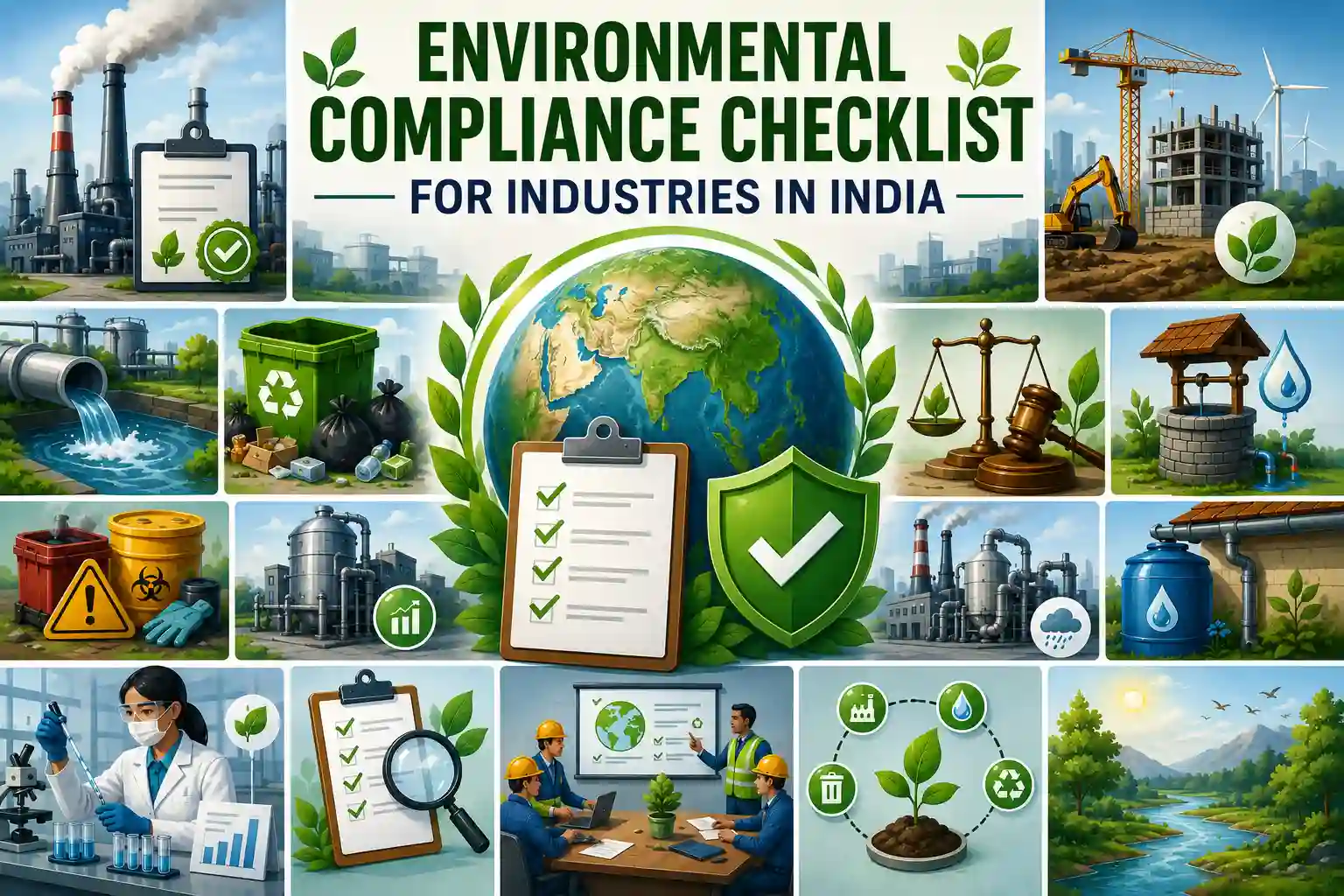
Industries in India are required to comply with multiple environmental regulations governing pollution control, groundwater extraction, waste management, emissions, hazardous waste handling, and environmental approvals.
Manufacturing units, warehouses, infrastructure projects, commercial establishments, industrial parks, processing units, hotels, hospitals, and construction projects may require several environmental approvals and ongoing compliance obligations before and during operations.
Failure to comply with environmental regulations may result in:
- Regulatory notices
- Environmental compensation
- SPCB enforcement action
- Project delays
- Operational restrictions
- Closure directions
- NGT proceedings
This guide provides a practical environmental compliance checklist for industries operating in India.
Why Environmental Compliance is Important
Environmental compliance helps industries:
- Avoid legal and regulatory risks
- Reduce environmental liability
- Improve operational sustainability
- Avoid Pollution Control Board penalties
- Maintain uninterrupted operations
- Improve environmental governance
- Reduce risk of NGT proceedings
Environmental enforcement in India has significantly increased through SPCBs, CPCB, CGWA, MoEFCC, and NGT oversight mechanisms.
Environmental Compliance Checklist for Industries
1. Environmental Clearance (EC)
Industries and projects covered under EIA Notification 2006 may require prior Environmental Clearance approval before project establishment or expansion.
Projects commonly requiring EC include:
- Mining projects
- Infrastructure projects
- Industrial estates
- Chemical industries
- Large manufacturing facilities
- Building & construction projects
Checklist :-
- Determine EC applicability under EIA Notification 2006
- Identify Category A or Category B project classification
- Conduct EIA study (if applicable)
- Prepare Environmental Management Plan (EMP)
- Conduct public hearing process (where applicable)
- Obtain Environmental Clearance approval
- Submit periodic EC compliance reports
2. Consent to Establish (CTE)
Industries generating pollution commonly require Consent to Establish (CTE) approval before construction or installation.
Checklist :-
- Identify SPCB applicability
- Determine Red / Orange / Green / White / Blue category
- Prepare pollution control infrastructure plan
- Submit CTE application through SPCB portal
- Obtain Pollution Board NOC before project establishment
- Install approved pollution control systems
3. Consent to Operate (CTO)
Industries generally require Consent to Operate (CTO) approval before commencing operations.
Checklist :-
- Install pollution control systems
- Conduct environmental monitoring
- Submit CTO application
- Maintain wastewater treatment systems
- Maintain air pollution control systems
- Renew CTO within validity period
- Comply with consent conditions
4. Groundwater NOC / Borewell Permission
Industries extracting groundwater through borewells or tube wells may require groundwater extraction permission.
Checklist :-
- Assess Groundwater NOC applicability
- Conduct water balance study
- Install rainwater harvesting systems
- Prepare hydrogeological assessment
- Obtain CGWA / State Groundwater Authority approval
- Monitor groundwater extraction quantity
5. Hazardous Waste Authorization
Industries generating hazardous waste commonly require authorization under Hazardous Waste Management Rules.
Checklist :-
- Identify hazardous waste category
- Maintain waste storage area
- Execute agreements with authorized recyclers
- Maintain manifest records
- Submit annual hazardous waste returns
- Ensure scientific disposal of hazardous waste
6. EPR (Extended Producer Responsibility) Compliance
Manufacturers, importers, and brand owners using regulated materials may require EPR registration.
Applicable EPR categories may include:
- Plastic Waste EPR
- E-Waste EPR
- Battery Waste EPR
- Used Oil EPR
- Waste Tyre EPR
Checklist :-
- Determine EPR applicability
- Register on CPCB EPR portal
- Identify packaging/material category
- Fulfill recycling obligations
- Maintain EPR certificates
- File annual returns and compliance reports
7. STP / ETP Compliance
Industries generating sewage or industrial effluent are generally required to maintain proper treatment systems.
Checklist :-
- Install STP / ETP systems
- Conduct periodic water analysis
- Maintain sludge disposal records
- Reuse treated water where applicable
- Monitor treated water quality
- Maintain operational logs
8. Air Pollution Control Compliance
Industries generating emissions must maintain air pollution control systems and emission monitoring mechanisms.
Checklist :-
- Install APCDs (Air Pollution Control Devices)
- Maintain stack monitoring records
- Conduct ambient air quality monitoring
- Monitor DG set emissions
- Comply with emission standards
9. Solid Waste Management Compliance
Industries generating solid waste must ensure proper segregation, handling, and disposal.
Checklist :-
- Segregate waste at source
- Maintain waste disposal records
- Ensure authorized disposal/recycling
- Prevent open dumping or burning
- Maintain housekeeping and waste storage systems
10. Rainwater Harvesting & Water Conservation
Many projects are required to implement groundwater recharge and water conservation measures.
Checklist :-
- Install rainwater harvesting systems
- Implement recharge structures
- Monitor water consumption
- Promote treated water reuse
- Maintain recharge system records
11. Environmental Monitoring & Reporting
Industries are increasingly required to conduct environmental monitoring and periodic reporting.
Checklist :-
- Conduct stack monitoring
- Conduct wastewater analysis
- Maintain laboratory reports
- Submit EC compliance reports
- Submit SPCB compliance reports
- Maintain online monitoring systems (where applicable)
12. Environmental Audit & Compliance Review
Periodic environmental audits help industries identify compliance gaps and regulatory risks.
Checklist :-
- Review environmental approvals
- Review consent validity periods
- Verify pollution control system performance
- Conduct internal compliance review
- Maintain environmental records and documentation
Common Environmental Compliance Mistakes by Industries
Industries commonly face enforcement action due to:
- Expired CTO approvals
- Operating without CTE
- Illegal groundwater extraction
- Non-functional STP/ETP systems
- Improper hazardous waste disposal
- Failure to submit compliance reports
- Non-compliance with EC conditions
- Missing environmental monitoring records
Recent NGT and SPCB enforcement trends show increasing scrutiny over industrial environmental compliance.
How Industries Can Improve Environmental Compliance
Industries should focus on:
- Timely approval renewals
- Proper environmental documentation
- Environmental monitoring systems
- Waste management compliance
- Groundwater management
- Internal compliance audits
- Employee environmental awareness
Proactive environmental compliance significantly reduces operational and legal risks.
Related Guides & Resources
- Environmental Clearance & EIA →
- Groundwater & Water NOC →
- Pollution Control Compliance →
- EPR & Waste Management →
- Environmental Laws & Notifications →
Need Help with Environmental Compliance?
Simplicomp provides support for:
- Environmental Clearance (EC)
- CTE & CTO approvals
- Groundwater NOC approvals
- EPR registration
- Hazardous waste compliance
- Environmental monitoring
- SPCB compliance management
- Environmental audits and reporting