

Introduction
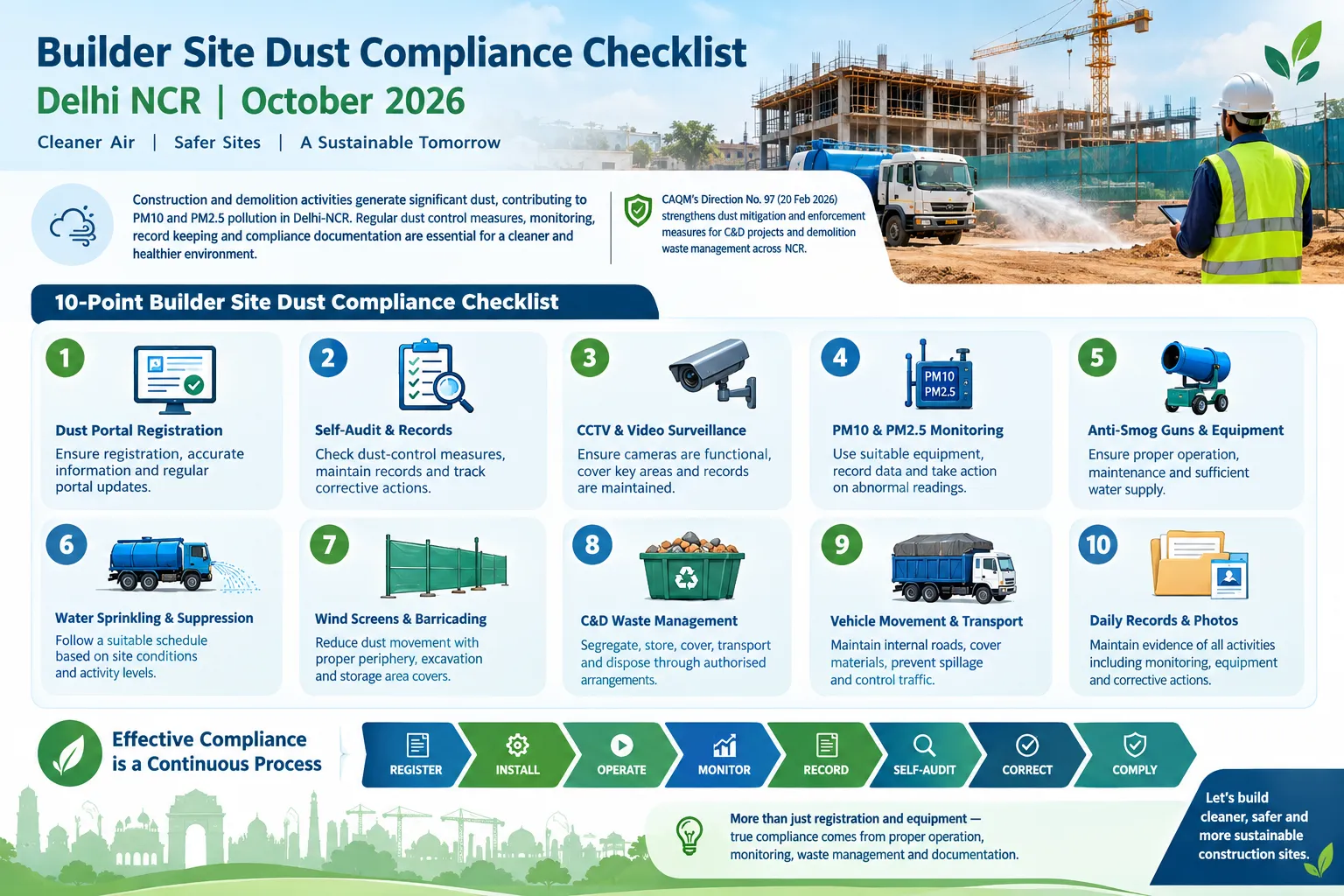
Construction and demolition activities are an important source of particulate matter in Delhi-NCR. Dust generated from excavation, demolition, material handling, construction traffic, stockpiles, loading and unloading can contribute to PM10 and PM2.5 pollution when effective control measures are not maintained.
For builders, developers, contractors and infrastructure project proponents, dust control is therefore not limited to installing equipment at the site. Regular operation of dust-control systems, monitoring, record keeping, self-assessment and compliance documentation are equally important.
In 2026, the Commission for Air Quality Management (CAQM) has continued to strengthen dust mitigation and enforcement measures for construction and demolition activities across NCR. CAQM's Direction No. 97, issued on 20 February 2026, specifically addresses dust mitigation in C&D projects and management of demolition waste.
Why Dust Compliance Is Important at Construction Sites
Construction sites can generate dust from several activities, including:
- Excavation and earthwork
- Demolition of existing structures
- Cutting, drilling and grinding
- Handling of sand, cement and aggregates
- Loading and unloading of construction materials
- Movement of construction vehicles
- Material stockpiling
- Debris handling
- Unpaved internal roads
- Transportation of C&D waste
Without suitable controls, these activities can increase dust emissions and affect surrounding roads, neighbouring properties and local air quality.
CAQM has noted that dust from C&D activities remains a significant contributor to PM10 and PM2.5 levels in NCR, while inspections have identified gaps particularly in the handling and transportation of C&D materials and demolition debris.
10-Point Builder Site Dust Compliance Checklist
A construction project should regularly review the following areas as part of its dust-control compliance programme.
1. Dust Portal Registration
Applicable construction and demolition projects should verify their registration requirements under the relevant dust-control portal and regulatory directions.
The project should maintain accurate registration information and ensure that details submitted through the portal correspond with the actual project.
Registration should not be treated as a one-time compliance activity. Project teams should continue to monitor portal-related requirements, submissions and records throughout the construction period.
2. Regular Self-Audit and Record Maintenance
Dust-control compliance should be checked regularly at the project site.
A self-audit can cover:
- Dust suppression arrangements
- Water sprinkling
- Site barricading
- Wind screens
- Material storage
- Vehicle movement
- Wheel-washing arrangements, where applicable
- C&D waste handling
- CCTV/video monitoring
- Particulate matter monitoring
- Housekeeping
- Record availability
The observations should be documented and corrective actions should be tracked.
Maintaining records is important because compliance should be demonstrable through site-level evidence rather than only through installed infrastructure.
For a broader framework for reviewing environmental compliance gaps, project teams can also refer to the Environmental Compliance Checklist for Industries in India.
3. CCTV and Video Surveillance
Video surveillance can support monitoring of dust-control practices at construction sites.
Where required or applicable, the project should ensure that cameras are:
- Properly positioned
- Operational
- Capable of covering relevant site areas
- Connected as required
- Maintained without prolonged downtime
- Supported by accessible records
CCTV coverage can help demonstrate the implementation of dust-control measures and identify activities that may require corrective action.
4. PM10 and PM2.5 Monitoring
Particulate matter monitoring is an important component of construction-site dust management.
Depending on the applicable project requirements, monitoring may involve PM10 and PM2.5 measurements through suitable monitoring equipment.
The project team should ensure that:
- Monitoring equipment is functional
- Monitoring locations are appropriate
- Data is recorded properly
- Equipment maintenance is documented
- Abnormal readings are reviewed
- Corrective action is taken where necessary
Monitoring should be integrated with actual dust-control practices instead of being treated only as a data-collection exercise.
5. Anti-Smog Guns and Dust Suppression Equipment
Anti-smog guns or other suitable dust-suppression systems may be required depending on project characteristics and applicable requirements.
Their effectiveness depends on proper operation.
The project should review:
- Equipment capacity
- Location
- Operating frequency
- Water availability
- Coverage area
- Maintenance condition
- Operating records
Simply keeping an anti-smog gun at the site does not demonstrate effective dust control if it is not being operated appropriately.
6. Water Sprinkling and Regular Dust Suppression
Water sprinkling can help control dust from exposed surfaces, internal roads, material handling areas and other dust-generating locations.
The project should establish a practical water-sprinkling schedule based on:
- Site conditions
- Weather
- Construction activity
- Traffic movement
- Exposed soil
- Dust generation levels
Water should be applied in a controlled manner to suppress dust without creating unnecessary waterlogging or drainage problems.
Where groundwater is used for project requirements, the applicable Groundwater Extraction Permission in India: Regulatory Requirements, Approvals & Compliance requirements should also be considered.
7. Wind Screens, Barricading and Site Enclosures
Construction sites should use suitable barricading and wind-control arrangements where required.
These measures can help reduce the movement of dust outside the project boundary.
Particular attention should be given to:
- Site periphery
- Excavation areas
- Material storage zones
- Demolition areas
- High-dust activity zones
- Areas exposed to strong winds
The condition and continuity of barricading should be checked regularly.
8. Construction and Demolition Waste Management
C&D waste should be handled, stored and transported in a controlled manner.
Waste management practices should address:
- Segregation
- Temporary storage
- Covering of waste where appropriate
- Controlled loading
- Transportation
- Avoidance of open dumping
- Prevention of debris accumulation
- Use of authorised disposal or processing arrangements, as applicable
CAQM's Direction No. 97 specifically links dust mitigation with improved management of demolition waste in NCR.
The Environment (Construction and Demolition) Waste Management Rules, 2025, referenced by CAQM, became effective from 1 April 2026 and strengthen the regulatory framework for C&D waste management.
9. Vehicle Movement and Material Transportation
Construction vehicles can become a significant source of dust, particularly when they move over unpaved or dusty internal roads.
The site should control dust generated from vehicle movement through appropriate measures such as:
- Water sprinkling
- Internal road maintenance
- Covered transportation of dusty materials
- Controlled vehicle movement
- Cleaning of vehicle tyres where applicable
- Prevention of material spillage
- Proper loading practices
Construction material and debris should be transported in a manner that minimises dust release during movement.
10. Daily Photo, Video and Compliance Records
Daily records can provide useful evidence of actual implementation.
Depending on the project's requirements, records may include:
- Dust-control activity photographs
- CCTV records
- PM monitoring data
- Water-sprinkling records
- Equipment operation records
- C&D waste movement records
- Self-audit reports
- Corrective-action records
- Site inspection observations
A consistent documentation system makes it easier for project management teams to identify gaps and demonstrate compliance during inspections.
Dust Compliance Is More Than Registration and Equipment
One of the most important aspects of construction-site environmental compliance is understanding that registration or equipment installation alone does not establish effective compliance.
A project may have a registered site, CCTV cameras, anti-smog guns and monitoring equipment, but still face compliance concerns if:
- Equipment is not operational
- Water sprinkling is irregular
- Dust-generating activities are uncontrolled
- C&D waste is improperly stored
- Monitoring data is not maintained
- Corrective actions are not documented
- Site conditions do not match declared information
Effective compliance requires a continuous cycle:
REGISTER → INSTALL → OPERATE → MONITOR → RECORD → SELF-AUDIT → CORRECT → COMPLY
Construction Site Inspection Readiness
An inspection-ready site should be able to demonstrate both physical implementation and supporting documentation.
Before an inspection, project teams should verify:
- Dust-control equipment is operational
- Water sprinkling is being carried out
- Barricading is maintained
- Construction materials are properly managed
- C&D waste is controlled
- Vehicle movement is managed
- CCTV/video systems are functional
- PM monitoring records are available
- Self-audit records are updated
- Corrective actions have been closed or are being tracked
The site should also ensure that responsible personnel understand the project's dust-control procedures and can provide relevant records when required.
For broader site-level compliance review, an Environmental Audit for Industries: Types, Process & Compliance Benefits approach can help identify documentation and implementation gaps.
Dust Compliance During Different Construction Activities
Dust-control requirements should be considered throughout the project lifecycle rather than only during major construction stages.
Excavation and Earthwork
Exposed soil and excavation activities can generate substantial dust. Water suppression, covering or stabilisation of exposed surfaces and controlled vehicle movement can help reduce emissions.
Demolition
Demolition can generate significant quantities of fine particulate matter and debris. Dust suppression and controlled handling of demolition waste are particularly important during this phase.
Material Storage
Sand, aggregates, soil and other dusty materials should be stored and managed in a manner that minimises wind-blown dust.
Building Construction
Cutting, drilling, grinding and material handling can generate localised dust. Appropriate controls should be implemented at the source.
Internal Transportation
Vehicle movement on dusty surfaces can resuspend settled material. Maintaining internal roads and applying suitable dust suppression measures can reduce this source.
Impact of GRAP on Construction Activities
Dust compliance becomes particularly important during periods of poor air quality in Delhi-NCR.
The revised GRAP framework includes dust mitigation measures for C&D sites at Stage I. At higher stages, restrictions on construction and demolition activities may become applicable depending on the prevailing air-quality conditions and the notified GRAP stage.
Therefore, construction companies should monitor applicable CAQM/GRAP directions and be prepared to implement additional measures or restrictions when required.
Regulatory Monitoring in Delhi-NCR
Dust compliance in NCR is subject to monitoring and enforcement by relevant authorities, including CAQM, State Pollution Control Boards, DPCC and concerned local bodies, depending on the location and nature of the project.
CAQM's enforcement framework has also been strengthened for smaller C&D sites. In August 2026, CAQM announced an amendment extending enforcement against gross violations at C&D sites with plot areas below 500 sq. m. and expanded prosecution-related powers to additional NCR local bodies.
This highlights the importance of not treating dust compliance as applicable only to large construction projects.
Consequences of Poor Dust Compliance
Failure to implement applicable dust-control requirements can result in regulatory action depending on the nature and severity of the violation.
Potential consequences may include:
- Notices or directions
- Environmental compensation
- Restrictions on project activities
- Corrective-action requirements
- Additional inspections
- Prosecution in applicable cases
- Project delays
- Reputational impact
The exact consequences depend on the applicable regulations, directions, project circumstances and nature of the violation.
For understanding how environmental compensation can arise from non-compliance, see Environmental Compensation Explained in India: When Industries Can Be Penalized.
Practical Monthly Dust Compliance Review
A monthly review can help project teams maintain continuous compliance.
The review may cover:
- Portal registration and project details
- Self-audit status
- CCTV/video surveillance
- PM10/PM2.5 monitoring
- Anti-smog gun operation
- Water sprinkling
- Barricading and wind screens
- C&D waste management
- Vehicle and material transportation
- Daily photographs and records
- Previous inspection observations
- Corrective-action status
The checklist should be adapted according to the applicable project requirements and regulatory directions.
How SimpliComp Can Help With Construction Dust Compliance
SimpliComp supports builders, developers, infrastructure companies and construction projects with environmental compliance and dust-management requirements.
Our support can include:
- Dust Portal Registration
- Construction-Site Dust Compliance Audit
- C&D Waste Compliance Support
- Anti-Smog Gun Assessment
- CCTV / Video Monitoring Compliance
- PM10 / PM2.5 Monitoring Support
- Site Inspection Readiness Assessment
- Dust-Control Documentation
- Compliance Record Review
- Corrective-Action Guidance
- Environmental Compliance Coordination
Our approach focuses on helping project teams establish practical site-level systems for implementation, monitoring and documentation.
Conclusion
Construction-site dust compliance in Delhi-NCR requires continuous attention throughout the project lifecycle. Registration, monitoring equipment and dust-control infrastructure are only part of the compliance framework. Effective operation, regular monitoring, C&D waste management, self-audits and proper documentation are equally important.
With CAQM continuing to strengthen dust mitigation and enforcement measures across NCR in 2026, builders and infrastructure project proponents should maintain an active compliance system rather than responding only when an inspection occurs.
A well-maintained dust compliance programme can help construction projects reduce particulate emissions, improve inspection readiness and maintain better environmental management throughout the construction period.
Related Guides & Resources
- Consent to Establish Process →
- Pollution Control Board Consent Conditions →
- Pollution Control Compliance →
- EPR & Waste Management →
- Environmental Laws & Notifications →
Need Help with Environmental Compliance?
Simplicomp provides support for:
- Consent to Establish (CTE) Approval
- Consent to Operate (CTO) Approval
- Consolidated Consent & Authorisation (CCA) Approval
- Factory Act License/Approvals
- Fire Safety NOC