

Introduction
Groundwater is an essential resource for industries, commercial establishments, infrastructure projects, and residential developments across Haryana. Businesses extracting groundwater through borewells must obtain the applicable permission and comply with the conditions prescribed by the Haryana Water Resources Authority (HWRA). Understanding groundwater extraction permission requirements in India is important before depending on groundwater for business operations.
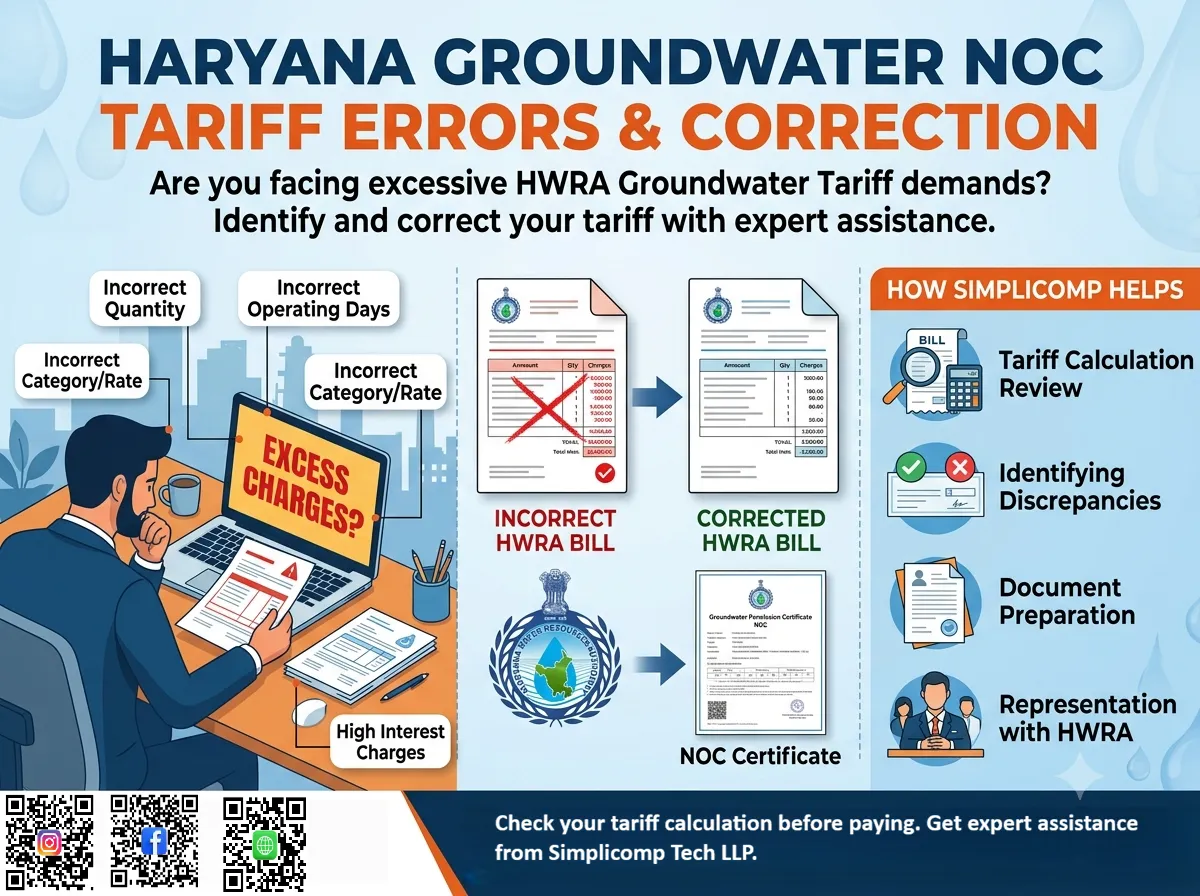
However, obtaining a Groundwater Permission Certificate may involve another financial obligation: the groundwater extraction tariff. Some applicants receive demands that appear higher than expected due to discrepancies in extraction quantities, operating days, applicable tariff rates, or previous payment records.
Simplicomp Environmental Compliance Company assists businesses in reviewing HWRA groundwater tariff assessments, identifying potential calculation errors, preparing supporting documents, and coordinating with the concerned authority.
What Is the HWRA Groundwater Extraction Tariff?
The groundwater extraction tariff is the amount payable for permitted groundwater extraction under the applicable regulatory framework. The assessment may depend on:
- Approved groundwater extraction quantity.
- Applicable tariff rate and category.
- Relevant extraction or operating period.
- Conditions specified in the permission.
- Previous outstanding tariff, where applicable.
Businesses should verify that the demand accurately reflects their approved extraction requirements and applicable regulatory provisions. If the assessed amount appears inconsistent with the permission or application, reviewing the calculation can help identify issues requiring clarification.
How Is the Groundwater Tariff Calculated?
A simplified representation of groundwater tariff calculation is:
Groundwater Tariff = Applicable Rate × Approved Groundwater Quantity × Applicable Number of Days
The actual methodology may vary according to applicable tariff provisions, extraction category, approved quantity, and other assessment parameters. Businesses should examine the detailed calculation and relevant permission conditions rather than relying only on the final payable amount.
A water balance study can help document water requirements and compare recorded consumption with approved groundwater extraction details.
Why Is a Detailed Tariff Review Important?
The final demand may be affected by extraction quantity, tariff rate, operating period, and previous outstanding amounts. An error in any parameter can influence the total assessment. Businesses should compare the demand with their approved requirements and applicable tariff methodology to determine whether clarification or a correction request is necessary.
Common Problems in HWRA Groundwater Tariff Calculations
1. Incorrect Groundwater Extraction Quantity
If the calculation considers a higher groundwater quantity than the approved requirement, the demand may exceed the amount expected by the applicant. Businesses should compare the quantity stated in their application, Groundwater Permission Certificate, and tariff assessment. Any mismatch should be documented with supporting records.
2. Incorrect Number of Operating Days
The number of days used in the assessment can significantly affect the total tariff. Applicants should verify whether the period considered is consistent with the applicable tariff methodology and permission conditions. Relevant dates and operating records can support a request for clarification.
3. Incorrect Tariff Rate or Category
Groundwater tariffs may vary according to the applicable category, extraction purpose, or regulatory classification. Businesses should confirm that the rate matches the provisions relevant to their permission. The groundwater categorization guide can help applicants understand groundwater assessment-area classification where relevant.
4. Mismatch Between Application and Tariff Assessment
Differences between application details and the tariff assessment may involve water requirements, extraction sources, or operating details. Comparing the application, approval documents, and demand calculation can help identify the discrepancy and determine the clarification required.
5. Incorrect Previous Tariff Balance
An unadjusted payment, incorrect opening balance, or discrepancy in earlier records may affect the current payable amount. Businesses should retain previous assessments, payment receipts, and correspondence to support verification.
Interest on Groundwater Tariff: Additional Financial Exposure
Applicants may face interest charges if payment is delayed beyond the prescribed period. The applicable provisions may specify an interest rate linked to the State Bank of India's Marginal Cost of Funds Based Lending Rate (MCLR), together with an additional component. The exact rate, commencement date, and calculation method should be verified against the applicable rules and the demand issued by HWRA.
Why Interest Requires Prompt Attention
When a substantial demand contains a possible calculation error, businesses may need time to review records and seek clarification. Meanwhile, payment deadlines and applicable interest provisions may create additional financial pressure.
- An incorrectly assessed principal amount may increase the demand.
- Delayed payment may lead to additional interest, where applicable.
- Unresolved discrepancies can create uncertainty about the payable amount.
- Businesses may face difficulties in financial planning and compliance management.
Submitting a correction request does not automatically suspend the payment deadline or stop interest from accruing. Applicants should seek written clarification from HWRA regarding their payment obligations while the discrepancy is under review.
Why Businesses Should Not Ignore an Incorrect Tariff Demand
An unresolved groundwater tariff issue can affect financial planning, compliance records, and groundwater-dependent operations. Businesses should identify the disputed parameter, gather supporting evidence, and submit a documented request for clarification or correction through the applicable procedure.
Understanding groundwater laws and regulations in India can also help businesses review their ongoing responsibilities and the conditions associated with groundwater extraction permissions.
How Simplicomp Helps Review HWRA Groundwater Tariff Discrepancies
Simplicomp Environmental Compliance Company assists businesses with groundwater permissions and related environmental compliance requirements. Our support includes reviewing tariff assessments, identifying potential discrepancies, organising evidence, and assisting with representations to the concerned authority.
1. Groundwater Permission Review
We examine the Groundwater Permission Certificate, application details, and approval documents to understand the approved extraction quantity, borewell details, applicable category, and permission conditions.
2. Tariff Calculation Verification
We compare the HWRA tariff assessment with available approval records and applicable calculation parameters, including quantity, tariff rate, relevant number of days, and previous balances. Where necessary, the calculation can be reconstructed to identify differences requiring clarification.
3. Identification of Potentially Excessive Charges
We help businesses understand the difference between the assessed amount and the amount that may be applicable under the relevant provisions. Any proposed correction should be supported by the applicable tariff methodology and project records.
4. Supporting Documentation
Depending on the case, relevant documents may include:
- Groundwater Permission Certificate.
- Application and approval records.
- Tariff demand and calculation details.
- Groundwater extraction requirements.
- Previous payment receipts.
- Correspondence with HWRA.
- Supporting technical or operational records.
Businesses can also consult the Groundwater NOC and borewell permission documents checklist to understand relevant documentation requirements.
5. Representation and Follow-Up
Simplicomp assists in preparing representations that explain the discrepancy, supporting calculations, and correction requested. We also help organise follow-up communication and responses to queries raised during the review process. The final decision regarding tariff correction or interest adjustment remains with the competent authority.
6. Revised Demand and Payment Clarification
If a correction is accepted, businesses should verify the revised demand, payment requirements, and applicable adjustments. We assist with reviewing the revised assessment and maintaining relevant compliance records.
HWRA Groundwater Tariff Review: Compliance Checklist
Before accepting or paying a substantial groundwater tariff demand, businesses should review the following:
- Confirm the approved groundwater extraction quantity.
- Verify the applicable tariff rate and category.
- Check the number of days used in the calculation.
- Compare the demand with permission conditions.
- Verify previous outstanding balances and payment adjustments.
- Review interest calculations and payment deadlines.
- Collect application, approval, and payment records.
- Prepare supporting calculations for identified discrepancies.
- Submit a clarification or correction request, where justified.
- Obtain written clarification regarding payment obligations during the review.
The applicability of these checks depends on the project's permission conditions and relevant regulatory provisions.
Conclusion
HWRA groundwater tariff discrepancies can create financial uncertainty when assessment parameters are not properly verified. Reviewing the approved extraction quantity, tariff rate, applicable period, previous balances, and interest calculation can help identify issues requiring clarification.
Businesses should maintain complete records, act promptly, and follow the applicable procedure when requesting a correction. Simplicomp can help organise supporting documentation, review tariff calculations, and prepare a clear representation for the concerned authority.
For assistance with groundwater permission compliance or an HWRA tariff assessment review, contact Simplicomp Environmental Compliance Company to discuss your requirements.
Related Guides & Resources
- Groundwater Noc Process →
- Groundwater Depletion Sustainable Development →
- Groundwater Recharge →
- Groundwater Annual Compliance Returns →
Need Help with Is Your HWRA NOC Tariff Calculated Incorrectly?
Simplicomp provides support for:
- Tariff Calculation Review
- Identifying Discrepancies
- Document Preparation
- Document Preparation
- Groundwater NOC
Need help reviewing your tariff calculation or NOC compliance? Let Simplicomp Tech LLP handle it for you! 🛡️