

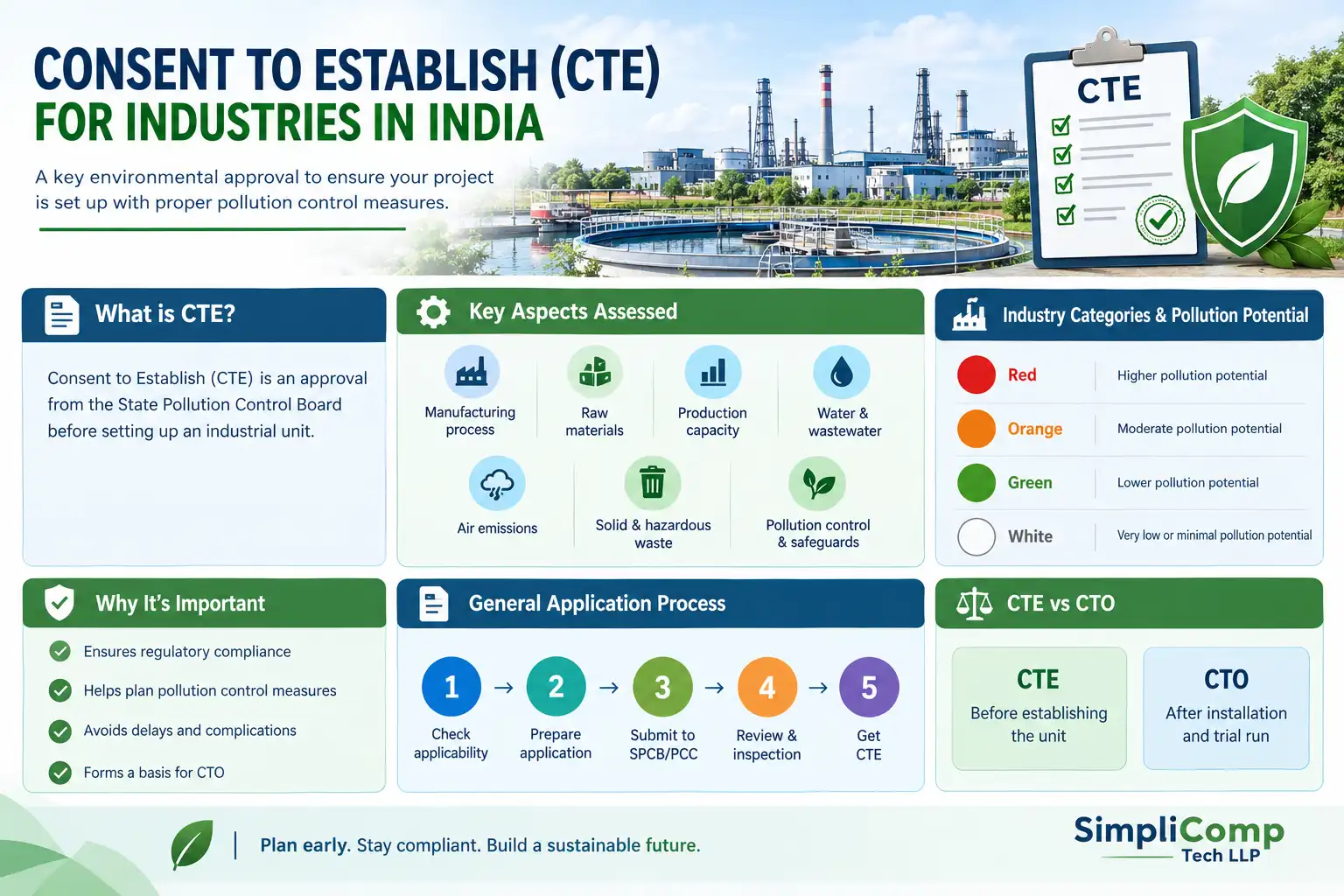
Consent to Establish (CTE) for Industries in India
Setting up a new industrial unit involves much more than selecting a site, installing machinery and commencing production. Industries with pollution potential may need to obtain several statutory approvals before construction, installation and commercial operations can begin.
One of the important environmental approvals for eligible industries is Consent to Establish (CTE) from the concerned State Pollution Control Board (SPCB) or Pollution Control Committee, as applicable.
CTE is intended to ensure that a proposed industrial unit has made appropriate arrangements for controlling pollution before the unit is established and starts operations.
Depending on the project, the regulatory process may also involve Environmental Clearance (EC), building permissions, groundwater approvals, hazardous waste authorization, factory-related approvals and other statutory permissions.
Therefore, CTE should be considered as part of the overall environmental compliance strategy for establishing an industrial project.
This guide explains the importance of Consent to Establish for industries, who may need it, the general application process, documents, industry categorization, CTE versus CTO, common mistakes and how SimpliComp can assist.
What Is Consent to Establish (CTE)?
Consent to Establish (CTE) is an approval issued by the concerned Pollution Control Board to eligible industrial units before they establish a project or undertake activities covered by the applicable pollution-control requirements.
The consent mechanism is associated with the requirements of the:
- Water (Prevention and Control of Pollution) Act, 1974
- Air (Prevention and Control of Pollution) Act, 1981
- Applicable rules, regulations and directions
- State Pollution Control Board procedures
The purpose of CTE is to assess the proposed project's pollution potential and the environmental management arrangements planned by the project proponent.
The Pollution Control Board may review aspects such as:
- Proposed manufacturing process
- Raw materials
- Production capacity
- Water consumption
- Wastewater generation
- Air emissions
- Fuel usage
- Pollution-control equipment
- Solid waste
- Hazardous waste
- Noise
- Sewage and effluent treatment
- Other environmental safeguards
The exact requirements depend on the industry, state and applicable regulatory framework.
Why Is Consent to Establish Important?
CTE plays an important role in the environmental planning of an industrial project.
Before establishing a pollution-potential unit, the project proponent should determine the applicable consent requirements and obtain the required approval from the competent authority.
CTE helps the regulator evaluate whether the proposed project has adequately planned for pollution prevention and control.
For the industry, obtaining CTE at the appropriate stage can help:
- Establish regulatory compliance before setting up the unit
- Identify pollution-control requirements early
- Plan environmental infrastructure
- Avoid regulatory complications
- Coordinate environmental approvals
- Reduce the risk of project delays
- Establish a framework for subsequent CTO compliance
It also allows environmental requirements to be incorporated into the project's design instead of being addressed only after installation.
Who Needs Consent to Establish?
The applicability of CTE depends on the nature of the proposed activity and the requirements of the concerned Pollution Control Board.
Industries are commonly categorized according to their pollution potential.
The source material refers to the following broad categories:
- Red
- Orange
- Green
- White
The pollution index framework is used to classify industries according to their pollution potential.
However, the exact applicability, category and consent requirements should be checked against the latest CPCB classification and the concerned SPCB/PCC provisions.
Industry Categories and Pollution Potential
Red Category
Red-category industries generally represent activities with comparatively higher pollution potential.
Such industries may involve:
- Significant air emissions
- Industrial effluent
- Hazardous waste
- High resource consumption
- Complex manufacturing processes
These projects usually require careful environmental planning and pollution-control measures.
Orange Category
Orange-category industries have moderate pollution potential.
The applicable consent requirements depend on the activity, production capacity and state-specific provisions.
Green Category
Green-category industries generally have lower pollution potential than Red and Orange categories.
However, being in the Green category does not automatically mean that all environmental approvals are unnecessary.
White Category
White-category activities are generally considered to have very low or practically minimal pollution potential under the applicable classification.
The exact consent requirement should still be verified with the relevant Pollution Control Board because procedures and exemptions can vary.
CTE vs CTO: What Is the Difference?
One of the most common questions among new industries is the difference between Consent to Establish (CTE) and Consent to Operate (CTO).
The basic distinction is:
| Consent to Establish (CTE) | Consent to Operate (CTO) |
|---|---|
| Obtained before establishing the unit | Obtained before starting regulated operations/production |
| Focuses on the proposed project | Focuses on actual operation |
| Reviews proposed pollution-control arrangements | Reviews operational pollution-control compliance |
| Based on proposed capacity/process | Based on installed/operational capacity and actual arrangements |
| Supports establishment of the project | Permits operation subject to applicable conditions |
In simple terms:
CTE = Permission/consent to establish the proposed unit
CTO = Consent to operate the established unit
The exact sequence and terminology can vary depending on the applicable state procedure.
CTE and Environmental Clearance Are Different
CTE and Environmental Clearance are not the same approval.
Environmental Clearance is governed by the applicable EIA framework and is required for projects covered by the relevant schedule and conditions.
Consent to Establish is issued by the Pollution Control Board under the applicable pollution-control laws and procedures.
A project may require both.
For example, an industrial project may need:
- Environmental Clearance
- Consent to Establish
- Groundwater permission/NOC, where applicable
- Hazardous waste authorization
- Factory-related approvals
- Fire approval
- Building approval
- Other statutory permissions
Therefore, project proponents should prepare a complete approval matrix instead of assuming that obtaining one environmental approval eliminates the need for others.
What Does the Pollution Control Board Check During CTE?
The Pollution Control Board may evaluate several aspects of the proposed project.
These can include:
Manufacturing Process
The proposed production process is reviewed to understand potential sources of pollution.
Raw Materials
Details of raw materials and their quantities may be required.
Production Capacity
The proposed production capacity is an important component of the consent application.
Water Requirement
The application may include details of:
- Freshwater requirement
- Process water
- Domestic water
- Water balance
- Wastewater generation
Effluent Management
Where industrial effluent is generated, the proposed treatment and disposal/reuse system should be described.
Air Pollution Control
The project may need to provide details regarding:
- Fuel
- Boilers
- Furnaces
- DG sets
- Process emissions
- Air pollution-control equipment
Waste Management
The application may need to address:
- Solid waste
- Hazardous waste
- Process waste
- Used oil
- Sludge
- Other applicable waste streams
Pollution-Control Equipment
Details of proposed pollution-control systems may be reviewed by the authority.
Documents Required for CTE Application
The exact documents vary according to the industry, state and project type.
Commonly required information may include:
- Application form
- PAN/GST/company details, where applicable
- Land ownership/lease documents
- Site plan
- Location map
- Layout plan
- Project report
- Manufacturing process flow
- Raw material details
- Product details
- Production capacity
- Water consumption details
- Water balance
- Wastewater generation details
- Effluent treatment proposal
- Air emission details
- Fuel consumption
- Air pollution-control equipment details
- Solid waste details
- Hazardous waste details
- Environmental Clearance, where applicable
- Environmental management information
- Capital investment details
- Other documents prescribed by the SPCB/PCC
The actual checklist should always be taken from the concerned authority's current procedure.
CTE Application Process
Although the exact process differs between states, the general CTE process can be understood through the following steps.
Step 1: Identify CTE Applicability
Determine whether the proposed industrial activity requires CTE.
Step 2: Determine Industry Category
Identify the applicable industry category according to the prevailing classification.
Step 3: Review Other Environmental Approvals
Check whether Environmental Clearance or any other prior approval is applicable.
Step 4: Prepare Project Details
Compile:
- Site information
- Production details
- Raw materials
- Manufacturing process
- Water requirement
- Wastewater
- Emissions
- Waste
- Pollution-control measures
Step 5: Prepare the CTE Application
Enter the required project information in the applicable SPCB/PCC online system or prescribed application format.
Step 6: Upload Documents
Submit the required technical and legal documents.
Step 7: Pay Applicable Fee
The consent fee is generally determined according to the applicable state rules, industry category and other prescribed parameters.
Step 8: Department Scrutiny
The Pollution Control Board reviews the application and may raise queries or request additional information.
Step 9: Site Inspection
Where required, the authority may conduct a site inspection or verification.
Step 10: Compliance With Queries
The project proponent should provide accurate responses and additional documents where requested.
Step 11: Grant of CTE
After satisfactory scrutiny, the authority may issue Consent to Establish with applicable conditions.
What Happens After Getting CTE?
Obtaining CTE does not mean that the project can ignore environmental requirements.
The project must establish the unit according to the approved proposal and comply with the conditions attached to the consent.
This may include installation of:
- Effluent Treatment Plant (ETP)
- Sewage Treatment Plant (STP)
- Air pollution-control equipment
- Hazardous waste storage systems
- Solid waste management systems
- Monitoring equipment
- Other environmental infrastructure
Any significant deviation from the approved project may require prior approval or amendment, depending on the applicable rules.
Consent to Operate After CTE
Once the industrial unit has been established and is ready to commence regulated operations, the project may need to obtain Consent to Operate (CTO).
At this stage, the Pollution Control Board can evaluate the actual environmental infrastructure and operational arrangements.
The project may need to demonstrate:
- Pollution-control equipment installed
- ETP/STP operational
- Waste-management systems implemented
- Emission-control systems functional
- Required monitoring arrangements in place
- Compliance with CTE conditions
- Actual production capacity
- Other applicable environmental safeguards
Validity of Consent to Establish
The validity of CTE is not necessarily identical across all states and projects.
It can depend on:
- State Pollution Control Board rules
- Industry category
- Project type
- Project conditions
- Environmental Clearance validity, where linked
- Specific conditions mentioned in the consent
Therefore, industries should always refer to the validity period mentioned in their issued CTE and the applicable state regulations.
CTE Fees
CTE fees can vary significantly depending on the applicable state regulations.
Factors may include:
- Industry category
- Capital investment
- Project type
- Pollution potential
- Proposed activity
- State-specific fee structure
For this reason, a single nationwide CTE fee cannot be stated for every industry.
The project proponent should calculate the applicable fee based on the current requirements of the concerned SPCB/PCC.
Common Reasons for Delay in CTE
CTE applications can face delays when project information is incomplete or inconsistent.
Some common issues include:
Incomplete Documents
Missing land, project or technical documents can result in queries.
Incorrect Project Details
Differences in production capacity, investment, raw materials or process information can lead to clarification requests.
Inadequate Pollution-Control Planning
The proposed environmental infrastructure should be appropriate for the project's pollution potential.
Incorrect Industry Classification
Selecting an incorrect category can affect the application and fee.
Missing Environmental Clearance
Where EC is applicable, the project should address the EC requirement before proceeding with the relevant consent process.
Poor Water Balance
Water consumption and wastewater generation should be properly calculated and supported.
Common Mistakes Industries Should Avoid
Starting the Project Without Required Consent
Industries should determine applicable consent requirements before beginning regulated establishment activities.
Applying Without Reviewing EC Applicability
Some projects may require EC in addition to CTE.
Providing Generic Technical Information
Project-specific manufacturing and pollution-control information is essential.
Incorrect Capital Investment
Since fees may depend on investment, inaccurate information can create problems.
Ignoring Waste Management
Hazardous and non-hazardous waste streams should be identified at the planning stage.
Not Planning for CTO
The pollution-control infrastructure proposed during CTE should also support the project's eventual CTO requirements.
CTE for New Industries
For a new industrial unit, environmental compliance should ideally begin during the project planning stage.
A new industry should assess:
- Site suitability
- Industry category
- EC applicability
- CTE applicability
- Water availability
- Wastewater treatment
- Air emissions
- Waste generation
- Pollution-control systems
- Future CTO requirements
CTE for Existing Industry Expansion
CTE may also become relevant when an existing unit proposes certain changes or expansion, depending on the applicable state requirements.
Examples may include:
- Production capacity enhancement
- New product
- Additional process
- Additional pollution source
- Expansion of plant area
- Change in manufacturing process
- Additional machinery
The existing consent should be reviewed before implementing such changes.
Role of an Environmental Consultant in CTE
Preparing a CTE application is not simply about filling out an online form.
The technical information submitted should accurately represent the proposed industrial activity and environmental management arrangements.
An environmental consultant can assist with:
- CTE applicability assessment
- Industry categorization
- EC applicability review
- Documentation
- Water balance preparation
- Wastewater assessment
- Air emission assessment
- Pollution-control planning
- Application preparation
- Online submission
- Query response
- Regulatory coordination
- CTE amendment support
- CTO planning
This can help project proponents avoid inconsistencies and reduce unnecessary delays.
How SimpliComp Helps With CTE
SimpliComp Tech LLP provides environmental consultancy and regulatory compliance support for industries seeking Consent to Establish and related environmental approvals.
Our CTE consultancy can cover the complete application lifecycle.
CTE Applicability Assessment
We assess the proposed industrial activity and identify the applicable consent requirements.
Industry Classification
We help evaluate the applicable pollution category based on the prevailing classification framework.
Documentation Support
Our team can assist in preparing the technical and supporting documents required for the application.
Pollution-Control Planning
We help identify suitable environmental management and pollution-control measures based on the proposed process.
Online Application Support
We can assist with preparing and submitting the application through the applicable State Pollution Control Board system.
Query and Compliance Support
If the authority raises observations or requests clarification, we assist in preparing appropriate responses.
CTO Planning
CTE should be planned with the subsequent CTO stage in mind. SimpliComp can also support industries in understanding the requirements for obtaining Consent to Operate.
Why Choose SimpliComp for CTE Consultancy?
Choosing the correct environmental approval route at the beginning can save time and reduce compliance risks.
SimpliComp approaches CTE applications by considering:
- Project type
- Industry category
- Production capacity
- Manufacturing process
- Water requirement
- Wastewater generation
- Air emissions
- Waste generation
- Pollution-control systems
- Applicable regulatory framework
Our objective is to provide a structured environmental compliance roadmap rather than treating CTE as an isolated documentation exercise.
CTE Compliance Checklist for Industries
Before submitting a CTE application, industries should review:
- Industry category identified
- CTE applicability confirmed
- EC applicability checked
- Land documents available
- Site plan prepared
- Layout prepared
- Manufacturing process documented
- Raw materials identified
- Product capacity calculated
- Water requirement calculated
- Water balance prepared
- Wastewater generation assessed
- ETP/STP requirements assessed
- Air emission sources identified
- Pollution-control equipment planned
- Solid waste identified
- Hazardous waste identified
- Investment details verified
- Applicable fee assessed
- Required documents compiled
Conclusion
Consent to Establish (CTE) is an important environmental approval for eligible industrial projects in India. It allows the concerned Pollution Control Board to evaluate the proposed project's pollution potential and planned environmental safeguards before the unit is established.
A successful CTE application requires more than basic documentation. The project must present accurate information about its manufacturing process, production capacity, raw materials, water requirement, wastewater, emissions, waste generation and pollution-control systems.
Industries should also understand that CTE is only one part of the overall environmental compliance framework. Depending on the project, Environmental Clearance, CTO, groundwater permissions, waste authorizations and other statutory approvals may also be applicable.
For this reason, environmental approvals should be assessed together during the project planning stage.
SimpliComp provides CTE consultancy and environmental compliance support for industries across India, helping project proponents understand applicable requirements, prepare documentation and navigate the regulatory process.
Related Guides & Resources
Need Help with CPCB Categorization & Pollution Board Approvals?
Simplicomp provides support for:
- CPCB categorization assessment
- CTE & CTO approvals
- Pollution Board NOC applications
- Environmental compliance audits
- Hazardous waste compliance
- Industrial compliance management