

Introduction
Groundwater is a vital source of water for industries, infrastructure projects, institutions, agriculture, and communities across India. As groundwater extraction continues to increase, regular monitoring has become essential to ensure that aquifers remain healthy and groundwater resources are used sustainably.
Groundwater monitoring involves the systematic observation, measurement, and evaluation of groundwater levels, groundwater quality, and groundwater extraction over time. It enables industries and regulatory authorities to understand how groundwater resources are changing and whether extraction remains within sustainable limits.
Many environmental approvals and groundwater extraction permissions require ongoing groundwater monitoring as part of their compliance obligations. By collecting reliable data, organizations can identify potential issues early, improve water management practices, and demonstrate compliance with applicable regulations.
What is Groundwater Monitoring?
Definition
Groundwater monitoring is the continuous or periodic collection and analysis of information relating to groundwater quantity, groundwater quality, and groundwater abstraction.
The purpose of monitoring is to understand how groundwater conditions change over time and to identify any adverse impacts resulting from groundwater extraction, industrial activities, or natural factors.
Groundwater monitoring provides scientific evidence that supports sustainable water management and informed decision-making.
Why is Groundwater Monitoring Important?
Groundwater conditions can change gradually over months or years. Without regular monitoring, declining groundwater levels or deteriorating water quality may remain undetected until significant environmental or operational problems occur.
Groundwater monitoring helps to:
- Track groundwater level fluctuations.
- Measure groundwater abstraction.
- Assess groundwater quality.
- Detect contamination at an early stage.
- Evaluate the effectiveness of groundwater recharge measures.
- Support sustainable groundwater management.
- Demonstrate regulatory compliance.
- Improve long-term water security.
Monitoring also provides valuable data for future planning and resource management.
Who Needs Groundwater Monitoring?
Groundwater monitoring is commonly undertaken by:
- Manufacturing industries
- Industrial parks
- Mining projects
- Commercial establishments
- Residential townships
- Infrastructure projects
- Hotels and resorts
- Hospitals
- Educational institutions
- Government agencies
The extent of monitoring depends on the project's groundwater use, applicable regulations, and approval conditions.
Objectives of Groundwater Monitoring
The primary objectives include:
- Assess groundwater availability
- Monitor groundwater abstraction
- Identify long-term groundwater trends
- Evaluate groundwater quality
- Detect contamination
- Assess recharge effectiveness
- Support groundwater conservation
- Maintain compliance with regulatory approvals
Types of Groundwater Monitoring
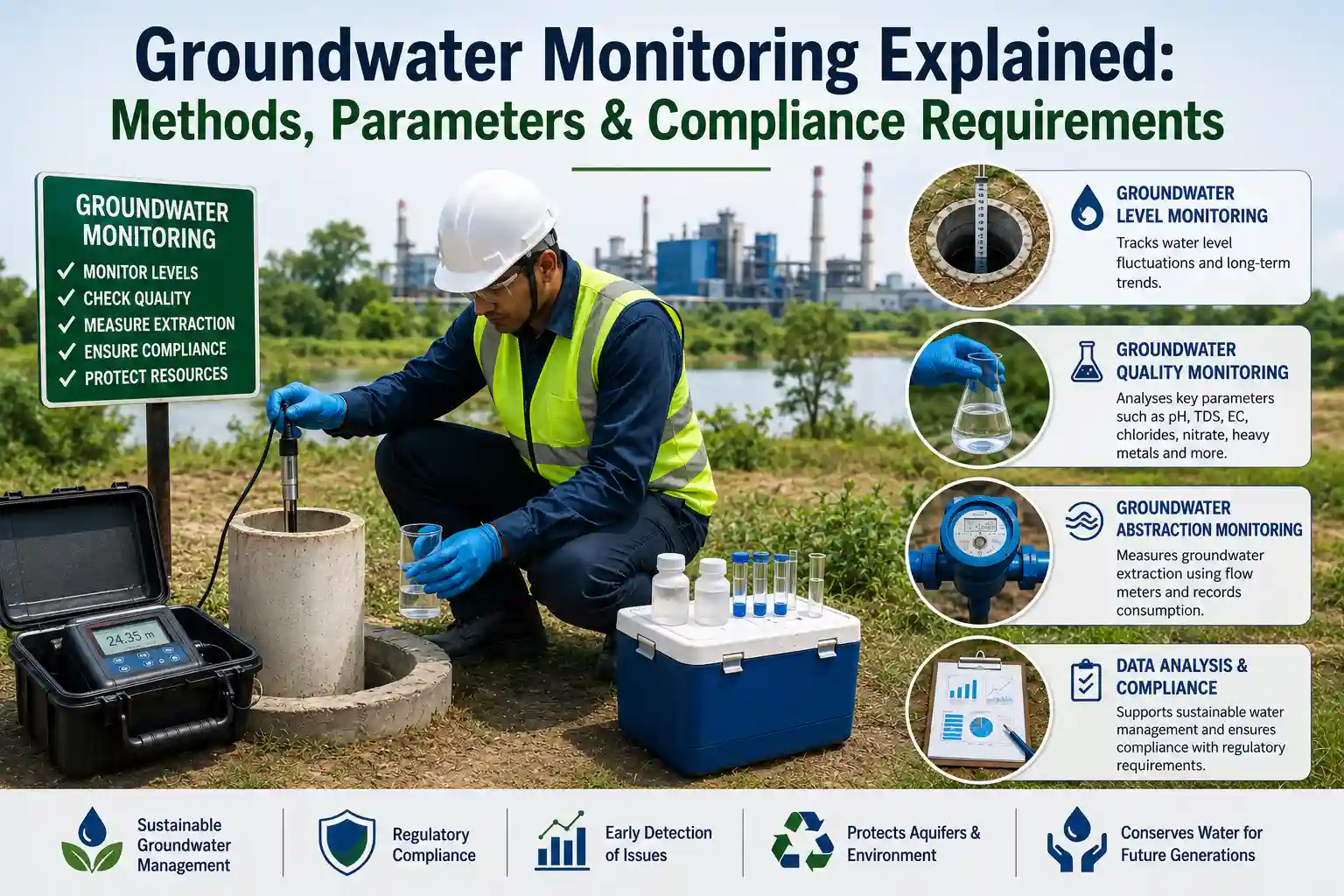
Groundwater monitoring generally includes three key components.
Groundwater Level Monitoring
Groundwater levels are measured periodically to understand seasonal fluctuations and long-term trends.
Typical observations include:
- Static water level.
- Seasonal water table variations.
- Long-term groundwater decline or recovery.
- Aquifer response to groundwater abstraction.
Groundwater Quality Monitoring
Water quality monitoring evaluates whether groundwater remains suitable for its intended use.
Depending on the project, common parameters include:
- pH
- Iron
- Nitrate
- Fluoride
- Chlorides
- Total Hardness
- Electrical Conductivity (EC)
- Total Dissolved Solids (TDS)
- Heavy metals (where applicable)
- Oil and grease (project-specific)
Regular testing helps detect contamination before it becomes a significant environmental concern.
Groundwater Abstraction Monitoring
- Daily groundwater abstraction.
- Monthly groundwater consumption.
- Flow meter readings.
- Borewell operating hours.
- Annual groundwater usage.
These records support compliance reporting and efficient water management.
Groundwater Monitoring Methods
Monitoring may involve several techniques depending on project requirements.
Observation Wells
Dedicated monitoring wells are used to measure groundwater levels without influencing groundwater extraction.
Digital Water Level Indicators
Electronic devices provide accurate measurements of groundwater depth.
Automatic Water Level Recorders
These instruments continuously record groundwater levels and are useful where frequent monitoring is required.
Flow Meters
Flow meters installed on extraction wells measure the quantity of groundwater withdrawn.
Laboratory Water Quality Analysis
Groundwater samples are analysed by accredited laboratories to determine physical and chemical characteristics.
Monitoring Frequency
The frequency of groundwater monitoring depends on the project type, regulatory conditions, and groundwater sensitivity.
Monitoring may be carried out:
- Monthly
- Quarterly
- Half-yearly
- Annually
Some projects may also require continuous monitoring using automated equipment.
Project proponents should follow the frequency specified in their regulatory approvals or applicable guidelines.
Groundwater Monitoring and Regulatory Compliance
Groundwater monitoring plays a central role in environmental compliance.
It may form part of the conditions attached to:
- Groundwater No Objection Certificate (NOC)
- Environmental Clearance (EC)
- Consent to Establish (CTE)
- Consent to Operate (CTO)
Regulatory authorities may require project proponents to maintain monitoring records and submit periodic compliance reports.
Best Practices for Effective Groundwater Monitoring
An effective monitoring programme should include:
- Establishing baseline groundwater conditions before project implementation.
- Installing calibrated monitoring equipment.
- Monitoring both groundwater quantity and quality.
- Maintaining accurate monitoring records.
- Periodically calibrating flow meters and instruments.
- Integrating groundwater monitoring with water conservation initiatives.
- Reviewing monitoring data to identify long-term trends.
- Promptly investigating abnormal changes in groundwater levels or quality.
These practices improve compliance while supporting sustainable groundwater management.
Groundwater Monitoring vs Groundwater Assessment
Although the terms are sometimes used interchangeably, they serve different purposes.
| Groundwater Monitoring | Groundwater Assessment |
|---|---|
| Continuous or periodic observation of groundwater conditions. | One-time or periodic evaluation of groundwater resources. |
| Tracks changes over time. | Determines current groundwater status. |
| Supports ongoing compliance. | Supports planning and regulatory decision-making. |
| Focuses on measurement and data collection. | Focuses on analysis and interpretation. |
Groundwater assessments often establish baseline conditions, while monitoring evaluates how those conditions change over time.
Conclusion
Groundwater monitoring is an essential component of responsible groundwater management. By regularly measuring groundwater levels, abstraction, and water quality, project developers can protect groundwater resources, identify potential problems early, and demonstrate compliance with environmental regulations.
Whether required under a Groundwater NOC, Environmental Clearance, or project-specific approval, an effective monitoring programme helps ensure that groundwater is used efficiently and sustainably for future generations.
Related Environmental Library Pages
Need Help with Groundwater NOC Approval?
Simplicomp provides support for:
- Groundwater NOC applications
- Borewell permission approvals
- CGWA approvals
- Water balance studies
- Rainwater harvesting compliance
- Groundwater documentation and regulatory coordination