

Introduction
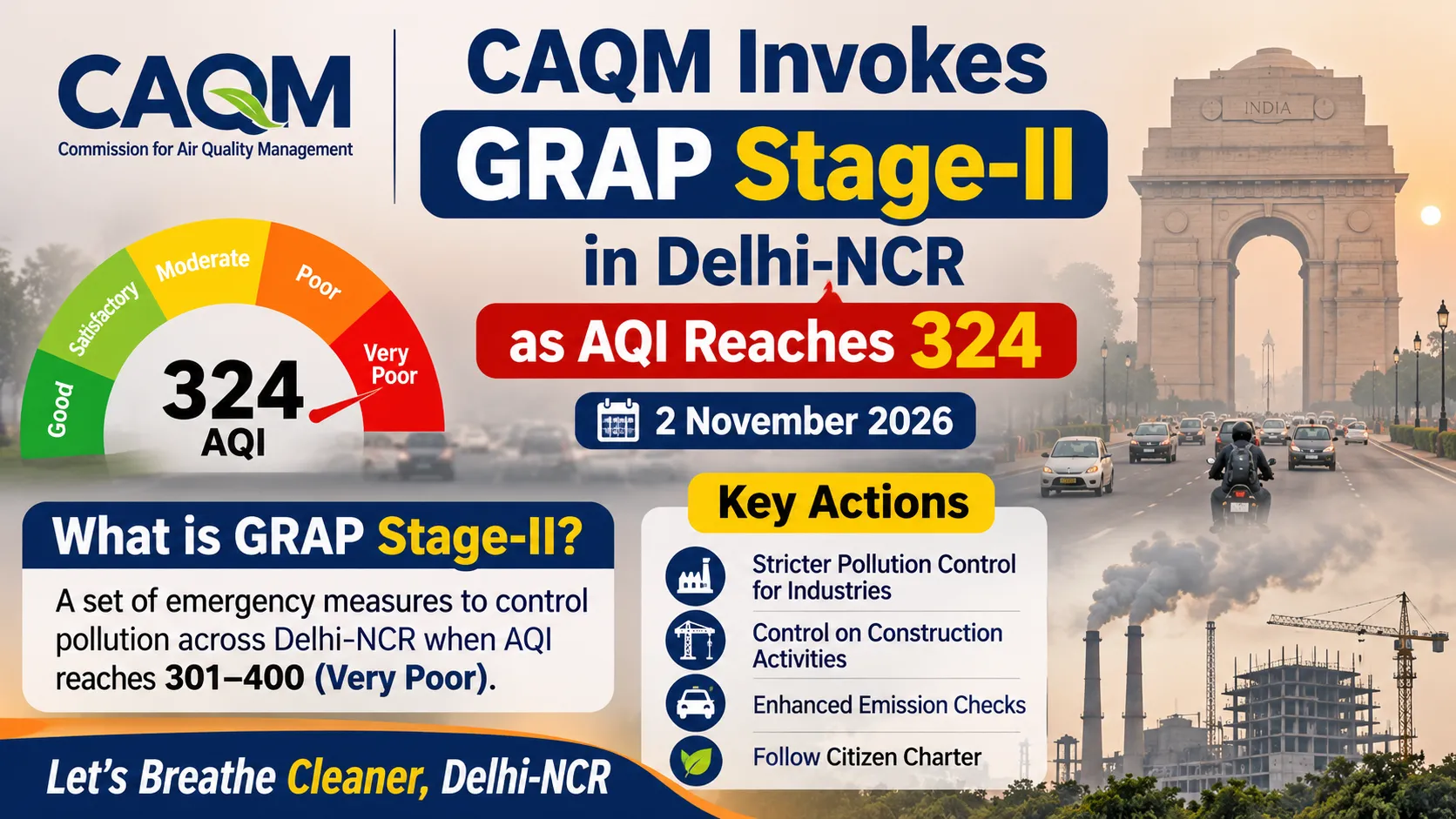
Air pollution across Delhi-NCR has become a growing concern as air quality deteriorates with the onset of winter. To control rising pollution levels and prevent the situation from becoming more severe, the Commission for Air Quality Management (CAQM) has invoked Stage-II of the Graded Response Action Plan (GRAP) across the entire National Capital Region.
According to the CAQM order dated 2 November 2026, Delhi's Air Quality Index (AQI) increased to 324, entering the 'Very Poor' category. Considering the rising pollution levels, unfavourable meteorological conditions and forecasts from the India Meteorological Department (IMD) and Indian Institute of Tropical Meteorology (IITM), the CAQM Sub-Committee decided to implement all actions under GRAP Stage-II with immediate effect.
This development is important for industries, construction companies, builders, commercial establishments and residents across Delhi-NCR, as pollution-control measures under both Stage-I and Stage-II must now be implemented by the concerned agencies.
For businesses operating in the region, this is also a reminder to review applicable environmental compliance requirements and follow the latest CAQM directions.
1. CAQM Invokes GRAP Stage-II Across Delhi-NCR
The CAQM Sub-Committee reviewed the air quality situation on 2 November 2026, along with weather forecasts and pollution trends.
The order highlighted the following AQI developments in Delhi:
| Date | Delhi AQI | Air Quality Category |
|---|---|---|
| 31 October 2026 | 117 | Moderate |
| 1 November 2026 | 261 | Poor |
| 2 November 2026 | 324 | Very Poor |
The AQI increased significantly within a short period, moving from the Moderate category on 31 October to the Very Poor category on 2 November.
The order also stated that unfavourable meteorological conditions contributed to the deterioration in air quality. IMD and IITM forecasts predicted that Delhi's AQI would remain in the Very Poor category in the coming days.
Considering this situation, CAQM decided to invoke all actions under Stage-II of the existing GRAP schedule across the entire NCR with immediate effect.
2. What Is GRAP Stage-II?
The Graded Response Action Plan (GRAP) is a set of emergency pollution-control measures implemented across Delhi-NCR according to the prevailing air quality situation.
The plan has four stages based on AQI levels:
| GRAP Stage | AQI Range | Air Quality Category |
|---|---|---|
| Stage-I | 201–300 | Poor |
| Stage-II | 301–400 | Very Poor |
| Stage-III | 401–450 | Severe |
| Stage-IV | Above 450 | Severe+ |
Each stage introduces additional pollution-control measures according to the severity of air pollution.
When Stage-II is invoked, the measures under Stage-I continue to remain applicable. Therefore, concerned agencies must implement and monitor the combined actions under both stages.
Important: The 2 November 2026 CAQM order specifically invokes Stage-II across the entire NCR. It does not state that Stage-I measures have been withdrawn.
3. What Does the 2 November CAQM Order Require?
The order directs all concerned implementing agencies across NCR to implement, monitor and review the actions under Stage-I and Stage-II of the extant GRAP schedule.
The main objectives are to:
- Prevent further deterioration in air quality.
- Strengthen pollution-control measures across NCR.
- Ensure proper implementation of the applicable GRAP actions.
- Maintain strict monitoring by concerned agencies.
- Encourage citizens to follow the Stage-I and Stage-II citizen charters.
The order also states that the GRAP Sub-Committee will closely monitor the air quality situation and review it from time to time based on Delhi's AQI and forecasts issued by IMD and IITM.
4. Impact of GRAP Stage-II on Industries and Businesses
The implementation of GRAP Stage-II is important for industries and commercial establishments because pollution-control requirements may become more closely monitored during periods of deteriorating air quality.
Industrial units should review their applicable environmental permissions, emission-control arrangements and operating conditions.
Industrial Pollution-Control Compliance
Industries should pay attention to:
- Valid Consent to Establish (CTE) and Consent to Operate (CTO), wherever applicable.
- Proper installation and operation of Air Pollution Control Devices (APCDs).
- Compliance with applicable industrial emission standards.
- Use of approved or permitted fuels.
- Proper maintenance of boilers, furnaces and other emission-generating equipment.
- DG set compliance with applicable requirements.
- Maintenance of environmental monitoring and operational records.
Industries should also review any additional restrictions or requirements applicable to their specific category, location and operations.
Businesses can understand their approval requirements through our guides on Consent to Establish (CTE) Process and Consent to Operate (CTO) Explained.
For a clear understanding of the two approvals, read Difference Between CTE and CTO.
Construction and Infrastructure Projects
Construction and infrastructure projects should continue following applicable CAQM directions and GRAP measures.
Important areas to review include:
- Construction and demolition dust-control arrangements.
- Proper covering of construction materials.
- Dust suppression at project sites.
- Covered transportation of construction materials and debris.
- Proper handling and disposal of construction and demolition waste.
- Compliance with applicable project-specific restrictions.
The exact construction restrictions depend on the GRAP stage and the directions in force. Businesses should verify the current schedule rather than assume that every activity is automatically prohibited under Stage-II.
Commercial Establishments
Commercial establishments should review their applicable pollution-control obligations and follow the relevant GRAP measures.
Businesses should also remain updated about further directions issued by CAQM and the concerned authorities.
5. Responsibilities of Government Agencies Under Stage-I and Stage-II
The CAQM order has directed all concerned agencies to implement, monitor and review the applicable GRAP actions across the entire NCR.
The order was circulated to several authorities and departments, including:
- Government departments of Uttar Pradesh, Haryana, Rajasthan and Delhi.
- Central Pollution Control Board (CPCB).
- Uttar Pradesh Pollution Control Board (UPPCB).
- Haryana State Pollution Control Board.
- Rajasthan State Pollution Control Board.
- Delhi Pollution Control Committee (DPCC).
- Municipal corporations and urban local bodies.
- Development authorities, including Noida and Greater Noida authorities.
- Transport departments and traffic police authorities.
- Public Works Departments.
- Delhi Metro Rail Corporation and other transport agencies.
- National Highways Authority of India (NHAI).
- Thermal power plant authorities and electricity distribution companies.
The wide circulation of the order highlights the coordinated role of different departments in implementing pollution-control measures across NCR.
6. Noida, Greater Noida and Ghaziabad Also Covered
The CAQM order applies to the entire NCR, not only Delhi.
The order was also circulated to authorities responsible for areas including:
- Noida.
- Greater Noida.
- Ghaziabad.
- Gautam Buddha Nagar.
- Meerut.
- Hapur.
- Bulandshahr.
- Baghpat.
- Other NCR districts and areas.
This means industries, construction projects and other regulated establishments in these locations should remain attentive to the applicable GRAP requirements.
Businesses should not assume that the restrictions and pollution-control measures apply only within Delhi's municipal boundaries.
7. What Should Industries Do After GRAP Stage-II Is Invoked?
Industries should review their environmental compliance position and ensure that pollution-control arrangements are functioning properly.
The following checklist can help businesses identify important areas requiring attention:
| Compliance Area | Recommended Action |
|---|---|
| CTE and CTO | Check validity and applicable consent conditions |
| APCDs | Verify installation, operation and maintenance |
| Industrial emissions | Review compliance with applicable standards |
| Fuel usage | Check permitted fuel requirements |
| DG sets | Review applicable emission and operating conditions |
| Construction dust | Ensure applicable dust-control measures |
| Waste management | Follow applicable collection and disposal requirements |
| CAQM directions | Monitor current directions and GRAP restrictions |
| Documentation | Maintain relevant approvals and monitoring records |
This is a general compliance checklist. The exact obligations depend on the nature of the business, applicable regulatory permissions and the GRAP measures in force.
For a more detailed review, businesses can refer to our Environmental Compliance Checklist for Industries.
Industries using online emission or effluent monitoring systems can also read our OCEMS Compliance Guide.
8. What Should Citizens Do Under GRAP Stage-I and Stage-II?
The CAQM order requests citizens to strictly follow the citizen charter under GRAP Stage-I and Stage-II.
Citizens can contribute to pollution reduction by adopting responsible practices such as:
- Avoiding unnecessary use of private vehicles.
- Using public transport and carpooling wherever possible.
- Keeping vehicle PUC certificates updated.
- Maintaining vehicle engines and tyre pressure.
- Avoiding unnecessary idling of vehicles.
- Avoiding open burning of waste.
- Segregating household waste.
- Ensuring proper disposal of construction and demolition waste.
- Avoiding activities that generate unnecessary dust.
- Following the latest pollution-control advisories.
- Reporting visible pollution violations through applicable official channels.
Collective participation by residents, businesses and government agencies is important for controlling air pollution across NCR.
9. How Simplicomp Can Help with Environmental Compliance
With the implementation of GRAP Stage-II, industries and project developers should pay attention to their applicable environmental approvals and pollution-control obligations.
Simplicomp provides environmental compliance consultancy support to help businesses understand and manage their regulatory requirements.
Our services include:
- Consent to Establish (CTE) consultancy.
- Consent to Operate (CTO) consultancy.
- Environmental documentation and application support.
- Pollution-control compliance guidance.
- Regulatory registrations and approvals.
- Assistance with applicable environmental compliance requirements.
- Support with approval-related documentation and regulatory processes.
Whether you operate a manufacturing unit, industrial facility or construction project in Noida, Greater Noida, Ghaziabad or another NCR location, reviewing your environmental compliance can help you remain prepared for regulatory requirements.
Simplicomp aims to provide a one-window solution for businesses seeking assistance with environmental approvals and compliance-related processes.
Related Guides & Resources
- CAQM Grap Guidelines 2026 Delhi NCR →
- CAQM Stage-1 Grap Delhi NCR →
- CAQM Inspections NCR Noida Penalty Environmental Compliance →
- CPCB Industry Categorization Guide →
Need Help with CAQM Closure Compliance?
Simplicomp provides support for:
- CAQM Closure Notice & Direction Review
- Environmental Compliance Gap Assessment
- Corrective & Preventive Action Plan
- Dust, Air Pollution & Environmental Compensation Compliance
- Documentation, Verification & Resumption Support