
Introduction
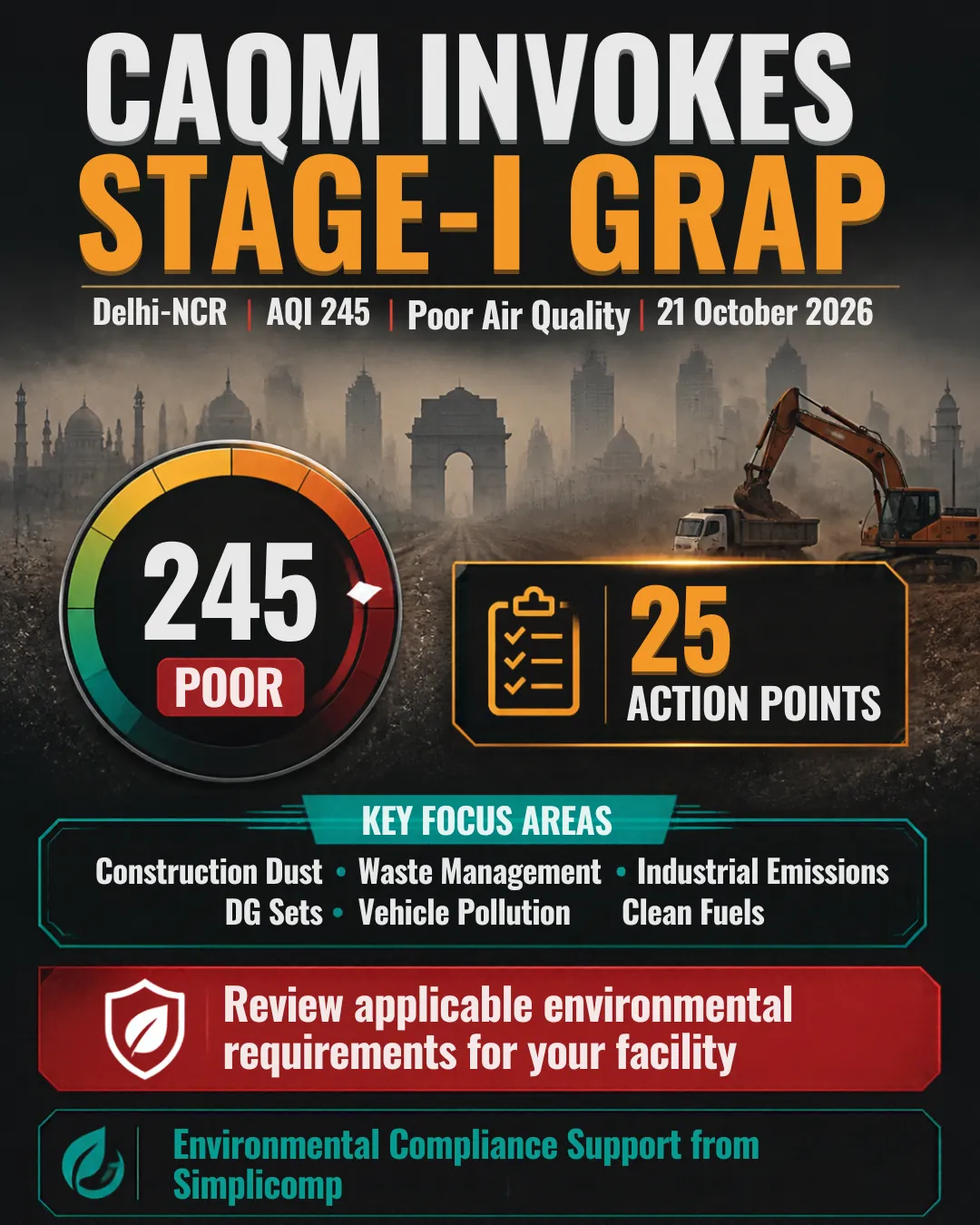
The Commission for Air Quality Management (CAQM) has invoked Stage-I of the Graded Response Action Plan (GRAP) across Delhi-NCR with immediate effect after Delhi’s Air Quality Index (AQI) entered the ‘Poor’ category. According to the Press Information Bureau (PIB) announcement dated 21 October 2026, Delhi recorded an AQI of 244 at 2 PM, which increased to 245 at 4 PM.
Stage-I GRAP applies when Delhi’s AQI is between 201 and 300. After reviewing the current air quality situation and forecasts from the India Meteorological Department (IMD) and the Indian Institute of Tropical Meteorology (IITM), the CAQM Sub-Committee decided to implement all 25 Stage-I action points across the entire National Capital Region (NCR).
These measures address pollution from construction activities, industries, waste management, road dust, diesel generator (DG) sets, vehicles and commercial establishments. The concerned agencies are expected to implement, monitor and review the measures to prevent further deterioration in air quality.
For industries, construction companies and commercial establishments, this announcement highlights the importance of reviewing applicable pollution-control requirements and maintaining appropriate environmental compliance practices. Businesses can refer to an Environmental Compliance Checklist Industrial Unit Takeover to review relevant environmental obligations.
What Is Stage-I GRAP?
The Graded Response Action Plan is a framework for implementing air-pollution control measures according to the severity of air quality in Delhi-NCR.
Under the announcement dated 21 October 2026, Stage-I was invoked because Delhi’s AQI reached the Poor category.
Key details of Stage-I GRAP:
- AQI range: 201–300
- Air quality category: Poor
- Announcement date: 21 October 2026
- Coverage: Entire Delhi-NCR
- Action points: 25 measures under Stage-I
The announcement requires the concerned agencies to implement, monitor and review the measures. Businesses should identify which requirements apply to their activities rather than assume that every activity is automatically prohibited.
Key Stage-I GRAP Measures for Industries and Businesses
1. Dust Control at Construction Sites
Construction and demolition (C&D) activities can release dust through material handling, transportation, storage and site operations. Stage-I GRAP requires proper implementation of applicable dust-mitigation directions and environmental management measures.
Key requirements include:
- Properly storing and covering construction materials and C&D waste.
- Transporting C&D materials and waste in covered vehicles.
- Using prescribed dust-control measures, including water sprinkling and anti-smog guns where required.
- Ensuring appropriate management and disposal of C&D waste.
- Strengthening dust suppression during road construction, widening, repair and maintenance.
The announcement specifically refers to C&D projects with plot sizes of 500 square metres or more. Projects covered by the relevant directions must meet the applicable web-portal registration and remote-monitoring requirements for dust mitigation.
Construction companies and developers should review the directions applicable to their projects and ensure that required dust-control arrangements are in place.
2. Waste Management and Prevention of Open Burning
Stage-I GRAP calls for regular collection and removal of municipal solid waste, C&D waste, industrial waste and hazardous waste from designated dumping sites and industrial areas.
The measures also require authorities to prevent illegal waste dumping on open land and ensure scientific disposal of dust collected during road sweeping.
Businesses should review their waste storage, collection and disposal practices. Industrial and hazardous waste must be managed according to the requirements applicable to the facility and waste category. Industries handling regulated hazardous waste can refer to the Hazardous Waste Authorization Process in India for guidance on authorization and related compliance requirements.
Open burning of biomass and municipal solid waste is prohibited under the measures. Authorities are also expected to intensify monitoring to prevent fires at landfill and dumping sites.
3. Industrial Pollution Control and Inspections
The CAQM announcement directs agencies to intensify inspections of industries, including units operating in non-conforming areas, and take strict penal or legal action against non-compliant and illegal units.
Pollution-control regulations applicable to industries, brick kilns and hot-mix plants must also be enforced, including compliance with prescribed emission standards and the use of approved fuels.
Industrial operators should review their applicable requirements, including pollution-control equipment, emission standards, fuel use, waste handling and relevant compliance records. Where online continuous emissions monitoring is applicable, the OCEMS Compliance Guide for Industries can help businesses understand relevant monitoring and compliance obligations.
The requirements may differ depending on the industry, location, production processes and applicable regulatory directions. Businesses should therefore assess their own compliance obligations instead of relying only on a general summary of GRAP.
4. Diesel Generator Set Restrictions
Stage-I GRAP requires regulated operation of DG sets across industrial, commercial and residential sectors in NCR according to CAQM Direction No. 76 dated 29 September 2023, including amendments, if any.
The announcement outlines conditions according to fuel type, capacity and applicable emission standards.
| DG set category | Requirement stated in the announcement |
|---|---|
| All capacities using LPG, natural gas, biogas, propane or butane | No restrictions stated in the table |
| Up to 800 kW meeting the specified MoEFCC standards | No restrictions stated in the table |
| Older-specification DG sets of 800 kW and above | Emission-control system or mechanism, subject to prescribed standards |
| Older-specification sets from 41 kW to below 800 kW | Dual-fuel mode or certified retrofitted emission-control devices |
| Older-specification sets from 19 kW to below 41 kW | Dual-fuel mode |
| Portable DG sets below 19 kW | Generally not permitted, except for prescribed emergency services |
The announcement identifies emergency services such as hospitals and other medical facilities, elevators and escalators, railways, metro services, airports, inter-state bus terminals, sewage treatment plants, water pumping stations, national security and defence projects, and telecommunications and IT/data services.
DG set owners should check the complete applicable direction and amendments before deciding whether their equipment may operate.
5. Vehicle Emissions and Traffic Management
The 25 action points include strict enforcement of Pollution Under Control (PUC) requirements, action against visibly polluting vehicles and enforcement of applicable restrictions on overage petrol and diesel vehicles.
The measures also cover traffic management, diversion of non-destined truck traffic through the Eastern and Western Peripheral Expressways, and restrictions on specified inter-city and inter-state buses entering Delhi-NCR.
The announcement identifies an exception for buses operating on electric, CNG or BS-VI diesel. It also encourages offices to introduce unified employee commuting and calls for additional public transport services through CNG and electric buses, metro and RRTS.
These measures aim to address vehicle-related pollution and improve traffic movement across the region.
6. Clean Fuel in Hotels and Restaurants
Stage-I GRAP calls for enforcement of the existing ban on using coal or firewood as fuel in tandoors at hotels, restaurants and open eateries.
These establishments are directed to use electricity-based, gas-based or other clean-fuel-based appliances as specified in the announcement. Food businesses should review the applicable fuel restrictions and ensure their operating practices meet the relevant requirements.
7. Other Pollution-Control Measures
Other action points include enforcement of emission norms at thermal power plants, compliance with applicable court or tribunal orders concerning firecrackers, and steps by distribution companies to minimise power interruptions in NCR.
The plan also calls for public-awareness activities through print, electronic and social media, bulk SMS and other channels. The 311 App, Green Delhi App and SAMEER App are among the platforms mentioned for reporting pollution-related complaints and supporting quick redressal.
Together, these 25 action points address several pollution sources and involve agencies, businesses and citizens across NCR. For additional context on the legal framework governing environmental disputes and enforcement, read the National Green Tribunal Act, 2010 Explained.
What Should Industries and Construction Projects Do?
Businesses can use the announcement as a prompt to review their applicable environmental requirements. Practical steps include:
- Review relevant directions: Identify the pollution-control and regulatory requirements applicable to the site and activity.
- Inspect dust-control arrangements: Check material covering, covered transportation, dust suppression and C&D waste management.
- Review waste practices: Ensure waste is handled appropriately and not illegally dumped or openly burned.
- Check DG set requirements: Verify fuel, capacity, emission-control arrangements and permitted operating conditions.
- Review industrial emissions: Check pollution-control systems, approved fuels and prescribed emission standards.
- Maintain relevant records: Keep applicable inspection, maintenance, monitoring and waste-disposal documentation.
- Check official updates: Refer to the current GRAP stage and the complete schedule published by CAQM.
The measures applicable to each business depend on its activities and the directions covering its facility. A general article should not replace the full official schedule or any specific regulatory requirement. Businesses can also consider an Environmental Audit to review applicable obligations and identify potential compliance gaps.
Get Environmental Compliance Support from Simplicomp
Understanding environmental requirements can be challenging when a facility needs to review air emissions, waste management, pollution-control systems and regulatory documentation.
Simplicomp provides environmental compliance consultancy support to businesses seeking guidance on applicable environmental requirements and compliance documentation. If your industrial unit, construction project or commercial establishment needs assistance reviewing its environmental compliance position, contact our team to discuss your requirements.
Need assistance with environmental compliance for your facility in Delhi-NCR?
- Call: +91 8285396139 / +91 9557117733
- Email: sales@simplicomp.in
- Website: https://simplicomp.in/
Connect with Simplicomp to discuss your requirements and identify the appropriate next steps for your facility.
Conclusion
CAQM invoked all 25 Stage-I GRAP action points across Delhi-NCR with immediate effect on 21 October 2026 after Delhi’s AQI reached 245 in the Poor category. The measures cover construction dust, waste management, industrial emissions, DG sets, vehicle pollution, clean fuels and public awareness.
Industries, construction companies and commercial establishments should review the requirements relevant to their activities, check the applicable directions and maintain appropriate compliance practices. Residents also have a role in reducing pollution through responsible transport, waste disposal and reporting of polluting activities.
Related Guides & Resources
- Pollution Control Board Consent Conditions →
- Caqm Grap Guidelines 2026 Delhi NCR →
- No Increase Pollution Load Nipl →
- Plastic Waste EPR Registration Guide →
Need Help with CAQM Closure Compliance?
Simplicomp provides support for:
- CAQM Closure Notice & Direction Review
- Environmental Compliance Gap Assessment
- Corrective & Preventive Action Plan
- Dust, Air Pollution & Environmental Compensation Compliance
- Documentation, Verification & Resumption Support