

Introduction
The Central Pollution Control Board (CPCB) classifies industries in India based on their pollution potential and environmental impact.
This categorization framework is used across India by:
- CPCB
- State Pollution Control Boards (SPCBs)
- Pollution Control Committees (PCCs)
for processing:
- Consent to Establish (CTE)
- Consent to Operate (CTO)
- Pollution Board NOC applications
- Inspection scheduling
- Environmental monitoring
- Industrial compliance management
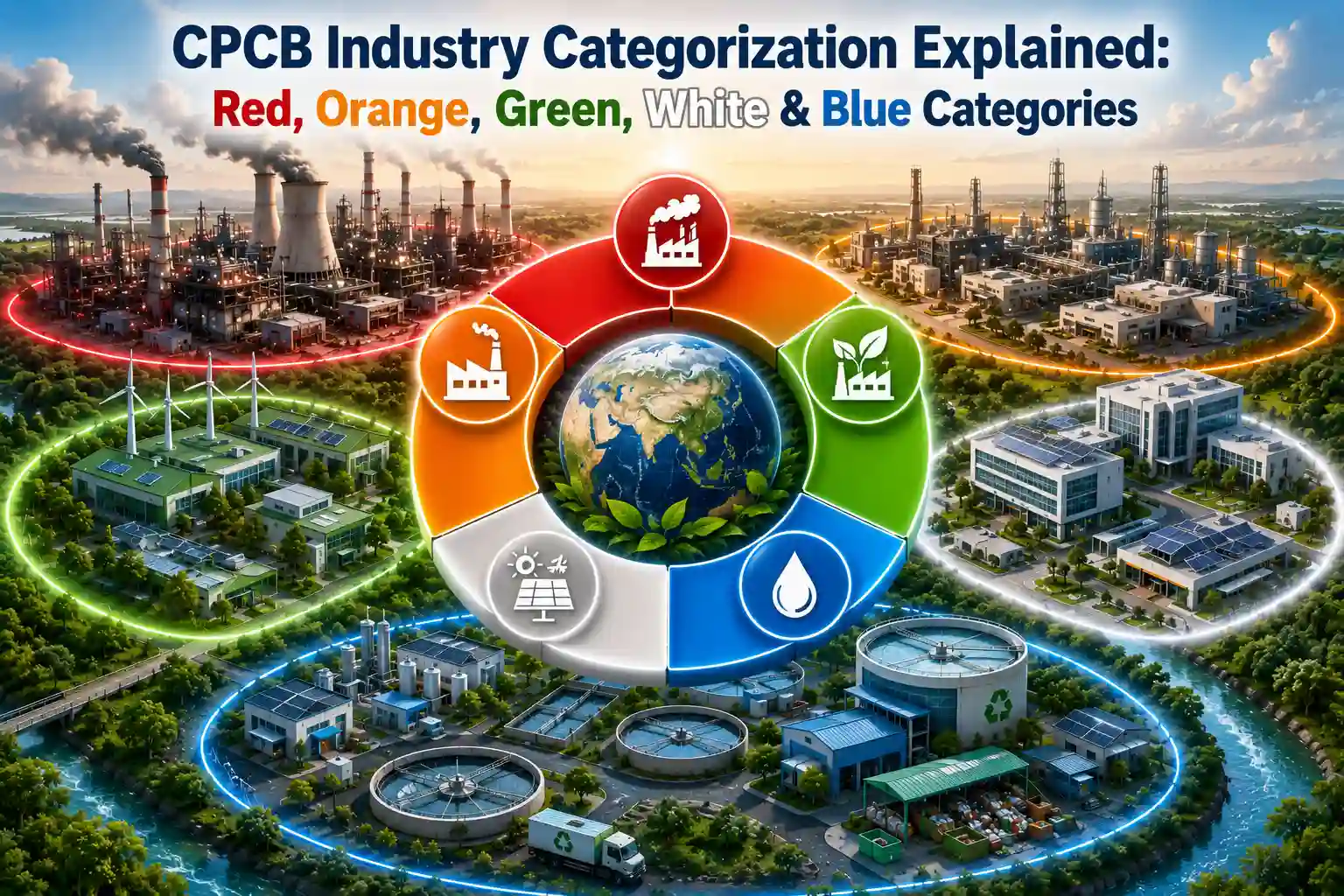
Industries are classified into:
- Red Category
- Orange Category
- Green Category
- White Category
- Blue Category
The latest revised framework was issued by CPCB in January 2025 under:
Classification of Sectors into Red, Orange, Green, White and Blue Categories
The revised methodology strengthens pollution-based industrial regulation and promotes cleaner production technologies and sustainable environmental management.
What is CPCB Industry Categorization?
CPCB industry categorization is a Pollution Index (PI)-based classification system developed to assess pollution potential from industrial activities.
The framework evaluates industries based on:
- Water pollution potential
- Air pollution potential
- Hazardous waste generation
- Environmental impact
The categorization system helps regulatory authorities determine:
- Applicable environmental approvals
- Consent validity
- Inspection frequency
- Pollution control obligations
- Monitoring requirements
SPCBs and PCCs generally implement this framework while processing industrial approvals.
Evolution of CPCB Industrial Classification Framework
The industrial categorization framework has evolved significantly over time.
| Year | Development |
|---|---|
| 1989 | Red, Orange & Green classification introduced |
| 2012 | CPCB standardized industrial sectors |
| 2016 | Pollution Index-based classification adopted |
| 2016 | White Category introduced |
| 2025 | Blue Category introduced |
The revised January 2025 CPCB framework classifies 419 industrial sectors and sub-sectors.
What is Pollution Index (PI)?
Pollution Index (PI) is the core methodology used by CPCB to classify industries.
The Pollution Index is calculated using:
- Water pollution score
- Air pollution score
- Hazardous waste generation score
The revised methodology evaluates:
- PIW (Water Pollution Index)
- PIA (Air Pollution Index)
- PIH (Hazardous Waste Index)
before calculating cumulative pollution impact.
Industries with higher Pollution Index values are categorized into higher pollution categories requiring stricter environmental compliance.
Key Parameters Considered by CPCB
Water Pollution Potential
Industries are evaluated based on:
- Wastewater generation
- Trade effluent characteristics
- BOD/COD levels
- Toxic pollutants
- Heavy metal discharge
Industries generating untreated or high-strength wastewater attract higher pollution scores.
Air Pollution Potential
Air pollution scoring considers:
- Industrial emissions
- Stack emissions
- VOC emissions
- Fuel type
- Process emissions
- Fugitive emissions
Industries using coal and liquid fuels generally attract higher pollution scores compared to cleaner fuels like PNG, LPG, CNG, or electricity.
Hazardous Waste Generation
CPCB also evaluates:
- Hazardous waste generation quantity
- Toxic waste characteristics
- Incinerable waste
- Landfillable waste
- Waste disposal requirements
Industries generating hazardous or toxic waste generally fall under higher pollution categories.
Red Category Industries
Red Category industries are classified as highly polluting industries with significant environmental impact.
Industries with:
PI ≥ 80 fall under Red Category
Common Examples of Red Category Industries
- Integrated cement plants
- Chemical manufacturing industries
- Distilleries
- Thermal power plants
- Petrochemical industries
- Large pharmaceutical industries
- Pulp & paper industries
Compliance Requirements for Red Category Industries
Red Category industries commonly require:
- Consent to Establish (CTE)
- Consent to Operate (CTO)
- Environmental Clearance (where applicable)
- Hazardous Waste Authorization
- Environmental monitoring systems
- OCEMS installation
- Frequent SPCB inspections
These industries generally face stricter environmental scrutiny.
Orange Category Industries
Orange Category industries have moderate pollution potential.
Industries with:
55 ≤ PI < 80 fall under Orange Category.
Common Examples of Orange Category Industries
- Food processing industries
- Hotels and commercial establishments
- Automobile service stations
- Medium engineering units
- Textile processing units
Compliance Requirements
Orange Category industries commonly require:
- Pollution Board NOC
- CTE & CTO approvals
- Environmental monitoring
- Waste management compliance
- Pollution control systems
Green Category Industries
Green Category industries have relatively lower pollution potential.
Industries with:
25 ≤ PI < 55 fall under Green Category.
Common Examples of Green Category Industries
- Packaging units
- Warehousing operations
- Small engineering units
- Eco-friendly assembly operations
Green category industries may still require consent approvals depending on SPCB regulations.
White Category Industries
White Category industries are considered practically non-polluting industries.
Industries with:
PI < 25 fall under White Category.
The White Category was introduced by CPCB in 2016 to reduce unnecessary regulatory burden for non-polluting industries.
Common Examples of White Category Industries
- Solar power generation
- Educational institutions
- Software operations
- Non-polluting assembly activities
Many White Category industries may receive exemptions from certain consent requirements subject to state regulations.
Blue Category Industries (New 2025 CPCB Category)
Blue Category for Essential Environmental Services (EES).
These are facilities established for pollution prevention, waste processing, and environmental management.
Common Examples of Blue Category Facilities
- Sewage Treatment Plants (STPs)
- Municipal Solid Waste processing facilities
- Composting facilities
- Construction & Demolition Waste processing plants
- Material Recovery Facilities (MRFs)
- Bio-methanation facilities
Blue Category facilities are considered environmentally beneficial infrastructure.
Total Categories Under Revised CPCB 2025 Framework
| Category | Number of Sectors |
|---|---|
| Red | 125 |
| Orange | 137 |
| Green | 94 |
| White | 54 |
| Blue | 9 |
The revised framework covers 419 industrial sectors and sub-sectors.
How CPCB Categorization Affects CTE & CTO Approvals
Industrial categorization significantly affects:
- Consent validity period
- Inspection frequency
- Monitoring obligations
- Pollution control requirements
- Environmental reporting obligations
Typical CTO validity periods may include:
| Category | Typical CTO Validity |
|---|---|
| Red | Up to 5 years |
| Orange | Up to 10 years |
| Green | Up to 15 years |
Blue Category facilities may receive additional incentives and compliance relaxations.
Why Correct Industrial Categorization is Important
Correct categorization helps industries:
- Identify applicable approvals
- Plan environmental compliance
- Avoid regulatory objections
- Install appropriate pollution control systems
- Reduce compliance risks
Incorrect categorization may result in:
- SPCB rejection
- Delayed approvals
- Environmental penalties
- Incorrect consent conditions
CPCB Focus on Cleaner Technology & Sustainable Compliance
The revised 2025 CPCB framework encourages industries to adopt:
- Cleaner fuels
- Wastewater recycling
- Renewable energy
- Cleaner production technologies
- Sustainable waste management systems
The framework also introduces incentives for environmentally progressive industries and essential environmental service projects.
Related Guides & Resources
Need Help with CPCB Categorization & Pollution Board Approvals?
Simplicomp provides support for:
- CPCB categorization assessment
- CTE & CTO approvals
- Pollution Board NOC applications
- Environmental compliance audits
- Hazardous waste compliance
- Industrial compliance management