

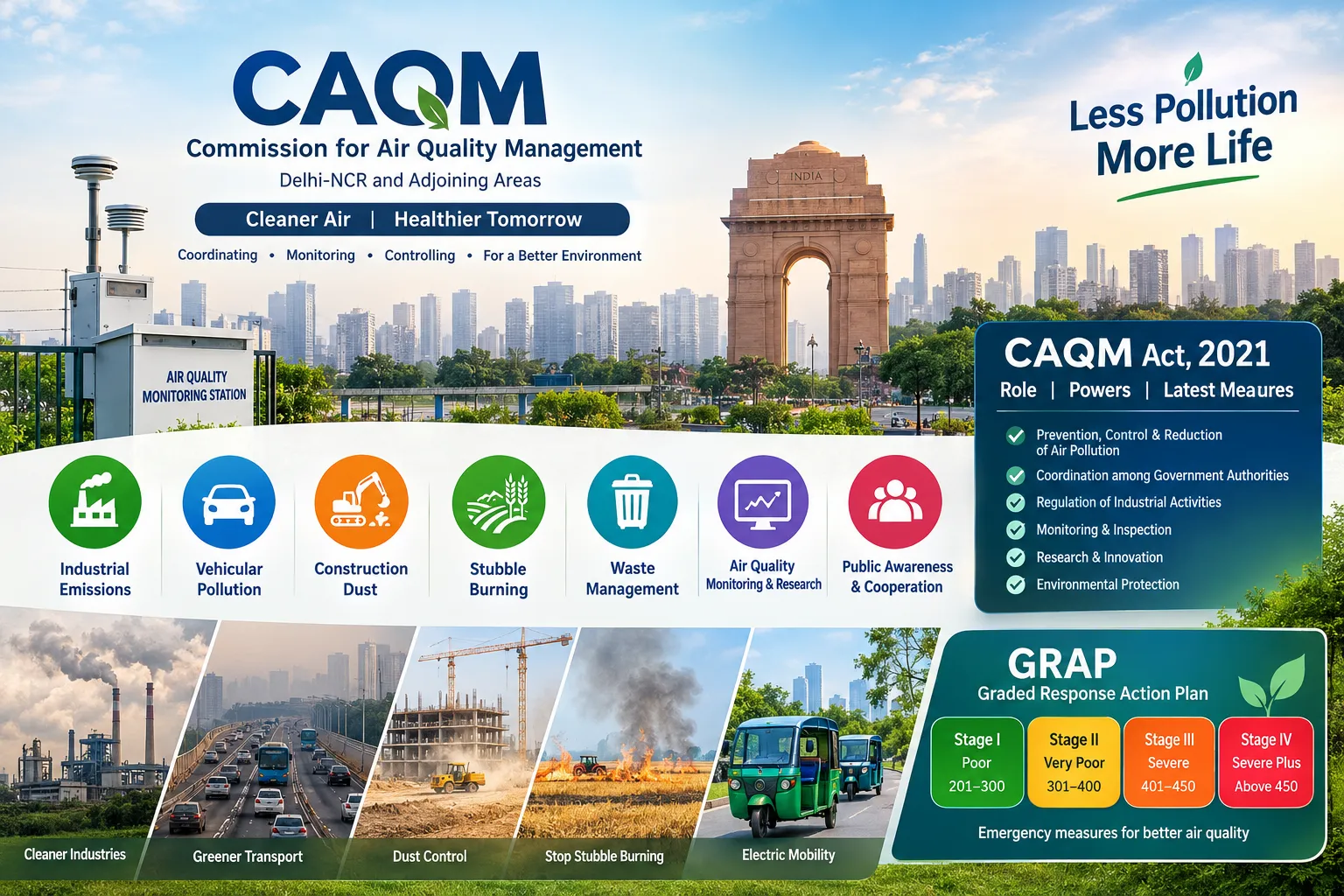
Introduction
Air pollution is one of the major environmental challenges affecting Delhi-NCR and its adjoining areas. Increasing vehicle emissions, industrial pollution, construction activities, road dust, waste burning and agricultural residue burning contribute to deteriorating air quality in the region.
To address these challenges through a coordinated approach, the Government of India established the Commission for Air Quality Management (CAQM) under the Commission for Air Quality Management in National Capital Region and Adjoining Areas Act, 2021.
The Act provides a statutory framework for coordinating air pollution prevention, control and management activities across Delhi-NCR and adjoining areas of Haryana, Punjab, Rajasthan and Uttar Pradesh.
In 2026, CAQM continues to play an important role in monitoring pollution sources, implementing regulatory measures and coordinating action among different government authorities. Businesses can also understand the broader legal framework through this guide on the Environment Protection Act, 1986.
What Is the Commission for Air Quality Management (CAQM)?
The Commission for Air Quality Management (CAQM) is a statutory body established to improve coordination, research, identification and resolution of air quality-related issues in Delhi-NCR and adjoining areas.
Its jurisdiction includes the National Capital Region and adjoining areas in Haryana, Punjab, Rajasthan and Uttar Pradesh where pollution sources adversely affect NCR's air quality.
The primary objective of CAQM is to develop a coordinated approach for managing air pollution instead of relying on separate and uncoordinated actions by different state authorities.
Objectives of the CAQM Act, 2021
The CAQM Act provides a legal framework to achieve several important environmental objectives:
- Prevent, control and reduce air pollution in Delhi-NCR.
- Coordinate the efforts of Central and State Government authorities.
- Identify major sources of air pollution.
- Regulate industries and activities contributing to air pollution.
- Monitor agricultural residue burning and promote better residue management.
- Improve air quality monitoring and research.
- Promote public awareness and environmental protection initiatives.
Powers and Functions of CAQM
Under Section 12 of the CAQM Act, 2021, the Commission has been provided with important powers and responsibilities to manage air pollution.
1. Coordination Between Government Authorities
CAQM coordinates with the Central Government, Delhi Government and adjoining state governments to ensure the effective implementation of air pollution control measures.
2. Regulation of Industrial Activities
The Commission can issue directions for regulating industrial operations and activities that contribute to air pollution. It can also direct the closure or regulation of industrial units where required under the Act.
Industries should also understand their applicable pollution-control obligations, including the Consent to Operate (CTO) requirements, before commencing or continuing regulated operations.
3. Inspection and Monitoring
CAQM can inspect premises, equipment and industrial activities, collect air samples and obtain relevant information to monitor compliance with environmental requirements.
For industries subject to continuous emissions monitoring requirements, the OCEMS Compliance Guide for Industries provides further information about monitoring systems and regulatory compliance.
4. Power to Issue Directions
The Commission can issue directions to relevant authorities, industries and other entities for preventing and controlling air pollution. Such directions have binding force under the Act.
5. Research and Air Quality Improvement
CAQM promotes research, technical studies and scientific approaches to identify pollution sources and develop effective air quality management strategies.
Major Air Pollution Control Measures in Delhi-NCR During 2026
During 2026, CAQM has continued to review and strengthen air pollution control measures across different sectors.
Some important developments include:
1. Control of Industrial Emissions
In February 2026, CAQM reviewed stricter particulate matter emission norms for industries across Delhi-NCR. The Commission also reviewed enforcement activities and compliance measures for industrial units.
Industrial facilities can use an Environmental Audit to assess their environmental performance and identify potential compliance gaps.
2. Prevention of Stubble Burning
Agricultural residue burning remains an important seasonal air pollution concern. CAQM issued Direction No. 96 in February 2026 for coordinated implementation of action plans to prevent and eliminate wheat stubble burning.
In May 2026, the Commission also reviewed action plans for preventing and controlling paddy stubble burning during the 2026 harvesting season.
3. Expansion of Air Quality Monitoring Stations
At its 28th Full Commission Meeting held on 15 May 2026, CAQM reviewed the expansion of the Continuous Ambient Air Quality Monitoring Stations (CAAQMS) network.
A total of 46 additional monitoring stations were proposed across Delhi-NCR, taking the planned network to 157 stations.
4. Promotion of Electric Three-Wheelers
CAQM approved the issuance of Draft Direction No. 100 in May 2026 regarding phased registration of only electric three-wheelers in the L5 category for passenger and goods transportation in Delhi-NCR.
This initiative aims to encourage cleaner mobility and reduce vehicular emissions.
5. Dust Pollution Management
Construction and demolition activities are important sources of dust pollution. CAQM has continued to review dust mitigation measures, construction waste management and compliance monitoring across the region.
Businesses involved in construction and industrial activities can refer to the Environmental Compliance Checklist for Industries in India to review applicable environmental requirements.
What Is GRAP and How Does It Help Control Air Pollution?
The Graded Response Action Plan (GRAP) is an important mechanism for taking emergency pollution-control measures in Delhi-NCR based on the severity of air pollution.
GRAP categorises air quality into four stages:
- Stage I – Poor: AQI 201–300
- Stage II – Very Poor: AQI 301–400
- Stage III – Severe: AQI 401–450
- Stage IV – Severe Plus: AQI above 450
Depending on the applicable stage, authorities implement different restrictions and preventive measures.
These may include road dust control, restrictions on construction activities, regulation of polluting vehicles, restrictions on industrial operations and other emergency measures.
GRAP measures are reviewed and implemented according to the prevailing air quality situation and applicable CAQM directions.
For a detailed explanation of the latest Stage-I implementation, read CAQM Invokes Stage-I GRAP in Delhi-NCR as AQI Reaches 245 in October 2026.
Penalties and Environmental Compensation Under the CAQM Act
The CAQM Act, 2021 includes provisions for penalties against violations of its applicable provisions, rules, orders and directions.
Section 14 provides for imprisonment of up to five years, a fine of up to ₹1 crore, or both, subject to the applicable legal provisions.
The Act also provides a separate mechanism for environmental compensation under Section 15, including provisions relating to agricultural residue burning.
These provisions support the enforcement of pollution-control requirements and environmental accountability. For a broader understanding of environmental penalties imposed on industries, read Environmental Compensation Explained in India.
Role of CAQM in Protecting the Environment
CAQM plays an important role in addressing air pollution through coordinated planning, monitoring and enforcement.
Its activities cover several important sectors, including:
- Industrial emissions and compliance monitoring.
- Vehicular pollution and cleaner transportation.
- Construction and demolition dust management.
- Agricultural residue and stubble burning.
- Waste management and prevention of open burning.
- Air quality monitoring and research.
- Public awareness and environmental communication.
Effective implementation of these measures requires cooperation between government agencies, industries, local authorities, farmers and citizens.
Need assistance with environmental compliance for your facility in Delhi-NCR?
- Call: +91 8285396139 / +91 9557117733
- Email: sales@simplicomp.in
Conclusion
The Commission for Air Quality Management Act, 2021 provides an important statutory framework for managing air pollution in Delhi-NCR and adjoining areas.
With increasing attention to industrial emissions, vehicle pollution, construction dust, agricultural residue burning and air quality monitoring, CAQM continues to coordinate various pollution-control initiatives.
The developments during 2026 demonstrate the importance of continuous monitoring, stronger enforcement and long-term environmental planning.
However, improving air quality requires more than regulatory action. Effective implementation, public participation and cooperation among all stakeholders are essential for creating a cleaner and healthier environment.
Related Guides & Resources
- Pollution Control Board Consent Conditions →
- OCEMS Compliance Guide →
- Forest Conservation Act 1980 →
- Pollution Control Board Consent Conditions →
Need Help with CAQM Closure Compliance?
Simplicomp provides support for:
- CAQM Closure Notice & Direction Review
- Environmental Compliance Gap Assessment
- Corrective & Preventive Action Plan
- Dust, Air Pollution & Environmental Compensation Compliance
- Documentation, Verification & Resumption Support