
Introduction
India’s expanding electric vehicle, renewable energy and energy storage sectors are increasing demand for battery recycling. A recycling plant needs more than machinery and industrial land: the operator must identify applicable environmental permissions, waste registrations and safety approvals. Requirements depend on battery chemistry, technology, capacity, location, water use and project activities. This guide outlines key compliance steps for 2026.
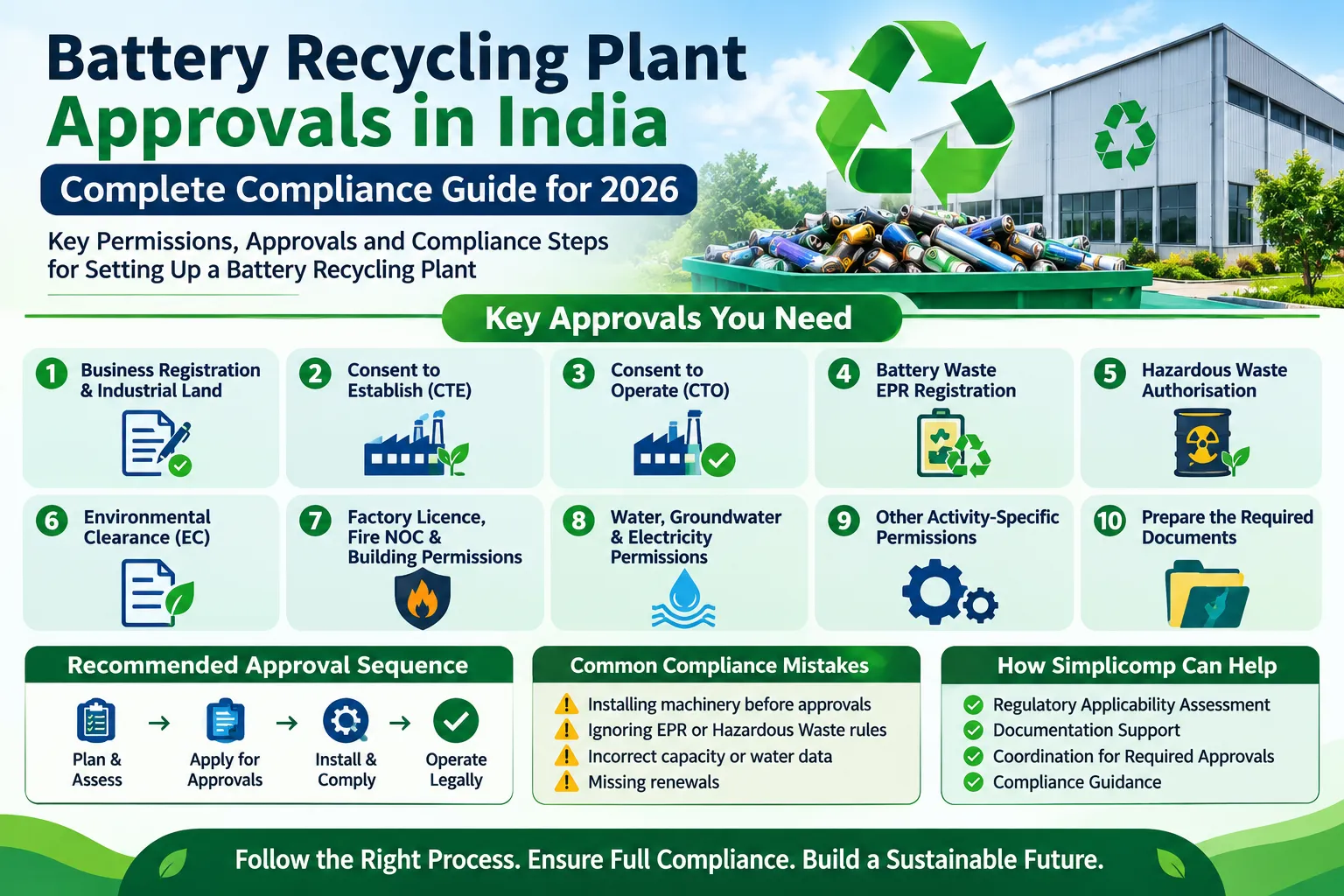
1. Business Registration and Industrial Land Approval
Establish the business as a proprietorship, partnership, LLP or company, and obtain PAN, GST registration where applicable, and other required registrations. Select land where the proposed activity is permitted. Check zoning, land-use classification, allotment conditions, building approval and local development rules. Keep ownership or lease papers, site layout and land-use documents ready; industrial zoning alone does not guarantee that every recycling activity is allowed.
For a broader overview of industrial permissions, refer to Environmental Approvals and Compliance Checklist for Manufacturing Plants.
2. Consent to Establish (CTE)
Before establishing the plant or installing machinery, the project generally needs Consent to Establish (CTE) from the State Pollution Control Board or Pollution Control Committee. The application may require the process, capacity, raw materials, products, water balance, wastewater, emission sources, pollution-control equipment, site plan and land papers. CTE conditions may cover emissions, wastewater, noise, waste storage and monitoring. Obtain this pre-establishment consent before activities covered by the state requirements. Procedures vary by state.
Read the Consent to Establish (CTE) Process and understand the Difference Between CTE and CTO.
3. Consent to Operate (CTO)
After installation and before commercial operation, the unit generally needs Consent to Operate (CTO). The Board may verify the installation against the approved proposal and CTE conditions. Documents can include CTE, compliance status, machinery details, pollution-control systems, wastewater and emission arrangements, waste records and monitoring reports. CTO specifies operating conditions and validity. CTE does not permit commercial production; follow all consent conditions and renewal requirements.
See the Consent to Operate (CTO) Requirements.
4. Battery Waste EPR Registration
Battery producers are regulated under the Battery Waste Management Rules, 2022, as amended. A recycling facility should assess its role and obtain the applicable recycler registration through the CPCB battery EPR portal, where required. Requirements depend on its activity and classification. Recyclers must maintain prescribed records, process batteries through the authorised system and meet applicable recycling and material-recovery obligations. Keep facility, process, capacity, technology and product details ready. EPR registration does not replace SPCB consents or hazardous-waste authorisation; follow applicable returns and certificate requirements.
5. Hazardous Waste Authorisation
Depending on the waste categories handled or generated, authorisation under the Hazardous and Other Wastes (Management and Transboundary Movement) Rules, 2016, may be required from the State Pollution Control Board. The application may require waste categories and quantities, process details, storage, treatment and disposal methods, safety measures and agreements with authorised facilities. Follow authorisation conditions, maintain records and returns, and send waste only to permitted destinations. Identify waste streams according to battery chemistry and technology.
Read the Hazardous Waste Authorisation Guide.
6. Environmental Clearance: Check Applicability
EC is not automatically required for every battery recycling plant. Check the EIA Notification, 2006, amendments, project activities, capacity, location and associated facilities. If the project falls under an applicable category, obtain clearance through the prescribed process before commencing the relevant activity. This may involve screening, scoping, environmental studies, public consultation and appraisal. EC does not replace CTE, CTO, EPR registration or waste authorisation.
7. Factory Licence, Fire NOC and Building Permissions
Factory registration or a factory licence may be required depending on worker strength, activity and statutory thresholds; confirm this with the state factory inspectorate. A Fire NOC may also apply under state and local rules. Assess risks from battery storage, charging, thermal processes and chemical handling, and provide required detection, suppression, ventilation, safe storage and evacuation arrangements. Obtain applicable building-plan, trade, development and occupancy permissions separately from environmental consents.
8. Water, Groundwater and Electricity Permissions
Prepare a water balance for domestic and process use, cooling, washing and reuse. If groundwater is proposed, check CGWA or State Ground Water Authority requirements, exemptions and conditions. Obtain permission before extraction where required, and follow approved quantity, metering, monitoring, recharge and payment conditions.
Simplicomp supports Groundwater NOC requirements in India and Industrial Water Balance Study requirements. You can also understand the Groundwater Extraction Permission process.
Arrange an authorised electricity connection and check additional permissions for DG sets, boilers, captive power and other utilities.
9. Other Activity-Specific Permissions
Depending on the process, additional permissions may apply to boilers, pressure vessels, chemical or petroleum storage, regulated-material transport and process-residue disposal. Forest or wildlife permissions may be relevant where forest land, protected areas or tree felling are involved. Prepare an activity-wise legal register and confirm applicability with the relevant authorities.
10. Key Documents to Prepare
Typical documents include:
- Business registration, PAN and GST details, where applicable.
- Land or lease papers, land-use permission, site plan and building approvals.
- Project report, process flow, layout, machinery list and capacity.
- Battery chemistry, raw-material, product and waste-category details.
- Water balance, source proof, wastewater estimates and treatment/reuse plan.
- Emission sources and pollution-control equipment details.
- Waste storage, handling, transport and disposal arrangements.
- Fire and factory documents, safety plan, authorisation letters and monitoring reports, as required.
Confirm the final checklist against current portal formats and state requirements.
For a broader document checklist, refer to the Environmental Compliance Checklist.
11. Recommended Approval Sequence
Define battery types, process, capacity, site and utilities. Verify land use; prepare the project report, process flow, layout and water balance. Assess EC and identify SPCB, EPR, hazardous-waste, factory and fire requirements. Obtain CTE and other pre-establishment permissions before relevant work. Install approved pollution-control and safety systems, complete required inspections or testing, and secure CTO before operation. Thereafter maintain renewals, returns, monitoring reports, waste records and consent conditions.
A compliance plan should assign responsibility for each approval, renewal date, reporting obligation and operating condition. Maintain a register of consents, authorisations, EPR filings, waste manifests, monitoring results, inspection records and authority correspondence. Reconcile quantities of batteries received, materials recovered, residues generated and waste dispatched with applicable records. Keep supplier and downstream recycler or disposal-facility documents traceable. Review the plant whenever capacity, process, fuel, raw material, water source or pollution-control equipment changes, because a modification may require prior intimation, amendment or fresh approval. Train workers in battery handling, spill response, fire emergencies and waste segregation. These controls help demonstrate that the facility continues to meet approval conditions and applicable laws.
12. Common Compliance Mistakes
Common mistakes include choosing unsuitable land, installing machinery before required approvals, treating EPR registration as a substitute for SPCB consent, overlooking hazardous-waste authorisation, and assuming EC always or never applies. Inaccurate capacity or water data, weak pollution-control design, unsafe storage, incomplete records and missed renewals can delay commissioning or invite regulatory action.
How Simplicomp Can Help
Simplicomp supports industrial projects with regulatory applicability assessment, documentation and coordination for CTE, CTO, Battery Waste EPR registration, hazardous-waste authorisation, groundwater permissions, water-balance studies and other applicable approvals. Scope depends on the project’s location, process and capacity. Final decisions rest with the competent authorities.
Related Guides & Resources
- E-waste Audit Electronic Waste Management Compliance →
- E-waste EPR Registration →
- EC Application Mistakes Parivesh →
- E-waste Recycling Plant Setup In India →
Need Help with CAQM Closure Compliance?
Simplicomp provides support for:
- CAQM Closure Notice & Direction Review
- Environmental Compliance Gap Assessment
- Corrective & Preventive Action Plan
- Dust, Air Pollution & Environmental Compensation Compliance
- Documentation, Verification & Resumption Support