

Introduction
Industries, factories, warehouses, infrastructure projects, commercial establishments, hotels, and manufacturing units often require Consent to Establish (CTE) approval before starting construction or operations.
CTE approval, commonly referred to as Pollution Board NOC, Pollution NOC, Factory Pollution Approval, or SPCB Consent, is issued by the State Pollution Control Board (SPCB) under environmental regulations related to air pollution, water pollution, wastewater discharge, hazardous waste generation, and industrial emissions.
One of the most common reasons for delay in CTE applications is incomplete or incorrect documentation during the Pollution Board approval process.
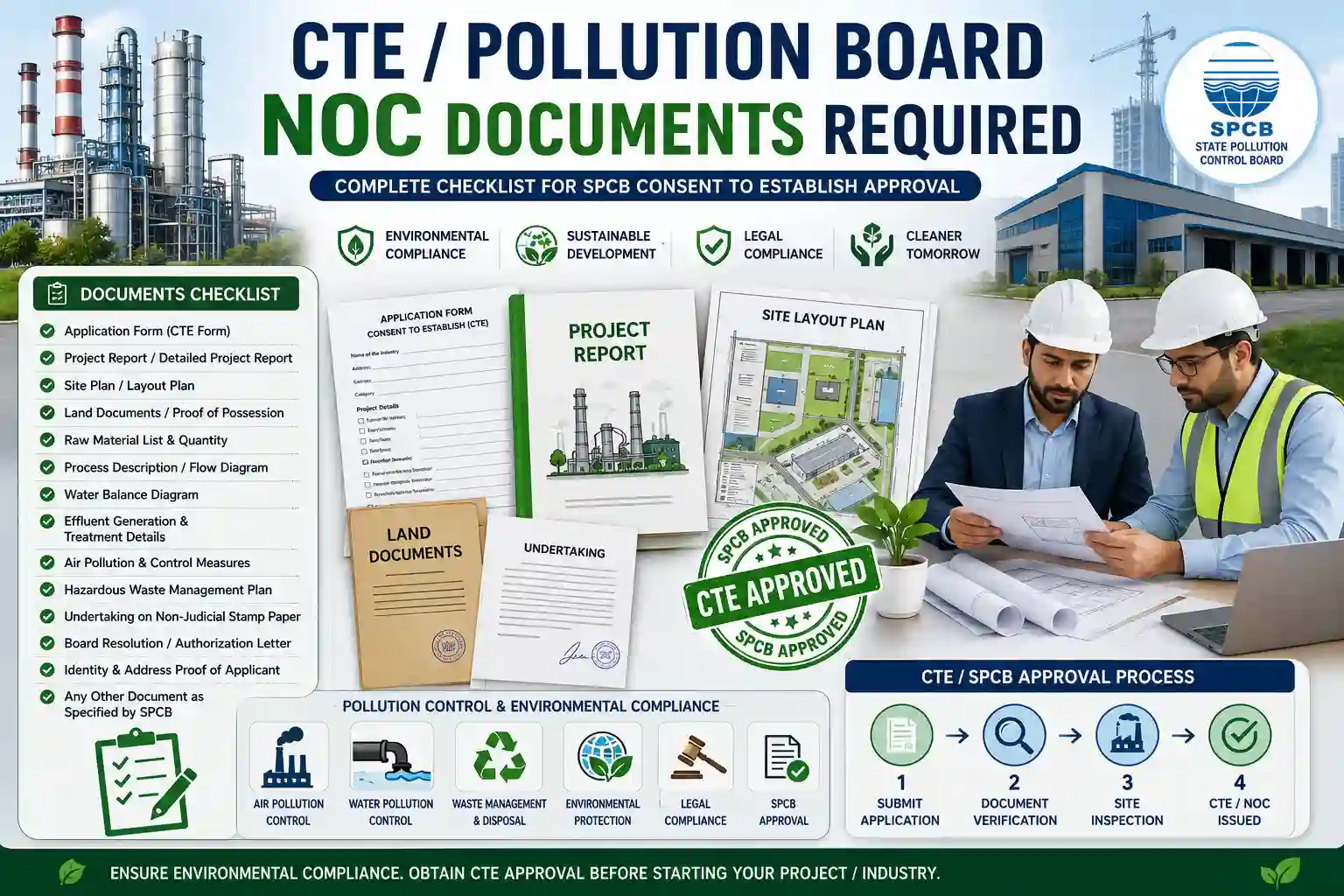
This guide explains the major documents commonly required for Consent to Establish (CTE), Pollution Board NOC, and SPCB approval applications in India.
What is Consent to Establish (CTE)?
Consent to Establish (CTE) is a mandatory approval issued by the State Pollution Control Board before establishing or constructing industrial units, projects, or commercial facilities that may generate pollution.
CTE approval is commonly known as:
- Pollution Board NOC
- Pollution NOC
- SPCB Approval
- Factory Pollution Clearance
- Industrial Pollution Consent
The approval ensures that proposed projects incorporate adequate pollution control systems and comply with environmental regulations before operations begin.
Who Requires CTE / Pollution Board NOC?
CTE approval may commonly apply to:
- Manufacturing industries
- Warehouses & logistics parks
- Hotels & commercial projects
- Construction projects
- Food processing units
- Pharmaceutical industries
- Chemical industries
- Infrastructure projects
- Hospitals and healthcare facilities
Applicability depends on:
- Industry category
- Pollution potential
- Manufacturing process
- Wastewater generation
- Air emission sources
CPCB Classification of Industries (Red, Orange, Green, White & Blue)
The Central Pollution Control Board (CPCB) classifies industries based on Pollution Index (PI), considering:
- Air pollution potential
- Water pollution potential
- Hazardous waste generation
- Resource consumption
- Environmental impact potential
The revised Classification of Sectors into Red, Orange, Green, White, and Blue Categories framework issued by CPCB in 2025 helps determine:
- Applicability of Consent to Establish (CTE)
- Pollution Board NOC requirements
- Consent to Operate (CTO) obligations
- Inspection frequency
- Environmental compliance requirements
- Pollution control monitoring obligations
Industries may fall under:
- Red Category Industries
- Orange Category Industries
- Green Category Industries
- White Category Industries
- Blue Category Industries
based on pollution potential and environmental impact.
Red Category Industries
Red category industries have high pollution potential and generally require stricter environmental compliance, monitoring, and Pollution Control Board approvals.
Examples may include:
- Chemical industries
- Distilleries
- Cement plants
- Textile dyeing units
- Thermal power plants
These industries commonly require:
- Consent to Establish (CTE)
- Consent to Operate (CTO)
- Environmental Clearance (EC)
- Hazardous waste authorization
- Environmental monitoring systems
Orange Category Industries
Orange category industries have moderate pollution potential and require Pollution Board approvals along with standard pollution control measures.
Examples may include:
- Food processing units
- Automobile workshops
- Hotels
- Packaging units
- Engineering industries
These industries commonly require:
- CTE approval
- CTO approval
- Wastewater management systems
- Pollution monitoring compliance
Green Category Industries
Green category industries generally have relatively lower pollution potential and simplified compliance requirements compared to Red and Orange category industries.
Examples may include:
- Small assembly units
- Non-hazardous packaging activities
- Certain fabrication units
- Low-emission service industries
Compliance obligations may vary depending on SPCB guidelines and local regulations.
White Category Industries
White category industries are considered practically non-polluting and may have minimal Pollution Control Board compliance requirements subject to applicable SPCB procedures.
Examples may include:
- Solar power generation
- Manual assembly activities
- Certain software and IT activities
- Non-polluting service operations
In many states, White category industries may not require Consent to Establish (CTE) or Consent to Operate (CTO), subject to SPCB regulations.
Blue Category Industries
Under the revised CPCB industry classification framework introduced in 2025, Blue Category was introduced for Essential Environmental Services involved in pollution control, waste management, recycling, environmental remediation, and resource recovery activities.
Examples may include:
- Sewage Treatment Plants (STPs)
- Waste-to-Energy plants
- Biomining projects
- Material Recovery Facilities (MRFs)
- Certain Compressed Biogas (CBG) plants
- Environmental remediation facilities
Certain sectors under Blue category may receive additional regulatory benefits such as extended Consent to Operate (CTO) validity periods and simplified compliance mechanisms subject to SPCB guidelines.
Key Documents Required for CTE Application
Company Registration Documents
Applicants are generally required to submit:
- Company incorporation certificate
- GST registration certificate
- PAN card
- Authorized signatory details
These documents establish applicant identity and legal ownership.
Land Ownership or Lease Documents
Authorities may require:
- Sale deed
- Lease deed
- Rent agreement
- Land allotment letter
- Possession certificate
These documents establish project site ownership or possession rights.
Detailed Project Report (DPR)
A project report generally includes:
- Nature of industry
- Manufacturing process
- Raw materials used
- Production capacity
- Utility requirements
- Pollution generation sources
The DPR helps SPCB assess pollution potential and environmental impact.
Site Layout & Factory Layout Plan
Applicants may need to provide:
- Site layout plan
- Factory layout
- Machinery layout
- Utility layout
- Greenbelt details
- Drainage layout
The layout should clearly identify pollution control systems and wastewater flow.
Manufacturing Process Flow Chart
Industries are generally required to submit a process flow diagram showing:
- Raw material input
- Manufacturing stages
- Waste generation points
- Emission sources
- Wastewater discharge points
This helps SPCB evaluate pollution generation and treatment systems.
Pollution Control System Details
Applicants may need to provide details of:
- Effluent Treatment Plant (ETP)
- Sewage Treatment Plant (STP)
- Air Pollution Control Devices (APCD)
- Chimney / stack details
- Wastewater recycling systems
Proper pollution control planning significantly improves CTE approval readiness.
Water Consumption & Wastewater Details
CTE applications commonly require:
- Freshwater requirement
- Source of water
- Wastewater generation quantity
- Treated water reuse details
- Water balance study
Improper water balance calculations frequently result in SPCB objections.
Hazardous Waste & Solid Waste Details
Industries generating waste may need to provide:
- Hazardous waste generation details
- Storage arrangements
- Disposal mechanism
- Solid waste management details
- Authorized recycler information
Waste management compliance is a critical component of Pollution Board approval.
Environmental & Regulatory Documents
Depending on project type, SPCB may require:
- Environmental Clearance (EC)
- Groundwater NOC
- Factory license documents
- Fire NOC
- Building approval documents
- Previous consent copies (if applicable)
Waste management compliance is a critical component of Pollution Board approval.
State Pollution Control Boards (SPCBs) in India
CTE approvals are generally issued by:
- Haryana State Pollution Control Board (HSPCB)
- Uttar Pradesh Pollution Control Board (UPPCB)
- Delhi Pollution Control Committee (DPCC)
- Maharashtra Pollution Control Board (MPCB)
- Punjab Pollution Control Board (PPCB)
- Karnataka State Pollution Control Board (KSPCB)
Each SPCB operates its own online consent management portal and approval framework.
Common Reasons for CTE Rejection or Delay
Applications are commonly delayed due to:
- Incomplete documentation
- Incorrect industry categorization
- Improper wastewater calculations
- Missing pollution control details
- Poor site layouts
- Non-compliance with SPCB guidelines
Proper documentation review significantly improves approval timelines.
Consent to Establish (CTE) Application Process
Step 1 – Industry Categorization
Determine applicable category based on pollution potential and industrial activity.
Industries may fall under:
- Red Category
- Orange Category/li>
- Green Category
- White Category
- Blue Category
under CPCB and SPCB classification frameworks.
Step 2 – Technical Documentation Preparation
Prepare:
- Project report
- Site layout
- Pollution control details
- Water balance calculations
- Waste management details
Step 3 – Online SPCB Portal Submission
CTE applications are generally submitted through State Pollution Control Board online portals.
The online system allows:
- Application filing
- Document upload
- Fee payment
- Consent tracking
Step 4 – Inspection & Approval
SPCB may review:
- Pollution control measures
- Wastewater systems
- Air emission controls
- Environmental safeguards
before granting Consent to Establish approval.
Why Proper CTE Documentation is Important
Accurate documentation helps:
- Reduce approval delays
- Improve SPCB compliance readiness
- Avoid regulatory objections
- Improve environmental planning
- Streamline Pollution Board approvals
Incorrect categorization or incomplete documents may result in application rejection or additional compliance requirements.
Related Guides & Resources
Need Help with CTE / Pollution Board Approval?
Simplicomp provides support for:
- Consent to Establish (CTE) applications
- Pollution Board NOC documentation
- SPCB approval coordination
- Pollution control compliance
- STP & ETP planning
- Environmental documentation and reporting