

Introduction
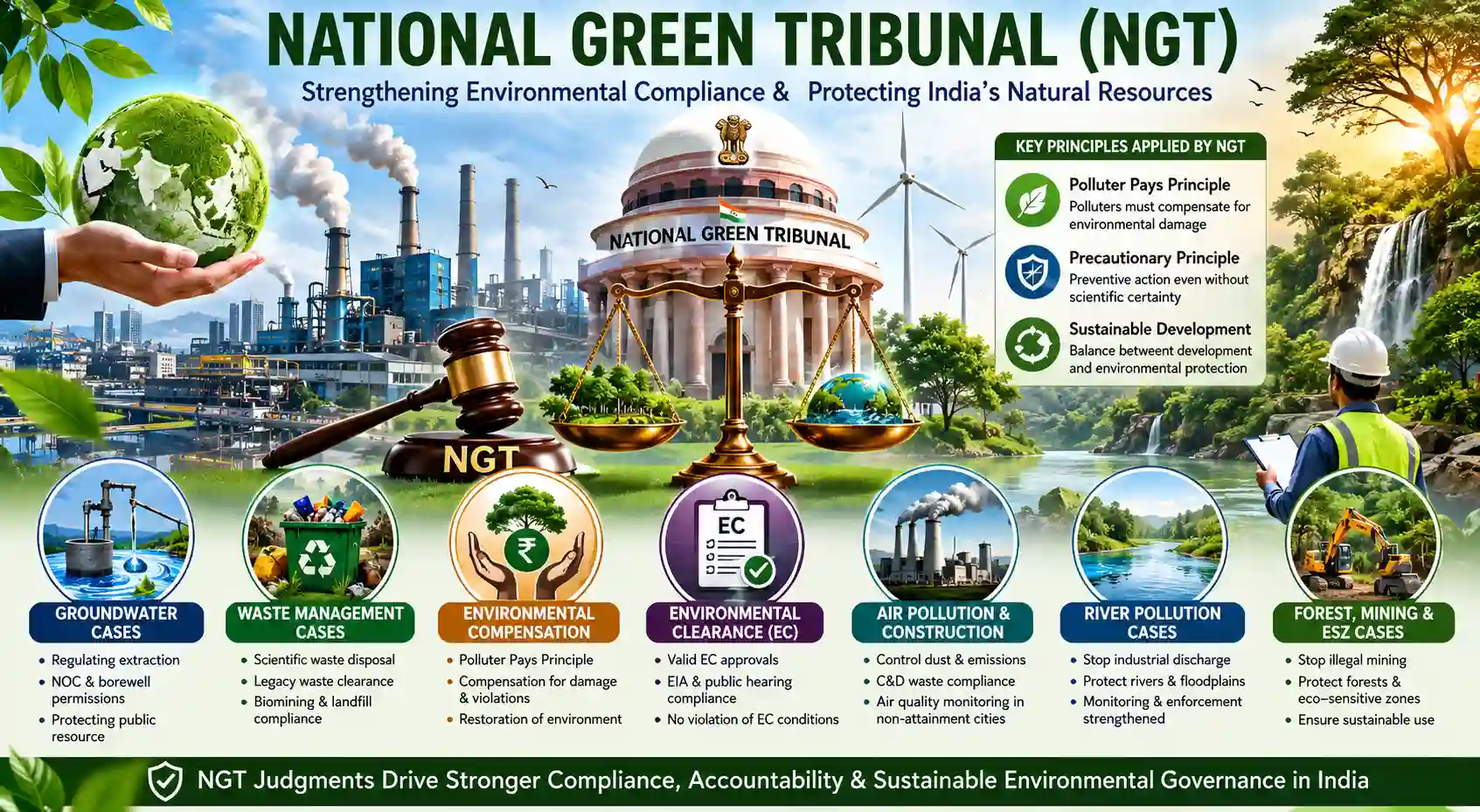
The National Green Tribunal (NGT) plays a major role in shaping environmental compliance, pollution control enforcement, industrial operations, groundwater regulation, and environmental governance in India.
Over the years, NGT judgments have significantly impacted industries, infrastructure projects, mining operations, waste management systems, and environmental approval mechanisms through strict enforcement of environmental laws and regulatory principles.
NGT decisions frequently apply important environmental principles such as:
- Polluter Pays Principle
- Precautionary Principle
- Sustainable Development
while addressing industrial pollution, environmental damage, groundwater extraction, waste mismanagement, and regulatory non-compliance.
This article highlights landmark and recent NGT judgments that have significantly influenced environmental compliance frameworks and industrial operations across India.
Why NGT Judgments are Important for Industries
NGT rulings influence:
- Environmental Clearance (EC) approvals
- Pollution Control Board enforcement
- Industrial operations
- Groundwater extraction permissions
- Environmental compensation mechanisms
- Waste management compliance
- Pollution monitoring requirements
- Environmental reporting obligations
Industries increasingly need stronger environmental compliance systems due to stricter environmental enforcement and tribunal oversight.
Landmark & Recent NGT Groundwater Cases
Shailesh Singh v. Hotel Holiday Regency (Original Application No. 176/2015)
This landmark NGT judgment became one of the most important groundwater regulation cases in India.
The Tribunal held that no hotel, industry, commercial establishment, or individual has an unrestricted or absolute right to extract groundwater for commercial purposes.
The judgment significantly strengthened groundwater regulation under the Central Ground Water Authority (CGWA) and reinforced the principle that groundwater is a public resource requiring sustainable management.
The Tribunal emphasized:
- Commercial groundwater extraction requires regulatory oversight
- Groundwater depletion affects public resources
- Environmental compensation may apply for illegal extraction
- Groundwater replenishment obligations may be imposed on violators
The ruling became a major precedent for subsequent Groundwater NOC and Borewell Permission cases across India.
Najafgarh Illegal Tanker Mafia Case (2026)
The NGT took cognizance of alleged large-scale illegal groundwater extraction activities in the Pankaj Garden area of Najafgarh involving private tanker operations.
The matter highlighted concerns related to:
- Unauthorized borewell operations
- Illegal groundwater trade
- Groundwater theft
- Regulatory enforcement failures
The Tribunal issued notices to:
- Delhi Government
- Delhi Jal Board (DJB)
- Police authorities
seeking action against illegal groundwater extraction and unauthorized sale of groundwater.
Yamuna Riverbed Illegal Water Extraction Case (2025)
The NGT initiated suo motu proceedings following reports of illegal groundwater extraction along the Yamuna riverbed using heavy machinery and submersible pumps.
The case involved concerns related to:
- Riverbed groundwater depletion
- Illegal commercial extraction
- Environmental damage
- Unauthorized borewell activity
The Tribunal directed:
- Delhi Jal Board (DJB)
- Central Ground Water Authority (CGWA)
- Delhi Pollution Control Committee (DPCC)
to take enforcement action and submit compliance reports.
Paharganj Hotel Groundwater Extraction Cases (2023–2026)
NGT addressed unauthorized groundwater extraction by hotels and commercial establishments operating without Groundwater NOC approvals in Paharganj, Delhi.
The Tribunal directed authorities to:
- Identify unauthorized borewells
- Verify groundwater permissions
- Seal illegal borewells
- Take enforcement action against violators
The proceedings resulted in large-scale sealing drives and increased scrutiny over commercial groundwater extraction activities.
Waste Management & Landfill Cases
The National Green Tribunal has increasingly imposed strict accountability on municipal authorities, industrial operators, and local bodies for improper waste management and landfill practices.
Recent cases demonstrate stronger enforcement under:
- Solid Waste Management Rules
- Legacy waste remediation obligations
- Biomining compliance
- Landfill environmental safeguards
Belgachia Trenching Ground Case (2026)
The Eastern Zone Bench of NGT addressed over-capacity dumping and unscientific waste disposal practices at the Belgachia trenching facility involving the Howrah Municipal Corporation.
The Tribunal restricted further waste dumping without expansion of scientific waste processing infrastructure and environmental safeguards.
Faridabad Pratapgarh Yard Case (2026)
The Tribunal intervened in landfill and waste processing activities involving the Municipal Corporation of Faridabad.
The matter highlighted concerns related to:
- Improper landfill planning
- Environmental zoning violations
- Greenbelt impacts
- Waste processing infrastructure
NGT emphasized that waste processing projects must comply with environmental safeguards and land-use planning requirements.
Amritsar Legacy Waste Case (2025–2026)
NGT directed authorities to implement time-bound clearance of legacy landfill waste in Amritsar through biomining and remediation measures.
The case reinforced growing judicial scrutiny over:
- Legacy waste dumpsites
- Municipal waste mismanagement
- Biomining implementation delays
- Environmental remediation obligations
Environmental Compensation & Polluter Pays Principle
NGT has significantly expanded the application of the Polluter Pays Principle for environmental violations and ecological damage.
Environmental compensation mechanisms are increasingly used for:
- Pollution violations
- Illegal groundwater extraction
- Improper waste disposal
- Hazardous waste violations
- Greenbelt encroachments
- Environmental restoration failures
Greater Noida Green Belt Encroachment Case (2025)
The Tribunal addressed illegal dumping of construction and demolition (C&D) waste inside designated greenbelt areas in Greater Noida.
The proceedings reinforced environmental accountability for:
- Illegal dumping
- Greenbelt degradation
- Construction waste mismanagement
- Environmental restoration obligations
Paryavaran Suraksha Samiti v. Union of India
This landmark environmental matter strengthened the authority of Pollution Control Boards to impose environmental compensation and enforce compliance against industries violating:
- Hazardous waste norms
- Wastewater management requirements
- STP/CETP obligations
- Pollution discharge standards
The matter continues to influence environmental compensation frameworks across India.
Environmental Clearance (EC) Violation Cases
NGT has repeatedly scrutinized projects commencing operations without valid Environmental Clearance approvals or violating EC conditions.
The Tribunal has strengthened accountability regarding:
- EIA data accuracy
- Public hearing compliance
- Expansion without approvals
- Environmental disclosure obligations
- Post-facto EC applications
Pipavav Port Expansion Case (2026)
The Pipavav Port proceedings highlighted increased scrutiny over Environmental Impact Assessment (EIA) submissions and environmental data reliability.
The Tribunal emphasized stricter review of:
- Environmental baseline data
- Public consultation procedures
- Coastal environmental impacts
- Project expansion compliance
Air Pollution & Construction Activity Cases
NGT has increasingly used National Clean Air Programme (NCAP) frameworks and construction waste rules to strengthen air pollution enforcement.
The Tribunal has focused on:
- Construction dust pollution
- Industrial emissions
- Improper debris handling
- Urban air quality deterioration
- Non-attainment city pollution monitoring
Construction & Demolition Waste Enforcement (2025–2026)
NGT has strengthened enforcement of Construction & Demolition Waste Management Rules involving:
- On-site waste segregation
- Debris transportation
- Dust suppression measures
- Scientific processing of construction waste
Construction firms failing to comply increasingly face notices and environmental compensation exposure.
Non-Attainment Cities Air Quality Monitoring Cases (2026)
Following NGT directions, State Pollution Control Boards submitted Source Apportionment reports identifying major contributors to:
- PM10 pollution
- PM2.5 pollution
- Industrial emissions
- Construction dust
The proceedings strengthened monitoring obligations in highly polluted urban regions.
Landmark & Recent NGT River Pollution Cases
NGT has significantly intensified enforcement against river pollution, industrial discharge, untreated sewage disposal, and ecological degradation of water bodies across India.
The Tribunal has repeatedly directed stricter action against:
- Untreated industrial discharge
- Non-functional ETPs/STPs
- Hazardous sludge disposal
- Riverbank encroachments
- Illegal groundwater extraction near river systems
Aami River Industrial Pollution Case (2025–2026)
The NGT initiated proceedings involving untreated industrial discharge into the Aami River near industrial areas of Gorakhpur.
The Tribunal formed a joint committee involving:
- CPCB
- UPPCB
to investigate industrial pollution and environmental accountability issues.
Ganga Floodplain Zoning & River Protection Orders (2026)
NGT issued directions concerning floodplain zoning and river pollution management involving major rivers such as:
- Ganga
- Yamuna
- Ramganga
- Betwa
The Tribunal directed stricter monitoring of:
- Hazardous sludge disposal
- Industrial bypass discharge
- Untreated sewage release
- Riverbank industrial activities
Katha River Industrial Effluent Case (2025–2026)
The Tribunal addressed allegations involving industrial effluent discharge and untreated sewage entering the Katha River system.
The proceedings strengthened scrutiny over industrial pollution and river ecosystem protection measures.
Jojari River Industrial Pollution Case (2026)
The Jojari River matter involved severe ecological degradation linked to industrial discharge and textile pollution.
The proceedings strengthened scrutiny over:
- Common Effluent Treatment Plants (CETPs)
- Zero Liquid Discharge (ZLD) systems
- Industrial wastewater management
particularly for industrial clusters and textile units.
Godavari River Pollution Monitoring Case (2025–2026)
The Southern Bench of NGT initiated proceedings concerning industrial pollution and chemical contamination along stretches of the Godavari River.
The Tribunal directed authorities to strengthen:
- Water quality monitoring
- Industrial discharge surveillance
- Pollution tracking systems
- Environmental enforcement measures
Forest, Mining & Eco-Sensitive Zone Cases
NGT has imposed strict scrutiny over illegal mining, forest diversion, sand mining, and eco-sensitive zone violations.
National Chambal Gharial Sanctuary Mining Case (2026)
The Tribunal addressed illegal sand mining activities affecting ecologically sensitive river ecosystems across Rajasthan, Madhya Pradesh, and Uttar Pradesh.
The proceedings reinforced stricter enforcement against:
- Illegal mining
- River ecosystem degradation
- Unauthorized riverbed extraction
- Eco-sensitive zone violations
Ganga Sand Mining Ban Case (2026)
NGT issued directions against unscientific sand mining practices near Kanpur and Unnao.
The Tribunal also addressed concerns involving:
- River diversion structures
- Stream obstruction
- Illegal mining infrastructure
- River morphology damage
Odisha Forest Encroachment Case (2026)
The Tribunal halted institutional construction activities involving forest land diversion without proper environmental and forest clearances.
The matter highlighted stricter scrutiny over:
- Forest land diversion
- Environmental approvals
- Eco-sensitive development projects
- Regulatory non-compliance
Key Environmental Principles Frequently Applied by NGT
Polluter Pays Principle
Polluting entities may be required to compensate for environmental damage and restoration costs.
Precautionary Principle
Preventive environmental safeguards may be required even where scientific certainty is incomplete.
Sustainable Development Principle
Economic development must be balanced with environmental protection and sustainable resource management.
Impact of NGT Judgments on Industrial Compliance
NGT rulings have significantly increased focus on:
- Environmental monitoring
- Pollution control systems
- Waste management infrastructure
- Environmental reporting
- Groundwater compliance
- Environmental risk assessment
- Industrial accountability
Industries are increasingly expected to maintain proactive environmental compliance frameworks.
How Industries Can Reduce Environmental Compliance Risks
Industries should focus on:
- Timely regulatory approvals
- Environmental monitoring systems
- Proper pollution control infrastructure
- Environmental reporting compliance
- Groundwater management
- Waste handling and disposal compliance
- Regular environmental audits
Strong environmental compliance planning helps reduce operational and regulatory risks.
Related Guides & Resources
- NGT Orders & Case Laws →
- Groundwater & Water NOC →
- Environmental Laws & Notifications →
- Pollution Control →
Need Help with Environmental Compliance?
Simplicomp provides support for:
- Environmental compliance assessments
- Pollution control approvals
- Environmental Clearance compliance
- Groundwater approvals
- Waste management compliance
- Environmental monitoring and reporting