

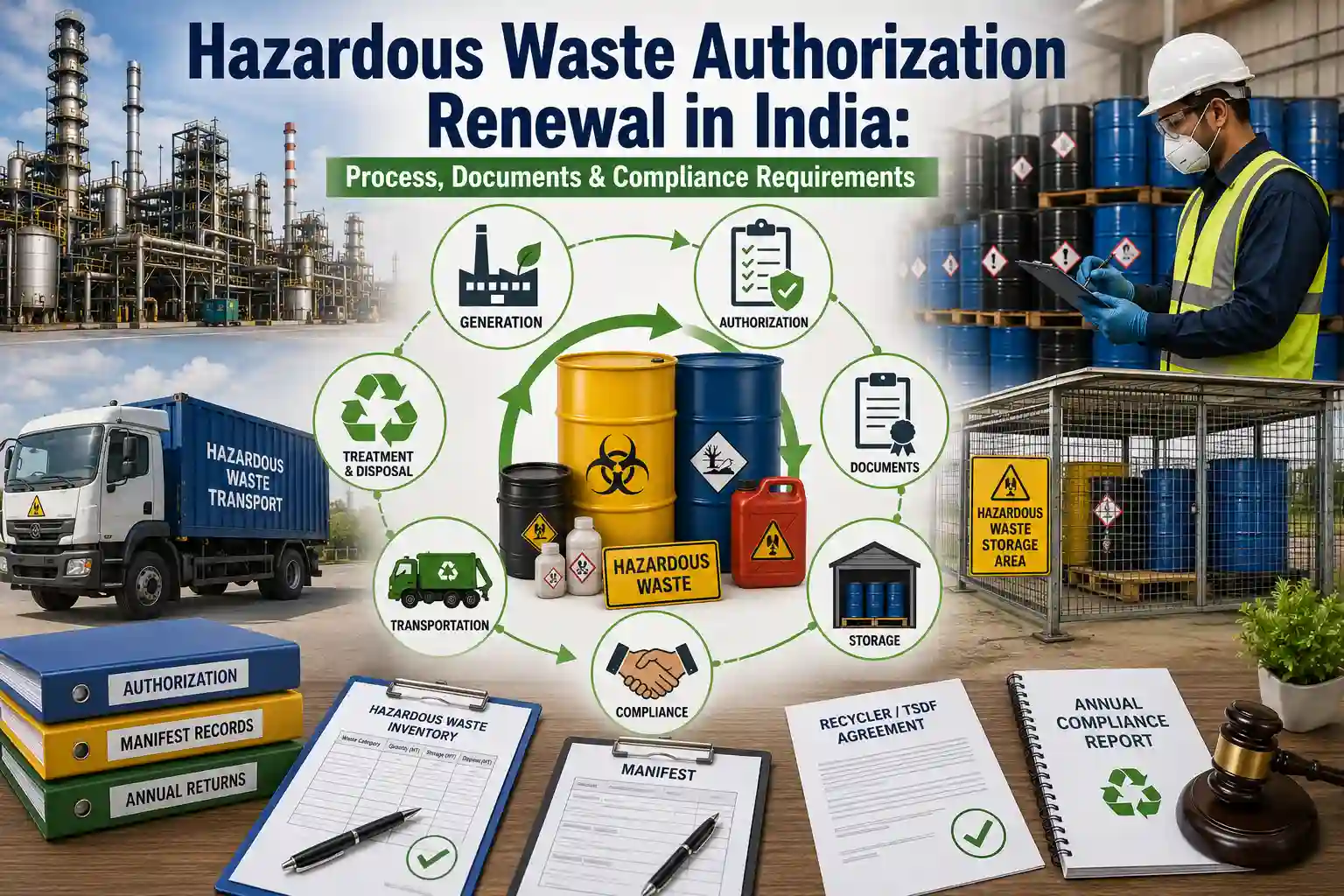
Hazardous Waste Authorization Renewal in India
Industries generating hazardous waste are required to maintain valid Hazardous Waste Authorization issued by the State Pollution Control Board (SPCB) under the Hazardous and Other Wastes (Management and Transboundary Movement) Rules, 2016.
Many industries focus on obtaining authorization but often overlook renewal requirements, compliance obligations, and record maintenance necessary for continued validity.
Failure to renew or comply with authorization conditions can result in:
- Show cause notices
- Environmental compensation
- SPCB enforcement action
- Suspension of Consent to Operate (CTO)
- Regulatory penalties
This guide explains the Hazardous Waste Authorization renewal process, required documents, timelines, and best practices for industries.
What is Hazardous Waste Authorization?
Hazardous Waste Authorization is a permission granted by the State Pollution Control Board allowing an industry to:
- Generate hazardous waste
- Store hazardous waste
- Transport hazardous waste
- Recycle or utilize hazardous waste
- Dispose of hazardous waste through authorized facilities
The authorization specifies:
- Waste categories
- Annual quantities
- Storage limits
- Disposal methods
- Compliance conditions
Industries must continuously comply with these conditions throughout the validity period.
Hazardous and Other Wastes (Management and Transboundary Movement) Rules, 2016
The Rules regulate:
- Generation
- Collection
- Storage
- Transportation
- Recycling
- Utilization
- Treatment
- Disposal
of hazardous waste generated by industries.
Which Industries Need Authorization Renewal?
Renewal requirements commonly apply to:
- Chemical industries
- Pharmaceutical units
- Electroplating industries
- Paint manufacturing units
- Engineering industries
- Automobile industries
- Battery manufacturing facilities
- Textile processing industries
- Petroleum and lubricant industries
- E-waste recycling facilities
Any industry generating hazardous waste under the Rules should periodically review the validity and compliance status of its authorization.
When Should Industries Apply for Renewal?
Industries should not wait until the last date of validity.
As a best practice, renewal preparation should begin well in advance to allow sufficient time for:
- Internal compliance review
- Document collection
- Record verification
- SPCB scrutiny
Early submission helps avoid operational risks arising from delays in approval.
Why is Hazardous Waste Authorization Renewal Important?
Renewal demonstrates that the industry continues to:
- Handle hazardous waste responsibly
- Maintain proper storage facilities
- Use authorized recyclers and TSDFs
- Maintain waste tracking records
- Comply with environmental regulations
During renewal review, Pollution Control Boards often assess the overall hazardous waste management system of the facility.
Documents Required for Hazardous Waste Authorization Renewal
The exact requirements vary between State Pollution Control Boards; however, industries commonly need:
Existing Authorization Copy
Previous authorization certificate and approval conditions.
Consent to Operate (CTO)
Valid Consent to Operate issued by the SPCB.
Hazardous Waste Inventory
Details of:
- Waste categories
- Annual quantities generated
- Storage quantities
- Disposal quantities
Annual Return Records
Copies of annual hazardous waste returns submitted to the SPCB.
Manifest Records
Records showing movement of hazardous waste to authorized recyclers, co-processors, or TSDF facilities.
Recycler / TSDF Agreements
Valid agreements or arrangements with:
- Authorized recyclers
- Co-processing facilities
- TSDF operators
Site Layout Plan
Showing:
- Hazardous waste storage area
- Production areas
- Waste handling facilities
Environmental Monitoring Records
Where applicable, industries may need to submit:
- Wastewater monitoring reports
- Air monitoring reports
- Environmental compliance records
Hazardous Waste Authorization Renewal Process
Step 1 – Compliance Review
Industries should first review:
- Existing authorization conditions
- Waste categories
- Annual waste quantities
- Disposal records
- Compliance status
Any discrepancies should be corrected before filing renewal applications.
Step 2 – Record Verification
Verify:
- Manifest records
- Waste inventories
- Disposal certificates
- Annual returns
Incomplete records frequently lead to regulatory queries.
Step 3 – Online SPCB Application
Most State Pollution Control Boards provide online portals for authorization renewal.
The application generally requires:
- Industry details
- Waste generation details
- Authorization information
- Document uploads
- Compliance declarations
Step 4 – SPCB Scrutiny
The SPCB may examine:
- Waste generation trends
- Storage practices
- Manifest compliance
- Disposal arrangements
- Previous compliance history
Step 5 – Site Inspection (if required)
In some cases, the Pollution Control Board may conduct site inspections to verify:
- Storage facilities
- Waste handling systems
- Record maintenance
- Authorization compliance
Step 6 – Grant of Renewal
Upon satisfactory review, the SPCB may renew the authorization subject to applicable conditions.
Common Reasons for Renewal Delays
Industries frequently face delays because of:
- Incomplete documentation
- Missing manifest records
- Invalid recycler agreements
- Improper waste categorization
- Storage non-compliance
- Pending SPCB notices
- Expired CTO approvals
Proper record management significantly improves approval timelines.
Hazardous Waste Storage Compliance During Renewal
One of the most scrutinized areas during renewal is hazardous waste storage.
Industries should ensure:
- Impervious flooring
- Covered storage area
- Proper labeling
- Spill containment arrangements
- Emergency response measures
- Fire safety provisions
Improper storage is a common reason for observations during inspections.
Manifest System Compliance
The Hazardous Waste Manifest System helps regulators track waste movement from generation to final disposal.
Industries should maintain:
- Transport records
- Recycler certificates
- Disposal acknowledgements
- Manifest copies
Missing manifest records can create significant compliance issues during renewal.
Annual Compliance Obligations
Industries holding authorization should continuously:
- Maintain waste inventory records
- Submit annual returns
- Track hazardous waste quantities
- Maintain storage facilities
- Use authorized recyclers
- Maintain disposal records
Authorization renewal becomes much easier when compliance is maintained throughout the year.
Common Mistakes by Industries
Many industries face regulatory issues because they:
- Delay renewal applications
- Dispose waste through unauthorized vendors
- Maintain incomplete manifests
- Store waste improperly
- Exceed authorized waste quantities
- Fail to submit annual returns
- Ignore authorization conditions
These issues may trigger notices and enforcement action.
Environmental Compensation for Hazardous Waste Violations
Pollution Control Boards and NGT may impose Environmental Compensation for:
- Unauthorized disposal
- Improper storage
- Illegal transportation
- Failure to obtain authorization
- Violation of authorization conditions
Environmental Compensation is increasingly being used as an enforcement tool under the Polluter Pays Principle.
Best Practices for Industries
Industries should:
- Maintain updated authorization records
- Conduct periodic compliance reviews
- Keep manifest records updated
- Verify recycler authorizations
- Train employees on hazardous waste handling
- Maintain dedicated storage facilities
- Track authorization validity dates
A proactive compliance approach significantly reduces regulatory risks.
Related Guides & Resources
- Hazardous Waste Authorization Process →
- Environmental Compensation Explained →
- Environmental Compliance Checklist for Industries →
- Pollution Control Compliance →
Need Help with Hazardous Waste Compliance?
Simplicomp assists industries with:
- Hazardous Waste Authorization applications
- Authorization renewals
- Waste inventory preparation
- Manifest compliance
- SPCB coordination
- Environmental compliance audits
- Waste management compliance