

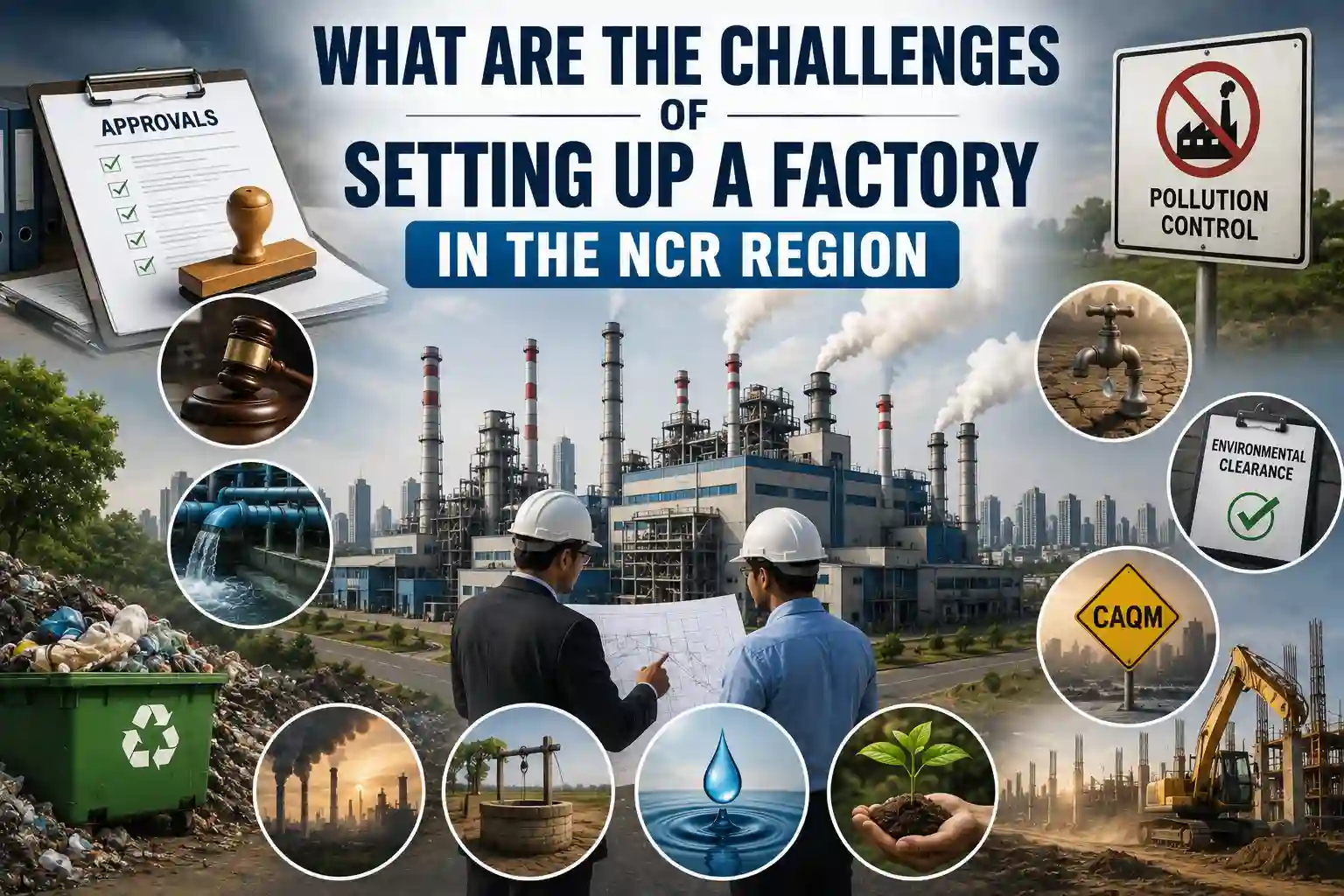
What are the Challenges of Setting Up a Factory in the NCR Region? Environmental Approvals Explained
The National Capital Region (NCR) is one of India's most important industrial and economic hubs. Covering Delhi and parts of Haryana, Uttar Pradesh, and Rajasthan, the region offers excellent infrastructure, connectivity, skilled manpower, and access to major markets.
However, setting up a factory in NCR is often more challenging than in many other parts of the country due to stringent environmental regulations and heightened scrutiny by multiple regulatory authorities.
Given the region's severe air pollution, groundwater stress, rapid urbanization, and environmental concerns, industrial projects are required to comply with a complex framework of environmental approvals before commencing operations.
This article explains the major environmental challenges businesses face while establishing factories in NCR and how they can navigate the approval process effectively.
Why is NCR Subject to Stricter Environmental Regulations?
The NCR region faces several environmental challenges:
- High air pollution levels
- Groundwater depletion
- Water scarcity
- Rapid urbanization
- Increasing industrialization
- Waste management pressures
Because of these challenges, regulatory authorities impose stricter environmental conditions compared to many other regions in India.
Projects are often subjected to greater scrutiny during approval and operation stages.
Challenge 1: Identifying Whether the Industry is Permitted in NCR
Before purchasing land or finalizing an industrial plot, investors must verify whether the proposed activity is permissible in the selected industrial area.
Key considerations include:
- Industrial zoning regulations
- Land use restrictions
- CPCB Industry Classification
- Red, Orange, Green, White and Blue Category classification
- Local industrial area restrictions
Certain highly polluting industries may face restrictions or additional scrutiny within NCR.
A wrong site selection can result in project delays and significant financial losses.
Challenge 2: Consent to Establish (CTE) from Pollution Control Authorities
Most manufacturing industries require Consent to Establish (CTE) before construction and installation activities begin.
Depending upon project location, approvals may be required from:
Haryana State Pollution Control Board (HSPCB)
For projects located in Gurugram, Faridabad, Manesar, Sonipat, Bahadurgarh, and other NCR districts of Haryana.
Uttar Pradesh Pollution Control Board (UPPCB)
For projects located in Noida, Greater Noida, Ghaziabad, Meerut, and adjoining NCR districts.
Rajasthan State Pollution Control Board (RSPCB)
For projects located in NCR districts of Rajasthan.
Obtaining CTE requires submission of:
- Project details
- Manufacturing process
- Water balance
- Pollution control measures
- Waste management systems
- Site plans
Approval timelines can vary depending on industry category and project complexity.
Challenge 3: Environmental Clearance (EC)
Certain projects require Environmental Clearance under the EIA Notification, 2006.
Industries requiring EC may need to undertake:
- EIA Studies
- Environmental Management Plans (EMP)
- Public Consultation (where applicable)
- Appraisal by Expert Committees
Environmental Clearance is often one of the most time-consuming approvals for large projects.
Failure to determine EC applicability at an early stage can significantly delay project implementation.
Challenge 4: Groundwater NOC and Water Availability
Groundwater availability is becoming a major concern across NCR.
Several districts fall within:
- Semi-Critical Areas
- Critical Areas
- Over-Exploited Areas
Projects proposing groundwater extraction may require approvals from:
- Central Ground Water Authority (CGWA)
- Haryana Water Resources Authority (HWRA)
- State Groundwater Authorities
Authorities often require:
- Water Balance Studies
- Rainwater Harvesting Systems
- Groundwater Recharge Structures
- Water Conservation Measures
In some locations, groundwater extraction permissions may be difficult to obtain.
Challenge 5: CAQM Regulations and Air Pollution Restrictions
One of the most significant challenges unique to NCR is compliance with requirements issued by the Commission for Air Quality Management (CAQM).
CAQM was established to improve air quality across the NCR and adjoining areas.
Industries may be required to comply with:
- Cleaner fuel requirements
- PNG adoption
- Emission control systems
- Dust control measures
- Construction and demolition management guidelines
- Air pollution monitoring requirements
Industries relying on highly polluting fuels may face additional restrictions.
CAQM directions increasingly influence project planning and operational decisions within NCR.
Challenge 6: Wastewater Management Requirements
Industrial facilities generating wastewater must establish appropriate treatment systems.
Depending on the industry, authorities may require:
- Effluent Treatment Plant (ETP)
- Sewage Treatment Plant (STP)
- Water Recycling Systems
- Zero Liquid Discharge (ZLD) Systems
Authorities evaluate wastewater management arrangements during both approval and operational stages.
Projects unable to demonstrate adequate wastewater treatment may face delays in obtaining approvals.
Challenge 7: Waste Management Approvals
Factories often require compliance under:
- Hazardous Waste Management Rules
- Plastic Waste Management Rules
- E-Waste Management Rules
- Battery Waste Management Rules
- Solid Waste Management Rules
Businesses must establish systems for:
- Waste segregation
- Storage
- Transportation
- Disposal through authorized facilities
Failure to address waste management requirements can result in approval delays and compliance issues.
Challenge 8: Air Pollution Control Requirements
Given NCR's air quality concerns, authorities place significant emphasis on air pollution control.
Industries may be required to install:
- Dust Collection Systems
- Bag Filters
- Scrubbers
- Cyclone Separators
- Emission Monitoring Systems
Air pollution control measures must be integrated during project planning itself.
Challenge 9: Multiple Regulatory Authorities
One of the biggest practical challenges is dealing with multiple authorities simultaneously.
Depending on the project, approvals may involve:
- Pollution Control Board
- Groundwater Authority
- SEIAA / MoEFCC
- Industrial Development Authority
- Fire Department
- Factory Department
- Local Authorities
- CAQM requirements
Coordination between different approvals often becomes a significant project management challenge.
Challenge 10: Increasing Environmental Compliance Obligations
Obtaining approvals is only the beginning.
After project commissioning, industries may need to comply with:
- Consent to Operate (CTO)
- Environmental Monitoring
- Groundwater Compliance
- Hazardous Waste Returns
- Form V Environmental Statement
- EC Compliance Reports
- EPR Compliance
Failure to maintain compliance can lead to notices, Environmental Compensation, and operational disruptions.
Common Reasons for CTE Rejection or Delay
Many businesses face delays because they:
- Purchase land before checking environmental restrictions
- Ignore groundwater availability
- Delay environmental approvals
- Underestimate CAQM requirements
- Fail to assess wastewater treatment requirements
- Ignore industry classification applicability
- Begin construction before obtaining approvals
Early environmental due diligence can prevent most of these issues.
Best Practices for Factory Setup in NCR
Businesses should:
- Conduct environmental due diligence before land purchase
- Verify CPCB industry category
- Assess EC applicability early
- Evaluate groundwater availability
- Prepare water balance studies
- Plan pollution control systems during project design
- Understand CAQM requirements
- Initiate approvals well before construction
- Engage experienced environmental consultants
Conclusion
The NCR region offers tremendous opportunities for industrial growth, but it also has one of the most stringent environmental regulatory frameworks in India.
Environmental Clearance requirements, Pollution Board approvals, groundwater restrictions, CAQM regulations, wastewater management obligations, and ongoing compliance requirements can significantly influence project timelines and costs.
Businesses that proactively address environmental requirements during project planning are far more likely to obtain approvals smoothly and avoid costly delays during implementation.