

Introduction
Groundwater is one of India's most valuable natural resources, supplying water for drinking, agriculture, industries, and infrastructure projects. However, increasing groundwater extraction combined with rapid urbanization and changing rainfall patterns has led to declining groundwater levels in many regions of the country.
One of the most effective ways to restore groundwater resources is through groundwater recharge. Recharge is the process by which water moves from the land surface into the soil and eventually reaches underground aquifers, replenishing groundwater reserves.
Both natural processes and engineered recharge systems play a vital role in maintaining groundwater availability. Today, groundwater recharge is not only an important environmental practice but is also incorporated into many regulatory frameworks governing groundwater abstraction and environmental approvals.
This guide explains groundwater recharge, its importance, different recharge methods, and its role in sustainable groundwater management.
What is Groundwater Recharge?
Definition
Groundwater recharge is the process through which water infiltrates the ground and replenishes underground aquifers.
Recharge occurs naturally through rainfall and seepage from rivers, lakes, ponds, and canals. It can also be enhanced using artificial recharge structures designed to increase the amount of water entering the aquifer.
Groundwater recharge helps maintain the balance between groundwater extraction and replenishment, ensuring that aquifers continue to provide reliable water supplies over the long term.
Why is Groundwater Recharge Important?
Recharge is essential because groundwater is continuously withdrawn for various purposes. Without adequate replenishment, groundwater levels decline over time.
Groundwater recharge helps to:
- Restore depleted aquifers.
- Improve groundwater availability.
- Reduce dependence on external water sources.
- Support sustainable groundwater extraction.
- Enhance drought resilience.
- Maintain base flows in rivers and streams.
- Improve long-term water security.
- Protect ecosystems dependent on groundwater.
Recharge is a key component of integrated water resource management.
Natural Groundwater Recharge
Natural recharge occurs without human intervention through hydrological processes.
Major sources include:
Rainfall Infiltration
A portion of rainfall infiltrates the soil and percolates downward to recharge aquifers.
River and Stream Seepage
Water from rivers and streams gradually infiltrates surrounding geological formations, contributing to groundwater recharge.
Lakes and Ponds
Natural and man-made water bodies allow water to seep into underlying aquifers over time.
Floodplain Recharge
During periods of high river flow, floodwaters infiltrate surrounding land and replenish groundwater.
Artificial Groundwater Recharge
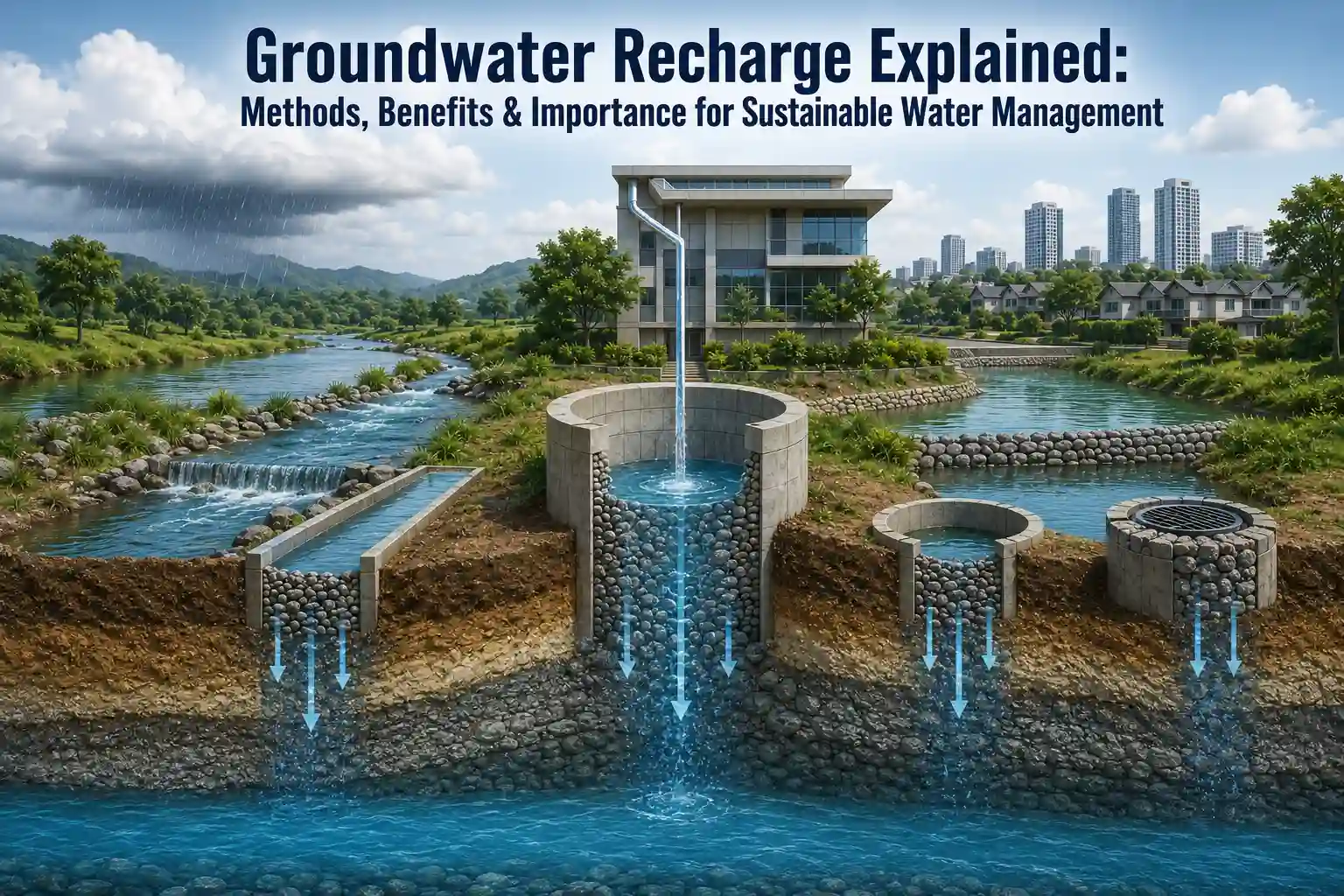
Artificial recharge involves engineering interventions that increase the amount of water entering underground aquifers.
Common methods include:
Recharge Pits
Excavated pits filled with filter media that allow rainwater to infiltrate into the ground.
Recharge Trenches
Long, narrow trenches that collect stormwater and facilitate groundwater recharge.
Recharge Wells
Specially designed wells used to inject treated rainwater or surface water directly into aquifers.
Percolation Tanks
Shallow reservoirs that temporarily store runoff and allow gradual infiltration into the ground.
Check Dams
Small barriers constructed across seasonal streams to slow water flow and increase infiltration.
Recharge Shafts
Vertical shafts constructed where impermeable surface layers prevent normal infiltration.
Injection Wells
In certain hydrogeological settings, treated water may be injected into deeper aquifers through specially designed wells.
| Rainwater Harvesting | Groundwater Recharge |
|---|---|
| Focuses on collecting and storing rainwater for future use. | Focuses on replenishing underground aquifers. |
| Water may be stored in tanks or reservoirs. | Water infiltrates into the ground. |
| Primarily improves water availability at the user level. | Improves groundwater resources at the aquifer level. |
| Can function independently. | Often uses harvested rainwater as the recharge source. |
In many projects, rainwater harvesting systems are integrated with recharge structures to maximize water conservation.
Groundwater Recharge and Regulatory Compliance
Groundwater recharge plays an important role in environmental compliance and groundwater regulation.
Authorities may require recharge measures for projects seeking:
- Groundwater No Objection Certificate (NOC)
- Environmental Clearance (EC)
- Consent to Establish (CTE)
- Consent to Operate (CTO)
Recharge structures are commonly included as part of water conservation plans, particularly in areas experiencing groundwater stress.
Factors Affecting Groundwater Recharge
Several factors influence the effectiveness of groundwater recharge.
Rainfall
Higher rainfall generally increases recharge potential, provided infiltration conditions are favourable.
Soil Characteristics
Sandy and gravelly soils allow greater infiltration than clay-rich soils.
Geological Formation
Rock type, fractures, and aquifer characteristics determine how easily groundwater can be recharged.
Land Use
Urbanization reduces recharge because paved surfaces prevent water from infiltrating into the ground.
Topography
Slope influences runoff and infiltration. Gentle slopes typically allow greater recharge than steep terrain.
Benefits of Groundwater Recharge
Groundwater recharge offers numerous environmental, economic, and social benefits.
Step 3 – Online Application Submission
- Restores groundwater reserves.
- Supports sustainable groundwater abstraction.
- Reduces groundwater depletion.
- Improves water availability during dry seasons.
- Enhances drought resilience.
- Supports agriculture and industry.
- Reduces flooding by increasing infiltration.
- Promotes long-term water security.
- Protects groundwater-dependent ecosystems.
Best Practices for Effective Groundwater Recharge
Successful recharge programmes require proper planning and maintenance.
Recommended practices include:
- Conduct a Hydrogeological Study before designing recharge systems.
- Assess groundwater quality.
- Install suitable recharge structures based on site conditions.
- Integrate rainwater harvesting with recharge systems.
- Prevent contamination of recharge water.
- Maintain recharge structures regularly.
- Monitor groundwater levels periodically.
These measures improve recharge efficiency and ensure long-term performance.
Challenges in Groundwater Recharge
Despite its benefits, groundwater recharge faces several challenges.
- Rapid urbanization and paved surfaces.
- Declining open spaces.
- Poor maintenance of recharge structures.
- Sedimentation reducing infiltration.
- Contaminated recharge water.
- Climate variability affecting rainfall.
- Lack of public awareness.
Addressing these challenges requires coordinated planning, sound engineering, and regular monitoring.
Conclusion
Groundwater recharge is a cornerstone of sustainable groundwater management. By replenishing aquifers through natural and artificial means, recharge helps offset groundwater extraction, improve water security, and protect ecosystems that depend on groundwater.
For industries, developers, institutions, and local authorities, investing in effective groundwater recharge measures not only supports environmental compliance but also contributes to the long-term conservation of one of India's most critical natural resources.
As groundwater stress continues to grow across many parts of India, recharge will remain an essential strategy for balancing development with responsible water resource management.
Related Environmental Library
Need Help with Groundwater NOC Approval?
Simplicomp provides support for:
- Groundwater NOC applications
- Borewell permission approvals
- CGWA approvals
- Water balance studies
- Rainwater harvesting compliance
- Groundwater documentation and regulatory coordination