

Introduction
Groundwater is one of India's most valuable natural resources, supporting drinking water supplies, agriculture, industries, and infrastructure projects. However, increasing demand and excessive extraction have placed significant pressure on groundwater reserves across many parts of the country.
To ensure sustainable groundwater management, the Central Ground Water Authority (CGWA) and State Groundwater Authorities classify assessment units based on the status of groundwater extraction. This categorization plays a critical role in determining whether new groundwater abstraction is permitted and what conditions apply to obtaining a Groundwater No Objection Certificate (NOC).
Understanding these groundwater categories is essential for industries, commercial establishments, infrastructure developers, educational institutions, hospitals, and residential projects that rely on groundwater.
This guide explains the different groundwater categories, how they are determined, and their implications for environmental compliance and project planning.
What is Groundwater Categorization?
Groundwater categorization is the process of classifying an assessment unit based on the relationship between groundwater recharge and groundwater extraction.
The objective is to identify areas where groundwater resources are under stress and to regulate extraction accordingly.
Each assessment unit is assigned a category based on scientific studies carried out periodically by the Central Ground Water Board (CGWB) in coordination with State agencies.
The categorization helps regulators decide:
- Whether groundwater extraction should be permitted.
- The level of regulatory control required.
- Additional conservation measures needed.
- Recharge obligations applicable to groundwater users.
What is an Assessment Unit?
Groundwater is not categorized village-wise or district-wise. Instead, it is assessed using hydrogeological units known as Assessment Units.
Depending on the state, an assessment unit may be a:
- Block
- Taluka
- Mandal
- Tehsil
- Watershed
Each unit is evaluated independently based on groundwater availability and extraction.
As a result, different assessment units within the same district may fall under different groundwater categories.
How is Groundwater Categorization Determined?
Groundwater categorization is based on scientific assessment of groundwater resources.
Authorities evaluate several factors, including:
- Annual groundwater recharge
- Annual groundwater extraction
- Long-term groundwater level trends
- Rainfall patterns
- Aquifer characteristics
- Land use
- Surface water availability
One of the most important indicators is the Stage of Groundwater Extraction, which compares annual groundwater extraction with the annual extractable groundwater resource.
Areas with higher extraction relative to recharge are subject to stricter regulation.
Categories of Groundwater Assessment Units
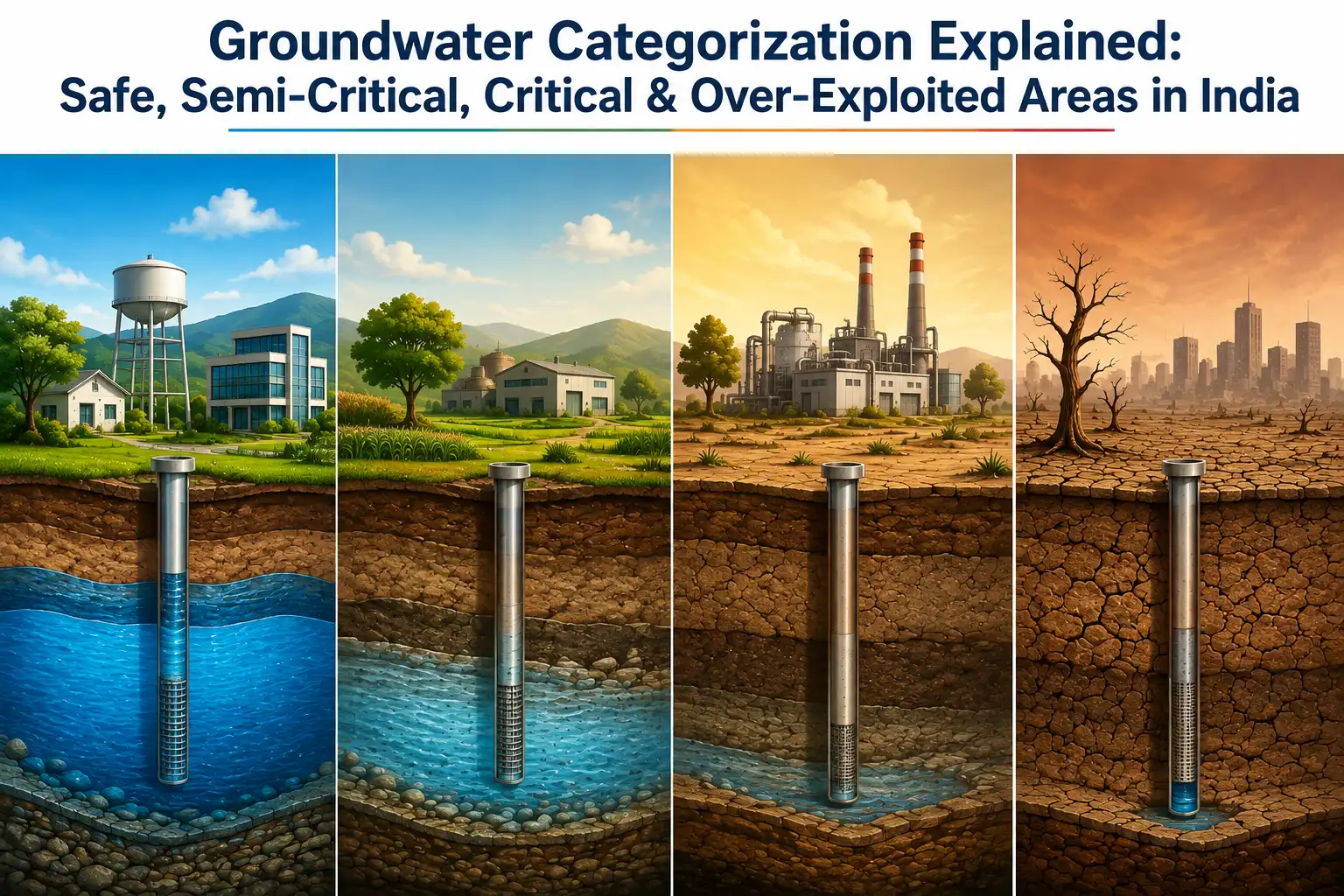
Groundwater assessment units are generally classified into four principal categories.
Safe Area
A Safe area is one where groundwater extraction remains well within sustainable limits and groundwater resources are considered adequate.
Characteristics include:
- Sufficient groundwater availability.
- Stable groundwater levels.
- Lower extraction pressure.
- Better long-term sustainability.
Projects in Safe areas generally have a higher likelihood of obtaining groundwater permissions, subject to applicable regulatory requirements.
Semi-Critical Area
A Semi-Critical area is one where groundwater extraction has increased significantly and continued monitoring is necessary.
These areas require greater emphasis on:
- Water conservation.
- Rainwater harvesting.
- Groundwater recharge.
- Efficient water use.
Authorities may impose additional conditions while granting groundwater extraction permissions.
Critical Area
Critical areas experience significant groundwater stress.
Groundwater withdrawal approaches or exceeds sustainable recharge levels, making resource management increasingly challenging.
Projects proposing groundwater extraction in Critical areas are subject to greater regulatory scrutiny.
Applicants may be required to demonstrate:
- Efficient water management.
- Wastewater recycling.
- Artificial recharge measures.
- Reduced dependence on groundwater.
Over-Exploited Area
Over-Exploited areas represent the highest level of groundwater stress.
In these areas:
- Annual groundwater extraction exceeds sustainable recharge.
- Water tables continue to decline.
- Groundwater availability is severely constrained.
Groundwater abstraction in Over-Exploited areas is strictly regulated, and new extraction permissions may be restricted or granted only under specific conditions prescribed by the applicable authority.
Why Does Groundwater Categorization Matter?
Groundwater categorization has a direct impact on environmental approvals and industrial planning.
It influences:
- Groundwater NOC eligibility.
- Permissible groundwater extraction.
- Water conservation obligations.
- Rainwater harvesting requirements.
- Artificial recharge measures.
- Environmental Clearance conditions.
- Industrial water management strategies.
Ignoring groundwater categorization during project planning can lead to delays in statutory approvals.
Groundwater Categorization and Groundwater NOC
The groundwater category of an assessment unit is one of the most important factors considered while evaluating Groundwater NOC applications.
Authorities may prescribe conditions relating to:
- Maximum permissible abstraction.
- Installation of digital water meters.
- Flow measurement systems.
- Rainwater harvesting structures.
- Groundwater recharge.
- Water audits.
- Annual compliance reporting.
Projects located in stressed groundwater areas are generally expected to adopt stronger water conservation practices.
How Can Industries Reduce Groundwater Dependence?
Industries can reduce pressure on groundwater by adopting sustainable water management practices such as:
- Recycling treated wastewater.
- Installing Sewage Treatment Plants (STPs).
- Using Effluent Treatment Plants (ETPs).
- Implementing Zero Liquid Discharge (ZLD) systems.
- Harvesting rainwater.
- Conducting regular Water Balance Studies.
- Installing water-efficient equipment.
- Monitoring groundwater abstraction.
These measures improve long-term water security and support regulatory compliance.
Common Misconceptions About Groundwater Categories
Several misconceptions exist regarding groundwater categorization.
Myth: A project in an Over-Exploited area can never obtain a Groundwater NOC.
Fact: Permissions may still be granted in certain cases, subject to applicable guidelines, eligibility criteria, and compliance with prescribed conditions.
Myth: Groundwater categorization never changes.
Fact: Categories are periodically revised based on updated groundwater resource assessments.
Myth: Only industries need to consider groundwater categories.
Fact: Infrastructure projects, commercial establishments, hospitals, educational institutions, mining projects, and residential developments may also be affected.
Best Practices for Project Developers
Before relying on groundwater as a water source, project proponents should:
- Verify the groundwater category of the assessment unit.
- Assess long-term water availability.
- Prepare a Water Balance Study.
- Incorporate rainwater harvesting.
- Plan wastewater recycling.
- Reduce freshwater demand through efficient technologies.
- Initiate Groundwater NOC applications well before project implementation.
Early planning can significantly reduce approval timelines and improve environmental compliance.
Conclusion
Groundwater categorization is a key component of India's groundwater management framework. By classifying assessment units as Safe, Semi-Critical, Critical, or Over-Exploited, regulatory authorities can ensure that groundwater extraction remains sustainable and environmentally responsible.
For industries and project developers, understanding the groundwater category of the project location is essential before planning groundwater abstraction. A proactive approach to water conservation, recycling, and recharge not only facilitates statutory approvals but also contributes to the long-term protection of one of India's most precious natural resources.
Related Environmental Library Pages
Need Help with Groundwater NOC Approval?
Simplicomp provides support for:
- Groundwater NOC applications
- Borewell permission approvals
- CGWA approvals
- Water balance studies
- Rainwater harvesting compliance
- Groundwater documentation and regulatory coordination