

Introduction
Groundwater is one of India's most valuable natural resources. It supports agriculture, industries, infrastructure development, commercial establishments, and drinking water supply for millions of people.
However, rapid population growth, urbanization, industrial expansion, and unsustainable groundwater extraction have placed enormous pressure on groundwater resources across the country.
Many regions that were once considered groundwater-safe are now classified as Semi-Critical, Critical, or Over-Exploited. As groundwater levels continue to decline, the issue is emerging as one of India's most significant environmental and developmental challenges.
The future of sustainable development in India depends not only on economic growth but also on how effectively we conserve and manage groundwater resources.
Sustainable Development and Environmental Responsibility
The concept of sustainable development gained global importance following the 1972 United Nations Conference on the Human Environment held in Stockholm.
The conference emphasized the need to balance:
- Environmental protection
- Economic development
- Social progress
India has since strengthened its environmental governance framework through legislation, environmental policies, and regulatory institutions aimed at protecting natural resources.
Several important environmental laws have emerged over the years, including:
- Water (Prevention and Control of Pollution) Act, 1974
- Air (Prevention and Control of Pollution) Act, 1981
- Environment (Protection) Act, 1986
- Various waste management rules and environmental regulations
While significant progress has been made in controlling pollution, groundwater conservation remains one of the most pressing environmental challenges facing the country.
Population Growth and Water Demand
India's growing population has significantly increased demand for water.
Water is required for:
- Drinking purposes
- Domestic consumption
- Agriculture
- Manufacturing
- Commercial activities
- Infrastructure development
As demand increases, groundwater extraction continues to rise.
Many cities, industries, institutions, and residential developments rely heavily on borewells and groundwater sources to meet daily water requirements.
Without adequate groundwater recharge, long-term water security becomes increasingly difficult.
Industrial Growth and Groundwater Stress
Industrial development is essential for economic growth, employment generation, and infrastructure expansion.
However, industries require substantial quantities of water for:
- Manufacturing processes
- Cooling systems
- Utility operations
- Cleaning and maintenance activities
In many industrial regions, groundwater has become the primary source of water supply.
At the same time, industrial expansion often results in:
- Increased land development
- Reduction in natural recharge areas
- Increased water demand
- Pressure on local aquifers
Sustainable industrial growth requires efficient water use, wastewater recycling, rainwater harvesting, and groundwater recharge initiatives.
Haryana State Pollution Control Board (HSPCB)
For projects located in Gurugram, Faridabad, Manesar, Sonipat, Bahadurgarh, and other NCR districts of Haryana.
Urbanization and Infrastructure Development
India is witnessing rapid urbanization as people migrate from rural areas to cities in search of employment, education, and improved living standards.
The expansion of:
- Residential townships
- Commercial complexes
- Industrial parks
- Roads and highways
- Urban infrastructure
has significantly altered natural hydrological systems.
Large areas that once allowed rainwater to infiltrate into the soil are now covered by concrete surfaces.
As a result:
- Groundwater recharge decreases
- Surface runoff increases
- Urban flooding becomes more frequent
- Dependence on groundwater extraction increases
This imbalance contributes directly to declining groundwater levels.
Agriculture and Groundwater Extraction
Agriculture remains one of the largest consumers of groundwater in India.
Groundwater is extensively used for:
- Irrigation
- Crop cultivation
- Rural water supply
In many regions, excessive groundwater extraction has exceeded natural recharge rates.
Water-intensive crops, inefficient irrigation practices, and dependence on borewell irrigation have accelerated groundwater depletion.
The long-term sustainability of agriculture depends upon improving water-use efficiency and promoting groundwater conservation measures.
The Rise of Groundwater Regulation
For many years, groundwater extraction remained largely unregulated in several parts of the country.
Growing concerns regarding groundwater depletion led to increased regulatory intervention through:
- Central Ground Water Authority (CGWA)
- State Groundwater Authorities
- Environmental Clearance conditions
- Groundwater NOC systems
Today, industries, infrastructure projects, commercial establishments, and institutions are increasingly required to:
- Obtain groundwater permissions
- Install flow meters
- Develop groundwater recharge structures
- Submit annual compliance reports
These measures aim to promote sustainable groundwater management.
Why Groundwater Aquifers Are Declining
Several factors contribute to groundwater depletion:
Excessive Groundwater Extraction
Groundwater withdrawal often exceeds natural recharge rates.
Reduction in Green Cover
Deforestation and loss of vegetation reduce soil infiltration capacity.
Urban Expansion
Concrete surfaces prevent rainwater from naturally recharging aquifers.
Lack of Rainwater Harvesting
Many developments fail to adequately capture and recharge rainwater.
Climate Variability
Changes in rainfall patterns affect groundwater recharge rates.
Poor Water Management
Inefficient water use continues to place pressure on groundwater resources.
Environmental Awareness: The Missing Link
While regulations play an important role, long-term groundwater conservation ultimately depends on public awareness and responsible water use.
Organizations, industries, institutions, and communities must adopt:
- Rainwater harvesting
- Water conservation practices
- Water recycling systems
- Groundwater monitoring
- Sustainable water management plans
Environmental awareness remains one of the most effective tools for protecting groundwater resources.
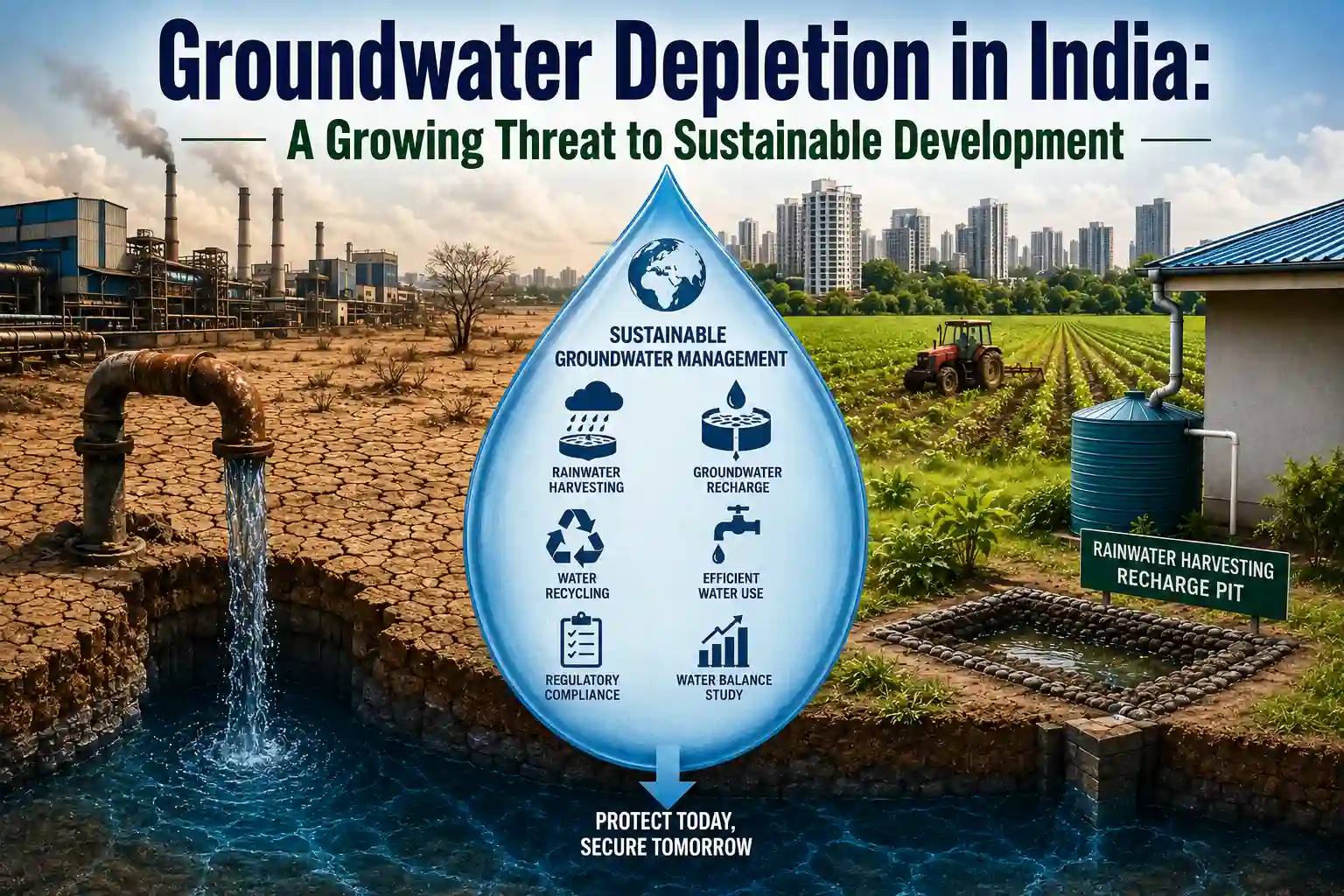
Solutions for Sustainable Groundwater Management
Groundwater depletion cannot be addressed through a single intervention.
A comprehensive approach should include:
Rainwater Harvesting
Capturing and recharging rainwater to replenish aquifers.
Groundwater Recharge Structures
Recharge pits, recharge wells, and recharge trenches.
Water Recycling
Reuse of treated wastewater for industrial and non-potable applications.
Water Balance Studies
Assessing water demand and identifying conservation opportunities.
Efficient Water Use
Reducing wastage across domestic, industrial, and agricultural sectors.
Regulatory Compliance
Ensuring compliance with groundwater approvals and environmental conditions.
Conclusion: From Awareness to Action
Groundwater depletion is no longer a future concern—it is a present reality affecting industries, agriculture, infrastructure projects, cities, and communities across India.
While artificial recharge and rainwater harvesting can significantly improve groundwater availability, sustainable groundwater management requires a broader approach involving policy, technology, environmental awareness, and responsible resource use.
Protecting groundwater is not only an environmental responsibility but also an economic and social necessity.
The decisions made today regarding water conservation, recharge, recycling, and sustainable development will determine India's water security for future generations.