

Introduction
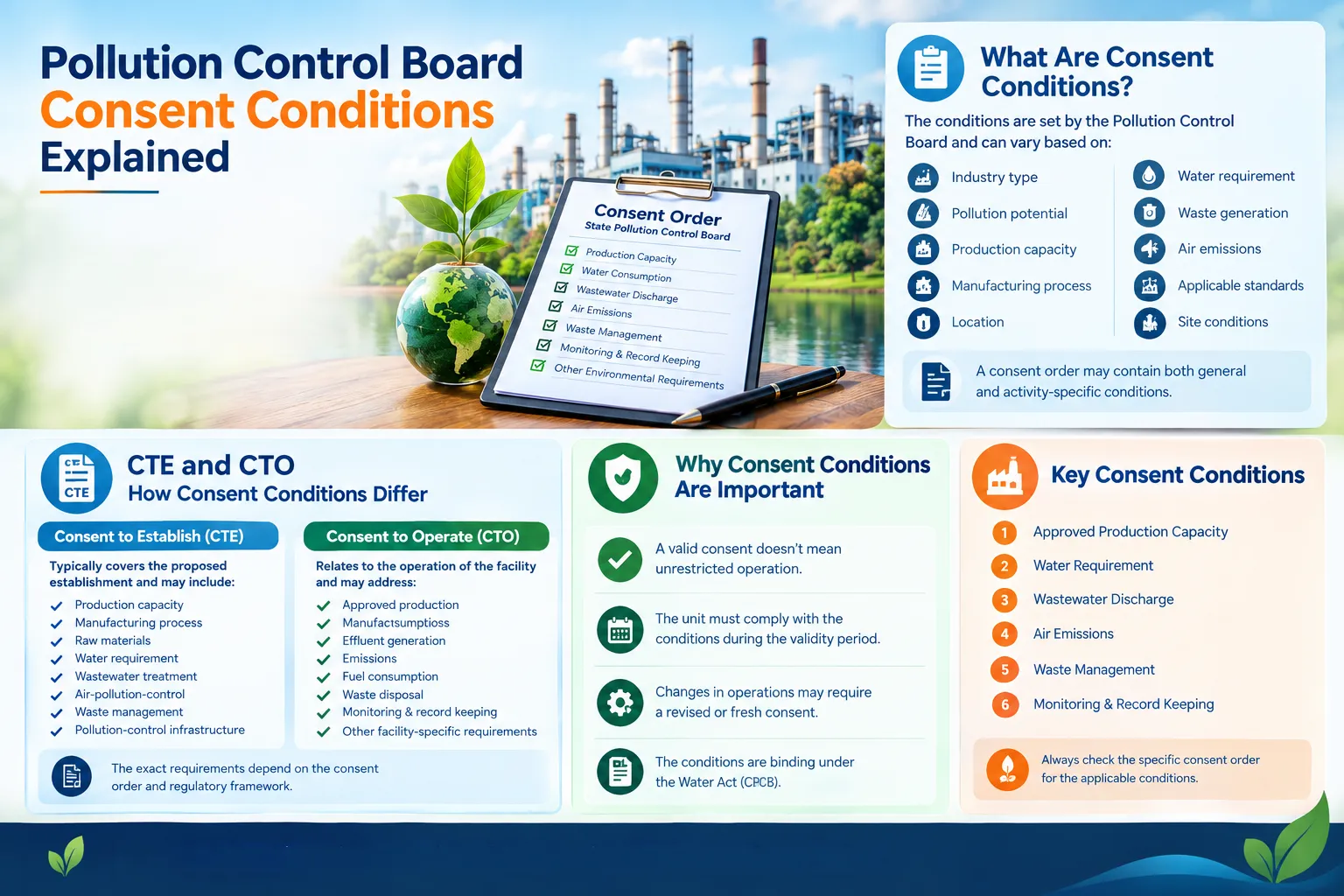
Pollution Control Board Consent Conditions Explained
Obtaining Consent to Establish (CTE) or Consent to Operate (CTO) from the concerned State Pollution Control Board is an important part of environmental compliance for applicable industries and activities.
However, receiving a consent certificate is not the end of the compliance process.
A Pollution Control Board consent order generally contains specific conditions that the unit is required to follow during establishment and operation. These conditions may relate to production capacity, water consumption, wastewater discharge, air emissions, pollution-control equipment, waste management, monitoring, record keeping and other environmental requirements.
Under the Water (Prevention and Control of Pollution) Act, 1974, consent may be granted subject to conditions, including conditions relating to the nature, composition, temperature, volume or rate of effluent discharge and the period for which the consent remains valid.
Therefore, industries should not look at a CTE or CTO only as an approval document. The conditions attached to the consent order are an important part of the compliance obligation.
What Are Pollution Control Board Consent Conditions?
Pollution Control Board consent conditions are requirements specified by the concerned Board while granting applicable consent to an industrial unit or other regulated activity.
The conditions can vary depending on factors such as:
- Industry type
- Pollution potential
- Production capacity
- Manufacturing process
- Water requirement
- Wastewater generation
- Air-emission sources
- Waste generation
- Location
- Applicable environmental standards
- Pollution-control systems
- Specific site conditions
A consent order may therefore contain both general conditions and activity-specific conditions.
The exact requirements should always be checked from the applicable consent order and regulatory framework rather than assuming that every industry has the same conditions.
CTE and CTO: How Consent Conditions Differ
Consent to Establish (CTE)
Consent to Establish generally relates to establishing an applicable industrial activity or taking steps toward establishment, subject to the conditions imposed by the concerned Pollution Control Board.
CTE conditions may relate to proposed:
- Production capacity
- Manufacturing process
- Raw materials
- Water requirement
- Wastewater treatment
- Air-pollution-control arrangements
- Waste-management systems
- Pollution-control infrastructure
The purpose is to ensure that the proposed establishment is planned with the required pollution-control measures.
For a detailed understanding of the application process, documents and Pollution Board approval requirements, see Consent to Establish (CTE) Process in India.
Consent to Operate (CTO)
Consent to Operate relates to the operation of the facility subject to the applicable conditions.
CTO conditions may address:
- Approved production
- Water consumption
- Effluent generation
- Effluent treatment
- Emission sources
- Fuel consumption
- Pollution-control equipment
- Waste generation and disposal
- Environmental monitoring
- Record keeping
- Other facility-specific requirements
The conditions applicable to a particular unit depend on its consent order and the requirements of the relevant regulatory framework.
Why Consent Conditions Are Important
A common misunderstanding is that once a unit receives CTO, it can operate freely as long as the certificate has not expired.
That is not how consent compliance should be approached.
A consent may remain valid for a specified period while the unit is still required to comply with the conditions attached to it.
For example, a consent order may specify limits or requirements relating to:
- Production
- Wastewater
- Emissions
- Water use
- Waste
- Monitoring
- Pollution-control equipment
If actual operations change significantly from the approved or consented parameters, the unit may need to assess whether a revised or fresh consent is required.
The CPCB-hosted Water Act specifically provides that consent conditions are binding on the relevant person or entity carrying out the covered activity.
Key Pollution Control Board Consent Conditions
1. Approved Production Capacity
One of the first conditions to check is the production capacity approved or recorded in the consent.
The consent may specify:
- Product
- Production quantity
- Unit of production
- Manufacturing activity
- Approved capacity
Why It Matters
Production levels can directly affect:
- Water consumption
- Wastewater generation
- Air emissions
- Waste generation
- Pollution-control requirements
Common Mistake
Increasing production beyond the consented parameters without first checking the applicable regulatory requirement.
What to Do
Compare actual production records with the current consent and assess whether any change in consent is required.
2. Product and Manufacturing Process
Consent documents may contain details of the products and processes covered by the approval.
A change in manufacturing activity may affect the facility's:
- Raw materials
- Chemical consumption
- Wastewater
- Emissions
- Waste generation
- Pollution load
Common Mistake
Introducing a new product or manufacturing process without reviewing its environmental implications.
Better Practice
Before making a significant process or product change, review the existing consent and determine whether regulatory approval or modification is required.
3. Water Consumption
Water use can be an important part of consent compliance.
Depending on the facility, records may need to cover:
- Process water
- Domestic water
- Cooling water
- Boiler requirements
- Recycled water
- Groundwater, where applicable
- Other water sources
For industries where groundwater extraction is involved, the Groundwater Extraction Permission in India should also be considered along with the applicable consent conditions.
Common Mistake
Monitoring production but not maintaining a proper record of actual water consumption.
Better Practice
Maintain regular water-consumption records and compare actual use with the applicable consent conditions and other water-related permissions.
4. Wastewater Generation and Discharge
Consent conditions can address the quantity and characteristics of wastewater or effluent generated by a facility.
Relevant aspects may include:
- Wastewater generation
- Effluent treatment
- Discharge points
- Treated effluent quality
- Reuse
- Disposal arrangements
- ETP operation
The Water Act specifically recognises consent conditions relating to the nature, composition, temperature, volume or rate of effluent discharge.
For understanding key wastewater parameters such as BOD, COD, TDS and TSS, see BOD, COD, TDS & TSS in Wastewater.
Common Mistake
Assuming that an ETP is sufficient simply because it has been installed.
Better Practice
Review whether:
- ETP capacity matches actual wastewater generation
- The system is operating properly
- Monitoring is being conducted
- Treated effluent meets applicable requirements
- Sludge is managed appropriately
5. Air Emission Conditions
For facilities having boilers, furnaces, process stacks, DG sets or other emission sources, the consent may contain requirements concerning air emissions and pollution-control systems.
The facility should review applicable details relating to:
- Emission sources
- Stack information
- Fuel
- Pollution-control equipment
- Monitoring
- Applicable emission standards
Common Mistake
Installing an air-pollution-control device but not maintaining or operating it properly.
Better Practice
Maintain pollution-control equipment and keep required monitoring and maintenance records.
6. Pollution-Control Equipment
Consent conditions may require specific pollution-control systems depending on the facility.
Examples may include:
- ETP
- STP
- Scrubber
- Bag filter
- Dust-collection system
- Electrostatic precipitator
- RO system
- ZLD system
- Oil and grease separator
- Other applicable control systems
For facilities dealing with sewage and industrial effluent treatment, understanding the difference between STP and ETP can help in identifying the appropriate treatment requirements.
Important Point
The requirement is generally not limited to installing equipment.
The unit may also need to ensure that the required systems are:
- Operational
- Properly maintained
- Adequately operated
- Monitored where applicable
- Supported by appropriate records
7. Hazardous and Other Waste Management
A consent order may contain requirements concerning waste generated from the facility, while separate authorisations or rules may also apply depending on the waste type.
The unit should review:
- Waste categories
- Quantity
- Storage
- Handling
- Disposal
- Authorised agencies
- Records
- Applicable returns
Where hazardous waste is generated, industries should also understand the Hazardous Waste Authorization Process in India and the requirements applicable to their facility.
Common Mistake
Focusing on production waste while ignoring waste generated from ETPs, maintenance and pollution-control equipment.
Better Practice
Maintain an inventory of all applicable waste streams and ensure that storage and disposal follow the relevant requirements.
8. Environmental Monitoring
Monitoring requirements can form an important part of consent compliance.
Depending on the facility, monitoring may relate to:
- Effluent
- Stack emissions
- Ambient air
- Noise
- Water quality
- Other applicable parameters
The exact parameters and frequency depend on the applicable conditions and regulatory requirements.
For a broader understanding of industrial monitoring requirements, see the OCEMS Compliance Guide for Industries.
Common Mistake
Conducting monitoring only when consent renewal or inspection is approaching.
Better Practice
Follow the applicable monitoring schedule and maintain organised reports and supporting records.
9. Record Keeping and Documentation
Environmental records help demonstrate whether consent conditions are being followed.
Depending on the facility, records may include:
- Production records
- Water consumption
- Fuel consumption
- Wastewater generation
- ETP operation
- Monitoring reports
- Waste-disposal records
- Hazardous-waste records
- Pollution-control equipment maintenance
- Regulatory submissions
- Consent documents
Common Mistake
Keeping environmental records only for inspection or renewal purposes.
Better Practice
Maintain records continuously and organise them according to the applicable consent conditions.
10. Consent Validity
Consent orders are generally issued for a specified validity period or under applicable validity provisions.
The facility should track:
- Date of consent
- Validity period
- Renewal requirements
- Applicable conditions
- Changes introduced during the consent period
For units approaching renewal, the CTO Renewal Process & Documents Required in India provides additional guidance on renewal-related requirements.
Common Mistake
Checking only the expiry date and ignoring other conditions.
Better Practice
Maintain a compliance calendar covering both consent validity and recurring environmental obligations.
11. Special and Additional Conditions
Not every consent order contains exactly the same requirements.
The Pollution Control Board may include facility-specific or additional conditions based on applicable regulatory requirements and local circumstances.
The 2025 Water consent guidelines, for example, provide that State Boards may incorporate additional conditions in consent according to local conditions and policies, while not relaxing the conditions or standards specified in the guidelines.
Common Mistake
Following only standard industry practices and ignoring the specific conditions written in the consent order.
Better Practice
Read the complete consent order and convert each applicable condition into an internal compliance checklist.
12. Changes in the Existing Facility
Environmental consent compliance should be reviewed whenever there is a significant change in the facility.
Examples include:
- Increase in production
- New products
- Additional machinery
- New manufacturing process
- Increased water consumption
- Increased wastewater
- New emission source
- Additional chemical storage
- Change in fuel
- Change in waste generation
For production-capacity changes where the pollution load is not increased, industries may also need to understand the concept of No Increase in Pollution Load (NIPL).
Common Mistake
Making the operational change first and checking the environmental approval requirement afterward.
Better Practice
Review the existing CTE/CTO and applicable requirements before implementing significant changes.
Common Mistakes in Consent Compliance
Mistake 1: Treating CTO as a One-Time Approval
A CTO is not simply a certificate to be obtained and filed away. The applicable conditions need to be followed throughout the relevant operating period.
Mistake 2: Checking Only the Consent Expiry Date
Validity is only one part of the consent. The conditions attached to the order also require attention.
Mistake 3: Ignoring Production Limits
Higher production can affect water consumption, wastewater, emissions and waste generation.
Mistake 4: Not Comparing Actual Operations With the Consent
The approved documents and actual site conditions should be periodically compared.
Mistake 5: Poor ETP/STP Operation
An installed treatment system does not automatically demonstrate compliance.
Mistake 6: Not Maintaining Monitoring Records
Missing or incomplete records can make it difficult to demonstrate compliance.
Mistake 7: Ignoring Waste-Management Requirements
Waste generated by production and pollution-control systems should be identified and managed through applicable arrangements.
Mistake 8: Making Process Changes Without Regulatory Review
Changes in process, products, machinery or pollution load may require prior regulatory assessment.
Mistake 9: Ignoring Additional Conditions
Facility-specific conditions may be particularly important because they are directly attached to the consent order.
Mistake 10: Reviewing Compliance Only During Renewal
Environmental compliance should be monitored throughout the operating period rather than only when consent renewal becomes due.
How to Review a Pollution Control Board Consent Order
A practical consent review can be completed in the following manner.
Step 1: Verify Basic Details
Check:
- Company name
- Site address
- Industry/activity
- Consent type
- Consent number
- Validity
Step 2: Check Approved Activities
Review:
- Products
- Production capacity
- Manufacturing process
- Raw materials
Step 3: Review Water and Wastewater Conditions
Check:
- Water source
- Water consumption
- Wastewater generation
- Treatment system
- Discharge/reuse arrangements
For projects where water use, wastewater generation and reuse need to be evaluated together, an Industrial Water Balance Study can help in understanding the overall water flow and compliance requirements.
Step 4: Review Air-Emission Conditions
Identify:
- Boilers
- Furnaces
- DG sets
- Process stacks
- Pollution-control equipment
- Monitoring requirements
Step 5: Review Waste Conditions
Check:
- Waste categories
- Quantities
- Storage
- Disposal
- Authorised agencies
- Records
Step 6: Read Special Conditions
Do not skip the additional or special conditions section.
These conditions may contain facility-specific requirements.
Step 7: Compare With Actual Site Conditions
Finally, compare the consent document with:
- Current machinery
- Actual production
- Water use
- Wastewater
- Emission sources
- Waste generation
- Pollution-control systems
This helps identify potential gaps between approved conditions and actual operations.
Consent Conditions Compliance Checklist
| Compliance Area | What Should Be Reviewed |
|---|---|
| Consent Status | CTE/CTO and applicable validity |
| Production | Approved capacity vs actual production |
| Products | Approved products vs actual products |
| Raw Materials | Approved/declared materials and actual use |
| Water | Approved/declared requirement vs actual consumption |
| Wastewater | Generation, treatment and discharge/reuse |
| Air Emissions | Sources, controls and monitoring |
| Pollution-Control Equipment | Installation, operation and maintenance |
| Waste | Generation, storage and disposal |
| Monitoring | Applicable parameters and frequency |
| Records | Monitoring, production and waste records |
| Special Conditions | Facility-specific consent requirements |
| Changes | Process, capacity or equipment modifications |
For a broader industry-level checklist covering approvals, records, monitoring and other recurring requirements, see the Environmental Compliance Checklist for Industries in India.
What Happens If Consent Conditions Are Not Followed?
Failure to comply with applicable consent conditions can result in regulatory action depending on the nature of the non-compliance and the applicable legal framework.
Possible consequences may include:
- Notices seeking compliance
- Directions for corrective action
- Consent-related complications
- Additional regulatory scrutiny
- Environmental compensation or penalties where applicable
- Restrictions on operations
- Other action available under applicable law
The actual consequence depends on the specific facts, applicable legislation, regulatory directions and nature of the violation.
The Water Act also provides for action where activities covered by the consent provisions are undertaken without the required consent or contrary to applicable requirements.
Consent Conditions and Environmental Compliance Audit
A consent-condition review can be an important part of an environmental compliance audit.
A practical audit can compare:
Consent Conditions → Actual Operations → Records → Monitoring Results → Site Conditions
For example:
- Consent Condition: Approved production capacity
- Records: Monthly production data
- Site: Installed machinery and operating lines
- Finding: Actual operations do not match the documented parameters
Such a review can help identify gaps before they develop into larger compliance concerns.
Why Regular Consent-Condition Review Is Important
Consent compliance should not be reviewed only when:
- CTO renewal is due
- An inspection is scheduled
- A notice is received
- Production is being expanded
- A new product is introduced
- An environmental incident occurs
A periodic review can help identify changes and compliance gaps at an earlier stage.
An internal review may cover:
- Consent conditions
- Production
- Water consumption
- Wastewater
- Air emissions
- Waste management
- Monitoring
- Pollution-control equipment
- Regulatory submissions
- Site conditions
How SimpliComp Can Help With Consent Compliance
SimpliComp provides environmental consultancy support for industries and project proponents dealing with Pollution Control Board consent and ongoing environmental compliance requirements.
Our support can include:
- CTE/CTO document review
- Consent-condition assessment
- Compliance-gap identification
- Environmental monitoring review
- ETP/STP assessment
- Air-pollution-control review
- Waste-management compliance support
- Water and wastewater compliance review
- Consent renewal support
- Regulatory documentation
- Corrective-action planning
- Environmental compliance guidance
The objective is to help businesses understand their applicable consent conditions and identify areas requiring attention during ongoing operations.
Conclusion
Pollution Control Board consent should not be viewed simply as an approval certificate.
The conditions attached to the consent order are an important part of environmental compliance and may cover production, water consumption, wastewater, air emissions, pollution-control systems, waste management, monitoring, documentation and operational changes.
Some common compliance mistakes include:
- Not reading the complete consent order
- Checking only the validity date
- Exceeding approved production parameters
- Ignoring water and wastewater requirements
- Poor operation of pollution-control systems
- Not maintaining monitoring records
- Improper waste management
- Making process changes without regulatory review
- Ignoring special or additional conditions
- Reviewing compliance only during consent renewal
A regular review of the consent order against actual site operations can help industries identify potential gaps and take corrective action in a timely manner.
For industries holding CTE or CTO, understanding the specific conditions attached to the consent is an important part of maintaining environmental compliance.
Related Environmental Library Pages
Need Help with Consent to Establish (CTE) Approval?
Simplicomp provides support for:
- Consent to Establish (CTE) approvals
- Pollution NOC applications
- SPCB documentation and coordination
- STP and ETP compliance
- Pollution control planning and regulatory support