

Introduction
Groundwater is a critical source of water for industries, infrastructure projects, commercial establishments, and communities across India. As groundwater resources face increasing pressure due to rapid urbanization, industrial growth, and climate variability, regulatory authorities require project proponents to assess the potential impact of groundwater extraction before granting approvals.
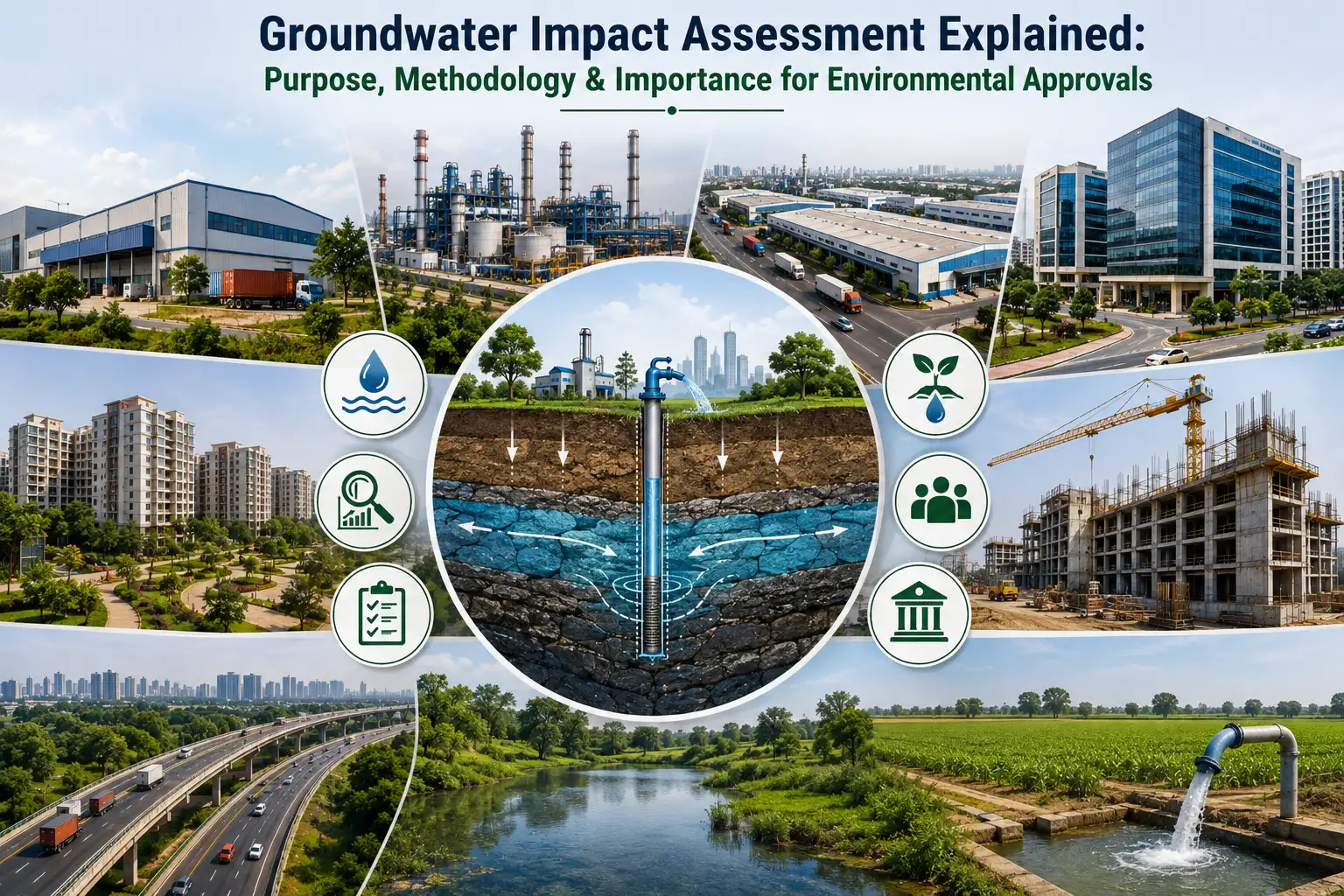
A Groundwater Impact Assessment (GIA) is a scientific study that evaluates how a proposed project may affect groundwater availability, aquifer health, nearby wells, groundwater quality, and long-term sustainability.
The findings of a Groundwater Impact Assessment help authorities determine whether groundwater extraction is environmentally sustainable and whether additional mitigation measures are necessary.
This article explains what a Groundwater Impact Assessment is, why it is required, how it is conducted, and its role in environmental compliance.
What is a Groundwater Impact Assessment?
A Groundwater Impact Assessment (GIA) is a technical evaluation carried out to assess the likely effects of groundwater abstraction on the surrounding hydrogeological environment.
The study examines both the quantity and quality of groundwater and predicts how the proposed withdrawal may influence:
- Groundwater levels
- Aquifer recharge
- Nearby wells and borewells
- Surface water bodies
- Groundwater quality
- Long-term water availability
The assessment enables regulators and project developers to understand whether the proposed extraction can be sustained without causing unacceptable environmental impacts.
Why is a Groundwater Impact Assessment Important?
Groundwater is a finite resource that replenishes slowly in many regions.
Excessive or poorly planned extraction can result in:
- Declining groundwater levels
- Drying of nearby wells
- Reduced water availability for surrounding communities
- Land subsidence in extreme cases
- Deterioration of groundwater quality
- Ecological impacts on rivers, wetlands, and lakes
A Groundwater Impact Assessment helps identify these risks before groundwater abstraction begins and recommends appropriate mitigation measures.
When is a Groundwater Impact Assessment Required?
A Groundwater Impact Assessment may be required for projects that involve significant groundwater abstraction or are located in environmentally sensitive or groundwater-stressed areas.
Typical projects include:
- Manufacturing industries
- Industrial estates
- Commercial complexes
- Residential townships
- Infrastructure projects
- Mining projects
- Large institutions
- Hotels and resorts
- Hospitals
- Logistics parks
The requirement depends on applicable guidelines issued by the Central Ground Water Authority (CGWA), State Groundwater Authorities, or environmental regulators.
Objectives of a Groundwater Impact Assessment
The primary objectives of the study are to:
- Evaluate groundwater availability.
- Assess the sustainability of proposed extraction.
- Estimate the zone of influence of pumping.
- Predict changes in groundwater levels.
- Identify potential impacts on neighbouring users.
- Recommend water conservation measures.
- Support regulatory approvals.
- Promote sustainable groundwater management.
Components of a Groundwater Impact Assessment
A comprehensive Groundwater Impact Assessment generally includes the following components.
Hydrogeological Assessment
The study examines local geological and hydrogeological conditions, including aquifer characteristics, groundwater occurrence, and groundwater flow patterns.
Groundwater Resource Assessment
Available groundwater resources and existing abstraction levels are evaluated using published groundwater assessment reports and field investigations.
Water Demand Assessment
The study estimates the proposed groundwater requirement for:
- Industrial processes
- Cooling systems
- Boilers
- Domestic use
- Landscaping
- Utility services
These estimates are usually supported by a Water Balance Study.
Impact Prediction
Using hydrogeological data and engineering calculations, the study predicts the potential impacts of groundwater abstraction on:
- Water table levels
- Nearby borewells
- Aquifer recharge
- Surface water interactions
- Long-term groundwater availability
Mitigation Measures
Where necessary, the assessment recommends measures such as:
- Rainwater harvesting
- Artificial groundwater recharge
- Water recycling
- Reduced groundwater abstraction
- Efficient water use technologies
- Continuous groundwater monitoring
Methodology for Conducting a Groundwater Impact Assessment
Although the methodology varies depending on project size and location, a typical assessment involves:
Step 1 – Collection of Baseline Data
Gather information on:
- Rainfall
- Geology
- Hydrogeology
- Existing groundwater levels
- Groundwater quality
- Existing borewells
- Water demand
Step 2 – Field Investigation
Field studies may include:
- Site reconnaissance
- Borewell inventory
- Water level measurements
- Aquifer observations
- Water quality sampling
Step 3 – Water Demand Analysis
Estimate groundwater requirement using a detailed Water Balance Study.
Step 4 – Impact Assessment
Evaluate the likely impacts of groundwater abstraction using hydrogeological principles and available data.
Step 5 – Mitigation Planning
Recommend measures to minimize environmental impacts and improve long-term sustainability.
Benefits of a Groundwater Impact Assessment
A properly conducted assessment helps:
- Improve groundwater planning.
- Support Groundwater NOC applications.
- Facilitate Environmental Clearance.
- Reduce regulatory queries.
- Protect nearby groundwater users.
- Improve water-use efficiency.
- Promote sustainable development.
- Strengthen environmental compliance.
Groundwater Impact Assessment and Groundwater NOC
Groundwater Impact Assessments often support Groundwater NOC applications by demonstrating that proposed groundwater abstraction:
- Is scientifically justified.
- Will not cause unacceptable environmental impacts.
- Includes adequate conservation measures.
- Is supported by groundwater recharge initiatives.
- Incorporates efficient water management practices.
Such studies provide regulators with greater confidence while evaluating groundwater abstraction proposals.
Difference Between a Groundwater Impact Assessment and a Hydrogeological Study
Although the two studies are closely related, they serve different purposes.
| Groundwater Impact Assessment | Hydrogeological Study |
|---|---|
| Evaluates the environmental impact of groundwater abstraction. | Investigates geological and hydrogeological characteristics of the site. |
| Focuses on sustainability and regulatory compliance. | Focuses on aquifer properties and groundwater occurrence. |
| Predicts future impacts of groundwater withdrawal. | Provides scientific data used in groundwater assessments. |
| Supports environmental approvals and groundwater management decisions. | Supports groundwater investigations, borewell planning, and resource evaluation. |
In many projects, a Hydrogeological Study forms the basis of a Groundwater Impact Assessment.
Conclusion
A Groundwater Impact Assessment is an essential scientific tool for evaluating whether groundwater extraction is environmentally sustainable. By assessing groundwater availability, predicting the effects of pumping, and recommending appropriate conservation measures, the study supports responsible water resource management and informed regulatory decision-making.
For industries and project developers, conducting a comprehensive Groundwater Impact Assessment not only facilitates statutory approvals but also demonstrates a commitment to sustainable development and long-term groundwater conservation.
Related Environmental Library Pages
Need Help with Groundwater NOC Approval?
Simplicomp provides support for:
- Groundwater NOC applications
- Borewell permission approvals
- CGWA approvals
- Water balance studies
- Rainwater harvesting compliance
- Groundwater documentation and regulatory coordination