

Introduction
Groundwater is an essential resource for industries, infrastructure projects, commercial developments, agriculture, and communities across India. Before groundwater can be extracted responsibly, it is important to understand the geological formations that store and transmit water beneath the earth's surface.
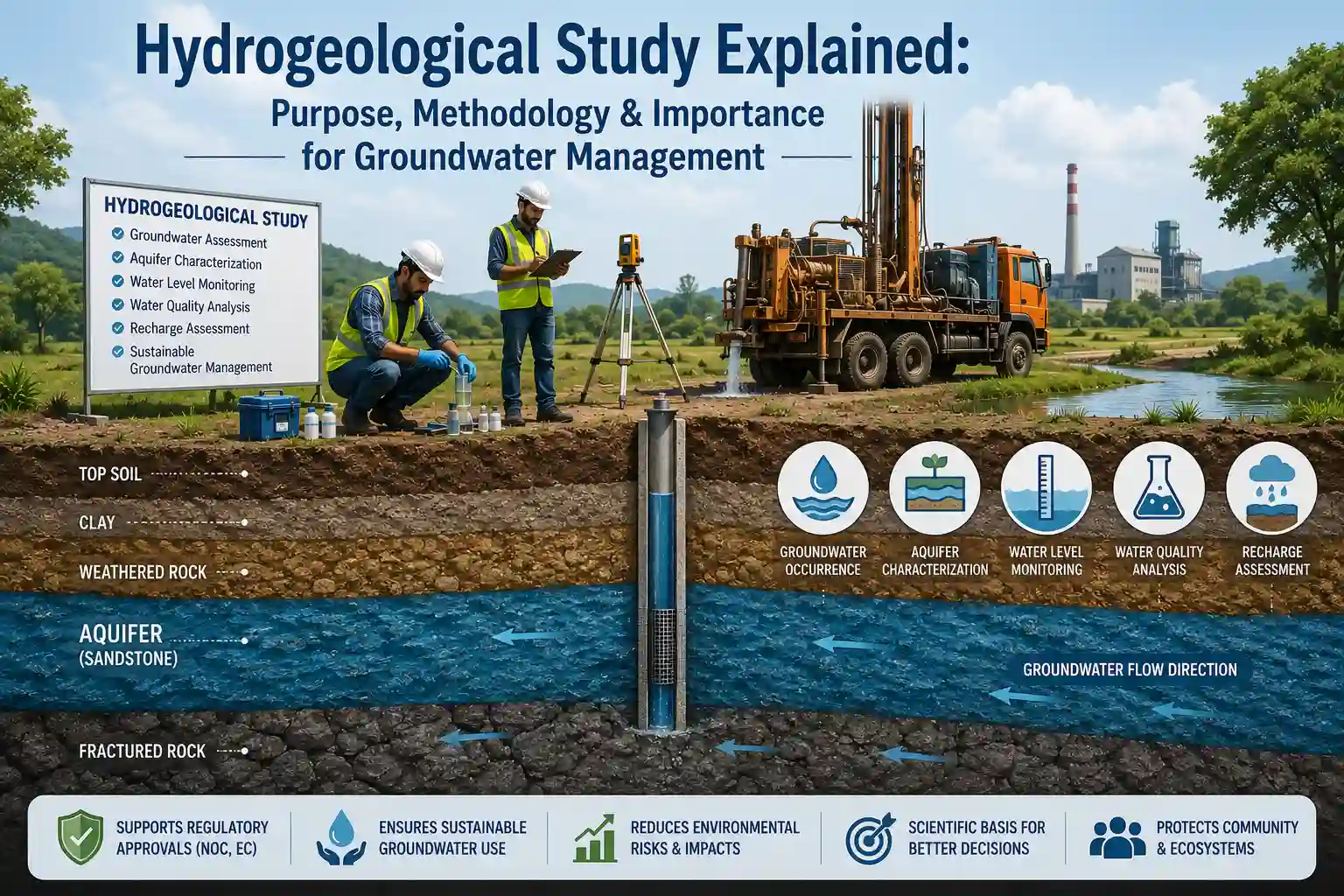
A Hydrogeological Study provides this understanding by evaluating the occurrence, movement, availability, and quality of groundwater within a project area. The study forms the scientific foundation for groundwater investigations and is widely used to support Groundwater No Objection Certificate (NOC) applications, Environmental Clearance (EC), water resource planning, and sustainable groundwater management.
By analysing aquifer characteristics and groundwater conditions, a Hydrogeological Study helps determine whether groundwater extraction is technically feasible and environmentally sustainable.
This guide explains what a Hydrogeological Study is, when it is required, how it is conducted, and why it plays a vital role in environmental compliance.
What is a Hydrogeological Study?
A Hydrogeological Study is a scientific investigation of groundwater systems and the geological formations that store and transmit groundwater, known as aquifers.
The study examines the interaction between geology and groundwater to understand:
- Groundwater occurrence
- Aquifer characteristics
- Groundwater flow direction
- Recharge mechanisms
- Water table fluctuations
- Groundwater availability
- Groundwater quality
The information generated helps determine the suitability of groundwater as a reliable water source while ensuring that extraction does not adversely affect surrounding users or the environment.
Why is a Hydrogeological Study Important?
A Hydrogeological Study helps project developers and regulatory authorities:
- Understand groundwater availability.
- Identify suitable aquifers.
- Assess recharge potential.
- Evaluate groundwater quality.
- Estimate sustainable groundwater abstraction.
- Plan borewell locations.
- Support environmental approvals.
- Promote responsible groundwater management.
The study reduces uncertainty and provides a scientific basis for groundwater-related decisions.
When is a Hydrogeological Study Required?
Hydrogeological Studies are commonly undertaken for projects that depend on groundwater or may affect groundwater resources.
Typical applications include:
Groundwater NOC Applications
Many groundwater abstraction projects require hydrogeological information to demonstrate the availability and sustainability of groundwater resources.
Environmental Clearance (EC)
Projects seeking Environmental Clearance may conduct hydrogeological investigations to evaluate groundwater conditions and assess potential environmental impacts.
Industrial and Infrastructure Projects
Industries, commercial developments, residential townships, logistics parks, hospitals, educational institutions, and infrastructure projects often undertake Hydrogeological Studies during project planning.
Mining Projects
Mining operations frequently require hydrogeological assessments to evaluate groundwater inflows, dewatering requirements, and impacts on surrounding aquifers.
Water Supply Projects
Government agencies and private developers use Hydrogeological Studies while planning groundwater-based water supply systems.
Objectives of a Hydrogeological Study
The main objectives include:
- Understanding the local geological setting.
- Identifying aquifer systems.
- Assessing groundwater occurrence.
- Evaluating groundwater recharge.
- Determining groundwater quality.
- Estimating groundwater availability.
- Supporting sustainable groundwater abstraction.
- Providing technical input for regulatory approvals.
Components of a Hydrogeological Study
A comprehensive Hydrogeological Study generally includes several technical investigations.
Geological Assessment
The study begins by evaluating local geology, including rock formations, soil types, fractures, faults, and lithological characteristics that influence groundwater movement.
Wastewater Generation
The study estimates the quantity of wastewater generated from each activity and categorizes it into industrial effluent, domestic sewage, cooling tower blowdown, boiler blowdown, or other wastewater streams.
Aquifer Characterization
The properties of aquifers are assessed, including:
- Aquifer type
- Thickness
- Hydraulic characteristics
- Storage capacity
- Water-bearing formations
Groundwater Level Assessment
Groundwater levels are measured to determine:
- Static water level
- Seasonal fluctuations
- Long-term trends
- Groundwater flow direction
Groundwater Quality Assessment
Water samples may be analysed to evaluate physical, chemical, and, where necessary, microbiological characteristics.
Parameters commonly assessed include:
- pH
- Total Dissolved Solids (TDS)
- Hardness
- Chlorides
- Fluoride
- Nitrate
- Heavy metals (where applicable)
Recharge Assessment
The study evaluates natural and artificial groundwater recharge sources, including:
- Rainfall infiltration
- Surface water bodies
- Recharge structures
- Permeable formations
Existing Groundwater Use
Information is collected on nearby:
- Borewells
- Open wells
- Industrial groundwater users
- Agricultural extraction
- Public water supply systems
This helps assess cumulative groundwater stress in the area.
Methodology of a Hydrogeological Study
Although the scope varies depending on project requirements, a Hydrogeological Study generally follows these steps.
Step 1 – Desk Study
Review available information, including:
- Geological maps
- Hydrogeological maps
- Groundwater resource assessments
- Topographic maps
- Satellite imagery
- Previous investigation reports
Step 2 – Field Investigation
Site investigations may include:
- Geological observations
- Borewell inventory
- Groundwater level monitoring
- GPS mapping
- Aquifer observations
- Water sample collection
Step 3 – Data Analysis
The collected information is analysed to understand groundwater conditions, aquifer characteristics, recharge mechanisms, and groundwater movement.
Step 4 – Interpretation
Experts interpret the hydrogeological data to estimate groundwater potential and identify any constraints affecting groundwater development.
Step 5 – Recommendations
The study concludes with recommendations on:
- Sustainable groundwater abstraction
- Borewell location
- Recharge measures
- Water conservation
- Monitoring requirements
- Compliance measures
Benefits of a Hydrogeological Study
Conducting a Hydrogeological Study offers several advantages.
- Improves groundwater resource planning.
- Supports Groundwater NOC applications.
- Assists Environmental Clearance documentation.
- Identifies sustainable groundwater sources.
- Reduces the risk of unsuccessful borewell development.
- Supports groundwater conservation.
- Facilitates long-term water security.
- Strengthens environmental compliance.
Hydrogeological Study vs Groundwater Impact Assessment
Although closely related, these studies have different objectives.
| Hydrogeological Study | Groundwater Impact Assessment |
|---|---|
| Investigates existing groundwater conditions. | Evaluates the impact of proposed groundwater abstraction. |
| Focuses on geology and aquifer characteristics./td> | Focuses on environmental consequences of groundwater use. |
| Provides baseline scientific information. | Uses baseline information to predict future impacts. |
| Supports groundwater investigations and resource evaluation. | Supports regulatory decision-making and environmental management. |
In practice, the findings of a Hydrogeological Study often provide the technical foundation for a Groundwater Impact Assessment.
Common Challenges in Hydrogeological Investigations
Hydrogeological studies may encounter challenges such as:
- Limited historical groundwater data.
- Seasonal variation in groundwater levels.
- Complex geological formations.
- Insufficient monitoring wells.
- Variable rainfall patterns.
- Changes in surrounding groundwater abstraction.
These factors highlight the importance of using qualified professionals and reliable data sources.
Conclusion
A Hydrogeological Study is one of the most important scientific investigations undertaken before groundwater development. By evaluating aquifer characteristics, groundwater availability, recharge potential, and water quality, the study provides the technical foundation for sustainable groundwater management.
For industries, infrastructure developers, and institutions planning to use groundwater, a well-executed Hydrogeological Study supports informed decision-making, facilitates statutory approvals, and contributes to the long-term conservation of India's groundwater resources.
Related Resources
Need Help with Groundwater NOC Approval?
Simplicomp provides support for:
- Groundwater NOC applications
- Borewell permission approvals
- CGWA approvals
- Water balance studies
- Rainwater harvesting compliance
- Groundwater documentation and regulatory coordination