

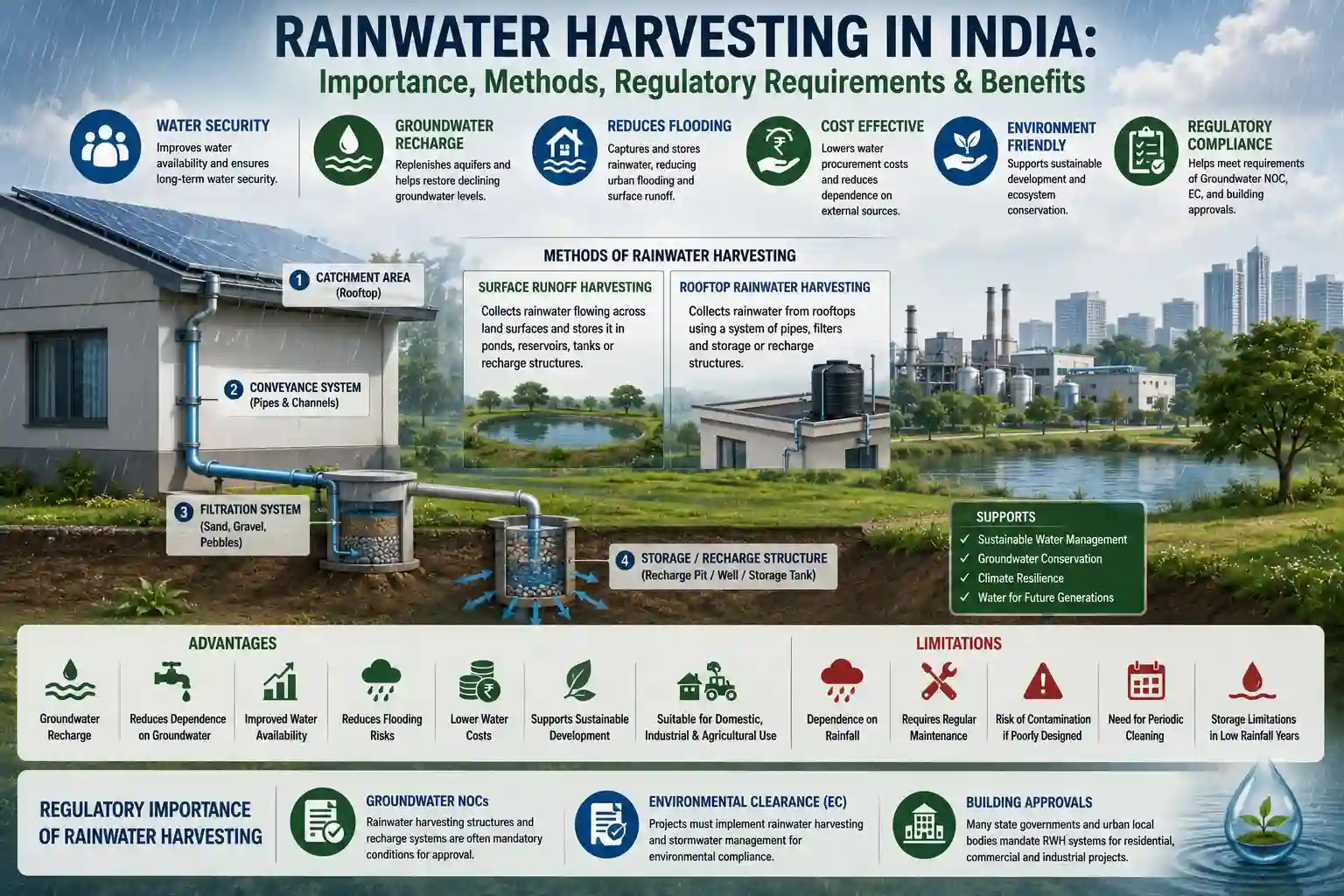
What is Rainwater Harvesting?
Rainwater harvesting (RWH) is the process of collecting, storing, and recharging rainwater for future use.
The collected rainwater may be:
- Stored for domestic use
- Used for irrigation
- Used in industrial operations
- Used in construction activities
- Recharged into groundwater aquifers
Rainwater harvesting is one of the most effective methods for conserving water resources and improving groundwater availability.
Why is Rainwater Harvesting Important?
Water is one of the most critical natural resources supporting:
- Human survival
- Agriculture
- Industrial development
- Infrastructure growth
- Ecosystem stability
Rapid urbanization, industrialization, and increasing population are placing enormous pressure on freshwater resources across India.
Rainwater harvesting helps bridge the gap between water demand and water availability.
Population Growth and Water Demand
India's growing population has significantly increased the demand for water.
Water is required for:
- Drinking purposes
- Domestic use
- Agriculture
- Manufacturing
- Infrastructure development
- Commercial establishments
As demand increases, groundwater extraction also rises, making groundwater conservation increasingly important.
Industrial Growth and Groundwater Stress
Industrial development plays an important role in economic growth and employment generation.
However, industries require significant quantities of water for:
- Manufacturing processes
- Cooling systems
- Boiler operations
- Utility services
In many regions, groundwater has become the primary source of industrial water supply, leading to increased pressure on groundwater aquifers.
Rainwater harvesting helps industries reduce dependence on groundwater while improving water sustainability.
Urbanization and Water Scarcity
Rapid urbanization has increased demand for:
- Housing
- Commercial complexes
- Infrastructure projects
- Industrial parks
As open land is replaced by roads, buildings, and paved surfaces, natural groundwater recharge decreases.
This often results in:
- Declining groundwater levels
- Water scarcity
- Increased dependence on borewells
- Urban flooding during heavy rainfall
Rainwater harvesting helps restore natural recharge mechanisms and improve groundwater availability.
Groundwater Recharge: A Critical Need
Groundwater aquifers are replenished naturally when rainwater infiltrates into the soil.
However, excessive groundwater withdrawal combined with reduced recharge has caused groundwater levels to decline in many parts of India.
Rainwater harvesting helps:
- Recharge aquifers
- Improve groundwater availability
- Reduce groundwater depletion
- Support sustainable water management
Groundwater recharge has become a key requirement under many Groundwater NOCs issued by CGWA and State Groundwater Authorities.
Rainwater Harvesting and Climate Change
Rainwater harvesting contributes to climate resilience by:
- Improving groundwater storage
- Reducing drought impacts
- Supporting water security
- Enhancing ecosystem stability
Deforestation, urban expansion, and land-use changes often reduce groundwater recharge and affect local hydrological cycles.
Proper rainwater harvesting helps mitigate some of these impacts and supports sustainable development.
Methods of Rainwater Harvesting
The selection of a rainwater harvesting system depends on:
- Terrain
- Rainfall pattern
- Land availability
- Groundwater conditions
- Water demand
Two commonly used methods are described below.
Surface Runoff Harvesting
Surface runoff harvesting involves collecting rainwater flowing across land surfaces and storing it for future use.
The collected water may be stored in:
- Ponds
- Reservoirs
- Water storage tanks
- Recharge structures
This method is commonly used for:
- Irrigation
- Industrial water supply
- Groundwater recharge
Rooftop Rainwater Harvesting
Rooftop rainwater harvesting is one of the most popular and cost-effective methods of water conservation.
Rainwater falling on rooftops is collected through a system of pipes and directed to:
- Recharge pits
- Recharge wells
- Storage tanks
- Collection reservoirs
A typical rooftop rainwater harvesting system consists of:
Catchment Area
Usually the rooftop of a building.
Conveyance System
Pipes and channels carrying rainwater.
Filtration System
Filters using sand, gravel, and pebbles to remove impurities.
Storage or Recharge Structure
Storage tanks or groundwater recharge pits.
Regulatory Importance of Rainwater Harvesting
Rainwater harvesting is increasingly becoming a regulatory requirement under:
Groundwater NOCs
Groundwater authorities often require:
- Rainwater harvesting systems
- Recharge pits
- Recharge wells
- Water conservation measures
as conditions of approval.
Environmental Clearance (EC)
Many Environmental Clearance approvals require:
- Rainwater harvesting structures
- Stormwater management systems
- Water conservation measures
for project compliance.
Building Approvals
Several state governments and urban local bodies mandate rainwater harvesting systems for:
- Residential projects
- Commercial complexes
- Industrial facilitie
Rainwater Harvesting and Flood Management
Rainwater harvesting not only conserves water but also helps reduce:
- Urban flooding
- Flash floods
- Surface runoff
- Soil erosion
By capturing and storing rainwater, these systems reduce the volume of water flowing through drainage networks during heavy rainfall events.
Advantages of Rainwater Harvesting
Rainwater harvesting offers several benefits:
- Groundwater recharge
- Reduced dependence on groundwater
- Improved water availability
- Reduced flooding risks
- Lower water procurement costs
- Support for sustainable development
- Suitable for domestic, industrial, and agricultural use
- Environment-friendly technology
- Reduced pressure on municipal water supplies
- Improved water security
Many rainwater harvesting systems operate with minimal energy requirements and relatively low maintenance costs.
Limitations of Rainwater Harvesting
Certain challenges should also be considered:
- Dependence on rainfall availability
- Regular maintenance requirements
- Risk of contamination if not properly designed
- Need for periodic cleaning
- Storage limitations during low rainfall years
Proper design, operation, and maintenance can significantly reduce these challenges.
Best Practices for Effective Rainwater Harvesting
Organizations should:
- Conduct site-specific assessments
- Design recharge structures appropriately
- Maintain filtration systems
- Clean recharge pits regularly
- Monitor groundwater levels
- Integrate rainwater harvesting with water conservation programs
- Maintain compliance records where required
Conclusion
Rainwater harvesting is no longer merely an environmental initiative—it is becoming an essential component of sustainable water management.
With increasing groundwater stress, rapid urbanization, industrial growth, and climate-related challenges, rainwater harvesting offers a practical and effective solution for improving water security and supporting long-term sustainability.
For industries, infrastructure projects, commercial establishments, and residential developments, rainwater harvesting not only contributes to environmental conservation but also supports compliance with groundwater, environmental clearance, and water management requirements.
Related Resources
Need Help with Groundwater NOC Approval?
Simplicomp provides support for:
- Groundwater NOC applications
- Borewell permission approvals
- CGWA approvals
- Water balance studies
- Rainwater harvesting compliance
- Groundwater documentation and regulatory coordination