

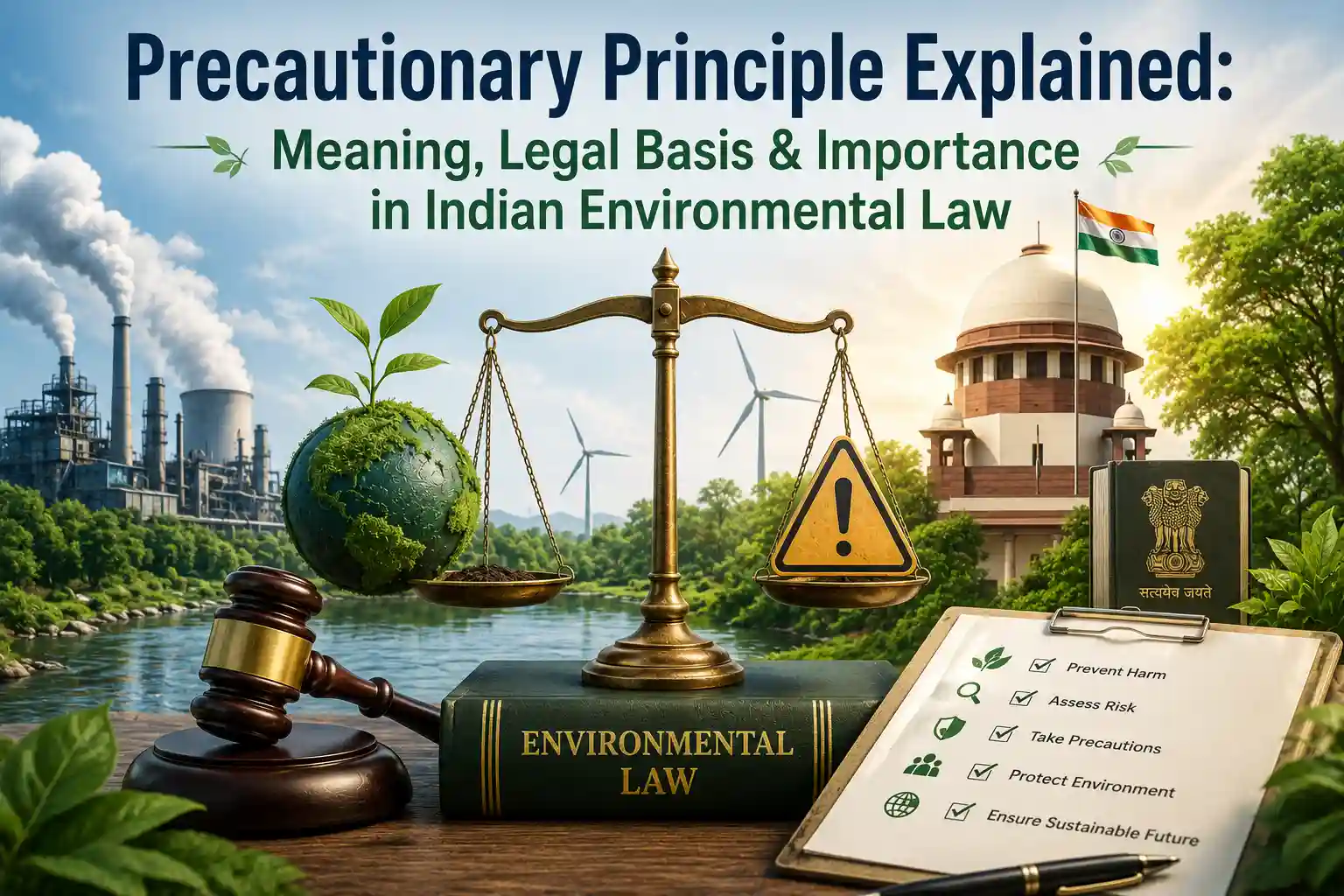
Introduction
Environmental protection often requires action before irreversible damage occurs. Waiting for complete scientific certainty may lead to serious environmental consequences that cannot be reversed. To address this challenge, environmental law follows the Precautionary Principle, which emphasizes prevention rather than cure.
Today, the Precautionary Principle forms one of the foundational principles of environmental governance in India. It guides the decisions of the National Green Tribunal (NGT), the Supreme Court, Pollution Control Boards, and environmental authorities while evaluating industrial projects, environmental clearances, pollution control measures, and natural resource management.
This article explains the meaning, legal basis, importance, and practical application of the Precautionary Principle in India.
What is the Precautionary Principle?
The Precautionary Principle is an environmental law doctrine that requires preventive action when there is a risk of serious or irreversible environmental damage, even if complete scientific evidence is not yet available.
In simple terms:
When there is a credible risk of environmental harm, authorities should act to prevent the damage instead of waiting for conclusive scientific proof.
The principle recognizes that delaying action until absolute certainty is achieved may result in irreversible environmental degradation.
Origin of the Precautionary Principle
The Precautionary Principle evolved through international environmental law and has become one of the guiding principles of sustainable development.
Major international milestones include:
- World Charter for Nature (1982)
- Rio Declaration on Environment and Development (1992)
- Principle 15 of the Rio Declaration
- Convention on Biological Diversity
Principle 15 of the Rio Declaration states that where there are threats of serious or irreversible environmental damage, lack of full scientific certainty should not be used as a reason for postponing cost-effective measures to prevent environmental degradation.
India has incorporated this principle through judicial interpretation and environmental legislation.
Legal Basis of the Precautionary Principle in India
Although the principle is not codified in a single legislation, it has become an integral part of Indian environmental law.
Article 21 of the Constitution
The Right to Life under Article 21 has been interpreted by the Supreme Court to include the right to a clean and healthy environment.
Article 48A
The State has a constitutional obligation to protect and improve the environment.
Article 51A(g)
Every citizen has a fundamental duty to protect and improve the natural environment.
National Green Tribunal Act, 2010
Section 20 of the National Green Tribunal Act mandates the Tribunal to apply the Precautionary Principle while deciding environmental disputes.
What Does the Precautionary Principle Mean in Practice?
The principle encourages authorities and project proponents to identify and manage environmental risks before they result in actual damage.
Instead of reacting after pollution occurs, preventive measures are incorporated during the planning, approval, and operational stages of a project.
Examples include:
- Conducting Environmental Impact Assessments (EIA)
- Installing pollution control equipment
- Designing wastewater treatment systems
- Implementing groundwater recharge measures
- Adopting cleaner production technologies
- Monitoring environmental parameters regularly
The focus is on minimizing risk rather than responding after environmental degradation has already taken place.
How is the Precautionary Principle Applied in India?
The principle is widely applied by environmental regulators and judicial bodies.
National Green Tribunal (NGT)
The NGT routinely relies on the Precautionary Principle while deciding disputes involving:
- Environmental Clearance (EC)
- Groundwater extraction
- Industrial pollution
- Waste management
- Mining projects
- River conservation
The Tribunal may impose conditions or restrict activities where environmental risks are significant.
Supreme Court of India
The Supreme Court has repeatedly held that environmental protection should not wait until irreversible damage occurs.
Its judgments have strengthened the role of precaution in environmental decision-making.
Pollution Control Boards
Central and State Pollution Control Boards apply the principle while granting:
- Consent to Establish (CTE)
- Consent to Operate (CTO)
- Environmental monitoring requirements
- Emission and discharge standards
Common Applications of the Precautionary Principle
The principle is commonly applied in matters relating to:
- Environmental Clearance
- Air pollution control
- Water pollution prevention
- Groundwater management
- Hazardous waste handling
- Plastic Waste Management
- E-Waste Management
- Forest conservation
- Mining operations
- Industrial expansion projects
Landmark Judicial Decisions
Several landmark judgments have established the Precautionary Principle as a part of Indian environmental law.
Vellore Citizens Welfare Forum v. Union of India (1996)
In this landmark judgment, the Supreme Court declared that the Precautionary Principle is an essential feature of sustainable development and forms part of the law of the land.
A.P. Pollution Control Board v. Prof. M.V. Nayudu (1999)
The Supreme Court emphasized that environmental decisions involving scientific uncertainty should be guided by the Precautionary Principle.
The judgment also highlighted the importance of scientific expertise in environmental decision-making.
NGT Decisions
The National Green Tribunal has consistently relied upon the Precautionary Principle while evaluating industrial projects, groundwater extraction, infrastructure development, and environmental compliance.
Difference Between the Precautionary Principle and Polluter Pays Principle
| Precautionary Principle | Polluter Pays Principle |
|---|---|
| Focuses on preventing environmental harm before it occurs. | Focuses on making the polluter bear the cost after environmental damage occurs. |
| Preventive approach. | Corrective and compensatory approach. |
| Applied during planning and approvals. | Applied after violations or environmental damage. |
Together, these principles form the backbone of India's environmental governance framework.
Why is the Precautionary Principle Important?
The principle plays a vital role by:
- Preventing irreversible environmental damage.
- Encouraging sustainable development.
- Reducing long-term environmental costs.
- Protecting public health.
- Promoting scientific risk assessment.
- Improving environmental decision-making.
- Strengthening regulatory compliance.
It enables authorities to act proactively rather than reactively.
Challenges in Implementation
Implementing the Precautionary Principle is not without challenges.
These include:
- Scientific uncertainty in assessing environmental risks.
- Balancing economic development with environmental protection.
- Availability of reliable environmental data.
- Inconsistent application across sectors.
- Monitoring compliance with preventive measures.
Despite these challenges, the principle remains a cornerstone of environmental governance.
Conclusion
The Precautionary Principle has fundamentally changed the way environmental decisions are made in India. Rather than waiting for environmental damage to occur, it requires authorities, industries, and project developers to anticipate risks and adopt preventive measures at an early stage.
Recognized by the Supreme Court, the National Green Tribunal, and environmental regulators, the principle continues to guide Environmental Clearance, pollution control, groundwater management, and sustainable industrial development across the country.
As environmental challenges become increasingly complex, the Precautionary Principle will remain one of the most important legal tools for protecting India's natural resources and ensuring sustainable development.