

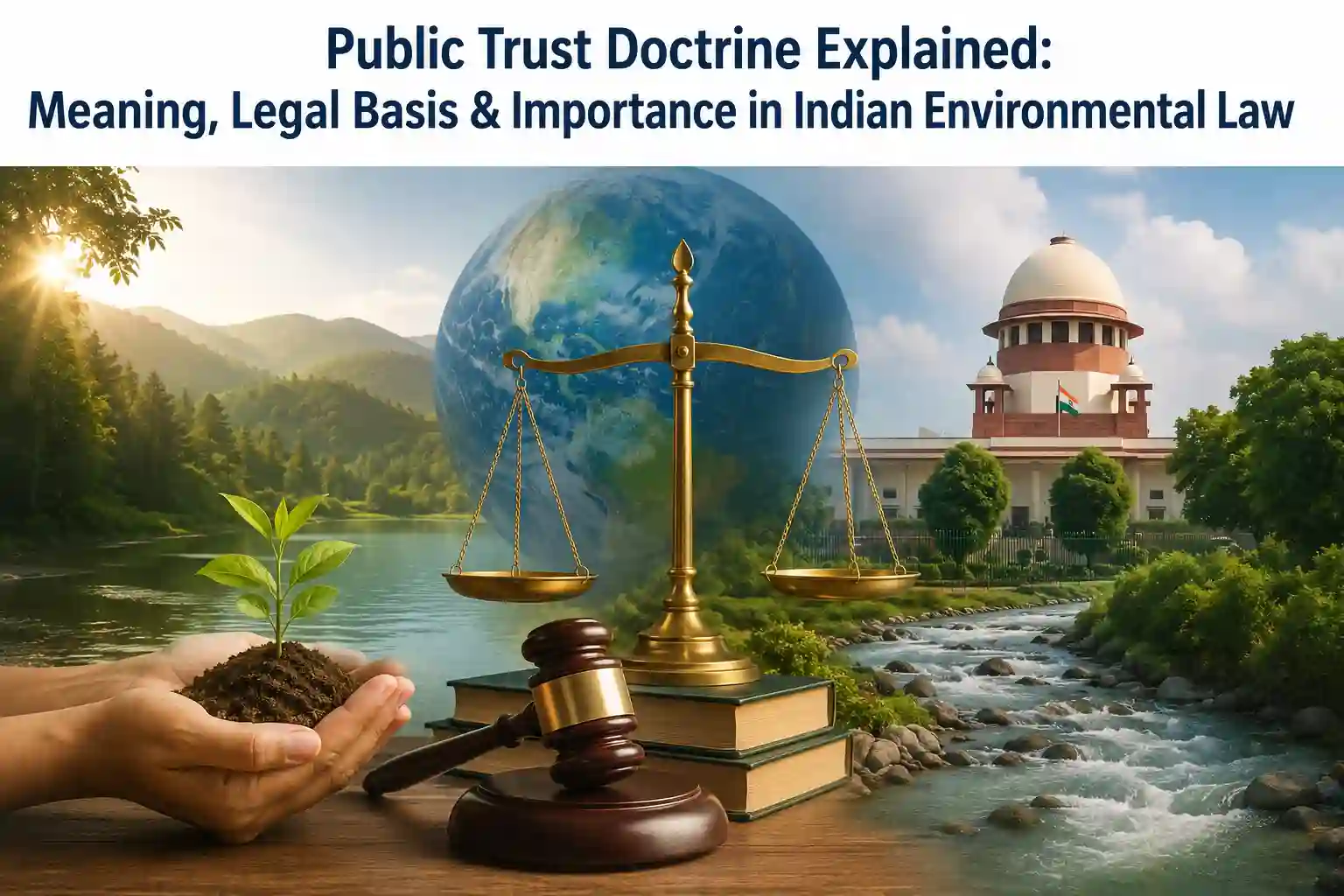
Introduction
Natural resources such as rivers, lakes, forests, wetlands, groundwater, beaches, and air are essential for the survival and well-being of society. These resources are not owned by any individual or private entity but are held by the government in trust for the benefit of the public.
This principle forms the basis of the Public Trust Doctrine, one of the fundamental principles of environmental jurisprudence in India. The doctrine places a legal obligation on the State to protect and preserve natural resources and ensure that they are used in a manner that serves the public interest and promotes sustainable development.
The Public Trust Doctrine has been repeatedly applied by the Supreme Court of India and the National Green Tribunal (NGT) while deciding cases involving environmental degradation, illegal mining, groundwater extraction, river pollution, forest diversion, and coastal regulation.
This article explains the meaning, legal basis, importance, and practical application of the Public Trust Doctrine in India.
What is the Public Trust Doctrine?
The Public Trust Doctrine is a legal principle that recognizes certain natural resources as common property belonging to the public. The government acts as a trustee of these resources and has a duty to protect, conserve, and manage them for the benefit of present and future generations.
In simple terms:
- The State does not own natural resources; it holds them in trust for the
- people and must ensure that they are used responsibly and sustainably.
The doctrine prevents the arbitrary transfer or misuse of public resources for private benefit when such actions harm the environment or public interest.
Origin of the Public Trust Doctrine
The concept of the Public Trust Doctrine has its roots in Roman law, which recognized that certain resources such as air, flowing water, the sea, and the seashore were common to all.
Over time, the doctrine evolved through common law and became an important principle in environmental jurisprudence worldwide.
In India, the doctrine has been developed and strengthened primarily through judicial decisions of the Supreme Court.
Legal Basis of the Public Trust Doctrine in India
Although the Public Trust Doctrine is not expressly codified in a single statute, it has become an integral part of Indian environmental law through constitutional provisions and judicial interpretation.
Article 21 of the Constitution
The Supreme Court has interpreted the Right to Life under Article 21 to include the right to a clean and healthy environment.
Article 48A
The Constitution directs the State to protect and improve the environment and safeguard forests and wildlife.
Article 51A(g)
Every citizen has a fundamental duty to protect and improve the natural environment.
Judicial Recognition
The Supreme Court has consistently recognized the Public Trust Doctrine as an essential principle guiding environmental governance and natural resource management in India.
What Resources are Protected Under the Public Trust Doctrine?
The doctrine generally applies to natural resources that are vital for public use and environmental sustainability.
These include:
- Rivers and lakes
- Groundwater
- Forests
- Wetlands
- Coastal areas
- Beaches
- Air
- Wildlife
- Biodiversity
- Public parks
- Ecologically sensitive areas
These resources must be managed in the larger public interest and cannot be exploited in a manner that causes irreversible environmental damage.
Responsibilities of the Government Under the Public Trust Doctrine
As trustee of natural resources, the government is expected to:
- Protect environmental resources from degradation.
- Prevent illegal exploitation of natural resources.
- Ensure sustainable use of forests, rivers, and groundwater.
- Balance development with environmental protection.
- Enforce environmental laws effectively.
- Prevent private monopolization of public resources.
- Safeguard ecological balance for future generations.
Failure to discharge these responsibilities may be challenged before courts or the National Green Tribunal.
Application of the Public Trust Doctrine in India
The doctrine influences decision-making across various environmental sectors.
Groundwater Management
Groundwater is regarded as a public resource. Authorities regulate extraction through licensing and compliance mechanisms to prevent over-exploitation.
Forest Conservation
Diversion of forest land for non-forest purposes is carefully regulated to protect ecological balance and biodiversity.
River and Wetland Protection
Courts have repeatedly directed authorities to prevent encroachment, pollution, and degradation of rivers, lakes, and wetlands.
Coastal Regulation
The doctrine supports the protection of coastal ecosystems, beaches, mangroves, and other environmentally sensitive coastal areas from unsustainable development.
Environmental Clearance
Authorities evaluating Environmental Clearance applications must consider whether proposed projects will adversely affect public natural resources and ecological sustainability.
Landmark Judicial Decisions
Several landmark judgments have firmly established the Public Trust Doctrine in India.
M.C. Mehta v. Kamal Nath (1997)
In this landmark case, the Supreme Court held that the State is the trustee of all natural resources and cannot transfer or permit their use in a manner that harms the environment or the public interest.
This judgment firmly established the Public Trust Doctrine as part of Indian environmental law.
Fomento Resorts and Hotels Ltd. v. Minguel Martins (2009)
The Supreme Court reaffirmed that natural resources are held in trust by the State and emphasized the government's duty to protect public resources from degradation.
National Green Tribunal Decisions
The NGT has applied the Public Trust Doctrine in numerous cases involving groundwater extraction, illegal mining, river pollution, wetlands, and environmental clearances.
The doctrine frequently guides decisions concerning conservation and sustainable use of natural resources.
Why is the Public Trust Doctrine Important?
The doctrine plays a vital role in environmental governance by:
- Protecting common natural resources.
- Preventing environmental degradation.
- Promoting sustainable development.
- Ensuring intergenerational equity.
- Holding governments accountable for environmental protection.
- Supporting transparent environmental decision-making.
- Strengthening environmental justice.
It reinforces the principle that natural resources should benefit society as a whole rather than a select few.
Challenges in Implementation
While widely recognized, implementing the Public Trust Doctrine presents several challenges:
- Balancing economic development with environmental conservation.
- Preventing illegal encroachments on public resources.
- Overcoming institutional and enforcement gaps.
- Addressing competing demands for land, water, and forests.
- Ensuring long-term ecological sustainability.
Effective governance and strong regulatory enforcement are essential for realizing the objectives of the doctrine.
Relationship with Other Environmental Principles
The Public Trust Doctrine works alongside other fundamental principles of environmental law.
- Precautionary Principle: Encourages preventive action where there is a risk of environmental harm.
- Polluter Pays Principle: Ensures that polluters bear the cost of environmental damage.
- Sustainable Development: Promotes balanced economic growth while conserving natural resources.
Together, these principles form the foundation of environmental jurisprudence in India.
Conclusion
The Public Trust Doctrine is a cornerstone of Indian environmental law. It recognizes that natural resources belong to the people and that the government acts as their trustee rather than their owner.
By requiring the State to conserve forests, rivers, groundwater, wetlands, biodiversity, and other ecological assets, the doctrine promotes sustainable development and protects the rights of both present and future generations.
Its continued application by the Supreme Court and the National Green Tribunal has strengthened environmental governance and reinforced the principle that environmental protection is a shared public responsibility.