

Introduction
Groundwater is one of the most important sources of freshwater for households, agriculture, industries and infrastructure projects. Although groundwater exists below the ground surface, it does not simply collect in large underground lakes. In most locations, it is stored within the pores, cracks and interconnected spaces of geological formations known as aquifers. For a better understanding of groundwater systems, you can also read our Groundwater Categorization Explained guide.
Understanding aquifers is important for anyone involved in groundwater development, borewell planning, groundwater assessment, recharge projects or environmental compliance. The characteristics of an aquifer determine how much groundwater can be stored, how quickly it can be replenished and how efficiently it can be extracted.
For industries and large developments, aquifer conditions are also relevant when assessing groundwater abstraction, recharge potential and the sustainability of water use. Businesses planning groundwater extraction can refer to our Groundwater Extraction Permission guide to understand the relevant requirements.
What Is an Aquifer?
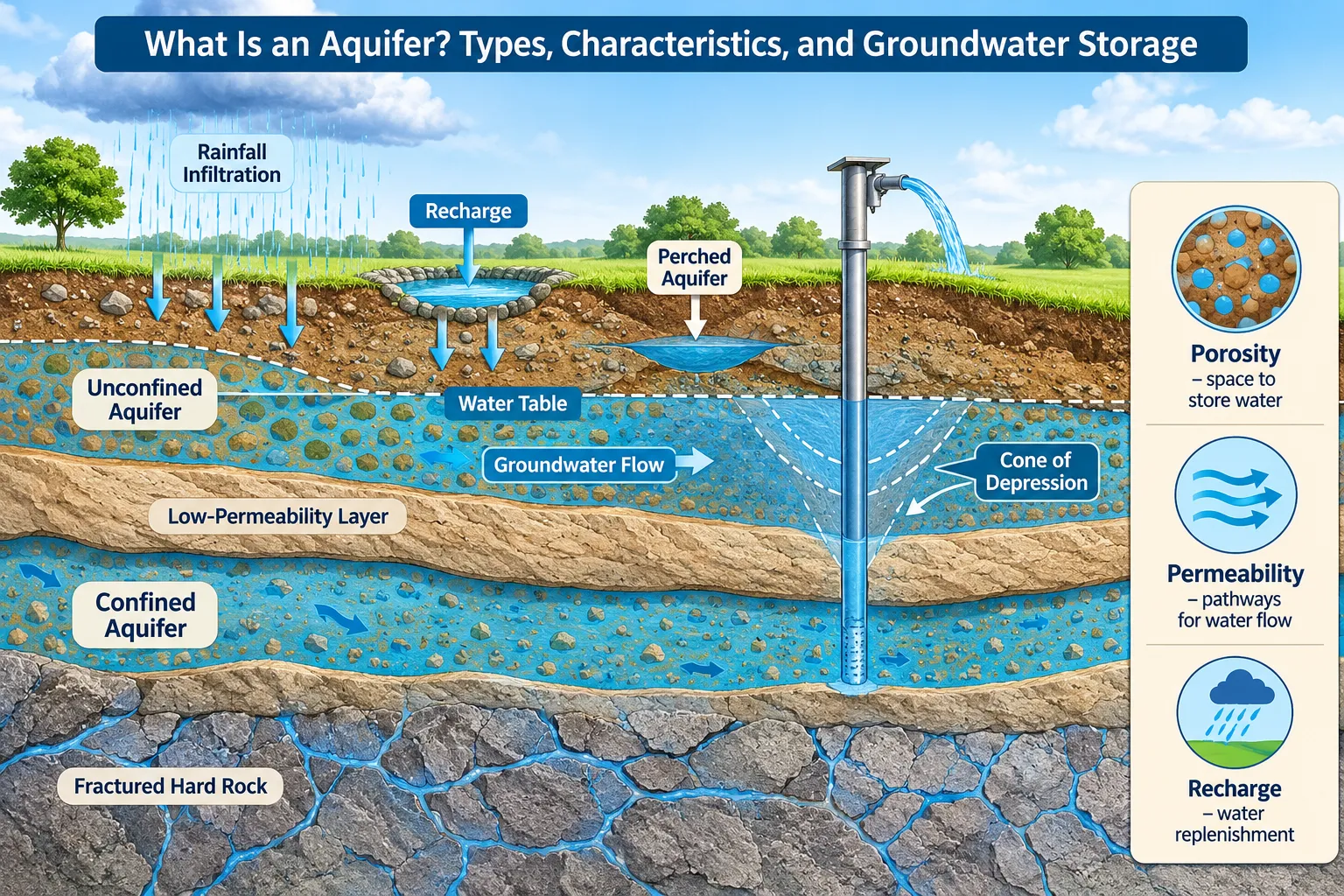
An aquifer is a geological formation or group of formations that can store and transmit groundwater in quantities that can be practically extracted or otherwise utilized.
Water enters an aquifer primarily through infiltration and recharge. It then moves through interconnected pores, fractures or other openings within the geological formation.
The ability of an aquifer to supply groundwater depends on factors such as:
- Type of geological material
- Porosity
- Permeability
- Hydraulic conductivity
- Thickness of the aquifer
- Recharge conditions
- Groundwater gradient
- Degree of fracturing
- Groundwater quality
- Seasonal variations
Therefore, two locations with similar rainfall may have completely different groundwater availability because their underlying aquifer systems are different. A site-specific Hydrogeological Study can help evaluate these subsurface conditions.
How Is Groundwater Stored in an Aquifer?
Groundwater storage does not necessarily mean that water is present in an underground cavity.
In unconsolidated formations such as sand and gravel, water occupies spaces between individual particles.
In hard-rock areas, groundwater may be stored and transmitted through:
- Fractures
- Joints
- Weathered zones
- Faults
- Vesicles or openings in certain rocks
The quantity of groundwater that can be stored depends partly on the available pore or fracture space and the ability of the formation to retain and transmit water.
A useful way to understand an aquifer is to consider three basic questions:
How much water can it hold? → How easily can water move through it? → How quickly can it be replenished?
These characteristics together influence groundwater availability.
Important Characteristics of an Aquifer
1. Porosity
Porosity refers to the proportion of void spaces within a geological material.
Higher porosity generally means that more space is available to store water. However, high porosity alone does not guarantee good groundwater yield.
For example, clay may have considerable pore space but water moves through it very slowly.
2. Permeability
Permeability describes the ability of a material to allow water to pass through its interconnected pores or openings.
Sand and gravel generally allow groundwater to move more easily than compact clay.
In fractured rocks, permeability may depend strongly on the number, size and connectivity of fractures.
3. Hydraulic Conductivity
Hydraulic conductivity indicates how readily groundwater can move through a particular geological formation under a hydraulic gradient.
It is an important parameter in groundwater modelling, well design and aquifer assessment.
Higher hydraulic conductivity can support faster groundwater movement and potentially higher well yields, provided adequate recharge and storage are available.
4. Aquifer Thickness
The thickness of the water-bearing formation influences groundwater storage and well performance.
A thick, productive aquifer can potentially provide greater groundwater availability than a thin formation, although thickness must always be considered together with hydraulic properties and recharge.
5. Recharge Potential
An aquifer is not an unlimited underground water reservoir.
Groundwater may be replenished through:
- Rainfall infiltration
- Rivers and streams
- Lakes and ponds
- Irrigation return flow
- Artificial recharge structures
- Other surface-water interactions
The rate and quality of recharge influence long-term groundwater sustainability. You can also explore our guide on Groundwater Recharge to understand how groundwater replenishment takes place.
Types of Aquifers
Aquifers can be classified in several ways depending on their geological and hydrogeological characteristics. One of the most common classifications is based on whether the groundwater is under atmospheric pressure or confined by relatively impermeable layers.
1. Unconfined Aquifer
An unconfined aquifer has no continuous confining layer above the groundwater zone. Its upper boundary is generally the water table.
Rainwater can infiltrate through the overlying soil and geological material and contribute to groundwater recharge.
Characteristics commonly associated with unconfined aquifers include:
- Water table forms the upper boundary
- Relatively direct connection with surface recharge
- Seasonal fluctuations may be significant
- Greater vulnerability to surface contamination
- Groundwater levels can respond relatively quickly to rainfall and extraction
Because of their connection with the surface, unconfined aquifers require careful protection against contamination.
2. Confined Aquifer
A confined aquifer is overlain and/or underlain by relatively low-permeability layers that restrict groundwater movement.
Groundwater within a confined aquifer can be under pressure. The water level observed in a well may therefore rise above the top of the aquifer.
Confined aquifers may:
- Receive recharge from distant areas
- Have longer groundwater travel times
- Be less directly affected by short-term surface conditions
- Require careful assessment before large-scale abstraction
The pressure condition of a confined aquifer is important when evaluating well behaviour and groundwater availability.
3. Perched Aquifer
A perched aquifer is a localized groundwater body that develops above the regional water table because of a relatively impermeable layer.
It may occur where infiltrating water accumulates on a discontinuous low-permeability zone.
Perched groundwater can be:
- Localized
- Seasonal
- Relatively shallow
- Vulnerable to drying
- Different from the main regional aquifer
Therefore, encountering water at a shallow depth does not necessarily mean that the main aquifer has been reached.
Aquifer vs Aquitard vs Aquiclude
Not every water-bearing geological layer behaves like an aquifer.
| Formation | General Function |
|---|---|
| Aquifer | Stores and transmits groundwater relatively effectively |
| Aquitard | Allows groundwater movement, but comparatively slowly |
| Aquiclude | May store water but transmits it very poorly |
| Aquifuge | Neither stores nor transmits appreciable groundwater under normal conditions |
These terms help hydrogeologists describe the movement and storage behaviour of subsurface formations.
Why Aquifers Are Important for Groundwater Management
Aquifers act as natural groundwater storage systems.
They help maintain water availability between rainfall events and can support:
- Domestic water supply
- Industrial water requirements
- Agricultural irrigation
- Municipal systems
- Baseflow to rivers and streams
- Ecosystem functions
However, groundwater extraction becomes a concern when withdrawal remains consistently higher than effective recharge. For more information about groundwater availability and regional assessment, see Groundwater Impact Assessment.
Long-term over-abstraction can result in:
- Declining groundwater levels
- Reduced well yield
- Increased pumping depth
- Higher energy consumption
- Drying of shallow wells
- Land subsidence in susceptible areas
- Deterioration of groundwater quality
- Reduced groundwater contribution to surface-water systems
This is why groundwater should be managed as a dynamic resource rather than an unlimited reserve.
Aquifer Recharge: How Does an Aquifer Refill?
Recharge occurs when water reaches the groundwater system and replenishes stored groundwater.
Natural recharge may occur through rainfall infiltration and surface-water interaction.
Artificial recharge can be supported through appropriately designed measures such as:
- Recharge pits
- Recharge trenches
- Recharge wells
- Percolation structures
- Rainwater harvesting systems
- Managed recharge systems
Rainwater harvesting can support groundwater recharge when the system is designed according to local site conditions. Read our Rainwater Harvesting in India guide for more information.
However, recharge structures should not be installed simply because groundwater levels are declining.
Before implementing recharge, it is important to understand:
- Local geology
- Aquifer characteristics
- Depth to groundwater
- Soil permeability
- Existing groundwater quality
- Recharge zone
- Seasonal groundwater fluctuation
- Source-water quality
- Existing borewell conditions
Poorly designed recharge can potentially introduce contaminants into the subsurface.
Aquifer and Groundwater Extraction
When a borewell or tube well extracts groundwater, the water level around the well may decline temporarily. This creates a cone of depression around the pumping well.
The size and behaviour of this cone depend on factors such as:
- Pumping rate
- Pumping duration
- Aquifer transmissivity
- Storage characteristics
- Well construction
- Recharge
- Boundary conditions
- Nearby pumping wells
Multiple high-capacity wells operating in the same aquifer can interact with each other and increase groundwater stress.
Therefore, groundwater development should consider the broader aquifer system rather than only the yield of an individual borewell. Industries planning borewell development can also review the Borewell Permission Rules for Industries.
What Is Aquifer Recharge and Discharge Balance?
Groundwater sustainability depends on the relationship between recharge and discharge.
A simplified groundwater balance can be expressed as:
Groundwater Change = Recharge − Natural Discharge − Abstraction ± Other Transfers
If long-term abstraction substantially exceeds recharge and other inflows, groundwater storage can decline.
Conversely, effective recharge and controlled abstraction can help maintain groundwater levels over time.
For industrial and infrastructure projects, this balance can be an important part of groundwater planning. A detailed Water Balance Study can help assess water demand, sources, use, reuse and discharge.
Factors Affecting Aquifer Performance
Aquifer behaviour varies significantly from one location to another.
Important factors include:
1.Geological Conditions
Rock type, fractures, weathering and sediment characteristics determine groundwater storage and movement.
2. Rainfall
Rainfall provides an important source of natural recharge, although not all rainfall becomes groundwater.
3. Land Use
Urbanisation can reduce natural infiltration because soil surfaces are replaced by:
- Buildings
- Roads
- Pavements
- Parking areas
- Other impervious surfaces
4. Groundwater Abstraction
High pumping rates can lower groundwater levels and alter groundwater flow.
5. Surface-Water Interaction
Rivers, lakes, wetlands and reservoirs may either receive groundwater discharge or contribute water to groundwater systems depending on local hydraulic conditions.
6. Groundwater Quality
Salinity, hardness, fluoride, nitrate, iron and other contaminants can affect the usability of groundwater. Regular Groundwater Monitoring can help identify changes in groundwater levels and quality.
Aquifer Assessment for Industrial Projects
For an industrial project planning groundwater abstraction, understanding the aquifer is more useful than relying only on a borewell yield test.
A technical assessment may consider:
- Hydrogeological setting
- Aquifer depth
- Water-level data
- Pumping-test results
- Recharge potential
- Groundwater quality
- Existing abstraction
- Nearby wells
- Seasonal variation
- Groundwater trends
- Proposed water demand
- Rainwater harvesting and recharge potential
These factors can help determine whether the proposed groundwater use is technically and environmentally sustainable. You can also explore our Hydrogeological Study resource for further information.
Aquifer Protection and Groundwater Quality
Aquifer protection is particularly important because contamination entering groundwater can be difficult and expensive to remove.
Potential contamination sources include:
- Untreated wastewater
- Industrial chemicals
- Fuel and oil storage
- Hazardous-waste areas
- Leaking septic systems
- Uncontrolled waste disposal
- Contaminated stormwater
- Excessive agricultural chemicals
Industries should therefore maintain proper controls around chemical storage, wastewater treatment, hazardous-waste handling and drainage systems.
Groundwater quality monitoring should also be designed according to the project's potential risks and regulatory requirements.
Role of Aquifers in Groundwater NOC and Compliance
For projects that require groundwater abstraction approval, aquifer characteristics can become an important part of technical assessment. Businesses can refer to our Groundwater NOC Process guide to understand the general approval process.
Depending on the applicable regulatory framework, project proponents may need to evaluate:
- Groundwater requirement
- Existing groundwater availability
- Proposed abstraction
- Recharge measures
- Water conservation measures
- Groundwater quality
- Hydrogeological conditions
- Rainwater harvesting
- Monitoring arrangements
A project should not treat groundwater approval as merely a documentation exercise. The proposed abstraction and recharge plan should be technically consistent with actual site conditions.
For additional information about the regulatory framework, read Groundwater Laws and Rules in India.
How Can Industries Improve Aquifer Sustainability?
Industries can reduce pressure on groundwater by combining demand management with recharge and reuse.
Practical measures include:
- Conducting a water audit
- Installing water meters
- Reducing process-water consumption
- Reusing treated wastewater
- Improving cooling-water management
- Optimising cleaning operations
- Harvesting rainwater
- Developing suitable recharge systems
- Monitoring groundwater levels
- Monitoring groundwater quality
- Reducing leakage and unnecessary consumption
The objective should be to reduce dependence on fresh groundwater wherever technically feasible. Industries can also explore Rainwater Harvesting in India for additional groundwater conservation measures.
Common Misconceptions About Aquifers
“An aquifer is an underground lake.”
Not necessarily. Groundwater is commonly stored within pores, fractures and other interconnected openings in geological formations.
“More porous rock always gives more groundwater.”
Not always. A formation may have high porosity but poor permeability, limiting groundwater movement and well yield.
“If a borewell has water, groundwater is abundant.”
A single productive borewell does not establish the sustainability of the entire aquifer.
“Recharge means pouring water into any borewell.”
Recharge requires hydrogeological assessment and suitable design. Poor-quality water or inappropriate recharge can create groundwater-quality risks.
“Groundwater level alone tells us aquifer health.”
Groundwater level is important, but aquifer assessment should also consider recharge, abstraction, quality, hydraulic properties and long-term trends.
When Should an Aquifer Study Be Considered?
A detailed hydrogeological or aquifer assessment may be useful when:
- A project proposes significant groundwater abstraction
- Groundwater levels are declining
- Existing borewells show reduced yield
- Recharge structures are being planned
- Groundwater quality has changed
- Multiple borewells are interacting
- Industrial expansion will increase water demand
- A groundwater approval application requires technical information
- Water conservation measures need to be evaluated
- The project is located in a groundwater-stressed area
A site-specific assessment can provide a better basis for groundwater management than generic assumptions about local water availability.
How Simplicomp Can Support Groundwater Management
Simplicomp supports industries, infrastructure projects, commercial developments and other organisations in addressing environmental and groundwater-related compliance requirements.
Our technical approach can include:
- Groundwater requirement assessment
- Hydrogeological data review
- Groundwater NOC support
- Water balance preparation
- Water audit and conservation planning
- Rainwater harvesting and recharge planning
- Groundwater monitoring support
- Compliance documentation
- Regulatory coordination
- Environmental compliance review
The objective is to help project proponents use groundwater responsibly while meeting applicable environmental requirements. For further guidance, explore our Groundwater Impact Assessment and Groundwater NOC Process resources.
Conclusion
An aquifer is much more than a subsurface water-bearing layer. It is a dynamic geological system that stores, transmits and receives groundwater over time.
Understanding aquifer type, porosity, permeability, recharge, groundwater movement and abstraction is essential for responsible groundwater management.
For industries and large projects, aquifer assessment can support better decisions regarding groundwater abstraction, recharge, water conservation and regulatory compliance. Instead of treating groundwater as an unlimited resource, projects should evaluate the capacity and behaviour of the underlying aquifer and plan water use accordingly.
A technically sound groundwater management strategy can help reduce resource stress, improve water security and support long-term environmental sustainability.
Related Environmental Library Pages
Need Help with Groundwater NOC Approval?
Simplicomp provides support for:
- Groundwater NOC applications
- Borewell permission approvals
- CGWA approvals
- Water balance studies
- Rainwater harvesting compliance
- Groundwater documentation and regulatory coordination