

Introduction
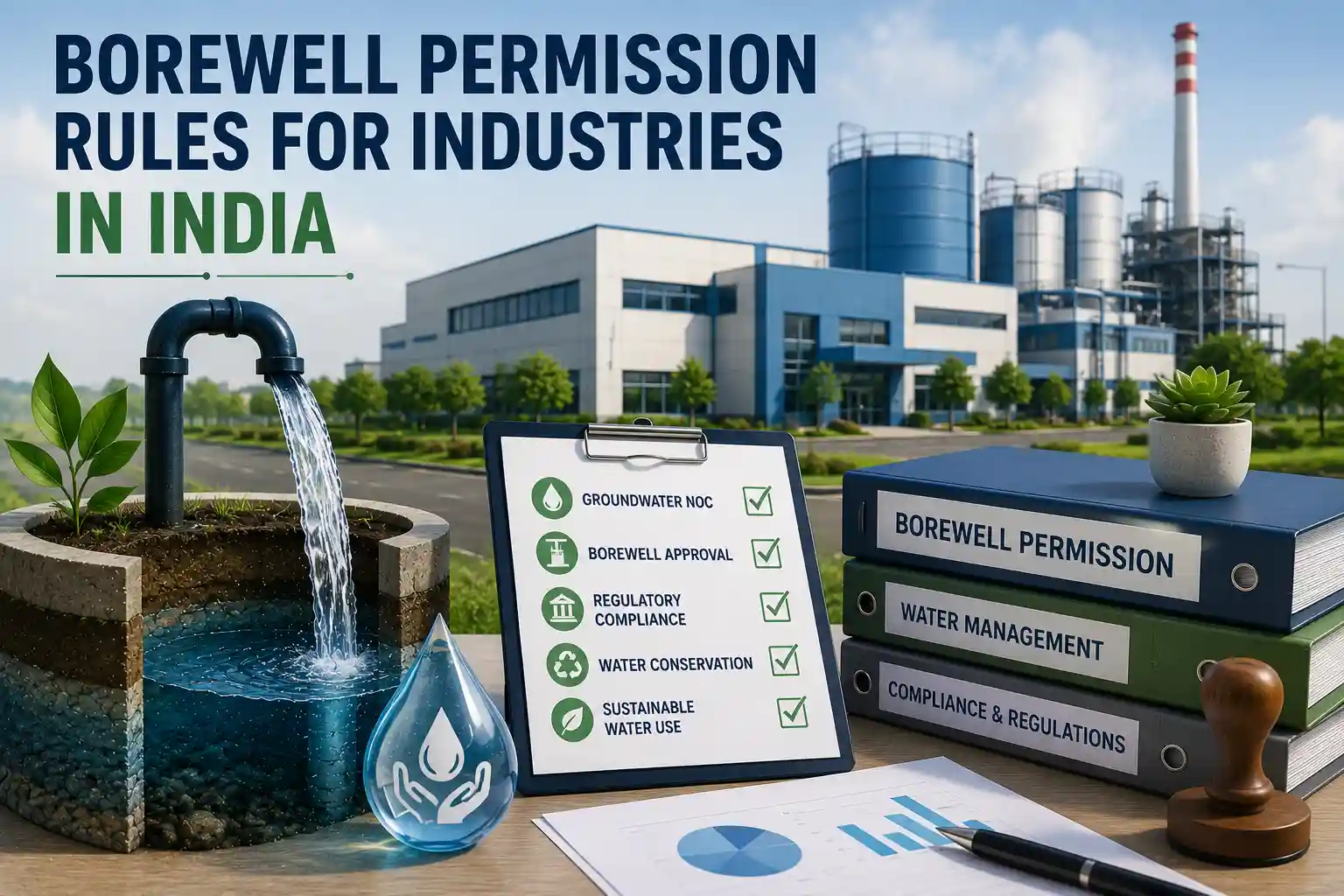
Industries across India frequently depend on groundwater for manufacturing processes, cooling systems, domestic consumption, construction activities, and utility requirements.
Industries across India frequently depend on groundwater for manufacturing processes, cooling systems, domestic consumption, construction activities, and utility requirements.
Before extracting groundwater, industries may be required to obtain:
- Groundwater NOC
- Borewell Permission
- Groundwater Certificate
- Water Extraction Permission
- CGWA Approval
Failure to obtain the required approvals can result in environmental compensation, sealing of borewells, legal action, and regulatory enforcement proceedings.
This guide explains the borewell permission rules applicable to industries and commercial establishments in India.
Why is Borewell Permission Required?
Groundwater is considered a public resource and its extraction is regulated to prevent:
- Groundwater depletion
- Over-extraction
- Aquifer degradation
- Water scarcity
- Environmental damage
Industries extracting groundwater beyond permissible limits may adversely impact local water availability and ecological balance.
Therefore, regulatory approvals are often required before borewell construction and groundwater withdrawal.
Authorities Regulating Groundwater Extraction
Groundwater regulation in India is implemented through both central and state-level authorities.
Depending on project location, approvals may be issued by:
Central Ground Water Authority (CGWA)
CGWA regulates groundwater extraction for industries, infrastructure projects, mining projects, and commercial establishments in many parts of India.
Haryana Water Resources Authority (HWRA)
HWRA regulates groundwater extraction permissions within Haryana.
Uttar Pradesh Ground Water Department (UPGWD)
UPGWD processes groundwater extraction approvals in Uttar Pradesh.
Punjab Water Regulation and Development Authority (PWRDA)
PWRDA regulates groundwater abstraction and recharge obligations in Punjab.
Other State Groundwater Authorities
Several states have established independent groundwater authorities responsible for groundwater management and borewell regulation.
Which Industries Require Borewell Permission?
Groundwater approval requirements generally apply to:
- Manufacturing industries
- Industrial parks
- Warehouses
- Commercial complexes
- Hotels
- Hospitals
- Educational institutions
- Infrastructure projects
- Construction projects
- Mining projects
Applicability depends on:
- Groundwater extraction quantity
- Project type
- Groundwater status of the area
- State-specific regulations
When is Groundwater NOC Required?
Groundwater NOC may be required before:
- Drilling a new borewell
- Operating an existing borewell
- Increasing groundwater extraction
- Expansion of industrial operations
- Commercial groundwater usage
Many industries incorrectly assume that owning land automatically grants rights to extract groundwater.
In reality, groundwater extraction may require regulatory approval depending on location and usage.
Groundwater Categories and Regulatory Scrutiny
Authorities often classify project locations into groundwater assessment categories such as:
- Safe Area
- Semi-Critical Area
- Critical Area
- Over-Exploited Area
Projects located in critical or over-exploited areas generally face stricter scrutiny and additional compliance obligations.
Groundwater extraction permissions in stressed aquifers may require:
- Detailed hydrogeological studies
- Water conservation measures
- Groundwater recharge commitments
- Additional technical evaluations
Documents Commonly Required for Borewell Permission
Applications commonly require:
Site Layout Plan
Showing:
- Project boundary
- Borewell location
- Water infrastructure
- Recharge structures
Water Balance Study
A detailed assessment of:
- Water requirement
- Water requirement
- Groundwater demand
- Wastewater generation
- Water reuse opportunities
Hydrogeological Assessment
In certain cases authorities may require:
- Aquifer assessment
- Groundwater availability study
- Recharge assessment
Rainwater Harvesting Proposal
Many authorities require:
- Rainwater harvesting systems
- Recharge pits
- Groundwater recharge structures
before granting approval.
Existing Borewell Details
Applicants may be required to disclose:
- Existing borewell locations
- Borewell depth
- Pumping capacity
- Groundwater extraction quantity
Borewell Permission Application Process
Step 1 – Determine Applicability
Assess whether Groundwater NOC requirements apply based on:
- Project type
- Location
- Groundwater extraction quantity
Step 2 – Prepare Technical Documentation
Compile:
- Water balance study
- Layout plans
- Groundwater data
- Recharge proposals
Step 3 – Online Application Submission
Applications are generally submitted through:
- CGWA portal
- State groundwater authority portals
along with prescribed fees and supporting documents.
Step 4 – Technical Review
Authorities review:
- Water requirement
- Groundwater availability
- Recharge measures
- Water conservation practices
Step 5 – Clarifications & Inspection
In some cases authorities may:
- Seek additional information
- Conduct site inspections
- Verify technical submissions
Step 6 – Grant of Groundwater NOC
Upon satisfactory review, approval may be issued subject to compliance conditions.
Rainwater Harvesting Requirements
Most groundwater authorities require industries to implement:
- Rainwater harvesting systems
- Recharge pits
- Groundwater recharge structures
- Water conservation measures
These systems help offset groundwater extraction and support sustainable resource management.
Compliance Obligations After Approval
Industries obtaining groundwater approval may be required to:
- Monitor groundwater extraction
- Install water meters
- Submit annual compliance reports
- Maintain rainwater harvesting systems
- Submit groundwater returns
- Comply with extraction limits
Failure to comply with approval conditions may result in enforcement action.
NGT & Regulatory Action Against Illegal Groundwater Extraction
Recent enforcement actions by NGT and groundwater authorities have strengthened scrutiny over unauthorized groundwater extraction.
Several cases involving:
- Hotels
- Commercial establishments
- Industrial units
- Water tanker operators
have resulted in:
- Environmental compensation
- Borewell sealing
- Regulatory notices
- Legal proceedings
Authorities are increasingly monitoring unauthorized groundwater use.
Penalties for Extracting Groundwater Without Permission
Industries extracting groundwater without required approvals may face:
- Environmental compensation
- Closure directions
- Borewell sealing
- Regulatory notices
- Legal proceedings
- Groundwater extraction restrictions
The financial and operational impact of non-compliance can be significant.
Best Practices for Industries
Industries should:
- Assess groundwater approval requirements before drilling borewells
- Prepare accurate water balance studies
- Implement rainwater harvesting systems
- Maintain groundwater monitoring records
- Respond promptly to authority queries
- Conduct periodic compliance reviews
- Renew approvals where applicable
Related Resources
- Groundwater NOC Process →
- How Long Groundwater NOC Takes →
- Environmental Compliance Checklist →
- Major NGT Judgments Impacting Industries →
Need Help with Groundwater NOC & Borewell Permission?
Simplicomp assists industries with:
- Groundwater NOC applications
- CGWA approvals
- HWRA approvals
- UPGWD approvals
- Water balance studies
- Hydrogeological assessments
- Rainwater harvesting compliance
- Groundwater compliance management