

Introduction
Diesel Generator (DG) Sets are widely used in industrial units, commercial establishments, residential societies and office buildings to provide backup electricity during power failures. However, diesel-powered generators release particulate matter and gaseous pollutants that contribute to air pollution, particularly in densely populated and industrial areas of Delhi-NCR. Businesses can also refer to our CAQM GRAP Guidelines for Delhi-NCR to understand broader air pollution control measures.
To control these emissions, the Commission for Air Quality Management (CAQM) has introduced regulatory measures for DG Set operations through Direction No. 76 dated 29 September 2023, followed by amendments dated 22 February 2024 and 11 December 2024.
Recently, on 18 November 2026, CAQM constituted an Expert Group to review existing DG Set emission standards and assess the effectiveness of Retrofitted Emission Control Devices (RECDs) and Dual Fuel Kits (DFKs).
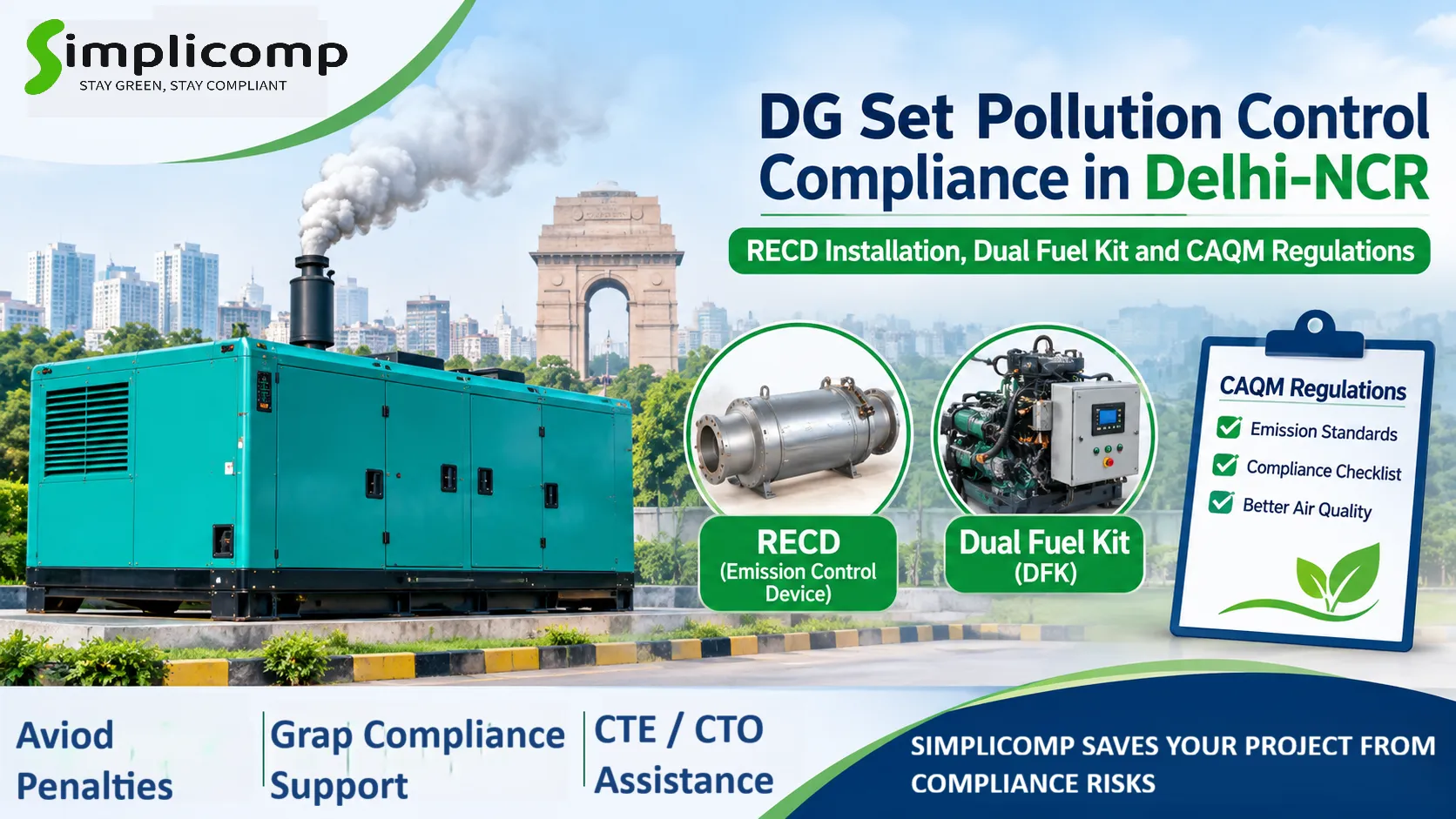
This article explains DG Set pollution control compliance in Delhi-NCR, RECD installation requirements, Dual Fuel Kit technology and important CAQM regulations that industries should know.
1. DG Set Pollution Control Compliance in Delhi-NCR
DG Set pollution control compliance refers to following the regulatory and technical requirements prescribed for controlling emissions from diesel generators.
CAQM regulates DG Set operations across Delhi-NCR under Section 12 of the Commission for Air Quality Management in National Capital Region and Adjoining Areas Act, 2021. For a better understanding of this regulatory framework, read our CAQM Act, 2021 – Air Pollution Control in Delhi-NCR.
These regulations are relevant to:
- Industrial and manufacturing units
- Commercial establishments and shopping complexes
- Residential societies and housing projects
- Corporate offices and institutional buildings
- Other establishments using DG Sets for backup power
Why Is DG Set Pollution Control Important?
Diesel generators release different pollutants during fuel combustion, including:
- Particulate Matter (PM): Fine particles that contribute to air pollution.
- Nitrogen Oxides (NOx): Gaseous pollutants that affect air quality.
- Carbon Monoxide (CO): A harmful gas produced during incomplete combustion.
- Hydrocarbons: Compounds associated with fuel combustion.
These emissions can increase the pollution burden, especially during periods of poor air quality in Delhi-NCR. The broader legal framework for controlling pollution is explained in the Environment Protection Act, 1986.
Therefore, CAQM has prescribed emission control measures based on DG Set capacity, applicable emission standards and available pollution control technologies.
CAQM Direction No. 76
CAQM issued Direction No. 76 on 29 September 2023 to regulate DG Set operations across industrial, commercial, residential and office establishments in NCR.
The direction was subsequently amended on 22 February 2024 and 11 December 2024.
The regulatory framework considers:
- DG Set capacity and specifications.
- Applicable emission standards.
- RECD installation requirements.
- Dual Fuel Mode requirements.
- Operational and emergency-use conditions.
Industries should identify their DG Set category and follow the applicable requirements under the latest directions and amendments. They should also review their wider Environmental Audit requirements to identify potential compliance gaps.
2. RECD Installation Requirements for DG Sets
RECD stands for Retrofitted Emission Control Device. It is an emission control system installed in an existing DG Set to reduce harmful pollutants released through exhaust gases.
Instead of replacing the entire generator, retrofitting involves installing a suitable pollution control device in the existing exhaust system, subject to technical compatibility and applicable regulatory requirements.
How Does an RECD Work?
An RECD is designed to treat exhaust emissions before they are released into the atmosphere. Depending on the technology, it can reduce particulate matter and other targeted pollutants.
Its selection and performance depend on:
- DG Set capacity and engine specifications.
- Exhaust gas flow and temperature.
- Technical compatibility with the generator.
- Applicable emission standards.
- Device certification and testing requirements.
Which DG Sets Require RECD or Other Emission Control Systems?
Under the amended CAQM framework, emission control requirements depend on DG Set capacity and applicable emission standards.
The following table provides a simplified overview of the capacity-based requirements for different categories.
| DG Set Category | Emission Control Requirement |
|---|---|
| LPG, Natural Gas, Biogas, Propane or Butane-operated DG Sets | No additional emission control system specified under this schedule |
| Up to 800 kW complying with MoEFCC notification G.S.R. 804(E), dated 3 November 2022 | No additional system specified under this schedule |
| 800 kW and above under older specifications | Suitable emission control mechanism, subject to prescribed standards |
| 41 kW to less than 800 kW under older specifications | Dual Fuel Mode or certified RECD |
| 19 kW to less than 41 kW under older specifications | Dual Fuel Mode |
| Portable DG Sets below 19 kW | Generally not permitted, except specified emergency services |
Note: This is a simplified summary. Actual applicability should be checked against the relevant CAQM directions, amendments and DG Set specifications.
Important Points Before RECD Installation
Industries planning to install an RECD should consider the following:
- Check DG Set Capacity: Identify the generator's rated capacity and applicable regulatory category.
- Verify Certification: Ensure the selected device meets the prescribed certification or approval requirements.
- Check Compatibility: Confirm that the RECD is suitable for the engine and exhaust configuration.
- Use Appropriate Installation Agencies: Follow applicable requirements regarding eligible vendors and installation agencies.
- Maintain Records: Keep installation documents, certification details and maintenance records available for inspection.
Proper installation and regular maintenance are important for achieving the intended emission control performance. Maintaining appropriate environmental monitoring and compliance records is also important during regulatory inspections.
3. Dual Fuel Kit (DFK) and Emission Control
A Dual Fuel Kit (DFK) enables a compatible diesel engine to operate using a combination of diesel and another fuel, commonly natural gas.
In this system, a portion of diesel consumption may be substituted with an alternative fuel, depending on the engine design and operating conditions.
CAQM recognises Dual Fuel Mode as an emission control approach for specified DG Set categories under its regulatory framework.
How Does a Dual Fuel Kit Work?
A conventional DG Set operates primarily on diesel. A Dual Fuel Kit introduces an additional fuel, such as natural gas, into the combustion system while retaining diesel for ignition, depending on the system design.
Its components may include:
- Gas supply arrangement.
- Fuel mixing and control system.
- Electronic control unit.
- Safety shut-off mechanisms.
- Engine monitoring systems.
The system controls the fuel combination to support compatible engine operation.
Benefits of Dual Fuel Technology
1. Reduced Diesel Consumption
A portion of diesel consumption may be substituted with natural gas, depending on the operating configuration.
2. Alternative Fuel Utilisation
Compatible DG Sets can utilise an alternative fuel alongside diesel.
3. Potential Emission Reduction
Depending on engine design and fuel combination, dual-fuel operation may reduce certain emissions compared with conventional diesel-only operation.
4. Regulatory Compliance Support
Where prescribed under applicable CAQM directions, Dual Fuel Mode can serve as an accepted emission control approach.
RECD vs Dual Fuel Kit
| Parameter | RECD | Dual Fuel Kit |
|---|---|---|
| Working Principle | Exhaust emission treatment | Combination of diesel and another fuel |
| Installation | Exhaust system | Engine fuel system |
| Main Purpose | Reduce targeted exhaust pollutants | Substitute a portion of diesel consumption |
| Key Requirement | Certification and compatibility | Fuel availability and engine compatibility |
The choice between RECD and Dual Fuel Mode depends on DG Set capacity, applicable CAQM requirements, technical feasibility and fuel availability.
4. CAQM DG Set Regulations: What Industries Should Know
Industries operating DG Sets in Delhi-NCR should understand that compliance involves more than installing pollution control equipment. They must also follow applicable emission standards and operational restrictions.
Important compliance considerations include:
A. Capacity-Based Requirements
Identify the capacity and emission-standard category of each installed DG Set. The applicable RECD or Dual Fuel requirement should be determined accordingly.
B. DG Set Documentation
Maintain relevant records, including:
- Manufacturer and model details.
- Rated capacity and engine specifications.
- Applicable emission certification.
- RECD installation documents, where applicable.
- Dual Fuel Kit details, where applicable.
- Maintenance and servicing records.
C. Operational Restrictions
DG Set operations must follow applicable CAQM directions and conditions. During periods of deteriorating air quality, additional restrictions may also apply under the Graded Response Action Plan (GRAP) in Delhi-NCR.
Installing an RECD or converting a generator to Dual Fuel Mode does not automatically provide unrestricted permission to operate during every GRAP stage.
D. Regulatory Updates
Industries should regularly monitor CAQM notifications, CPCB requirements and applicable State Pollution Control Board instructions to remain updated about regulatory changes. They should also understand the relevant Pollution Control Board Consent Conditions applicable to their industrial operations.
5. Latest CAQM Update: Expert Group for DG Set Emission Control – 18 November 2026
CAQM issued an order dated 18 November 2026 constituting an Expert Group to review existing DG Set emission control measures.
The group will undertake a technical review of Direction No. 76 and its subsequent amendments.
Its main responsibilities include:
- Reviewing existing emission standards.
- Assessing RECD effectiveness and operational performance.
- Evaluating Dual Fuel Kit systems.
- Identifying technological and compliance-related challenges.
- Recommending additional measures for controlling DG Set emissions.
The Expert Group includes representatives and technical experts from CAQM, Delhi Technological University, IIT Delhi, IIT Bombay, iCAT, ARAI and CPCB.
The group is chaired by Dr. Trilok Singh Panwar, Member-Technical, CAQM.
As per the order, the Expert Group may submit its report within two months.
Does this order introduce new DG Set restrictions?
No. The 18 November 2026 order constitutes an Expert Group to review the existing regulatory framework. It does not independently announce a new DG Set ban or an immediate RECD installation deadline.
However, its recommendations may help CAQM evaluate the need for improvements in existing emission control measures.
6. DG Set Compliance Checklist for Industries
Industries and commercial establishments can use the following checklist to review their DG Set compliance status:
- Identify the capacity and specifications of installed DG Sets.
- Check applicable emission standards.
- Review CAQM Direction No. 76 and its amendments.
- Verify RECD or Dual Fuel Kit applicability.
- Check certification and compatibility of emission control equipment.
- Maintain installation and maintenance records.
- Follow applicable DG Set operating restrictions.
- Monitor GRAP-related directions and future CAQM updates.
A structured compliance review can help industries identify potential gaps and prepare for regulatory inspections. Businesses can also refer to our Environmental Audit Guide for additional information about reviewing environmental compliance practices.
7. How Simplicomp Supports Environmental Compliance
Understanding environmental regulations and identifying applicable compliance requirements can be challenging for industrial and commercial establishments.
Simplicomp provides environmental compliance consultancy and regulatory assistance, including:
- Environmental Compliance Assessment.
- Consent to Establish (CTE) and Consent to Operate (CTO) Assistance.
- Pollution Control Board Approvals.
- Environmental Clearance Consultancy.
- Groundwater NOC Consultancy.
- Waste Management Authorisations and EPR Compliance.
- Environmental Documentation and Advisory.
For more information about the consent approval process, explore our Consent to Establish Process guide. Contact Simplicomp for assistance with environmental compliance assessment and applicable regulatory approvals.
Conclusion
DG Set pollution control is an important environmental compliance responsibility for industries, commercial establishments and residential societies operating across Delhi-NCR.
Understanding CAQM regulations, RECD installation requirements and Dual Fuel Kit technology can help businesses manage their emission control obligations.
Industries should review their existing DG Set arrangements, maintain appropriate documentation and stay updated with CAQM directions to remain prepared for evolving environmental compliance requirements.
Related Guides & Resources
- CAQM Grap Guidelines 2026 Delhi NCR →
- CAQM Stage-1 Grap Delhi NCR →
- CAQM Grap Stage-2 Delhi →
- CPCB Industry Categorization Guide →
Need Help with CAQM Closure Compliance?
Simplicomp provides support for:
- CAQM Closure Notice, Show Cause Notice & Regulatory Direction Review
- Industrial Environmental Compliance Audit & Gap Assessment
- Corrective and Preventive Action Plan for Pollution Control Compliance
- Air Pollution, Construction Dust Control & Environmental Compensation Compliance
- CAQM Compliance Documentation, Inspection Support & Closure Revocation Assistance