

Rainwater Harvesting Requirements under CGWA, HWRA & State Groundwater Authorities
Rainwater harvesting is no longer just a water conservation initiative—it has become a regulatory requirement for many industries, infrastructure projects, commercial establishments, institutions, and residential developments across India.
Organizations seeking Groundwater NOCs or permissions for groundwater extraction are often required to install and maintain rainwater harvesting and groundwater recharge systems as part of their approval conditions.
Authorities such as the Central Ground Water Authority (CGWA), Haryana Water Resources Authority (HWRA), Uttar Pradesh Ground Water Department (UPGWD), Punjab Water Regulation and Development Authority (PWRDA), and other state regulators increasingly emphasize groundwater recharge as a critical component of sustainable water management.
This guide explains the rainwater harvesting requirements commonly imposed by groundwater authorities and how organizations can ensure ongoing compliance.
Why Do Groundwater Authorities Mandate Rainwater Harvesting?
India is one of the world's largest users of groundwater.
Groundwater is extensively used for:
- Industrial operations
- Infrastructure projects
- Commercial establishments
- Residential developments
- Agriculture
- Institutional facilities
In many regions, groundwater extraction exceeds natural recharge rates, leading to:
- Declining groundwater levels
- Water scarcity
- Drying of borewells
- Reduced aquifer productivity
Rainwater harvesting helps replenish groundwater aquifers and restore the balance between groundwater extraction and recharge.
Challenge 1: Identifying Whether the Industry is Permitted in NCR
Most groundwater approvals are granted subject to specific conditions.
One of the most common conditions is the implementation of groundwater recharge measures through:
- Rainwater harvesting pits
- Recharge wells
- Recharge trenches
- Percolation systems
- Stormwater recharge structures
Authorities expect approved users to not only install these systems but also maintain them throughout the validity period of the approval.
CGWA Rainwater Harvesting Requirements
The Central Ground Water Authority (CGWA) regulates groundwater extraction in many parts of India.
Projects obtaining groundwater permissions are commonly required to:
Install Rainwater Harvesting Structures
Suitable recharge structures must be developed based on:
- Site conditions
- Hydrogeological characteristics
- Groundwater availability
- Rainfall patterns
Recharge Groundwater Aquifers
Projects are encouraged to maximize groundwater recharge through scientifically designed systems.
Maintain Recharge Infrastructure
Recharge pits and recharge wells must remain functional and free from blockages.
Monitor Compliance
Groundwater users may be required to submit evidence relating to:
- Rainwater harvesting structures
- Groundwater recharge systems
- Compliance with NOC conditions
HWRA Rainwater Harvesting Requirements
The Haryana Water Resources Authority (HWRA) places significant emphasis on groundwater conservation and recharge.
Projects granted groundwater permissions are commonly required to:
- Install rainwater harvesting systems
- Develop groundwater recharge mechanisms
- Maintain recharge structures
- Implement water conservation measures
- Promote treated wastewater reuse where feasible
Compliance with recharge obligations is often reviewed during inspections and approval renewals.
Requirements under Other State Groundwater Authorities
Many state groundwater authorities have adopted similar approaches.
Uttar Pradesh Ground Water Department (UPGWD)
Groundwater users may be required to implement recharge systems and maintain groundwater conservation measures.
Punjab Water Regulation and Development Authority (PWRDA)
Projects may be required to demonstrate groundwater sustainability measures including recharge infrastructure.
State Groundwater Authorities
Various states have introduced regulations encouraging:
- Rainwater harvesting
- Groundwater recharge
- Water conservation
- Water recycling
Organizations should always verify state-specific requirements applicable to their project location.
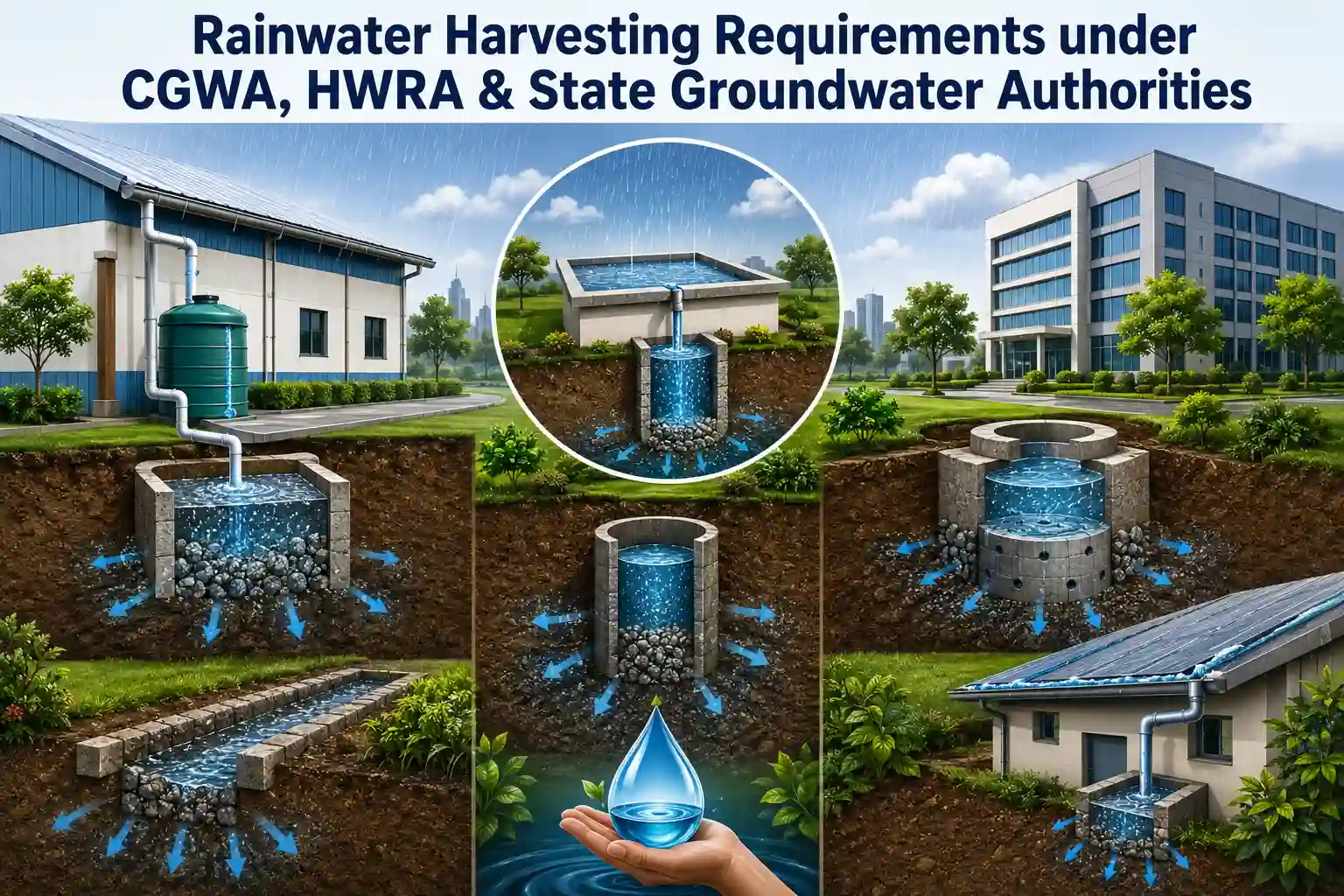
Common Rainwater Harvesting Structures
Groundwater authorities generally accept a variety of recharge mechanisms depending on site conditions.
Recharge Pits
Recharge pits allow rainwater to infiltrate into the soil and replenish groundwater aquifers.
These are among the most widely used recharge structures.
Recharge Wells
Recharge wells are designed to channel rainwater into deeper aquifer zones.
They are often used in urban areas where open land availability is limited.
Recharge Trenches
Recharge trenches collect stormwater runoff and facilitate groundwater recharge through infiltration.
Percolation Pits
Percolation pits help increase infiltration and improve groundwater recharge capacity.
Rooftop Rainwater Harvesting Systems
Rainwater collected from building rooftops is diverted to:
- Recharge pits
- Recharge wells
- Storage tanks
This is one of the most cost-effective recharge methods.
How Authorities Assess Rainwater Harvesting Compliance
During inspections or compliance reviews, authorities commonly verify:
Installation Status
Whether approved recharge structures have been installed.
Functional Condition
Whether the systems are operational and properly maintained.
Photographic Evidence
Authorities may request photographs of:
- Recharge pits
- Recharge wells
- Rainwater harvesting infrastructure
Maintenance Records
Records demonstrating periodic cleaning and maintenance.
Groundwater Recharge Measures
Evidence showing implementation of groundwater recharge commitments.
Rainwater Harvesting and Water Balance Studies
Water Balance Studies are often used to justify:
- Water demand
- Groundwater extraction requirements
- Recharge capacity
- Water conservation measures
A properly prepared Water Balance Study helps demonstrate how rainwater harvesting contributes to sustainable water management.
Rainwater Harvesting and Environmental Clearance
Many Environmental Clearance approvals contain conditions requiring:
- Rainwater harvesting systems
- Stormwater management plans
- Groundwater recharge measures
- Water conservation initiatives
Compliance with these requirements is often reviewed through Six-Monthly EC Compliance Reports.
Rainwater Harvesting and Groundwater NOC Renewal
Groundwater authorities frequently review compliance history before granting:
- Renewal of Groundwater NOCs
- Extension of permissions
- Additional groundwater extraction approvals
Poor maintenance of recharge structures may lead to observations during compliance reviews.
Common Compliance Issues
Authorities often identify:
- Non-functional recharge pits
- Blocked recharge wells
- Poor maintenance
- Lack of documentation
- Missing photographs
- Inadequate recharge infrastructure
- Failure to implement approved systems
These issues can affect future approvals and compliance status.
Best Practices for Rainwater Harvesting Compliance
Organizations should:
- Maintain all recharge structures
- Conduct periodic inspections
- Remove silt and debris regularly
- Maintain photographic records
- Monitor groundwater levels
- Integrate rainwater harvesting with water conservation initiatives
- Maintain compliance documentation
- Review NOC conditions periodically
Benefits of Effective Rainwater Harvesting
Properly implemented rainwater harvesting systems help:
- Improve groundwater recharge
- Reduce groundwater depletion
- Enhance water security
- Improve compliance performance
- Support sustainable development
- Reduce dependence on external water sources
- Strengthen groundwater NOC compliance
Need Help with Groundwater Compliance?
Simplicomp assists industries, infrastructure projects, real estate developers, and institutions with:
- Groundwater NOC applications
- Rainwater harvesting compliance
- Water Balance Studies
- Groundwater monitoring
- Annual compliance reporting
- Groundwater NOC renewals
- Water conservation planning