

Introduction
The EIA Notification 2006 issued by the Ministry of Environment, Forest and Climate Change forms the foundation of environmental clearance in India.
It mandates that projects with potential environmental impact must obtain prior Environmental Clearance (EC) before starting any activity.
If you are new to the approval process, read:
Purpose of EIA Notification 2006
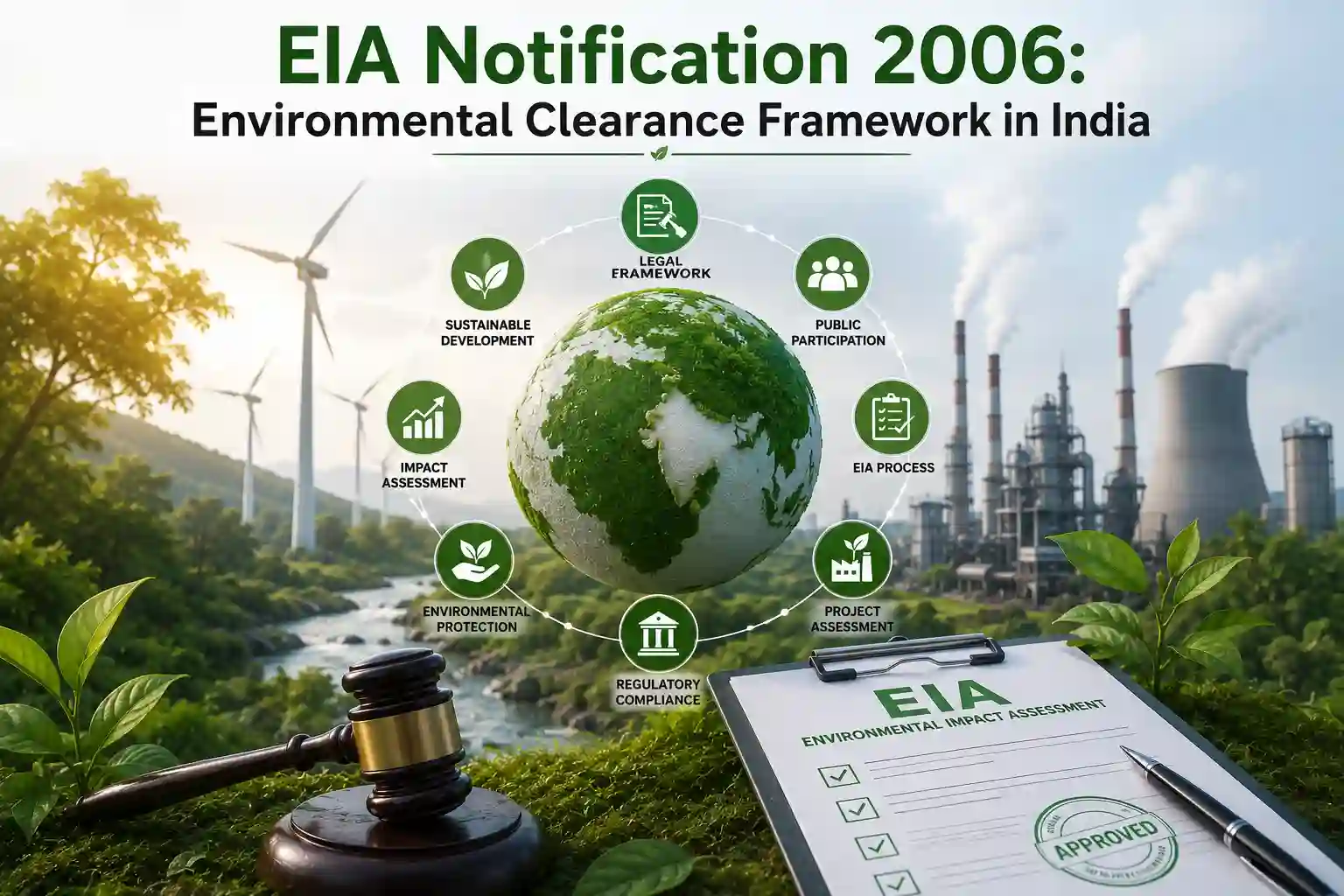
The notification establishes a structured framework to:
- Assess environmental impacts before approvals
- Ensure legal compliance
- Promote sustainable development
- Enable public participation
Projects that fail to comply with these requirements may face delays, rejection, or penalties.
What is Environmental Impact Assessment (EIA)?
Definition
EIA is a systematic process used to evaluate environmental impacts of proposed projects before decision-making.
Objectives
- Identify environmental risks early
- Assess impact on air, water, and land
- Recommend mitigation measures
- Support regulatory decisions
Applicability – When is EC Required?
Environmental Clearance is required for:
- New projects listed in the schedule
- Expansion or modernization
- Change in product mix
No construction or site work should begin before EC approval.
Project Categorization (A, B1, B2)
Category A
- Approved by MoEFCC
- High-impact projects
Category B
- Approved by SEIAA
Sub-classification:
- B1 → Requires EIA study
- B2 → Does not require EIA study
Environmental Clearance Process
Step 1 – Screening
Determines need for detailed EIA
Step 2 – Scoping
Defines Terms of Reference (ToR)
Step 3 – Public Consultation
Stakeholder and community feedback
Step 4 – EIA Report Preparation
Impact assessment and mitigation
Step 5 – Appraisal
Final evaluation and decision
Key Components of an EIA Report
- Baseline environmental data
- Impact assessment
- Mitigation measures
- Environmental Management Plan (EMP)
- Risk assessment
Timeline for Environmental Clearance
As per regulatory framework:
- Appraisal: ~60 days
- Final decision: ~105 days
Actual timelines may vary depending on documentation and public consultation.
Digital Environmental Clearance System
Applications are processed through the PARIVESH Portal, enabling online submission and tracking.
Post-Clearance Compliance
- Six-monthly reports
- Environmental monitoring
- Compliance with EC conditions
Poor compliance management may result in regulatory action.
Consequences of Non-Compliance
- Legal action
- Environmental penalties
- Project suspension or closure
Need Help with Environmental Clearance?
Simplicomp provides professional support for:
- Environmental Clearance applications
- EIA studies
- ToR compliance
- Documentation and regulatory coordination