

Introduction
Project categorization is a key component of the Environmental Clearance framework defined under the EIA Notification 2006 issued by the Ministry of Environment, Forest and Climate Change.
It determines:
- The level of assessment required
- The approving authority
- The complexity of the Environmental Clearance process
Why Project Categorization is Important
Categorization ensures that:
- Projects are evaluated based on environmental impact
- Regulatory efforts are proportionate to project scale
- Approval processes remain efficient and structured
It directly affects:
- Timelines
- Documentation
- Compliance requirements
Overview of EIA Categories
Projects are broadly divided into:
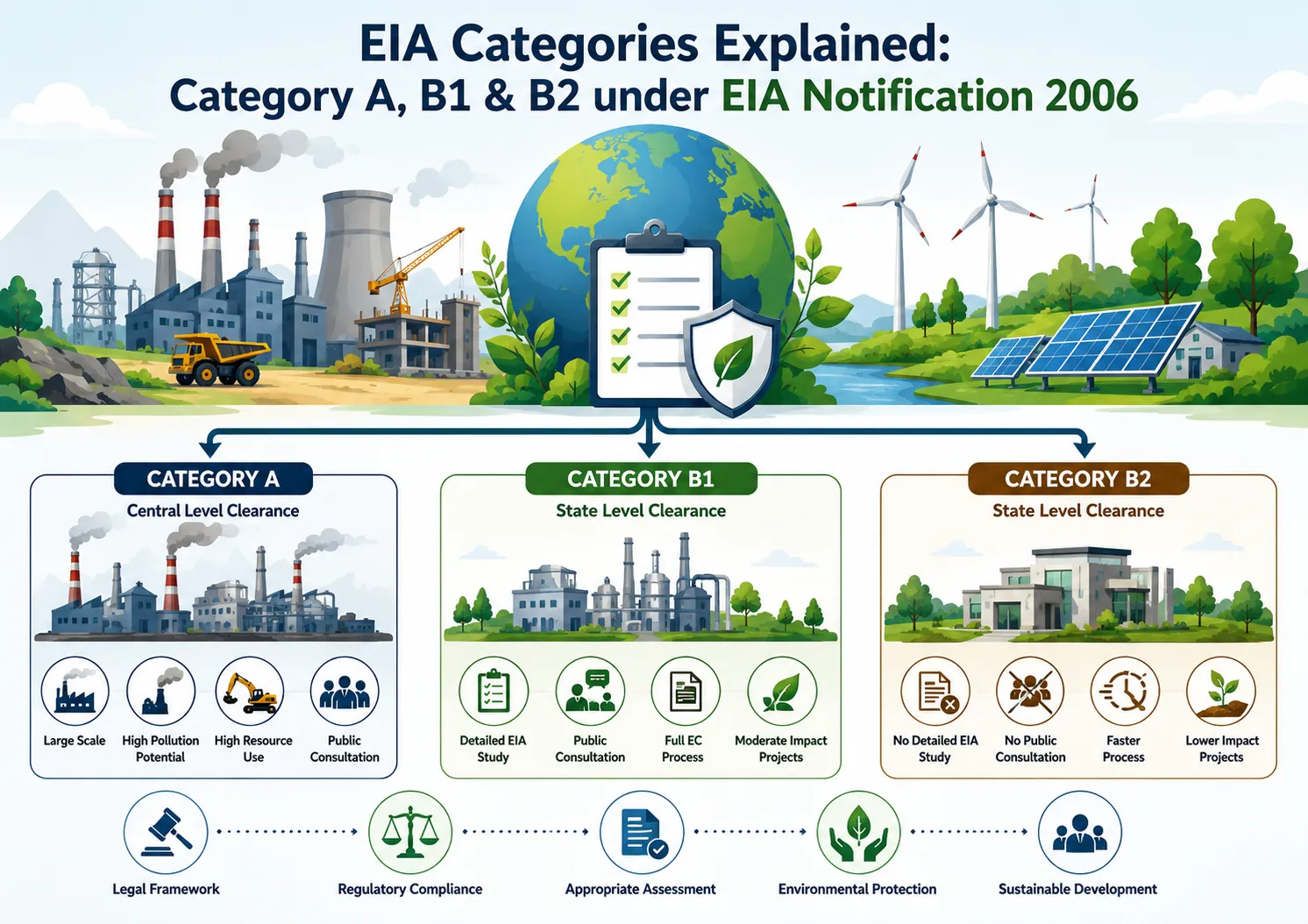
- Category A → Central level clearance
- Category B → State level clearance
Category B is further divided into:
- B1
- B2
Different categories follow different levels of scrutiny and documentation.
Category A Projects (Central Level Clearance)
Definition
Category A projects are those with significant environmental impact and require detailed evaluation at the central level.
Approval Authority
MoEFCC (Central Government)
Key Characteristics
- Large-scale operations
- High pollution potential
- Significant land and resource use
Examples
- Mining projects
- Thermal power plants
- Petroleum and chemical industries
- Large infrastructure projects
Such projects usually involve detailed EIA studies and public consultation.
Category B Projects (State Level Clearance)
Definition
Category B projects have relatively lower environmental impact and are evaluated at the state level.
Approval Authority
State Environment Impact Assessment Authority (SEIAA)
Category B1 Projects
- Require detailed EIA study
- Follow full Environmental Clearance process
- Include public consultation
Category B2 Projects
- Do NOT require detailed EIA study
- May be exempt from public consultation
- Faster approval process
Classification depends on thresholds defined in the notification schedule.
How Projects are Categorized
Projects are classified based on:
- Sector (industry, mining, infrastructure, etc.)
- Production capacity or size
- Location sensitivity (eco-sensitive zones, coastal areas, etc.)
These criteria are defined in the Schedule of the notification.
Role of Screening in Categorization
Screening is applicable for Category B projects.
Purpose:
- To determine whether the project falls under B1 or B2
- To decide if detailed EIA study is required
Impact of Categorization on EC Process
Categorization affects:
- Level of environmental assessment
- Documentation requirements
- Approval authority
- Timeline for clearance
Higher category → more detailed scrutiny.
Common Sectors Under Each Category
Category A
- Mining
- Thermal power
- Large industrial projects
Category B
- Construction projects
- Medium-scale industries
- Industrial estates
Key Considerations for Project Developers
Before applying for EC, project proponents should:
- Verify category based on schedule thresholds
- Assess whether EIA study is required
- Plan documentation accordingly
Related Environmental Library Pages
Need Help with Environmental Clearance?
Simplicomp provides support for:
- Environmental Clearance applications
- EIA categorization and screening
- ToR compliance
- Documentation and regulatory coordination