

Introduction
Groundwater is an important water source for industries, infrastructure projects, commercial establishments and other groundwater users across India. However, extracting groundwater without the required No Objection Certificate (NOC), applying late for NOC renewal or extracting more water than permitted can lead to Environmental Compensation (EC) under the applicable groundwater guidelines.
To encourage compliance and help resolve pending Environmental Compensation matters, the Ministry of Jal Shakti has notified the Ground Water Charges (Dispute Resolution) Scheme, 2026.
The scheme provides a one-time, voluntary and time-bound mechanism for eligible project proponents to settle certain Environmental Compensation liabilities with applicable relief. It also aims to encourage groundwater users to enter the regulatory framework and obtain the required approvals.
What Is the Ground Water Charges (Dispute Resolution) Scheme, 2026?
The Ground Water Charges (Dispute Resolution) Scheme, 2026 was notified by the Central Government through Gazette Notification S.O. 6179(E), dated November 12, 2026.
The scheme has been introduced by the Central Ground Ground Water Authority (CGWA) under the Ministry of Jal Shakti. It provides a limited opportunity for eligible project proponents to resolve specified Environmental Compensation cases related to groundwater extraction.
The scheme is intended to:
- Encourage groundwater users to obtain the required NOC.
- Facilitate settlement of eligible Environmental Compensation liabilities.
- Reduce avoidable representations and litigation.
- Improve groundwater regulatory compliance.
- Support the sustainable management of groundwater resources.
The scheme is a one-time settlement mechanism and does not mean that groundwater extraction rules have been relaxed permanently.
Which Groundwater Violations Are Covered?
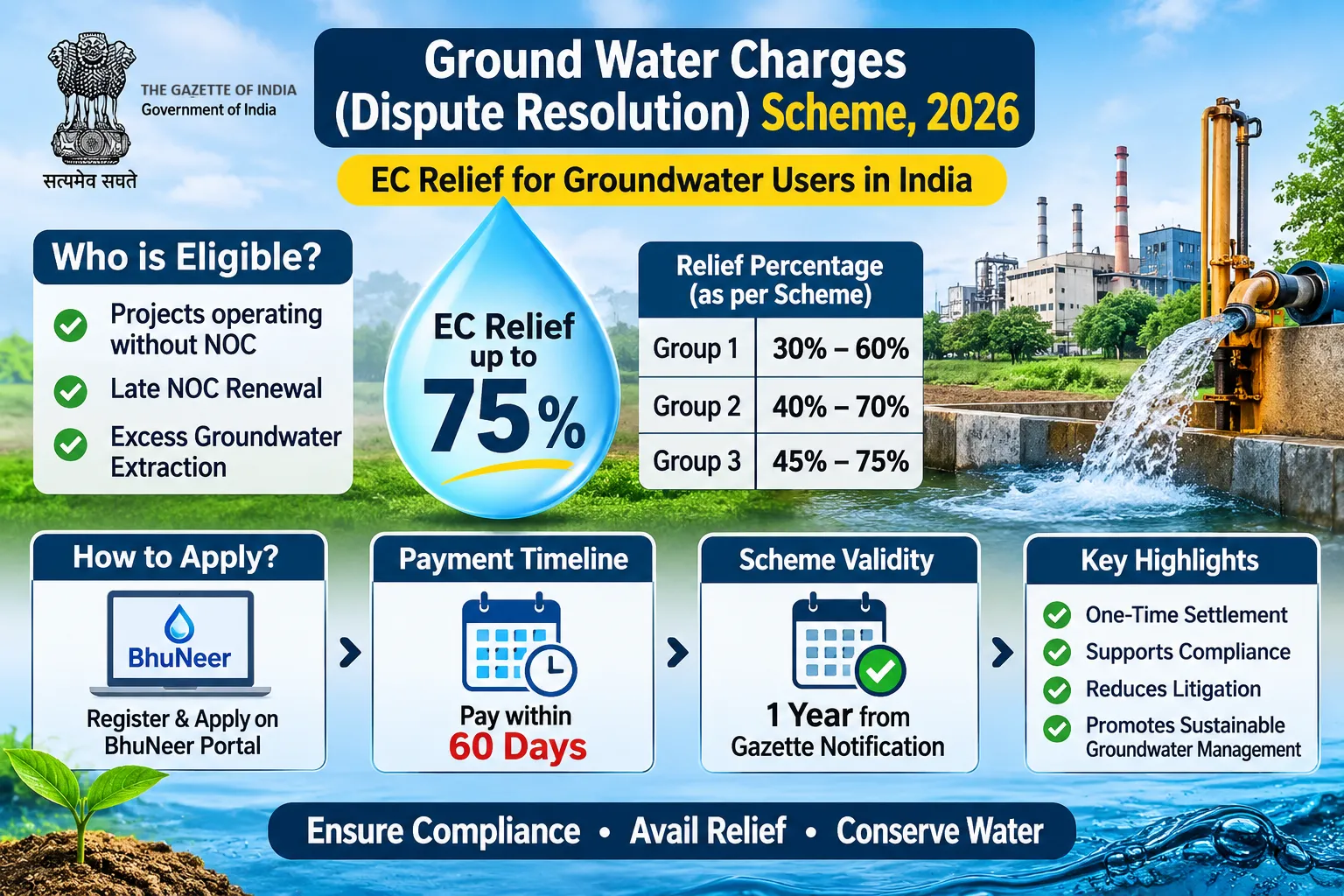
The scheme provides relief in Environmental Compensation for the following three categories:
1. Existing Projects Operating Without NOC
Existing projects that are extracting groundwater but have not obtained the required NOC may be eligible for relief, subject to the scheme's conditions.
Applicants can review the Groundwater NOC Process in India to understand the approval process.
2. Late Application for NOC Renewal
Projects that have failed to apply for renewal of their groundwater NOC within the prescribed time may also be covered.
3. Excess Groundwater Extraction
Projects that have extracted groundwater beyond the quantity permitted in their NOC may be eligible for relief under the applicable category.
The relief is available across different groundwater assessment categories, including Safe, Semi-Critical, Critical, Over-Exploited and Saline areas, subject to eligibility and applicable conditions. Read more about Groundwater Categorization.
How Much Environmental Compensation Relief Is Available?
The scheme provides different relief percentages depending on the type of violation, groundwater consumption and assessment unit category.
| Category | Environmental Compensation Relief |
|---|---|
| Group 1: Existing projects operating without NOC | 60% to 30% |
| Group 2: Late application for NOC renewal | 70% to 40% |
| Group 3: Excess groundwater extraction | 75% to 45% |
The applicable relief percentage is determined through the relief matrix provided in the scheme. It depends on the project's groundwater consumption and the classification of its assessment unit.
Example of EC Relief
The Gazette notification provides the following illustrations:
Example 1: Project operating without NOC
A project extracting 500 KLD groundwater in a Semi-Critical assessment unit has an Environmental Compensation liability of ₹20 lakh.
If the applicable relief is 50%, the calculation would be:
- Environmental Compensation: ₹20 lakh
- Relief: 50%
- Relief amount: ₹10 lakh
- EC payable after relief: ₹10 lakh
Example 2: Late NOC renewal
A project extracting 2,000 KLD groundwater in a Safe assessment unit has an EC liability of ₹40 lakh.
If the applicable relief is 70%, the calculation would be:
- Environmental Compensation: ₹40 lakh
- Relief: 70%
- Relief amount: ₹28 lakh
- EC payable after relief: ₹12 lakh
Example 3: Excess groundwater extraction
A project extracting 100 KLD groundwater in an Over-Exploited assessment unit has an EC liability of ₹10 lakh.
If the applicable relief is 75%, the calculation would be:
- Environmental Compensation: ₹10 lakh
- Relief: 75%
- Relief amount: ₹7.5 lakh
- EC payable after relief: ₹2.5 lakh
These examples are illustrative. The actual amount payable will depend on the project's case, applicable relief matrix and calculation verified by CGWA.
Who Can Apply Under the Scheme?
The scheme may cover eligible existing groundwater-extracting projects, including:
- Industrial projects
- Infrastructure projects
- Mining projects
- Other eligible project categories
It also covers eligible cases involving fresh or renewal applications, applications rejected earlier, and applications pending with CGWA where Environmental Compensation is applicable.
Valid documents such as Consent to Establish (CTE), Consent to Operate (CTO) or Consolidated Consent and Authorization (CCA) may be considered for determining the existence of a project before the scheme's announcement.
Applicants must also fulfil the basic eligibility requirements under the applicable groundwater guidelines.
For document requirements, applicants can refer to the Groundwater NOC and Borewell Permission Documents guide.
States and Union Territories Covered
According to the notification, the scheme applies to projects in the following 19 States and Union Territories where groundwater regulation is being carried out by CGWA:
- Assam
- Arunachal Pradesh
- Bihar
- Chhattisgarh
- Gujarat
- Jharkhand
- Madhya Pradesh
- Maharashtra
- Manipur
- Meghalaya
- Mizoram
- Nagaland
- Odisha
- Rajasthan
- Sikkim
- Tripura
- Uttarakhand
- Andaman and Nicobar Islands
- Dadra and Nagar Haveli and Daman and Diu
Project proponents should confirm the applicability of the scheme to their project and groundwater regulatory authority before applying.
How to Apply for the Ground Water Dispute Resolution Scheme?
Project proponents intending to avail the benefits of the scheme must register on the BhuNeer portal and submit the application as prescribed.
Applicants should carefully review their project details and prepare relevant groundwater and compliance information before submission.
Important conditions include:
- The application must contain accurate project and groundwater extraction information.
- Environmental Compensation and relief will be calculated using information submitted by the applicant and verified by CGWA.
- If a deficiency memo is issued, the applicant must rectify the deficiencies within 60 days.
- Failure to remove deficiencies within the prescribed period may result in rejection of the application without scheme benefits.
- Applicants must submit the required undertaking regarding earlier pending representations for revision of EC.
Once the application is accepted, changes to the submitted information may not be considered. Therefore, applicants should review their details carefully before final submission.
Payment Timeline and Important Conditions
The scheme includes specific payment and settlement conditions.
Payment Within 60 Days
The payable amount will be communicated to the project proponent through the BhuNeer portal and registered email.
The applicant must pay the amount in a single transaction within 60 days of communication of the charges. Failure to pay within this period will result in loss of eligibility for relief under the scheme.
The amount payable will be determined in accordance with the scheme, including the provision that the payable Environmental Compensation under relief or actual groundwater charges, whichever is higher, will have to be paid.
Pending Litigation
Eligible project proponents with pending litigation relating to the Environmental Compensation amount may apply under the scheme by submitting the prescribed irrevocable undertaking.
The settlement process may require withdrawal or disposal of the relevant proceedings. A provisional settlement order will not be treated as final discharge until the required documentary proof is submitted and accepted.
Cases Not Covered
The scheme does not provide benefits for Environmental Compensation cases that have already been finally adjudicated by a Court or Tribunal. It also excludes compensation imposed by the National Green Tribunal in matters currently under challenge before the Supreme Court of India.
For more information about the legal framework, refer to the National Green Tribunal (NGT) Act.
How Long Will the Scheme Remain Valid?
The scheme came into force on the date of its publication in the Official Gazette and will remain in force for one year from the date of Gazette notification, subject to its terms and conditions.
Applications submitted within the scheme period may be considered for relief if all eligibility and other requirements are fulfilled.
Project proponents should check the official BhuNeer portal and CGWA communications for application-related instructions and the applicable submission deadline.
What Happens After Availing Relief?
The scheme is a one-time opportunity to settle eligible Environmental Compensation and regularize groundwater abstraction.
After availing the benefit, project proponents must continue to comply with the applicable groundwater guidelines and NOC conditions.
Any subsequent non-compliance may attract enforcement action, including:
- Full Environmental Compensation as applicable
- Penalties under the applicable rules
- Sealing of borewells
- Other regulatory action as prescribed
The scheme does not create any right to similar relief in the future.
Why Groundwater Compliance Is Important for Industries
Groundwater compliance is an important part of environmental management for industries, infrastructure projects and commercial establishments.
Maintaining a valid groundwater NOC, applying for renewal on time and adhering to the permitted extraction quantity can help project proponents avoid unnecessary regulatory issues.
Businesses should also maintain proper groundwater extraction records and ensure that the information submitted to the regulatory authority is accurate and updated. Regular Groundwater Monitoring and Groundwater Annual Compliance & Returns can help groundwater users maintain compliance with applicable requirements.
Conclusion
The Ground Water Charges (Dispute Resolution) Scheme, 2026 provides a one-time opportunity for eligible groundwater users to seek relief in specified Environmental Compensation cases.
The scheme covers projects operating without NOC, late NOC renewal and excess groundwater extraction. However, relief depends on the applicable category, groundwater consumption, assessment unit and fulfilment of the scheme's conditions.
Project proponents should carefully review their groundwater compliance status, check their eligibility and follow the official application and payment process within the prescribed timeline.
Related Guides & Resources
- Groundwater Depletion Sustainable Development →
- Rainwater Harvesting Requirements Groundwater NOC →
- Groundwater Annual Compliance Returns →
- CPCB Industry Categorization Guide →
Need Help with Groundwater NOC Approval?
Simplicomp provides support for:
- Groundwater NOC applications
- Borewell permission approvals
- Water balance studies
- Groundwater documentation and regulatory coordination
- One-Window Solution