

Introduction
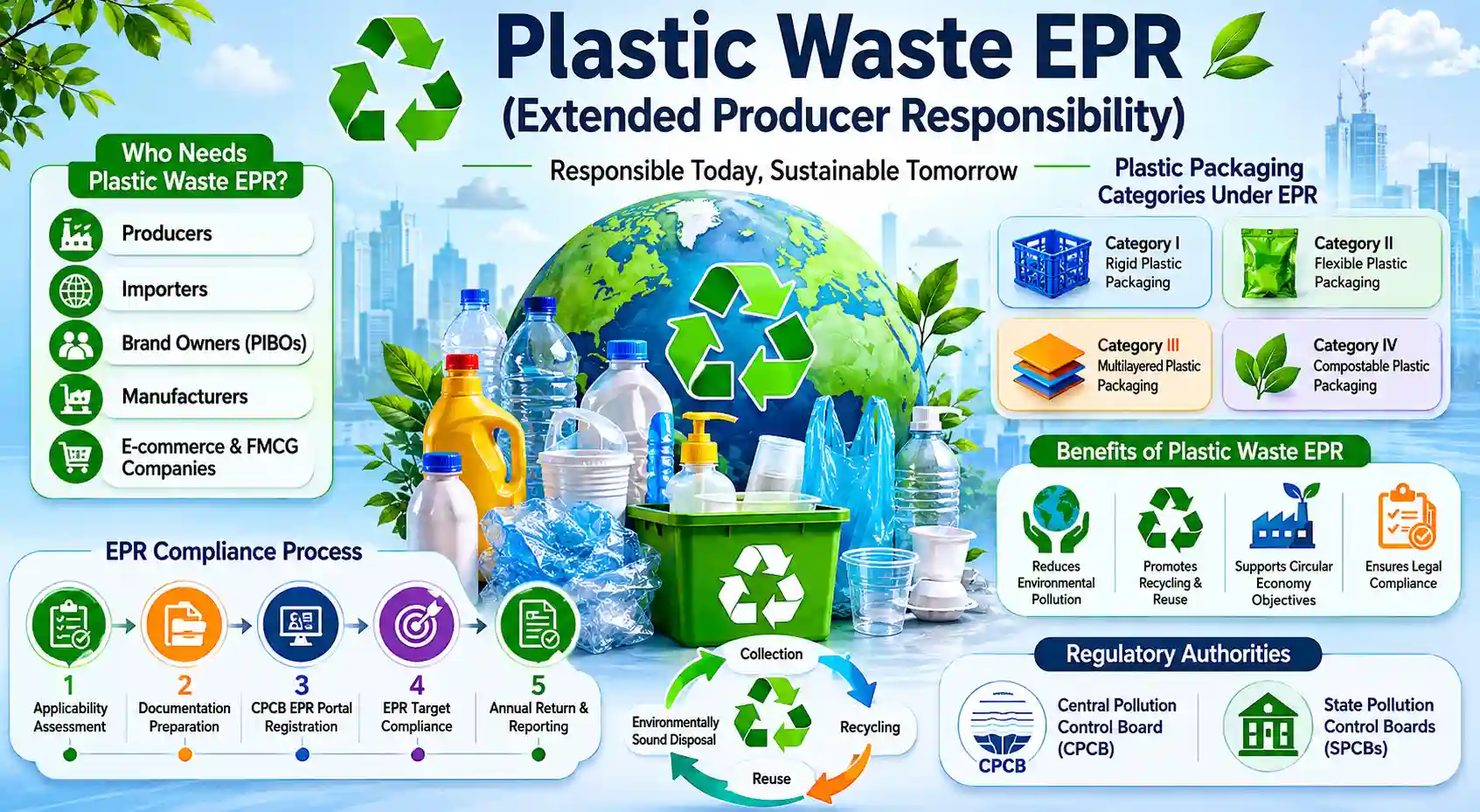
Plastic Waste EPR (Extended Producer Responsibility) is a mandatory environmental compliance framework applicable to producers, importers, and brand owners (PIBOs) dealing with plastic packaging in India.
The framework is regulated under the Plastic Waste Management Rules and monitored by the Central Pollution Control Board (CPCB) through the online EPR portal.
Plastic Waste EPR compliance aims to ensure environmentally sound collection, recycling, reuse, and disposal of plastic packaging waste generated after consumption.
What is Plastic Waste EPR?
Definition
Plastic Waste EPR is a regulatory obligation that makes producers, importers, and brand owners responsible for managing plastic packaging waste generated from their products in the market.
The framework promotes:-
- Plastic waste collection
- Recycling and reuse
- Sustainable packaging practices
- Circular economy objectives
- Reduction of environmental pollution
EPR obligations are generally applicable to:
- Producers
- Importers
- Brand Owners (PIBOs)
- Plastic packaging units
Plastic Waste Management Rules in India
Plastic Waste EPR compliance is regulated under the Plastic Waste Management Rules issued by the Ministry of Environment, Forest and Climate Change (MoEFCC).
The rules regulate:
- Plastic packaging waste
- Recycling obligations
- EPR targets
- Waste traceability
- Environmentally sound disposal
The framework also introduces mandatory recycling and reuse targets for PIBOs and plastic waste processors.
Who Requires Plastic Waste EPR Registration?
Plastic Waste EPR registration may be required for:
- Manufacturers using plastic packaging
- Importers of packaged products
- Brand owners
- FMCG companies
- E-commerce businesses
- Food and beverage companies
- Consumer goods companies
Applicability depends on:
- Plastic packaging usage
- Import quantity
- Product category
- Market supply quantity
Regulatory Authorities for Plastic Waste EPR Compliance
Central Pollution Control Board (CPCB)
CPCB regulates Plastic Waste EPR registration and compliance monitoring across India.
The authority oversees:
- EPR registration
- Online EPR portal management
- Recycling target monitoring
- Annual return filing
- Plastic waste compliance reporting
State Pollution Control Boards (SPCBs)
SPCBs assist in implementing Plastic Waste Management Rules and monitoring state-level environmental compliance obligations.
Plastic Packaging Categories Under EPR
Plastic packaging is generally categorized into:
Category I – Rigid Plastic Packaging
Includes rigid plastic containers and packaging materials.
Category II – Flexible Plastic Packaging
Includes single-layer or multilayer flexible plastic packaging.
Category III – Multilayered Plastic Packaging
Includes multilayer packaging materials containing different material combinations.
Category IV – Compostable Plastic Packaging
Includes certified compostable plastic packaging materials.
Different categories have separate EPR obligations, recycling targets, and compliance requirements.
Plastic Waste EPR Registration Process
Step 1 – Applicability Assessment
Determine:
- PIBO category
- Plastic packaging quantity
- Applicable EPR obligations
- Packaging categories
Step 2 – Documentation Preparation
Typical documents include:
- Company registration documents
- GST certificate
- PAN details
- IEC certificate (for importers)
- Plastic packaging details
- Brand authorization documents
Step 3 – CPCB EPR Portal Registration
Applications are submitted through the CPCB EPR portal.
The online system allows:
- EPR registration submission
- Document upload
- Target compliance reporting
- Certificate tracking
Step 4 – EPR Target Compliance
Registered entities are required to fulfill:
- Plastic waste collection targets
- Recycling obligations
- Reuse obligations
- Annual reporting requirements
Plastic Waste Recycling Obligations
PIBOs are required to ensure:
- Collection of equivalent plastic waste
- Recycling through authorized recyclers
- Environmentally sound disposal
- Documentation and traceability
Failure to fulfill recycling obligations may result in regulatory action.
Annual Return & Compliance Reporting
Registered entities may be required to submit:
- Annual returns
- Plastic packaging details
- Recycling quantity data
- EPR target fulfillment reports
Proper documentation and record maintenance are critical for compliance.
Common Reasons for Plastic Waste EPR Rejection
Common issues include:
- Incorrect packaging categorization
- Incomplete documentation
- Mismatch in packaging quantity
- Non-compliance with CPCB guidelines
Proper compliance planning significantly improves approval readiness.
Penalties for Non-Compliance
Failure to comply with Plastic Waste EPR regulations may result in:
- Environmental compensation
- Registration suspension
- Regulatory notices
- Financial penalties
- Legal action
Businesses operating without valid EPR registration may face enforcement action under environmental laws.
Online CPCB Plastic Waste EPR Portal
The CPCB Plastic Waste EPR Portal enables:
- Online registration
- Target compliance reporting
- Recycler linkage
- Annual return filing
- Certificate management
Digital compliance systems improve transparency and plastic waste traceability.
Related EPR & Waste Management Pages
Need Help with Plastic Waste EPR Registration?
Simplicomp provides support for:
- Plastic Waste EPR registration
- CPCB portal registration
- PIBO compliance documentation
- Recycling target compliance
- Annual return filing and reporting