

Introduction
Rainwater harvesting is one of the most effective and sustainable methods of conserving water and recharging groundwater aquifers. With increasing groundwater depletion, rapid urbanization, industrial growth, and changing rainfall patterns, rainwater harvesting has become an important component of water management strategies across India.
The design of a rainwater harvesting system depends upon several factors including:
- Terrain and topography
- Rainfall pattern
- Land availability
- Soil characteristics
- Groundwater conditions
- Water demand
Different regions of India require different rainwater harvesting approaches. Himalayan regions typically have steep slopes and high runoff potential, whereas plains and plateau regions have greater opportunities for water storage and groundwater recharge.
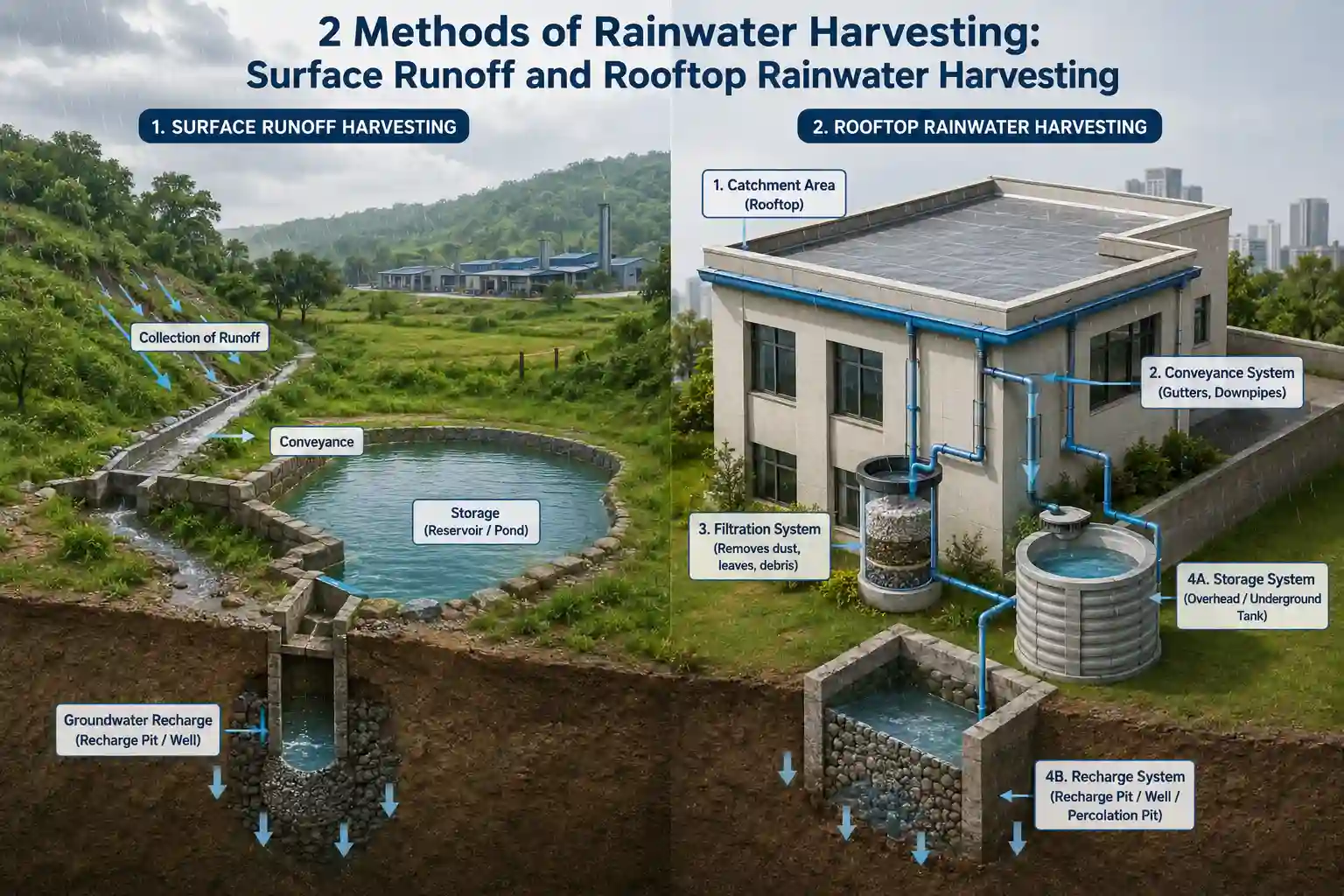
Broadly, rainwater harvesting can be implemented through two primary methods:
- Surface Runoff Harvesting
- Rooftop Rainwater Harvesting
Both methods play an important role in improving water availability and supporting groundwater conservation.
Understanding Catchment Areas
Before understanding rainwater harvesting methods, it is important to understand the concept of a catchment area.
A catchment area is any surface that receives rainfall and allows water to be collected, stored, or diverted for use or groundwater recharge.
Examples of catchment areas include:
- Rooftops
- Open land
- Roads and paved surfaces
- Watersheds
- Hill slopes
- Industrial premises
The larger the catchment area, the greater the potential for rainwater collection and groundwater recharge.
Method 1: Surface Runoff Harvesting
Surface Runoff Harvesting involves collecting rainwater flowing across land surfaces and storing it for future use or groundwater recharge.
During rainfall, a significant quantity of water flows over the ground surface and eventually drains into rivers, streams, lakes, or stormwater systems.
By capturing this runoff, organizations can reduce water wastage and improve water availability.
How Surface Runoff Harvesting Works
The process generally involves:
Collection of Runoff
Rainwater flowing across the ground surface is diverted into collection structures.
Conveyance
Channels, drains, or pipelines transport the collected runoff water.
Storage
The water is stored in:
- Reservoirs
- Storage ponds
- Water tanks
- Artificial lakes
- Recharge structures
Groundwater Recharge
Stored water may also be directed into recharge pits, recharge wells, or percolation systems to replenish groundwater aquifers.
Applications of Surface Runoff Harvesting
Surface runoff harvesting is commonly used for:
- Agricultural irrigation
- Industrial water supply
- Groundwater recharge
- Landscaping
- Community water storage
- Rural water conservation projects
Large infrastructure projects and industrial developments often integrate runoff harvesting systems as part of their environmental management plans.
Benefits of Surface Runoff Harvesting
- Reduces stormwater runoff
- Increases groundwater recharge
- Reduces soil erosion
- Supports irrigation requirements
- Improves water availability during dry periods
- Helps mitigate urban flooding
Method 2: Rooftop Rainwater Harvesting
Rooftop Rainwater Harvesting is one of the simplest, most cost-effective, and widely adopted methods of rainwater conservation.
In this system, rainwater falling on rooftops is collected and directed through pipes either:
- Into groundwater recharge structures, or
- Into storage tanks for future use
Since rooftops provide relatively clean catchment surfaces, rooftop harvesting systems are highly efficient and require comparatively less land.
How Rooftop Rainwater Harvesting Works
Rainwater falling on the roof is collected and transported through a network of pipes to a storage or recharge system.
The collected water can be:
- Recharged into groundwater aquifers
- Stored for domestic use
- Used for gardening
- Used for flushing
- Used for industrial utility purposes
Components of a Rooftop Rainwater Harvesting System
A typical rooftop rainwater harvesting system consists of four major components.
1. Catchment Area (Rooftop)
The rooftop acts as the primary collection surface.
Suitable catchment surfaces include:
- Residential buildings
- Commercial complexes
- Institutional buildings
- Industrial facilities
The size of the rooftop determines the volume of water that can be collected.
2. Conveyance System
The conveyance system includes:
- Gutters
- Downpipes
- Collection channels
- Drainage pipes
These components transport rainwater from the rooftop to the storage or recharge structure.
3. Filtration System
Before recharge or storage, rainwater is passed through filters to remove:
- Dust
- Leaves
- Debris
- Suspended particles
Common filtration materials include:
- Sand
- Gravel
- Pebbles
- Activated carbon filters (where required)
Proper filtration improves water quality and prevents clogging of recharge structures.
4. Storage or Recharge Structure
The filtered water can be directed into:
Storage Systems
- Underground tanks
- Overhead tanks
- Collection reservoirs
Recharge Systems
- Recharge pits
- Recharge wells
- Percolation pits
- Recharge trenches
The choice depends on site conditions and intended use.
Rooftop Harvesting for Groundwater Recharge
One of the most common applications of rooftop harvesting is groundwater recharge.
Rainwater is directed into recharge pits or recharge wells, allowing it to infiltrate naturally into underground aquifers.
This helps:
- Improve groundwater levels
- Reduce borewell dependency
- Support sustainable water management
- Improve groundwater availability during dry seasons
Natural Groundwater Recharge: Learning from Nature
In forested and mountainous regions, rainwater naturally infiltrates through layers of soil, rocks, and vegetation before reaching underground aquifers.
This natural filtration process often produces clear and mineral-rich water that emerges through springs and small streams.
Rainwater harvesting systems attempt to replicate this natural process by allowing rainwater to percolate through soil and recharge groundwater resources.
Surface Runoff vs Rooftop Rainwater Harvesting
| Parameter | Surface Runoff Harvesting | Rooftop Rainwater Harvesting |
|---|---|---|
| Source of Water | Ground runoff | Rooftop rainfall |
| Land Requirement | Higher | Lower |
| Installation Cost | Moderate to High | Low to Moderate |
| Water Quality | May require greater treatment | Generally cleaner |
| Groundwater Recharge | High | High |
| Suitable For | Large projects, agriculture, industries | Buildings, institutions, residential projects |
Which Method is Better?
There is no single best method.
The ideal solution depends upon:
- Available land
- Rainfall pattern
- Water demand
- Groundwater conditions
- Project type
Many industries, townships, commercial complexes, and institutions use a combination of both methods to maximize water conservation and groundwater recharge.
Rainwater Harvesting and Regulatory Compliance
Rainwater harvesting is increasingly becoming a regulatory requirement under:
- Groundwater NOCs
- Environmental Clearance conditions
- Building approval regulations
- Water conservation policies
Industries, commercial projects, group housing projects, educational institutions, and infrastructure developments are often required to install and maintain rainwater harvesting systems as part of their environmental compliance obligations.
Conclusion
Rainwater harvesting is one of the simplest and most effective tools for addressing groundwater depletion and improving water security.
Both Surface Runoff Harvesting and Rooftop Rainwater Harvesting offer practical solutions for conserving water, recharging groundwater aquifers, and supporting sustainable development.
As groundwater stress continues to increase across India, implementing rainwater harvesting systems is no longer just an environmental initiative—it is becoming a necessity for long-term water sustainability.